Memory Ladder · Free, age 8 to adult
Remember it on purpose, one rung at a time
Memory is not a talent you have. It is a habit you build. Learn how memory works from the ground up: make it vivid, space it out, and pull it from your head. Practice the six techniques from the infographic, then the systems behind memory challenges: number pegs, the Major System, card codes and long journeys. Lessons explain what the studies found, and practice checks your answers. No sign-up, nothing to pay.
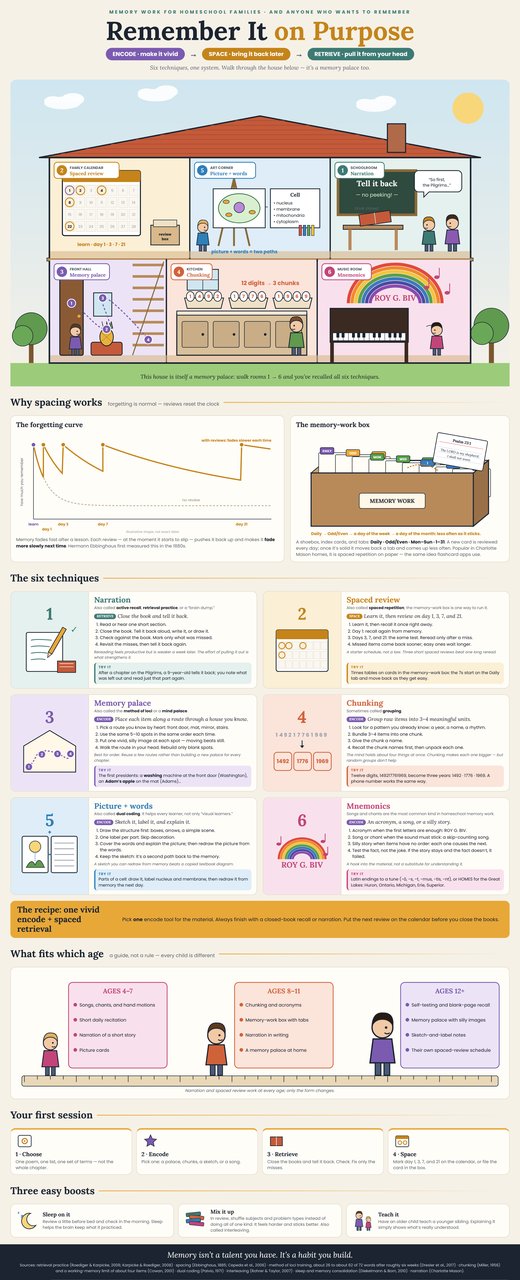
Start with the infographic
Remember It on Purpose shows the whole system on one page: encode, space, retrieve, and the six techniques as rooms in a house. Every course here builds on it.
Challenges
Learn real lists by heart: the presidents, the planets, the books of the Bible, a deck of cards, the digits of pi. Study, learn in chunks, recall in order and beat your best time.
Games
Short games that train the techniques: build a memory palace, chunk a long number, chain a story and match pairs.
The ladder
Each rung is a full course. Start where you are; topics from earlier rungs come back when you need them.
- High school
- Memory SystemsGrade 7–12 · 27 topics You are here
- Middle school
- Memory SkillsGrade 3–12 · 40 topics You are here
How the Memory Ladder works
- Find your rung. A short check, at most 30 questions, skips what you already know and finds your starting point.
- Learn from first principles. Each topic is one small idea. The lesson shows why it works, then walks through worked examples one step at a time.
- Master it before moving on. Three right answers, the last two in a row, pass a topic. If a topic gets hard, we point you to the skill underneath it.
- Review, spaced out. Passed topics come back after 1 day, then 3, 7, 16 days and longer, for two quick problems each. Harder topics that use an older one count as practice for it.
- Mix it up. Reviews and checkpoint quizzes mix problems from different topics, so you learn to tell which method a problem needs.
- Earn XP. About one point per minute of focused work. Set a daily goal and keep your streak going.
- One climb across subjects. Every ladder shares your XP, streak and reviews. When a topic needs a skill from another ladder, such as the algebra behind a formula, that skill comes first, labeled with its ladder.
Why these steps: the U.S. Institute of Education Sciences practice guide Organizing Instruction and Study to Improve Student Learning (Pashler and others, NCER 2007-2004) recommends spacing reviews out over time, alternating worked examples with problems students solve on their own, pairing pictures with words, and using quizzes to bring key content back. The Memory Ladder is built around those ideas.
More on Teddy Rook Book
- Remember It on PurposeThe infographic: six techniques drawn as rooms in a house that is itself a memory palace
- Memory challengesPresidents, planets, books of the Bible and more, with study, recall and timed modes
- Memory gamesBuild a palace, chunk a number, chain a story and match pairs
- Brain GamesMore quick games for attention and short-term memory
- Vocabulary flashcardsA thousand words with spaced review
- Language flashcardsWords in other languages, with spaced review
The other ladders
- Math LadderFrom counting in Pre-K to calculus, linear algebra and differential equations. 28 courses.
- Physics LadderMotion, forces and energy, then fluids, heat, electricity, light, atoms and the stars, from grade 8 to college. 8 courses.
- Chemistry LadderAtoms, bonds, moles and reactions, from high school chemistry through a full year of general chemistry. 3 courses.
- Economics LadderHow people, firms and whole economies choose: microeconomics, macroeconomics and calculus-based micro. 3 courses.
- Earth & Space LadderRocks, plates and volcanoes, oceans, weather and climate, and Earth's place among the planets and stars. 3 courses.
- Logic LadderClear thinking, from arguments and fallacies to syllogisms, truth tables and formal proofs, grade 7 to college. 3 courses.
- Etiquette LadderManners as kindness made into habits: please and thank you, the table, conversation, notes and hard moments, age 4 to adult. 3 courses.
- Egyptology LadderAncient Egypt from the Nile and the pyramids to reading hieroglyphs: history, Middle Egyptian, religion and art, and archaeology, age 8 to college. 6 courses.
- Ancient Scripts LadderHow ancient scripts work and how they were read again, beginning with Linear A and Linear B of the Bronze Age Aegean, high school to college. 1 courses.
- Vocabulary LadderOne thousand advanced words, each with a picture and a memory hook, plus the Greek and Latin roots that unlock them, grade 6 to adult. 2 courses.
- Biology LadderLiving things from seeds and tadpoles to cells, genes, evolution and ecosystems, age 5 through AP Biology and college. 4 courses.
- American History & Civics LadderThe American story and how its government works, from the flag and the Pilgrims to AP U.S. History, civics and the citizenship test, and on to law school courses in constitutional law. 7 courses.
- Writing & Grammar LadderFrom a first sentence to the persuasive essay: grammar and diagramming, usage and punctuation, paragraphs and essays, sources and citations, and rhetoric, age 6 to college. 6 courses.
- Geography LadderMaps and directions for young explorers, then the fifty states, the countries and capitals of the world, and human geography up to AP, age 5 to adult. 4 courses.
- Art & Drawing LadderDrawing from first lines to perspective and faces, color and design, and art history from the cave painters to mid-century modern, age 5 to college. 5 courses.
All the ladders share one progress: XP, your streak and your reviews.
Your progress is saved in this browser
No account needed. To move to another device, or to keep a backup, copy your save code and paste it in on the other device.
See your progress · The site's My Progress page backs up everything at once.