Infographics
Visual explainers on books, ideas, language and finance.
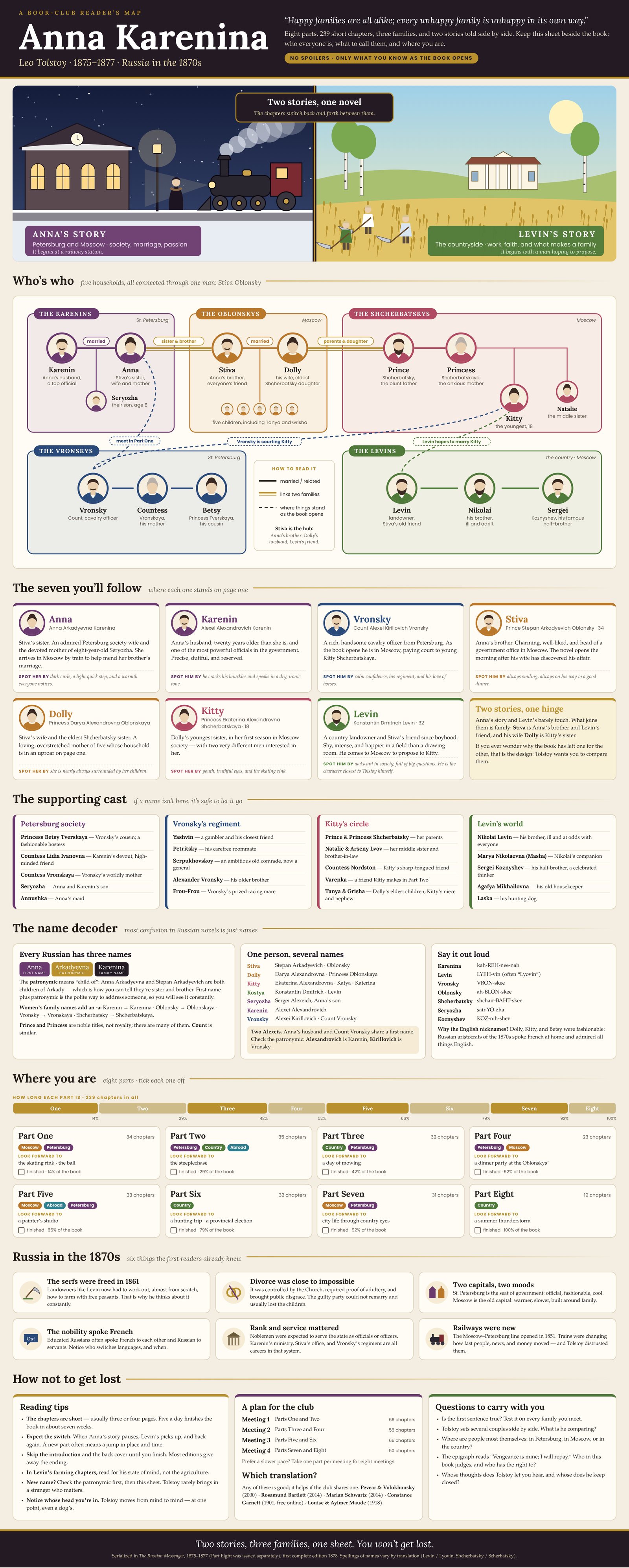
A no-spoilers sheet to keep beside Tolstoy's novel: the two stories it tells side by side, who's who in five households, the seven people you'll follow, how Russian names work and how to say them, where you are in the eight parts, six things about Russia in the 1870s that the first readers already knew, and tips for not getting lost.
🔗 Own page, to share or bookmark 📚 Anna Karenina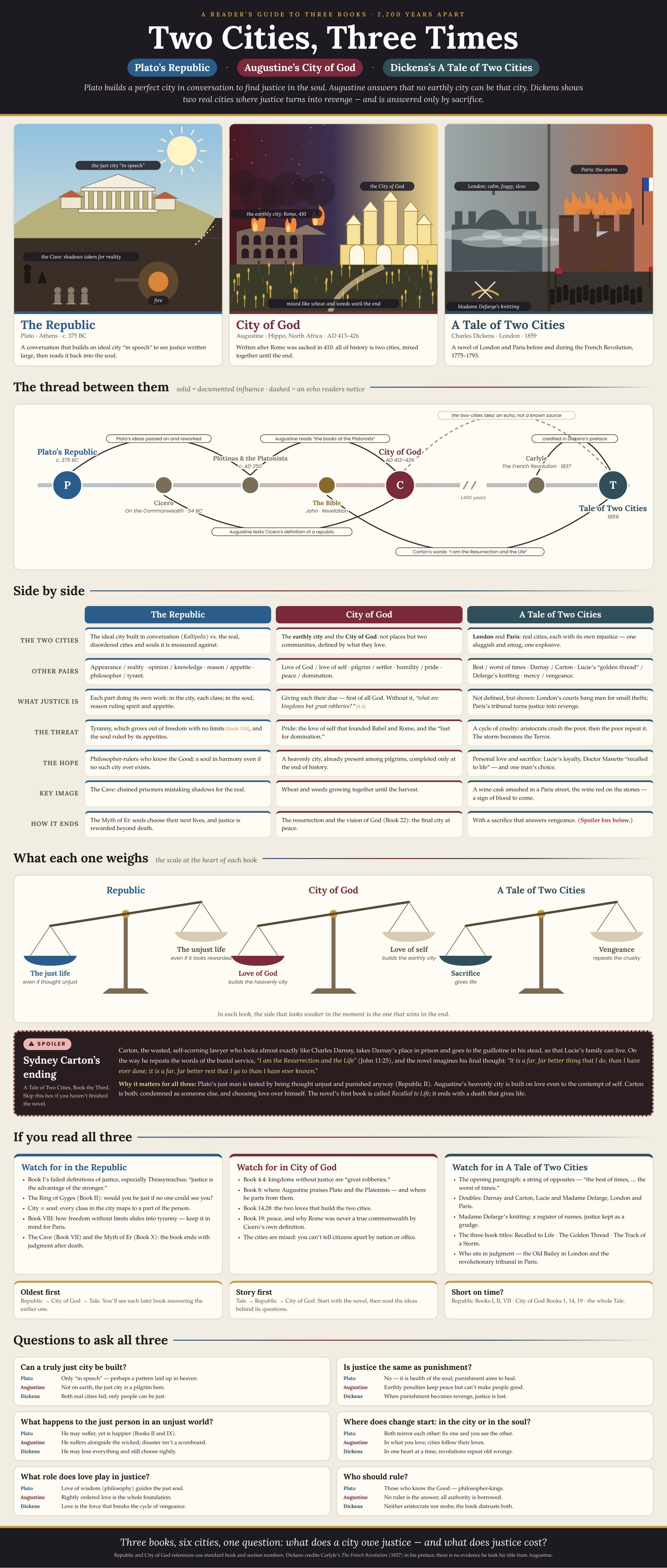
A reader's guide to three books 2,200 years apart: Plato's Republic, Augustine's City of God and Dickens's A Tale of Two Cities. The thread between them, a side-by-side comparison of their two cities, justice, threats and hopes, what each one weighs, what to watch for in each, three reading orders, and questions to ask all three.
🔗 Own page, to share or bookmark 📚 The Republic · City of God · A Tale of Two Cities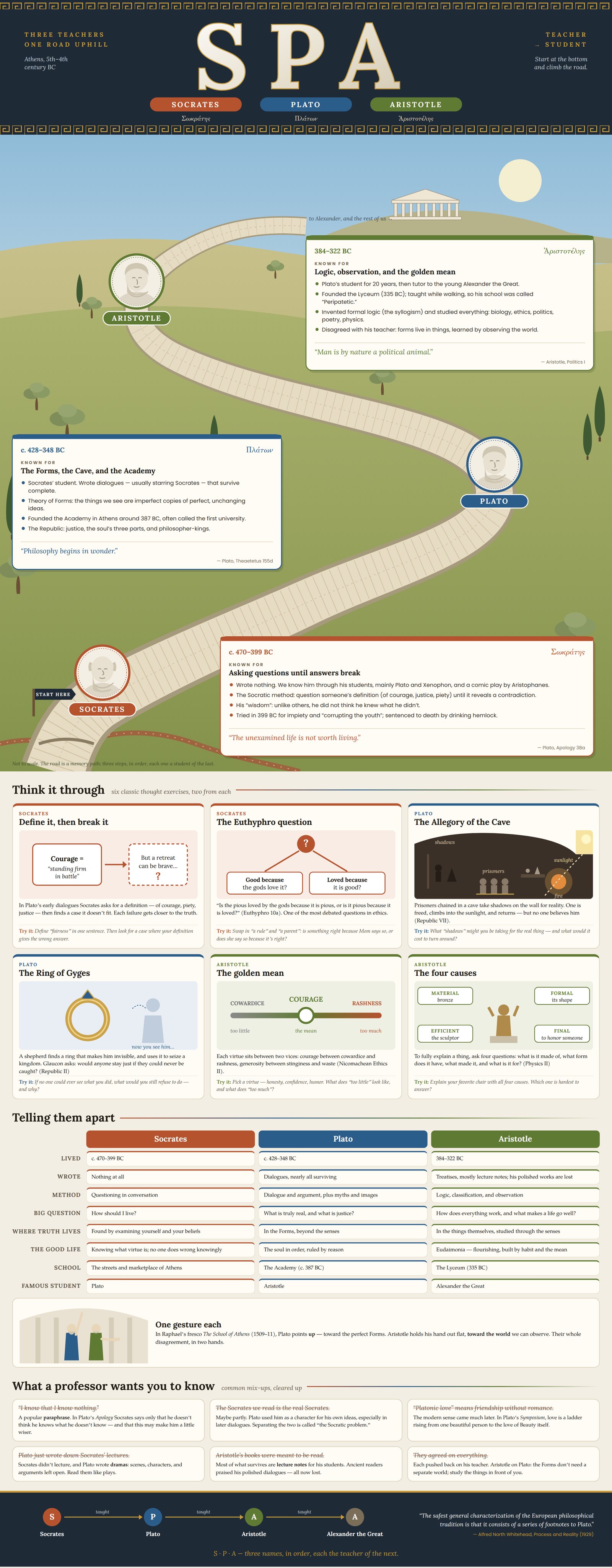
Three teachers on one road uphill, each the student of the one before: who they were and what each is known for, six classic thought exercises (the Euthyphro question, the Cave, the Ring of Gyges, the golden mean and more), a side-by-side comparison, and common mix-ups cleared up.
🔗 Own page, to share or bookmark 📚 The Republic · Nicomachean Ethics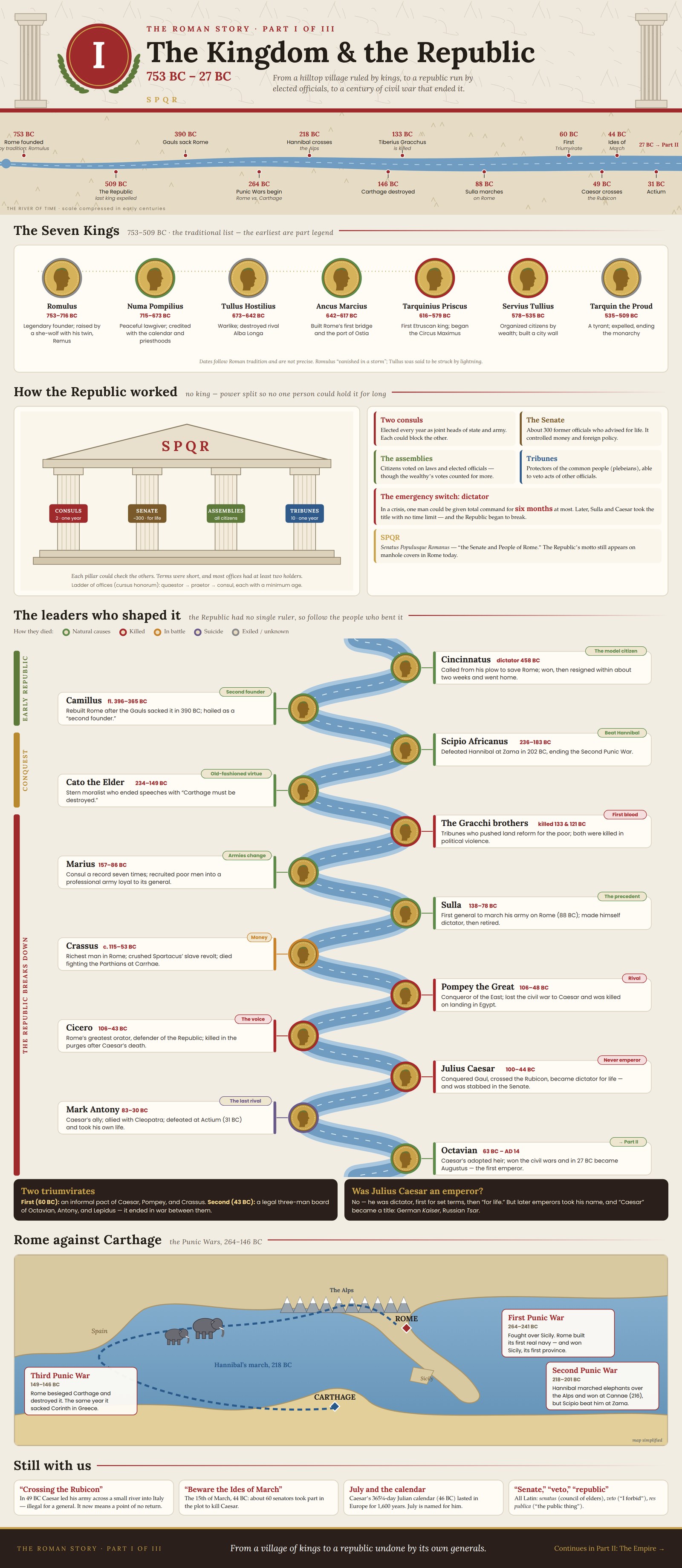
From a hilltop village ruled by kings to a republic undone by its own generals. The seven kings, how the Republic's consuls, Senate, assemblies and tribunes checked each other, the leaders who shaped it from Cincinnatus to Octavian, the Punic Wars on a map, and words and customs still with us.
✨ Continue: Part II, The Empire → 🔗 Own page, to share or bookmark 📚 The Early History of Rome · Plutarch's Lives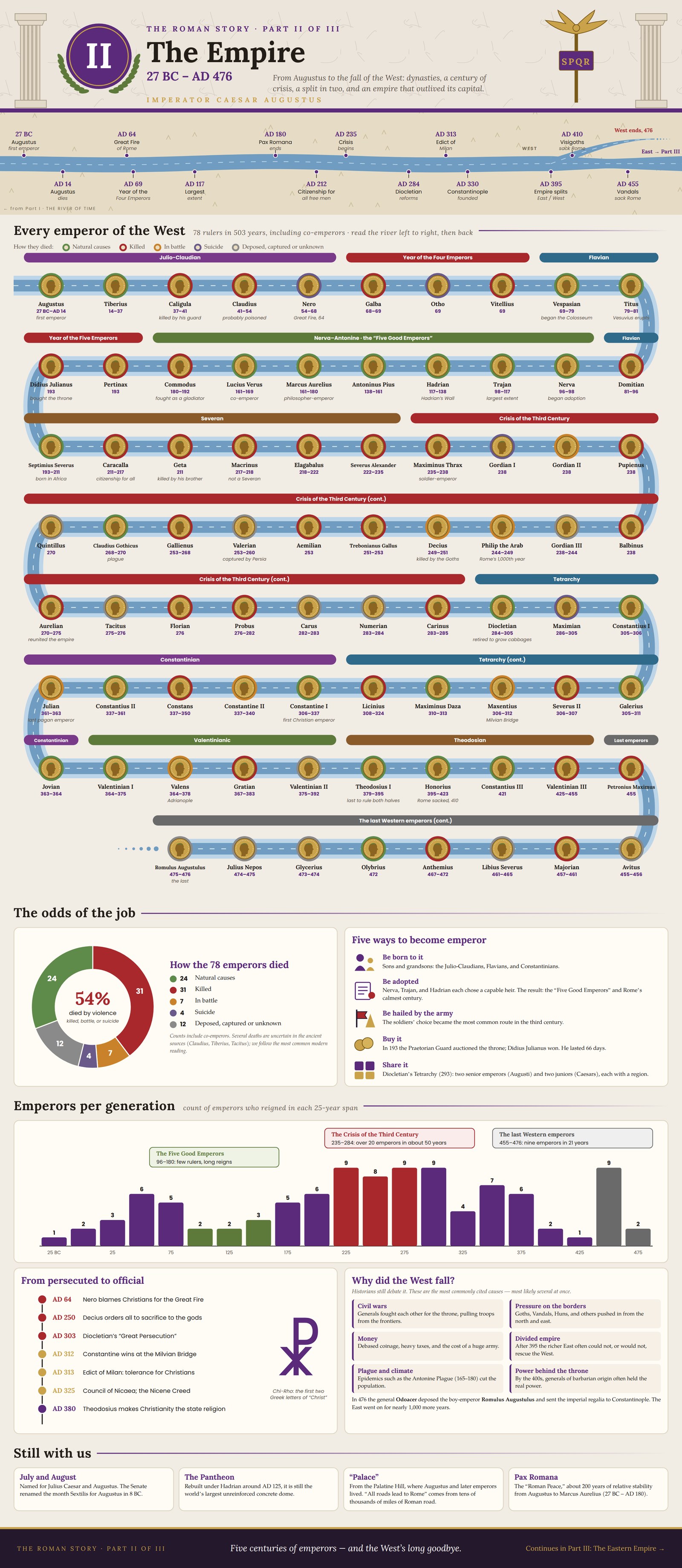
Every emperor of the West along a winding river, from Augustus to Romulus Augustulus, with how each one died. Also the odds of the job, five ways to become emperor, emperors per generation, Christianity from persecuted to official, and why the West fell.
✨ Continue: Part III, The Eastern Empire → 🔗 Own page, to share or bookmark 📚 Meditations · The History of the Decline and Fall of the Roman Empire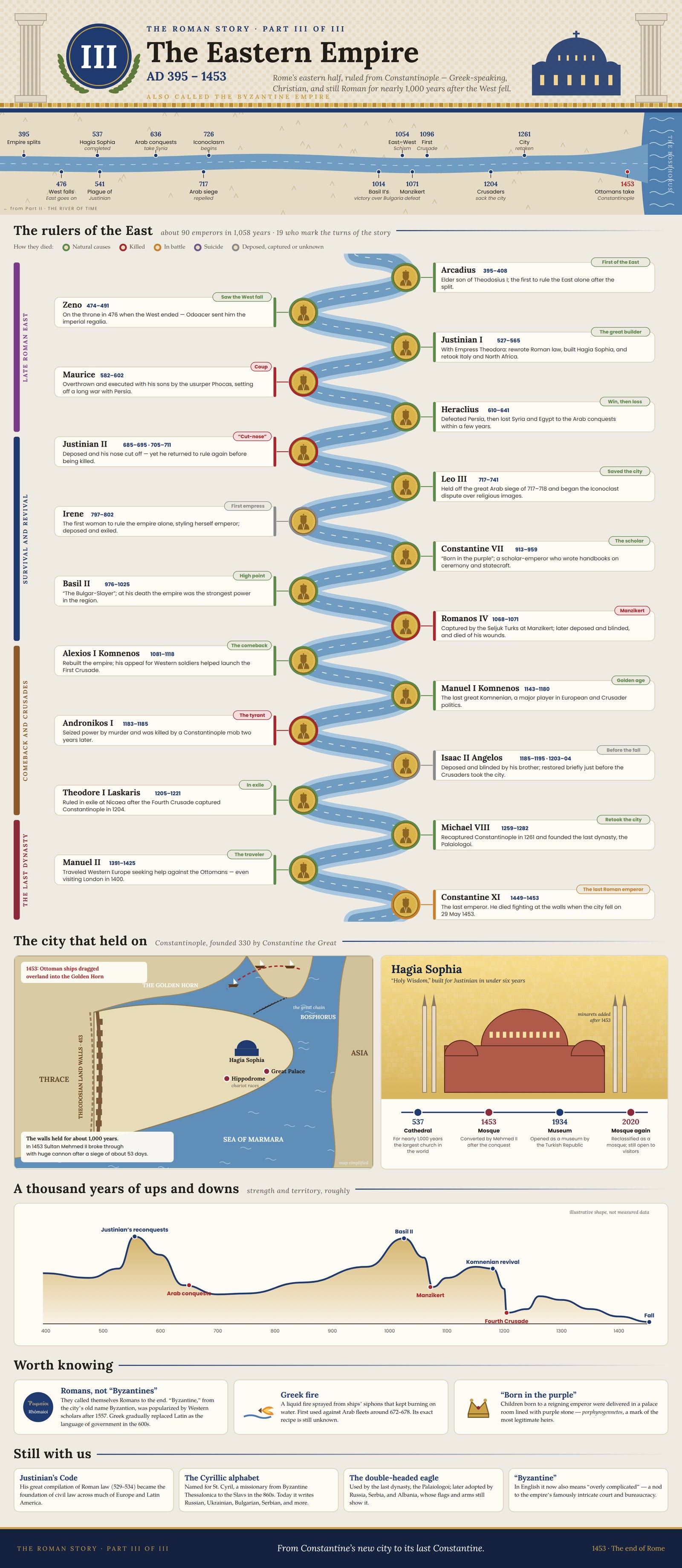
Rome's Greek-speaking eastern half, ruled from Constantinople for nearly a thousand years after the West fell: nineteen rulers who mark the turns of the story, the city and its walls, Hagia Sophia, a thousand years of ups and downs, and what is still with us.
✨ See all three parts side by side → 🔗 Own page, to share or bookmark 📚 The History of the Decline and Fall of the Roman Empire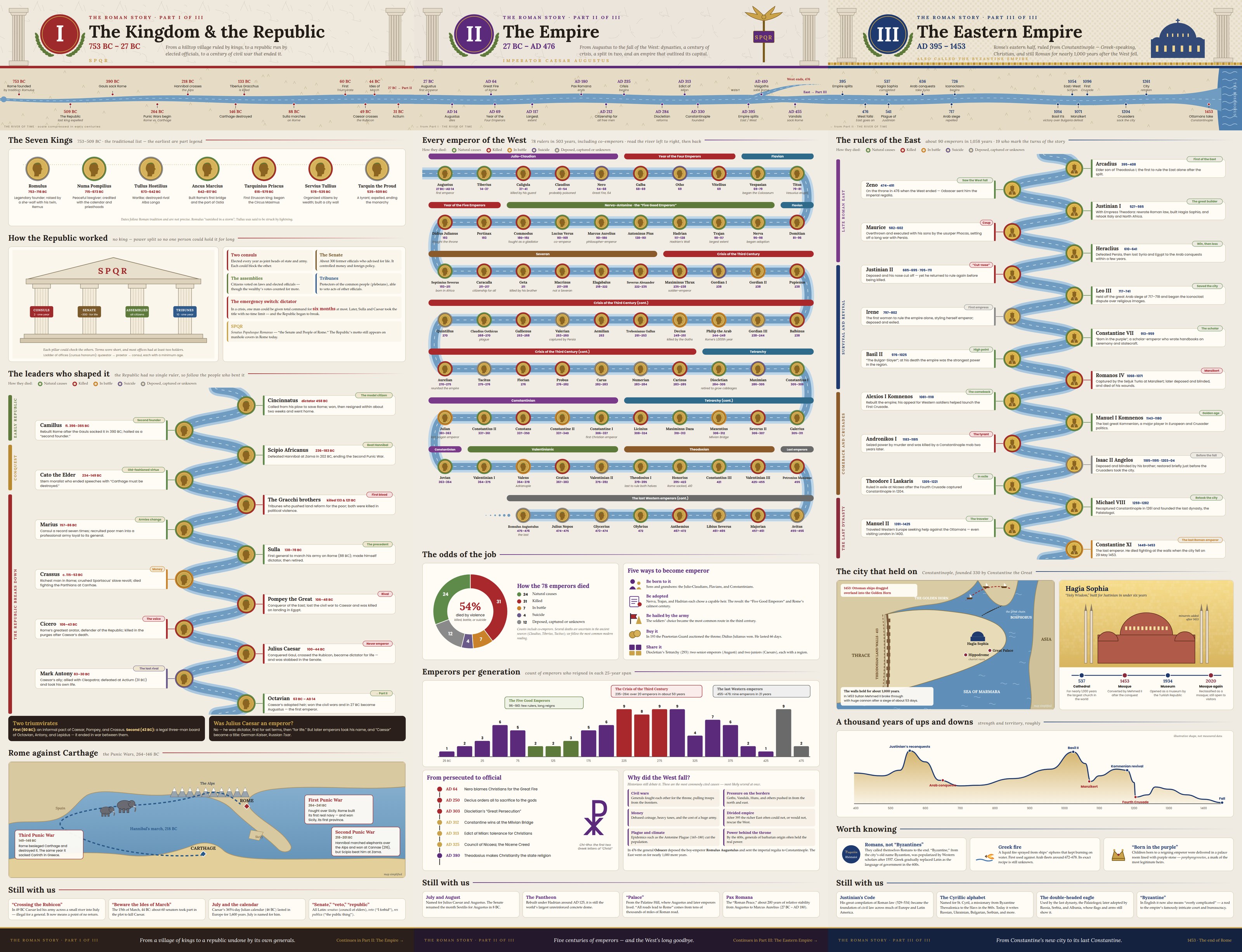
Parts I, II and III side by side as one poster, joined by a single river of time from the founding of Rome in 753 BC to the fall of Constantinople in 1453.
✨ Start with Part I → 🔗 Own page, to share or bookmark 📚 The Early History of Rome · Plutarch's Lives · Meditations · The History of the Decline and Fall of the Roman Empire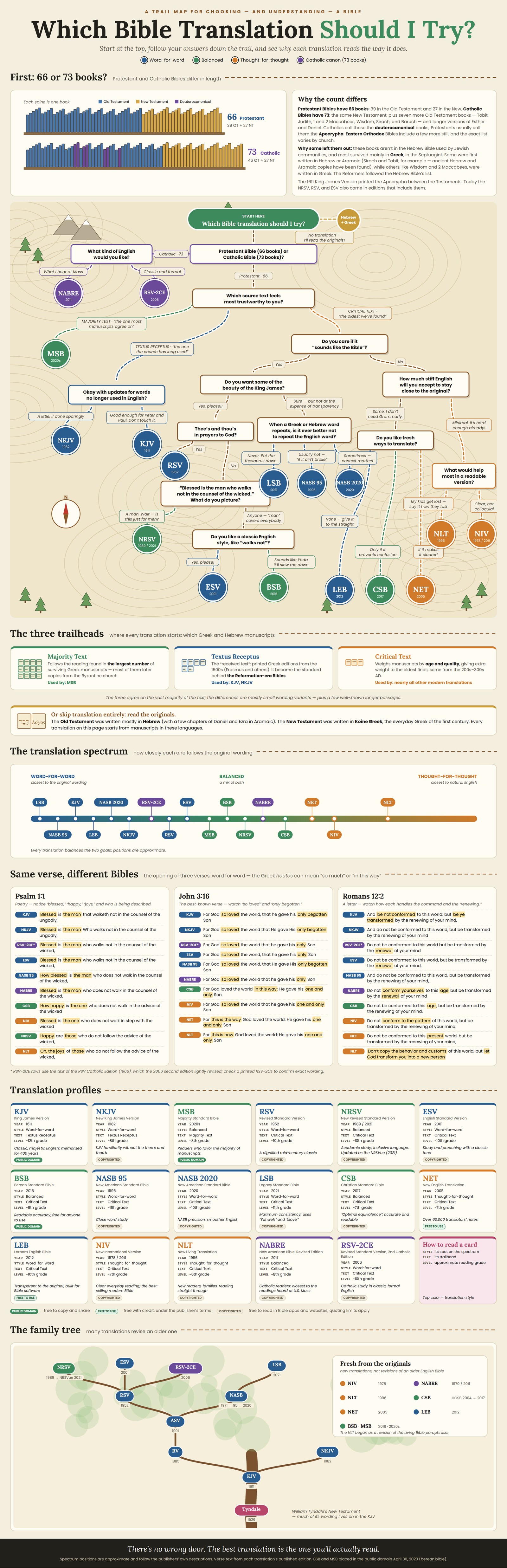
A trail map for choosing an English Bible: answer a few questions and follow the path to one of seventeen translations, from the KJV to the NLT. Also why Protestant and Catholic Bibles have 66 or 73 books, the three kinds of Greek source text, a word-for-word to thought-for-thought spectrum, three verses compared across the translations, a profile of each, and a family tree back to Tyndale.
✨ Read the Gospels in Koine Greek and Latin → 🔗 Own page, to share or bookmark 📚 The Holy Bible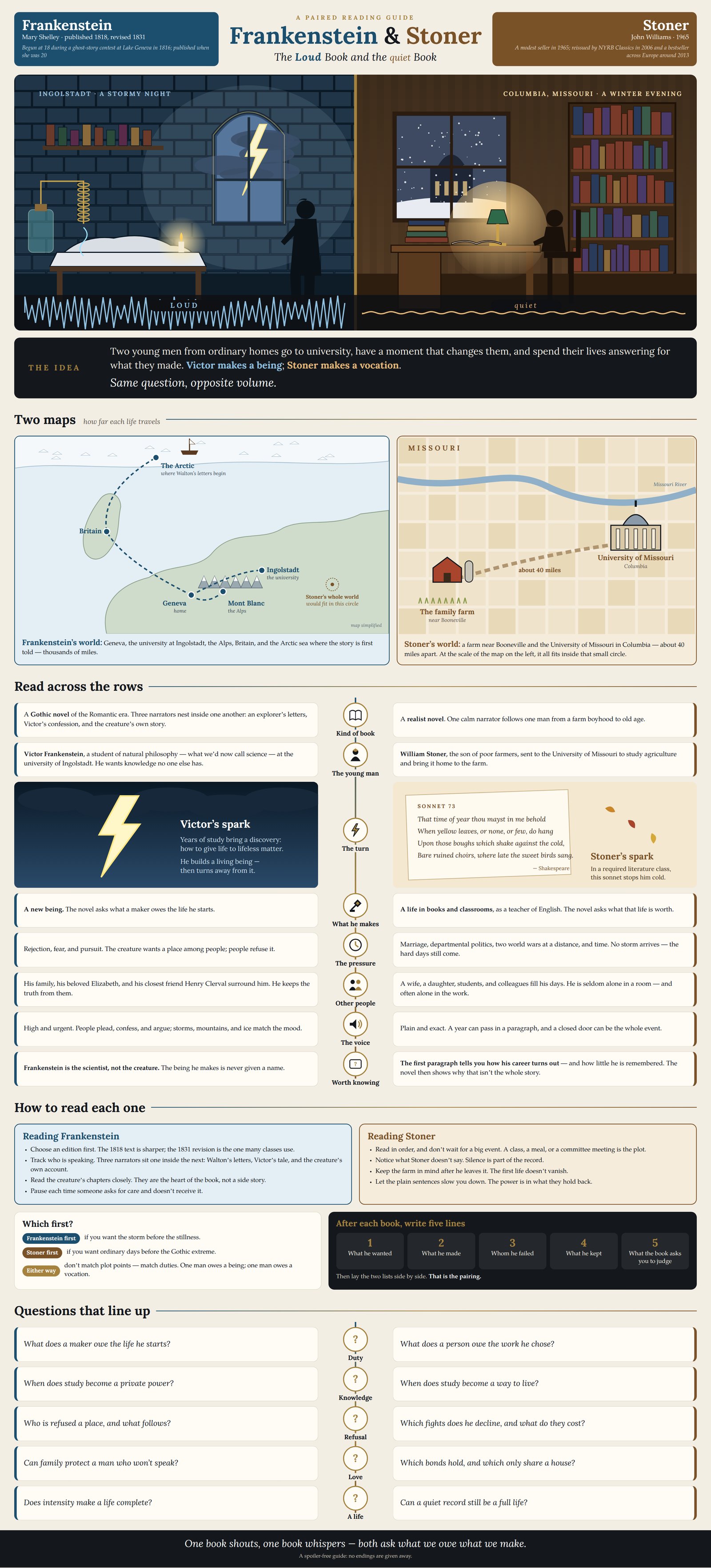
A paired reading guide to the loud book and the quiet book: two young men go to university, have a moment that changes them, and answer for what they made. Two maps, the two novels side by side, how to read each one, which to read first, and five questions that line up. Spoiler-free.
🔗 Own page, to share or bookmark 📚 Frankenstein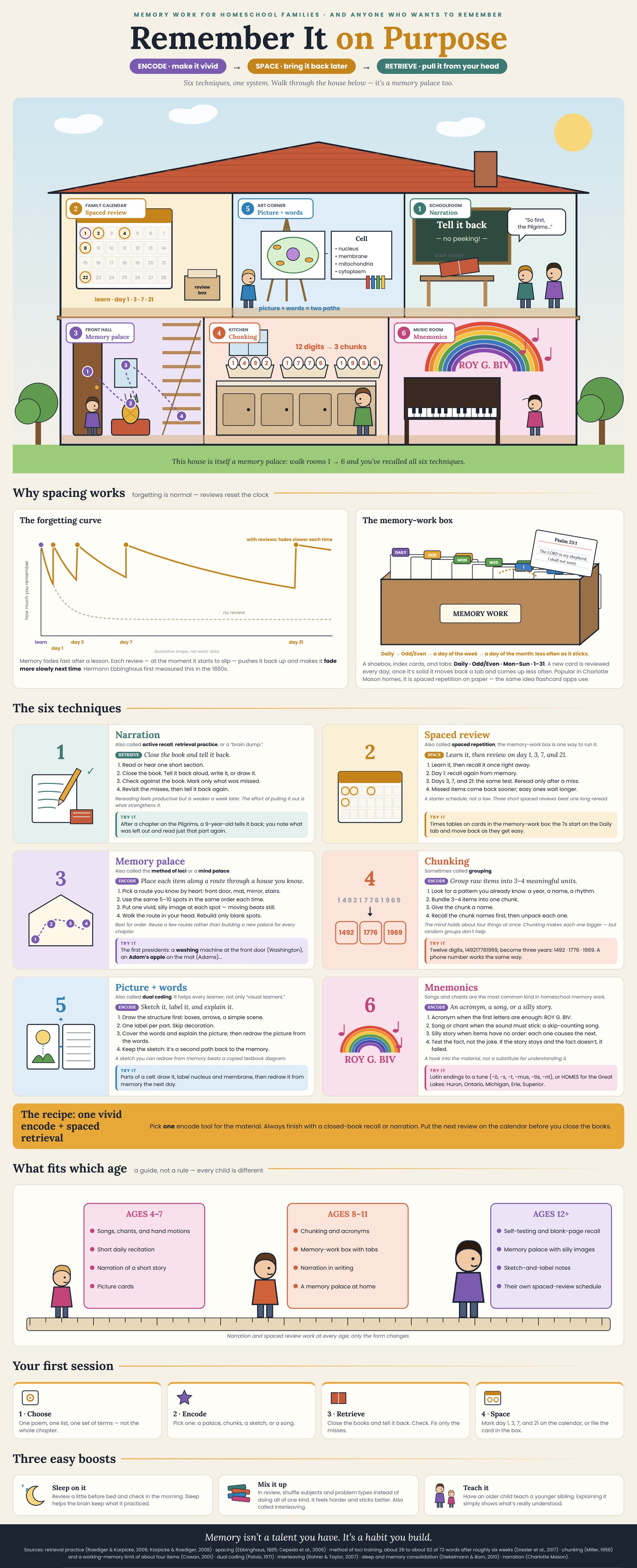
Memory work for homeschool families and anyone who wants to remember: six techniques (narration, spaced review, the memory palace, chunking, picture and words, mnemonics) drawn as rooms in a house that is itself a memory palace. Also the forgetting curve, a memory-work box, what fits which age, a first session and three easy boosts, with sources.
✨ Try it: the Memory Ladder and challenges → 🔗 Own page, to share or bookmark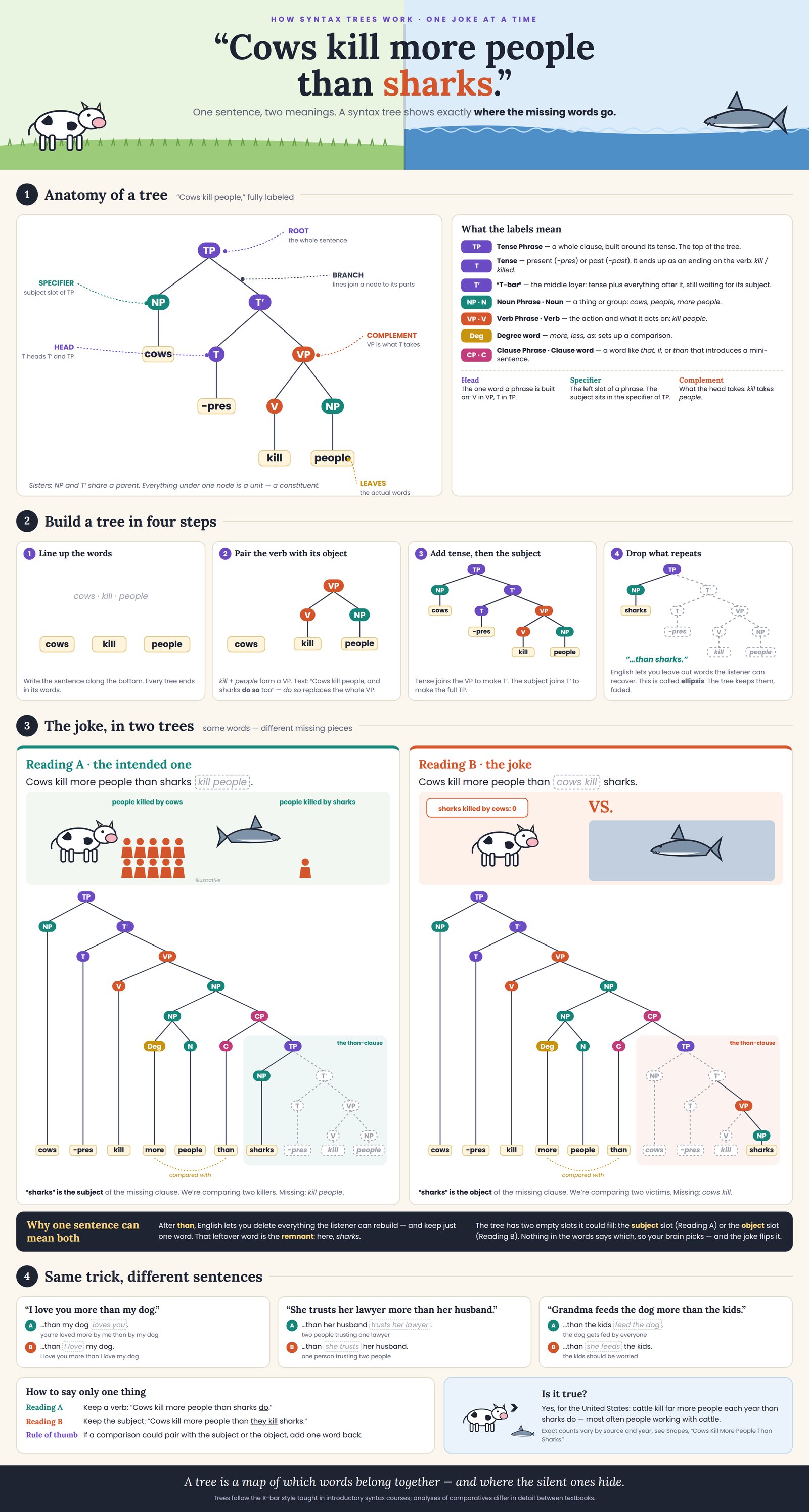
One sentence with two meanings, used to teach syntax trees: the labels (TP, NP, VP, CP), building a tree in four steps, and how the words left out after "than" make the joke. The two readings are drawn as trees, with more sentences that work the same way.
✨ Try it: build sentence trees yourself → 🔗 Own page, to share or bookmark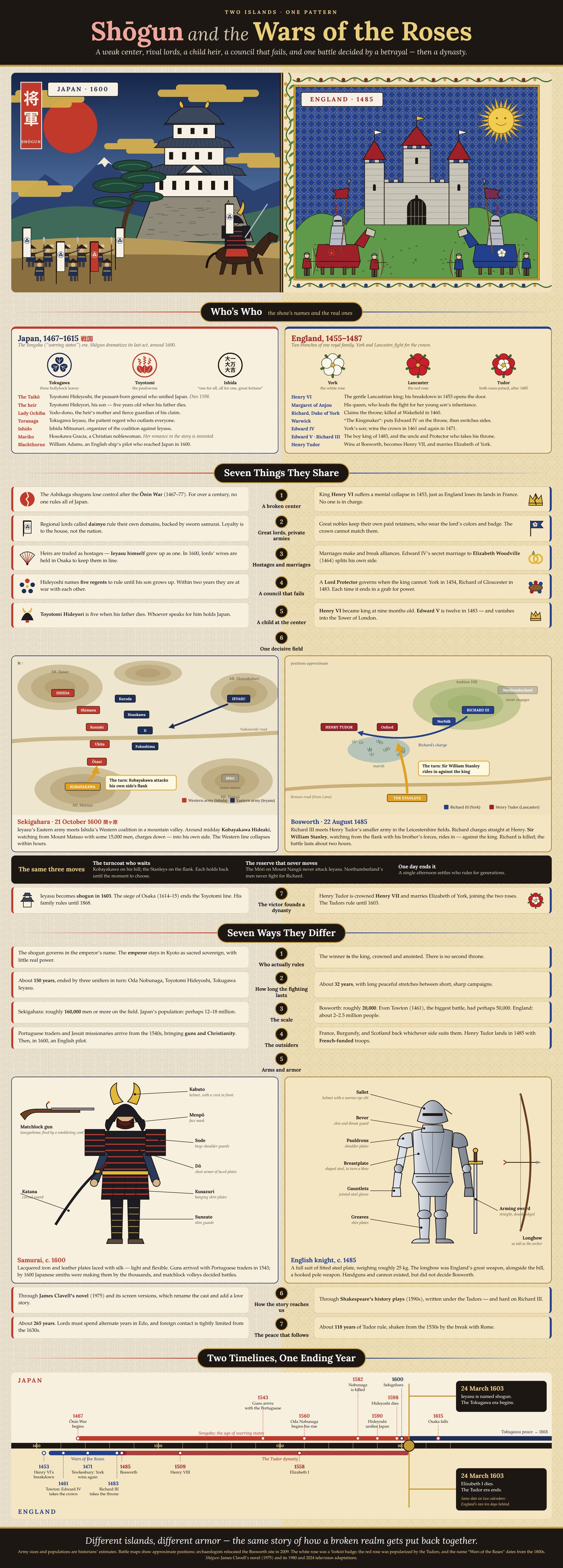
Japan around 1600 and England in 1485 side by side: a weak center, rival lords, a child heir, a council that fails, and one battle decided by a betrayal. Covers who's who, seven things the two stories share, seven ways they differ, the battles of Sekigahara and Bosworth, and a shared timeline.
🔗 Own page, to share or bookmark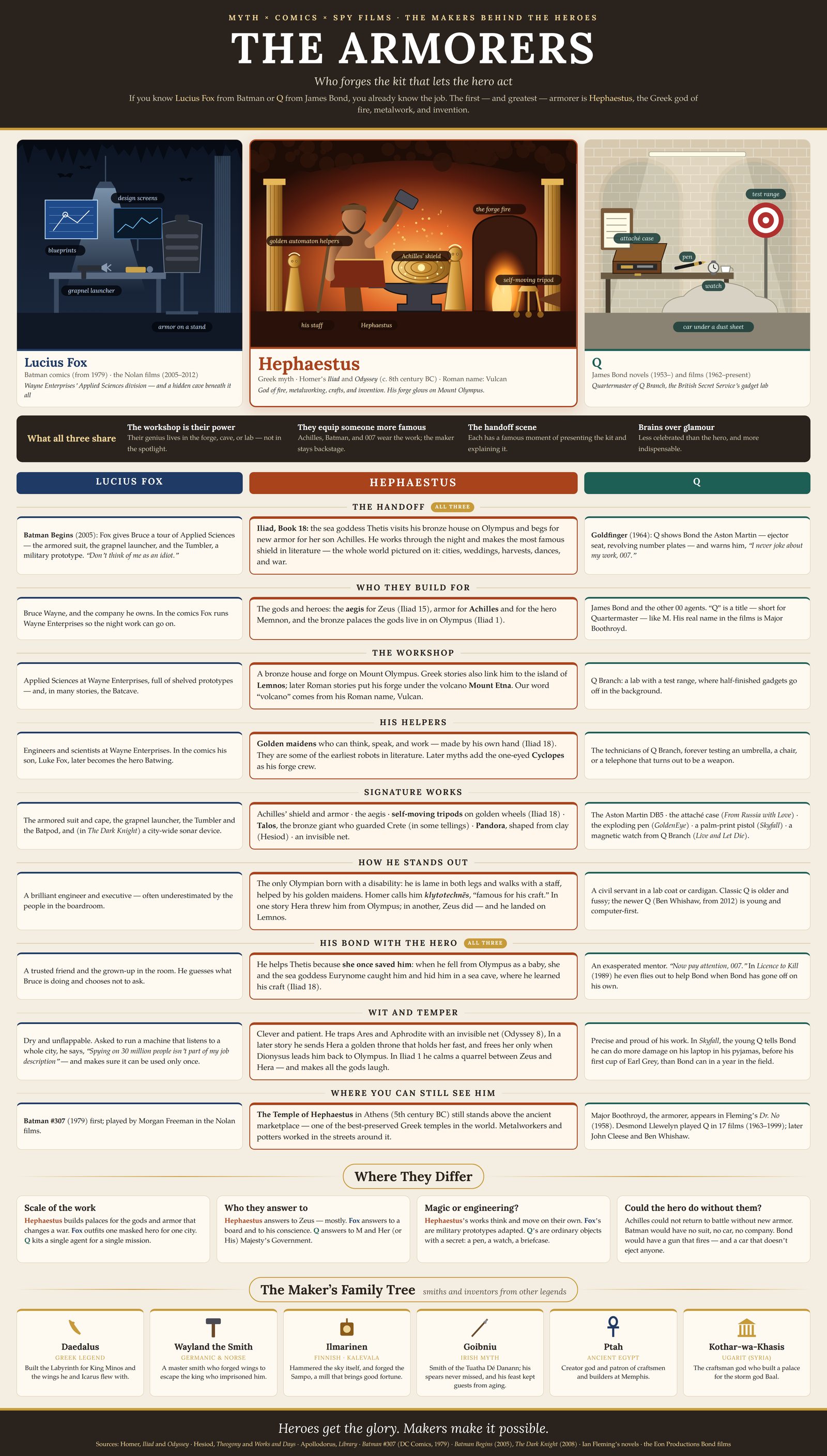
Compares Hephaestus, smith of the Greek gods, with Batman's Lucius Fox and James Bond's Q: the makers who build the hero's gear, plus a family tree of craftsmen from other myths.
🔗 Own page, to share or bookmark 📚 The Iliad · The Odyssey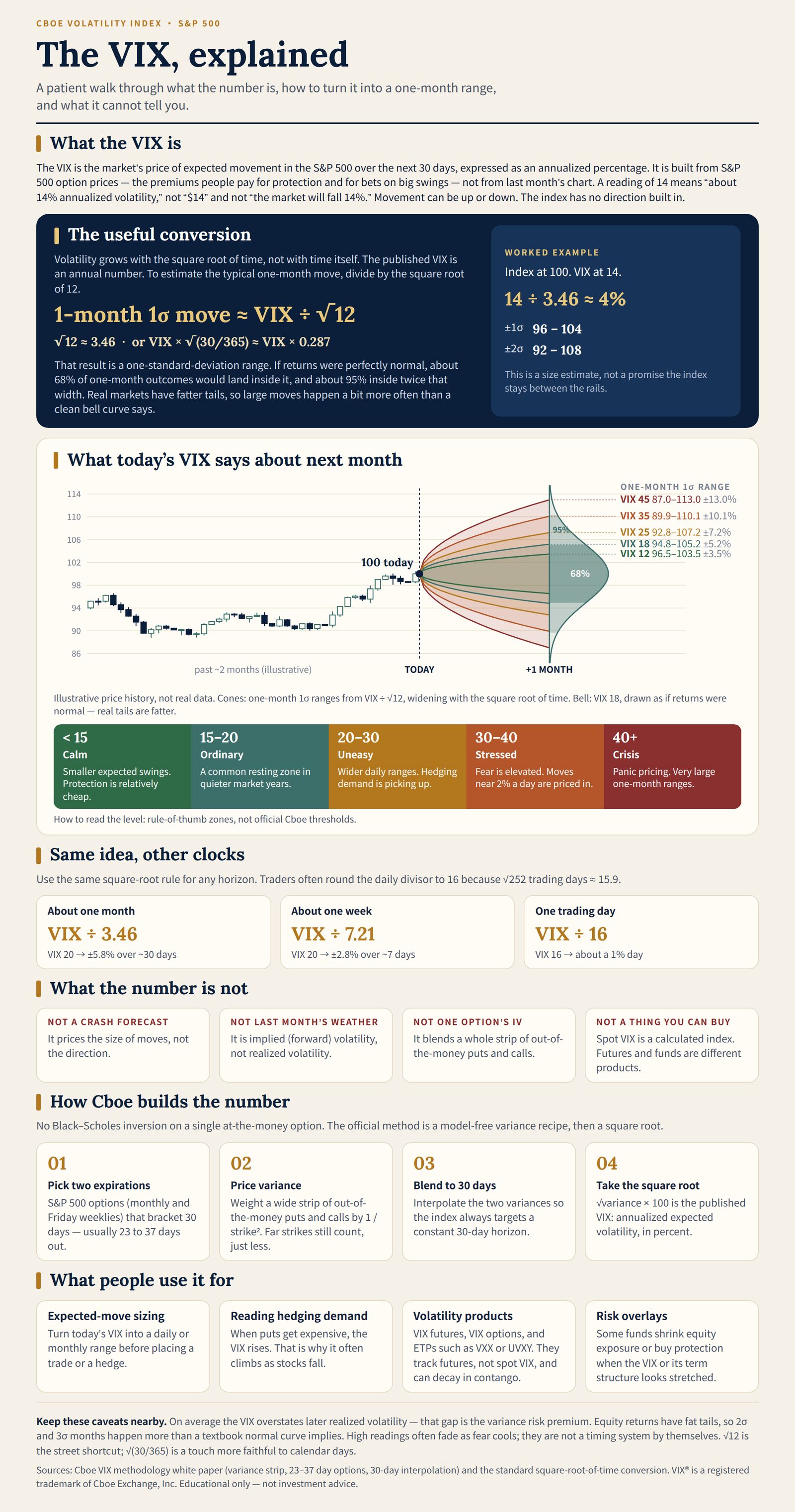
What the VIX measures, how to turn it into an expected one-month range for the S&P 500, and what the number can't tell you.
🔗 Own page, to share or bookmark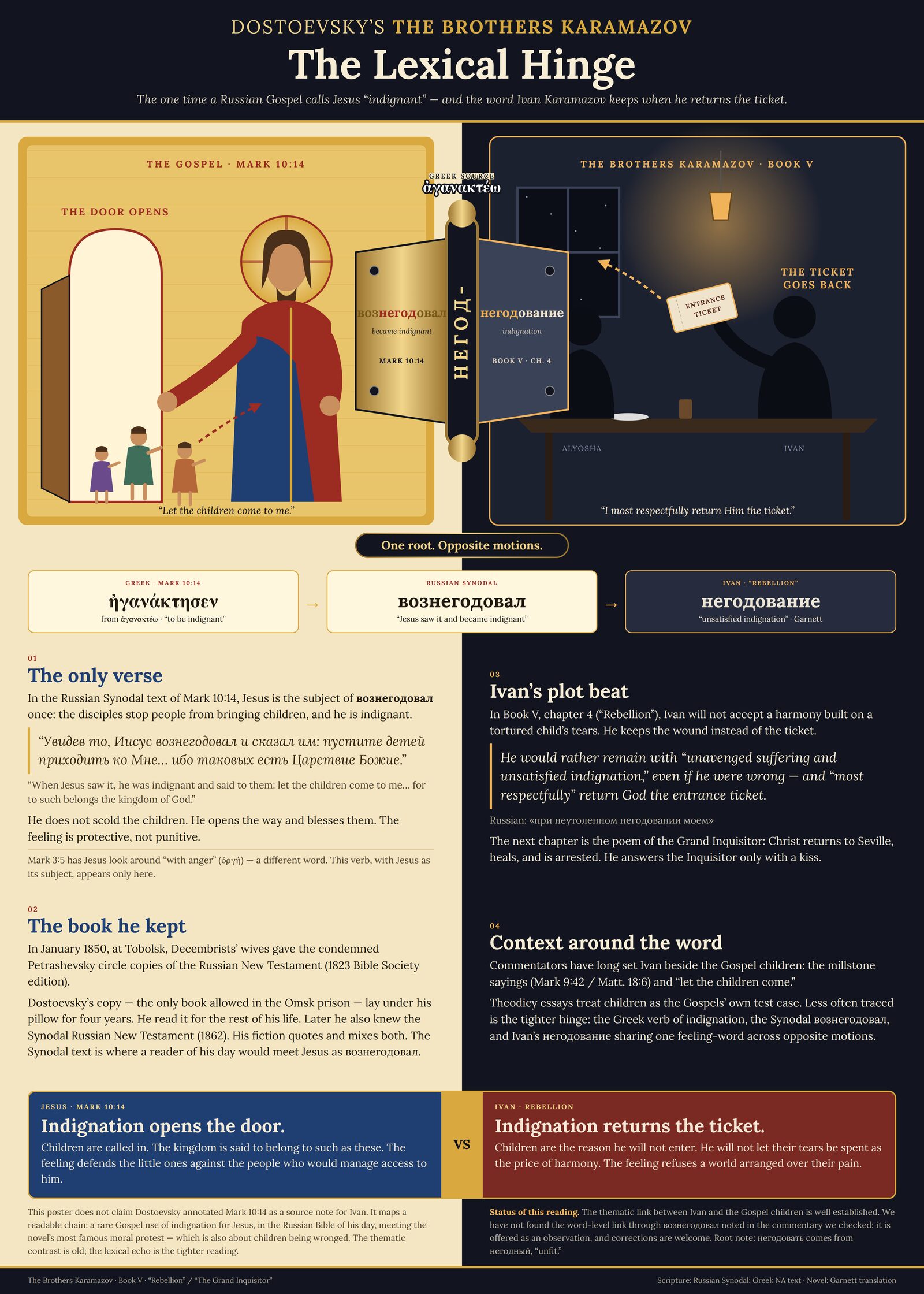
Traces one word for indignation from Mark 10:14 in Greek and Russian to Ivan's decision to "return the ticket" in The Brothers Karamazov.
🔗 Own page, to share or bookmark 📚 The Brothers Karamazov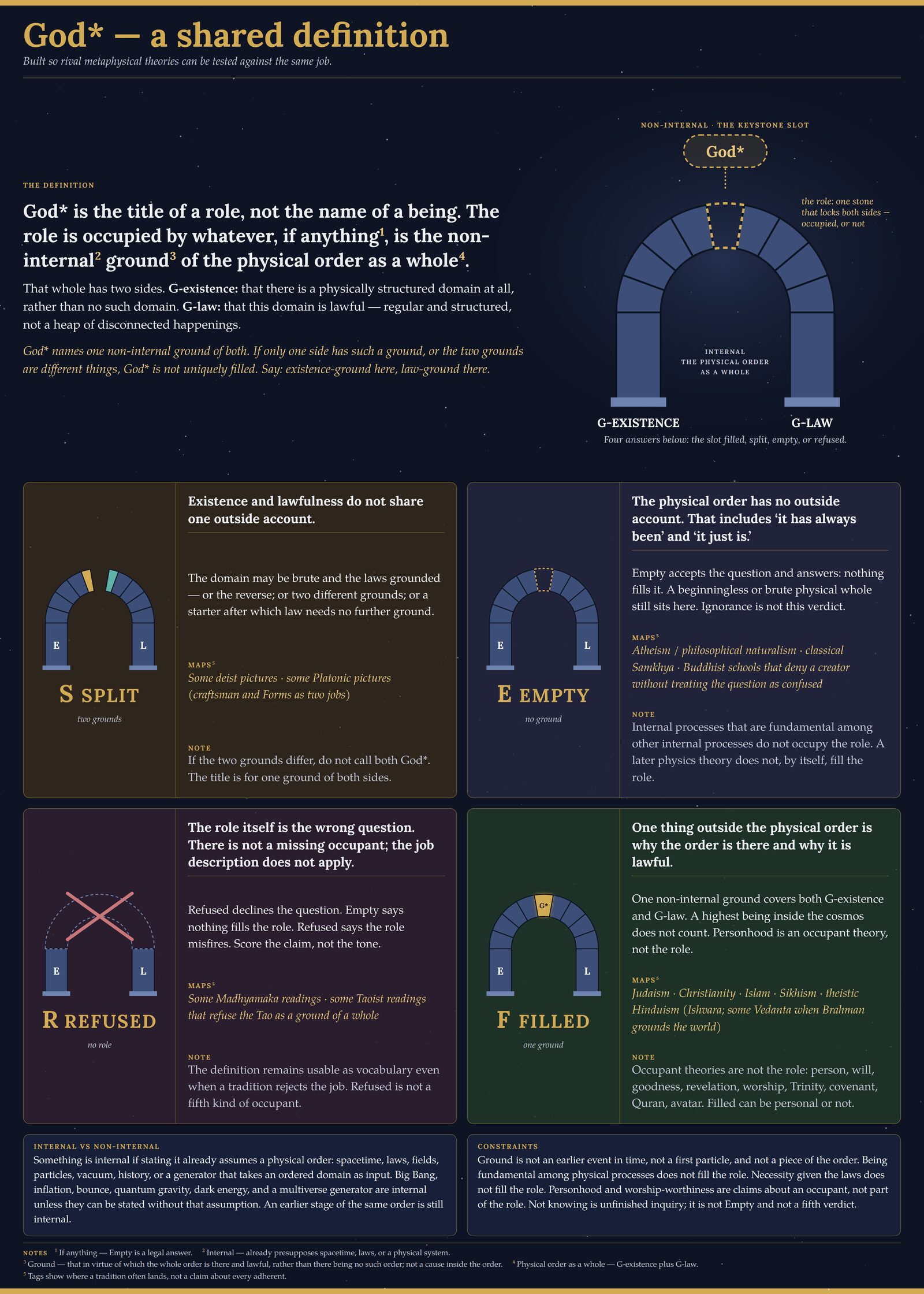
Proposes defining God as a role rather than a particular being, so different religions and worldviews can be compared on common ground.
📄 Read the full paper (PDF) 🔗 Own page, to share or bookmark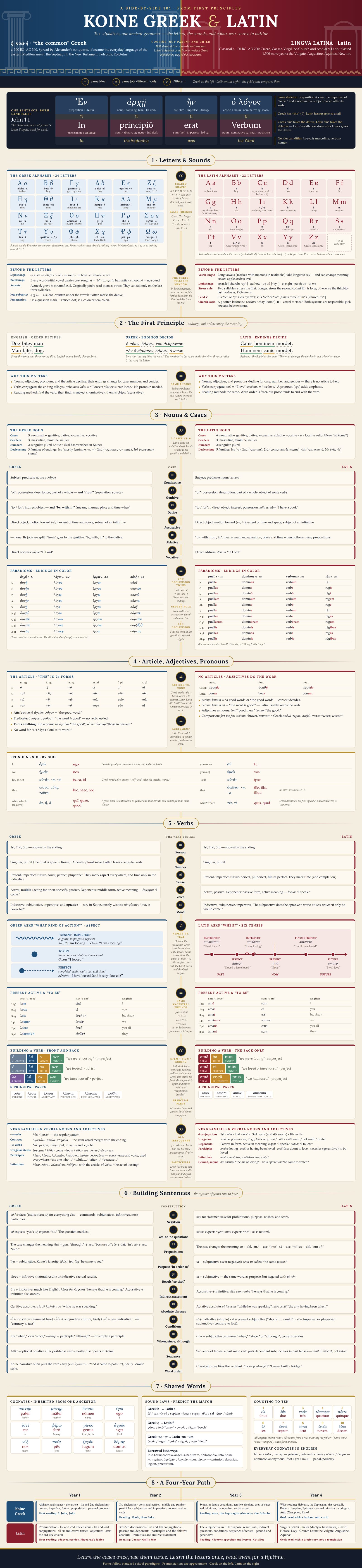
A side-by-side primer on the two languages of the New Testament and the Roman classics: alphabets, sounds, grammar, and an outline for learning both.
✨ The same chart as text, with a practice set → 🔗 Own page, to share or bookmark 🎬 Watch the video walk-through 📚 The Aeneid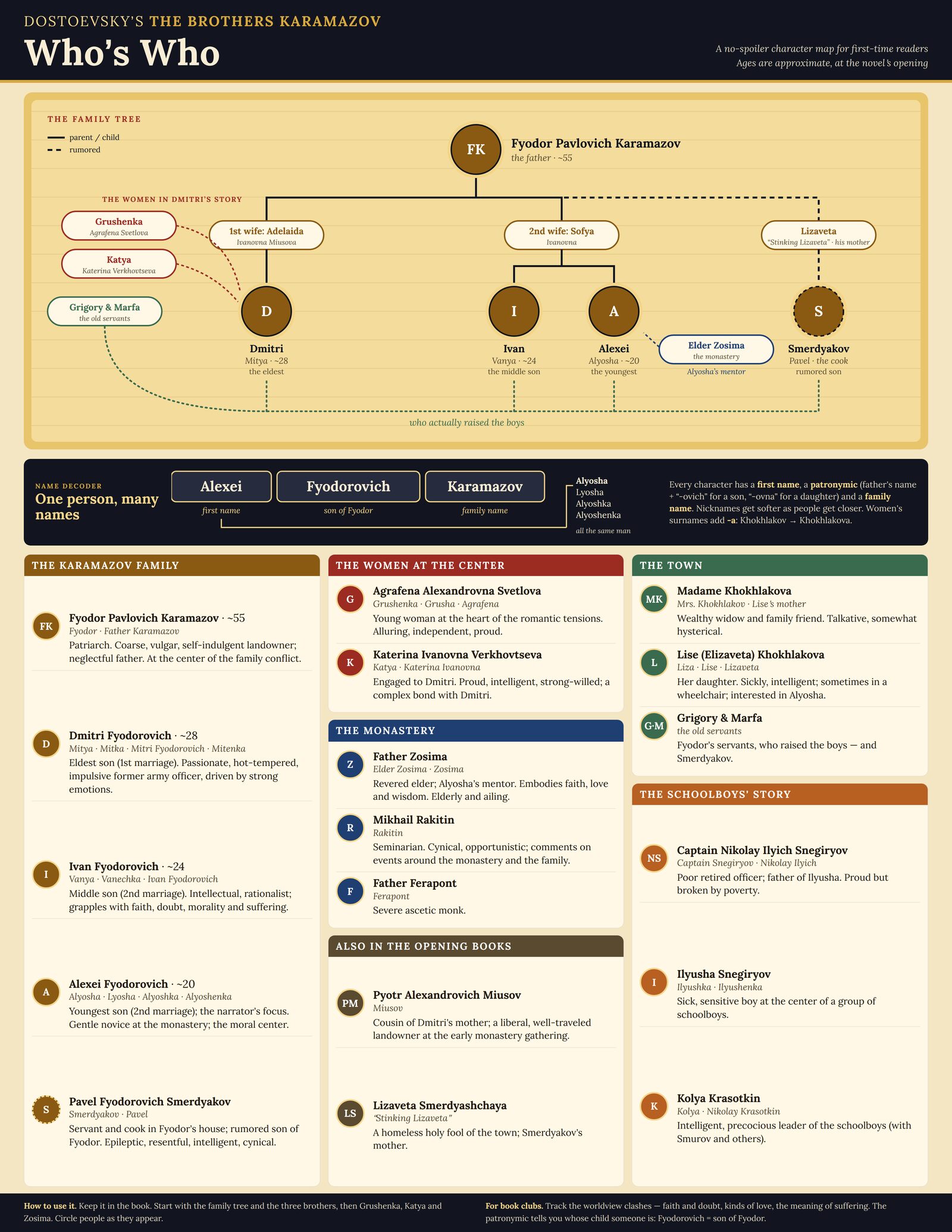
A no-spoiler character map for first-time readers: the family tree, the many nicknames, and who's who in the town.
🔗 Own page, to share or bookmark 📚 The Brothers Karamazov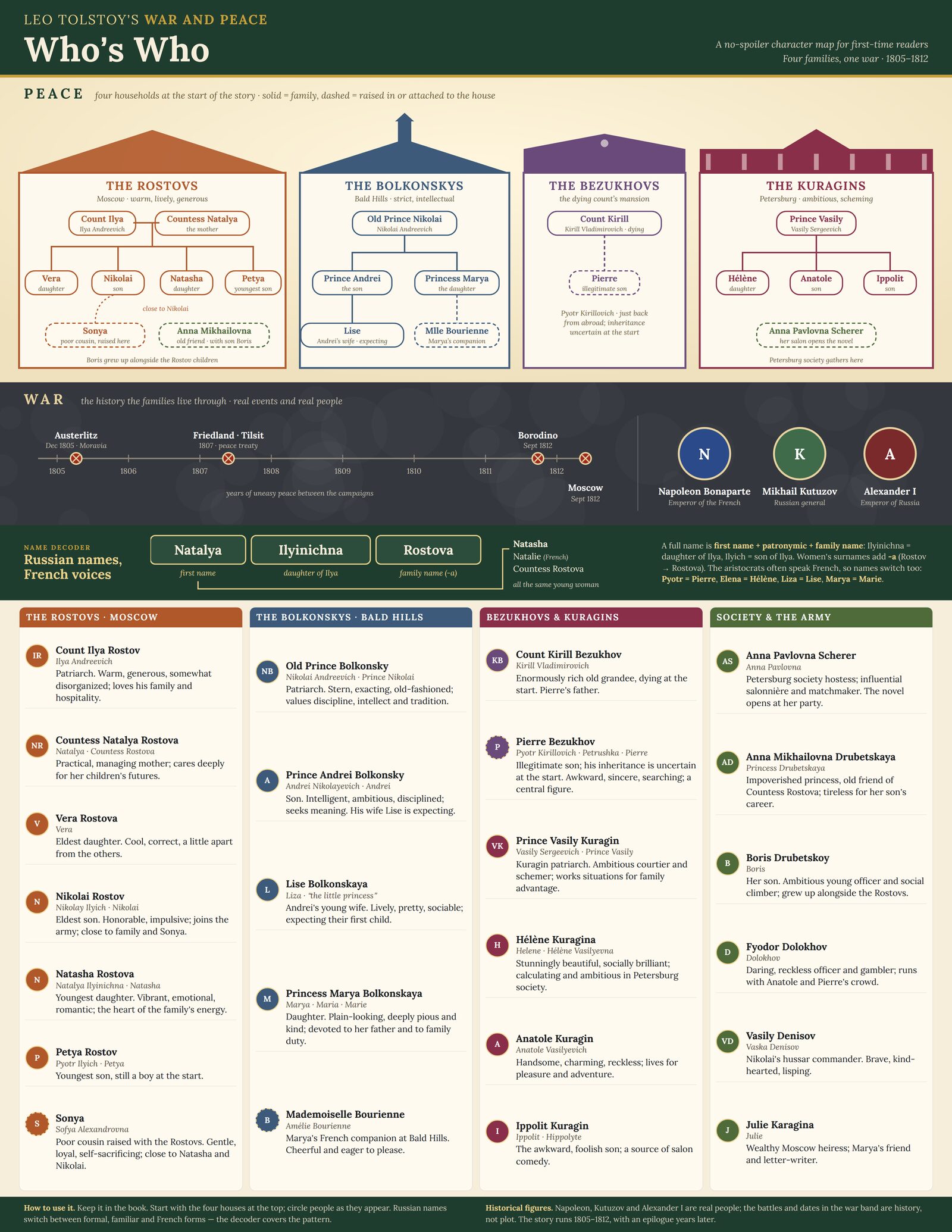
A no-spoiler guide to the four families, the war's key dates, and how Russian names work, so the huge cast stays straight.
🔗 Own page, to share or bookmark 📚 War and Peace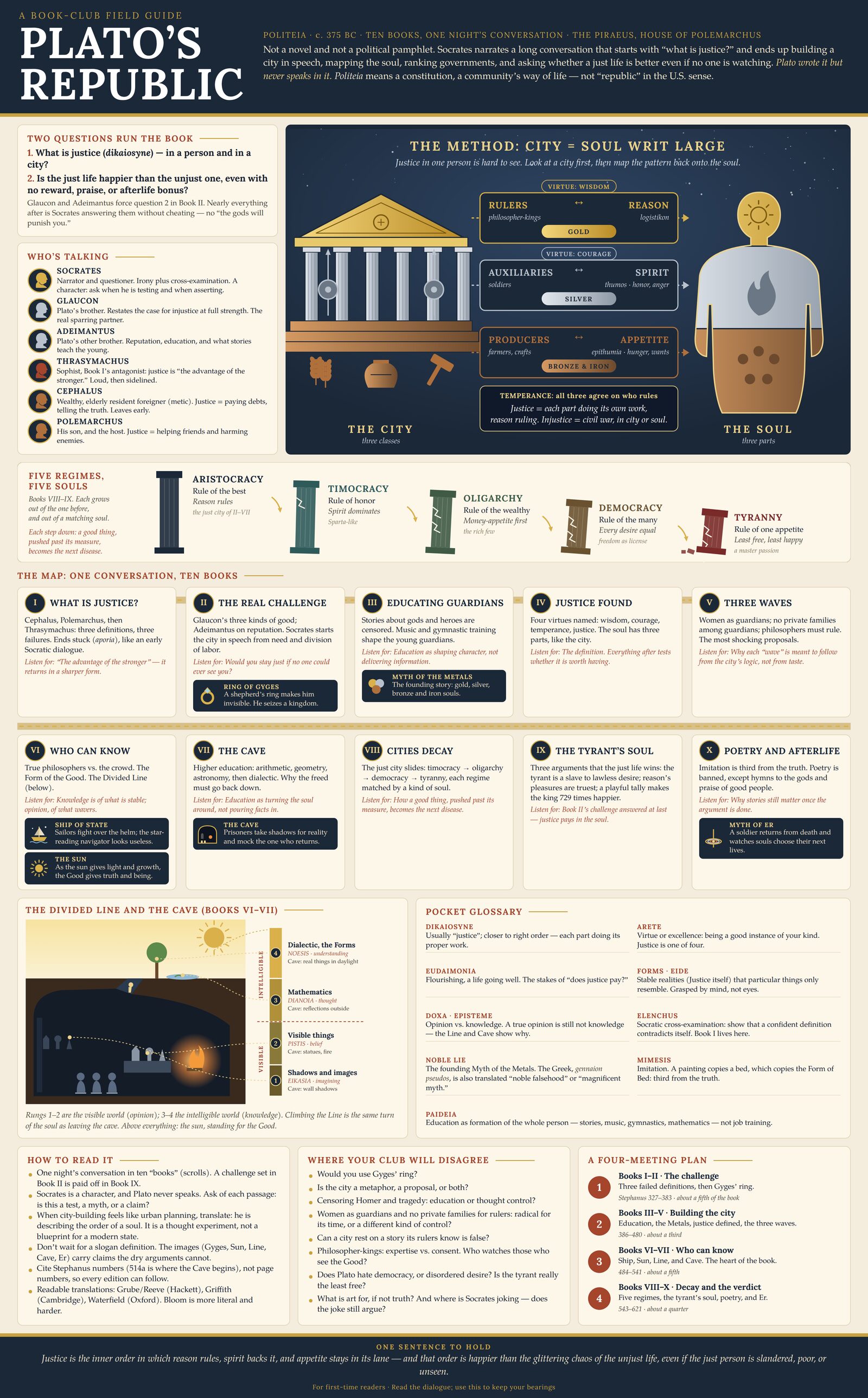
A book-club field guide: the two questions that drive the dialogue, the city–soul analogy, the five regimes, and a book-by-book map.
🔗 Own page, to share or bookmark 📚 The Republic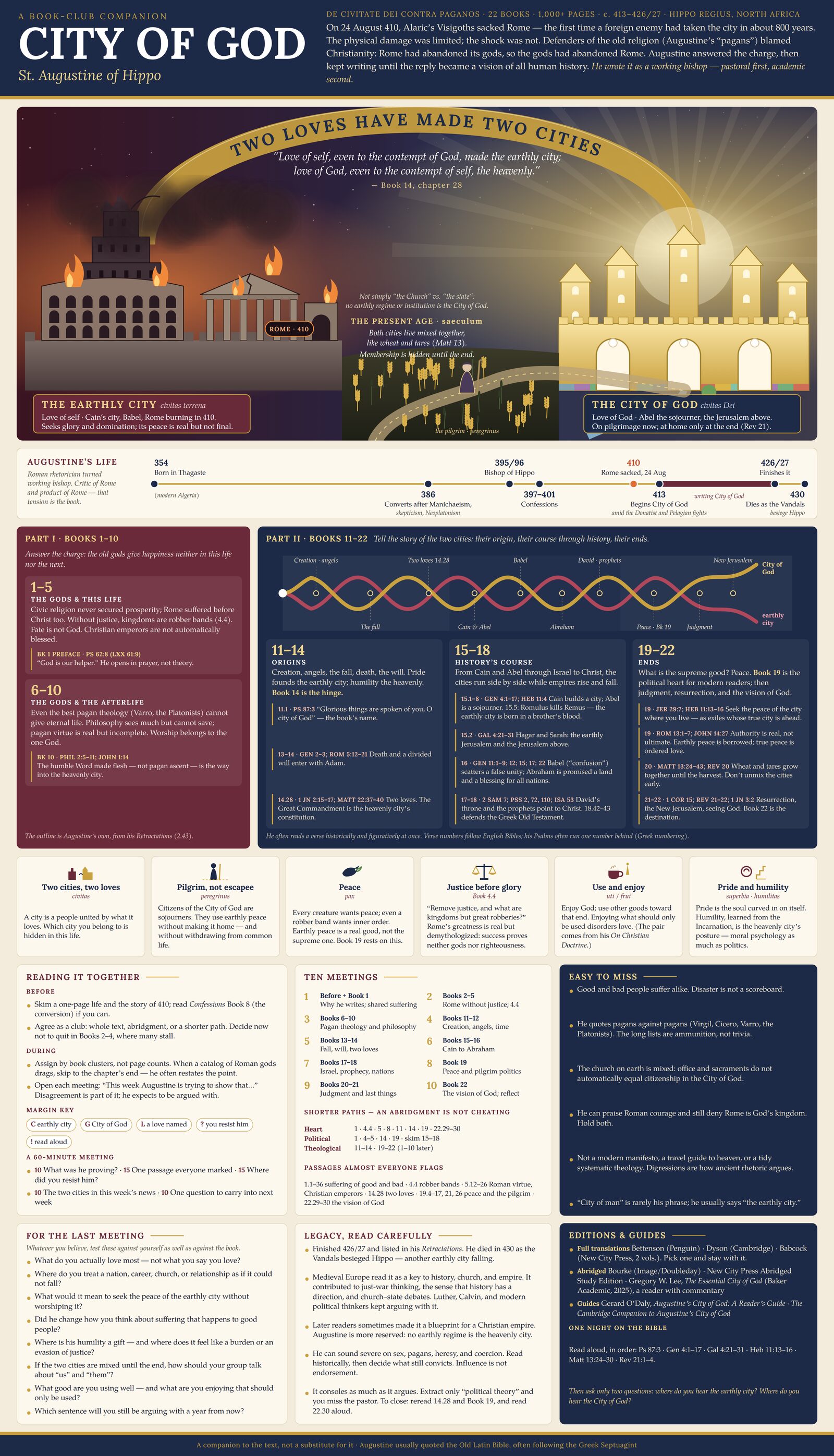
A book-club companion to Augustine's answer to the sack of Rome: the two cities, his life, and a map of all 22 books.
🔗 Own page, to share or bookmark 📚 City of God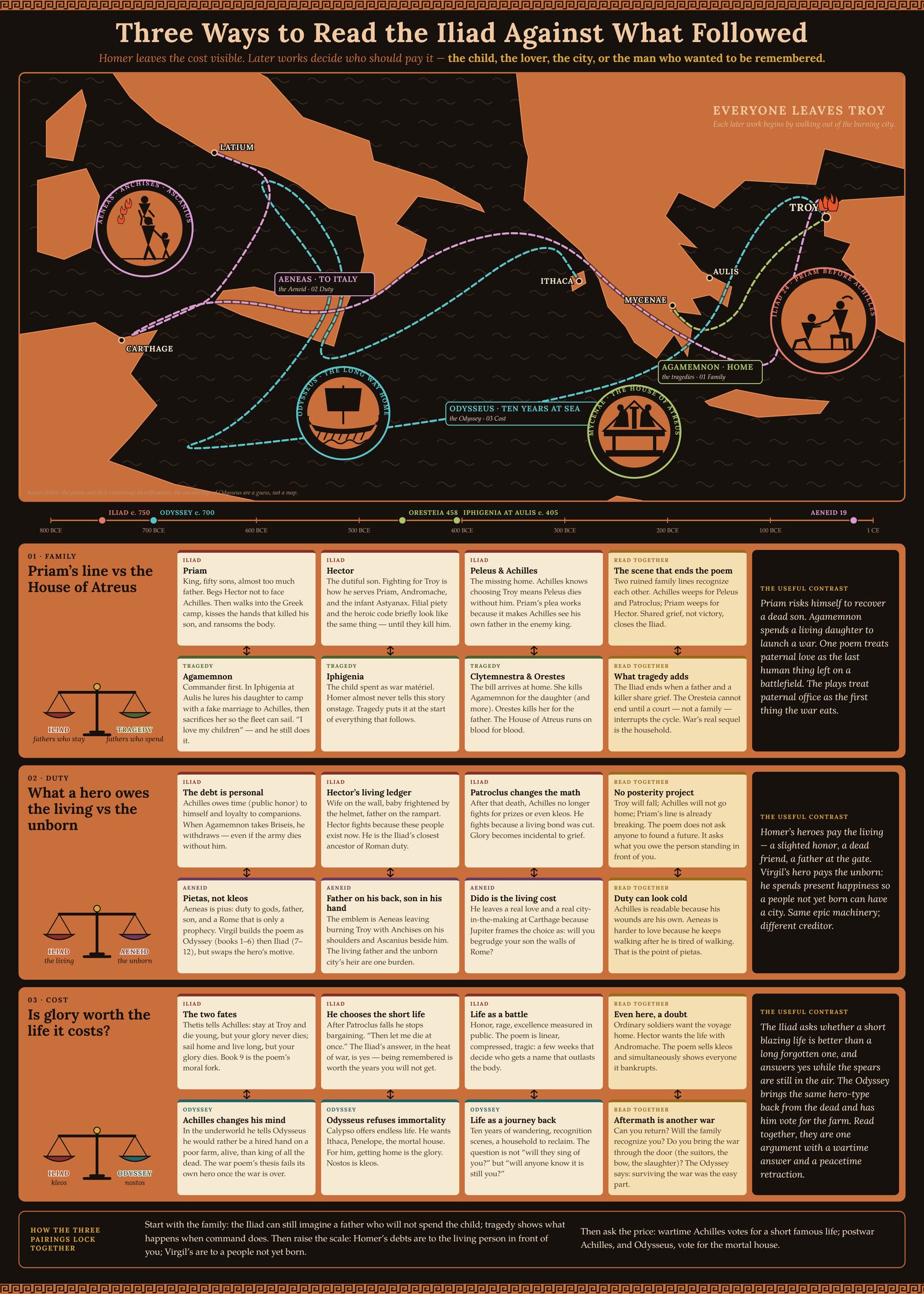
Follows the survivors out of Troy into the Odyssey, the Greek tragedies and the Aeneid, comparing how each answers who pays the cost of war.
🔗 Own page, to share or bookmark 🎬 Watch the video walk-through 📚 The Iliad · The Odyssey · The Aeneid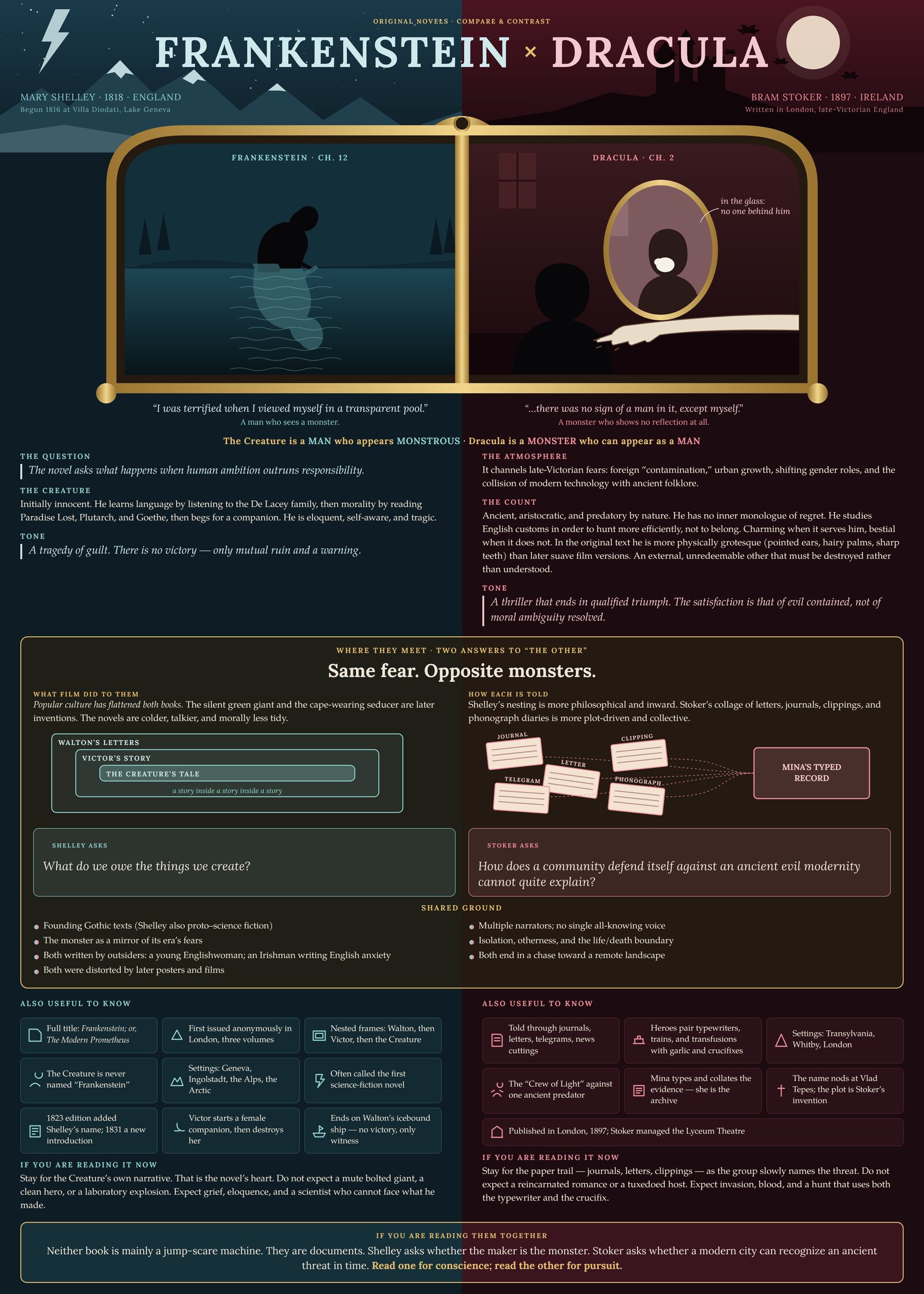
Compares the two founding horror novels: a man who looks like a monster and a monster who can pass as a man, and what film adaptations flattened.
🔗 Own page, to share or bookmark 📚 Frankenstein · Dracula · Paradise Lost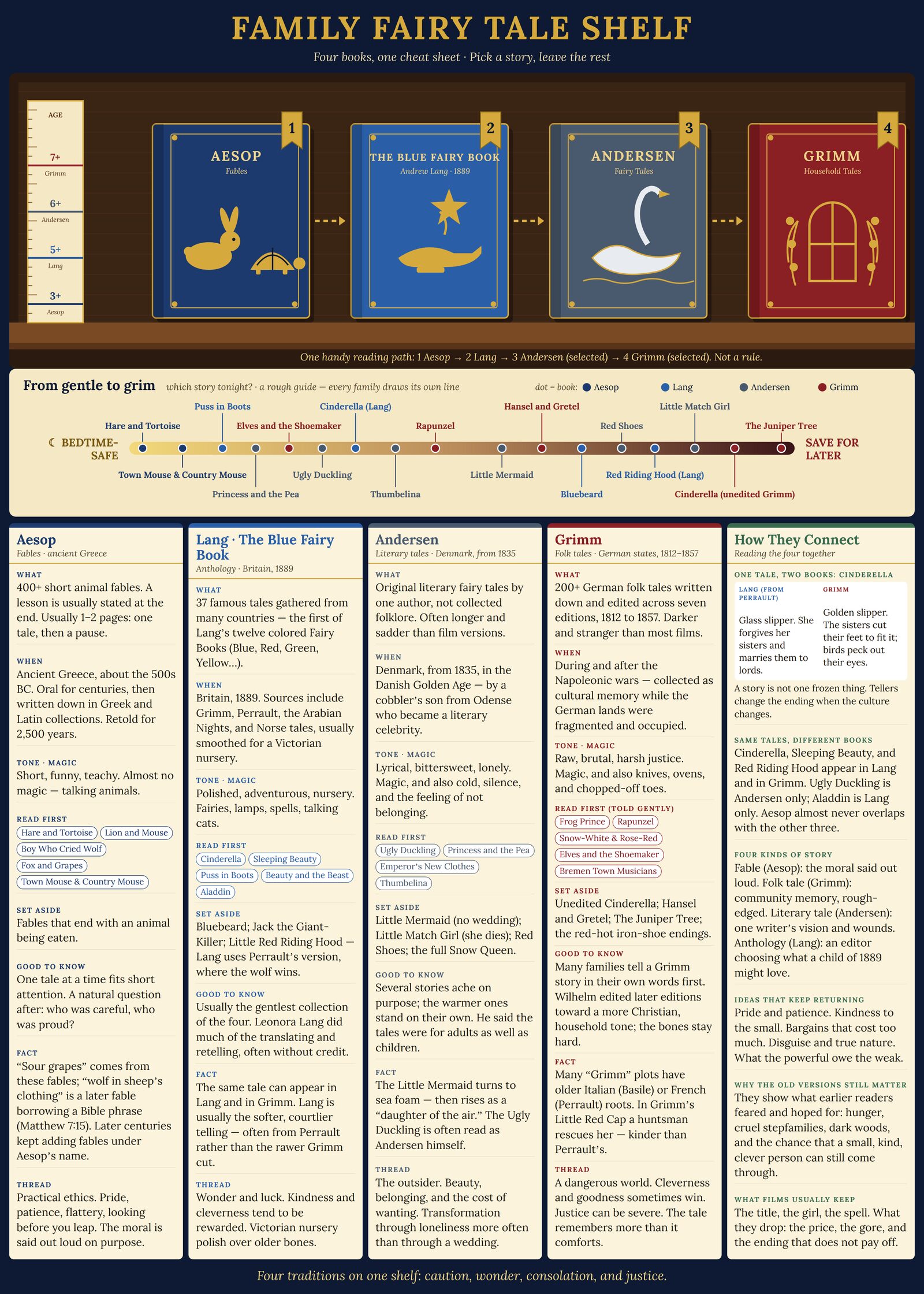
A family reading path through Aesop, Lang's Blue Fairy Book, Andersen and Grimm, with stories sorted from gentle bedtime tales to the grim ones.
🔗 Own page, to share or bookmark 📚 Aesop's Fables · The Little Mermaid and Other Fairy Tales · Grimm's Complete Fairy Tales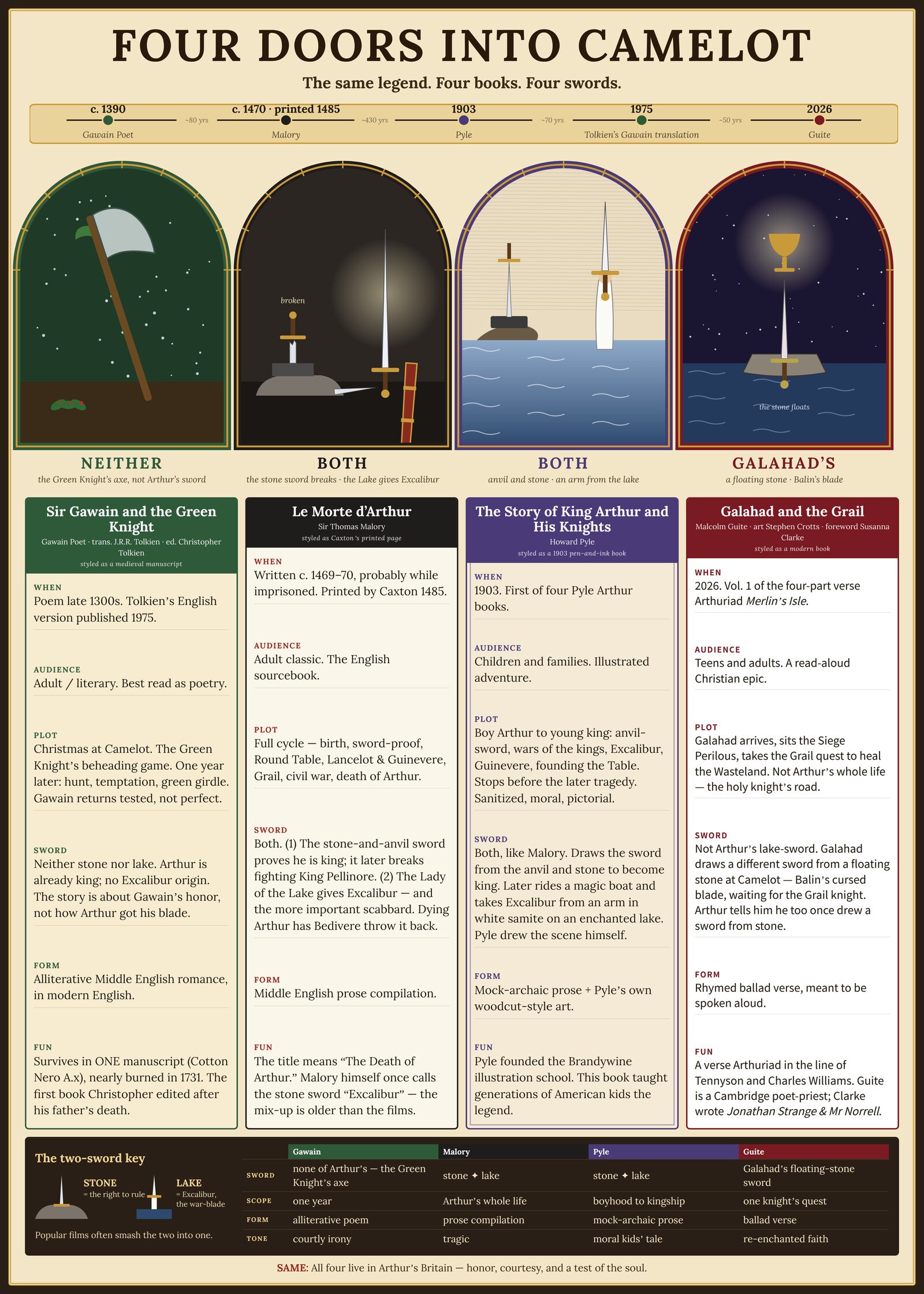
Four ways into the Arthur legend (Sir Gawain, Malory, Pyle and Guite) compared by era, audience and plot, to help you pick where to start.
🔗 Own page, to share or bookmark 📚 Sir Gawain and the Green Knight · The Story of King Arthur and His Knights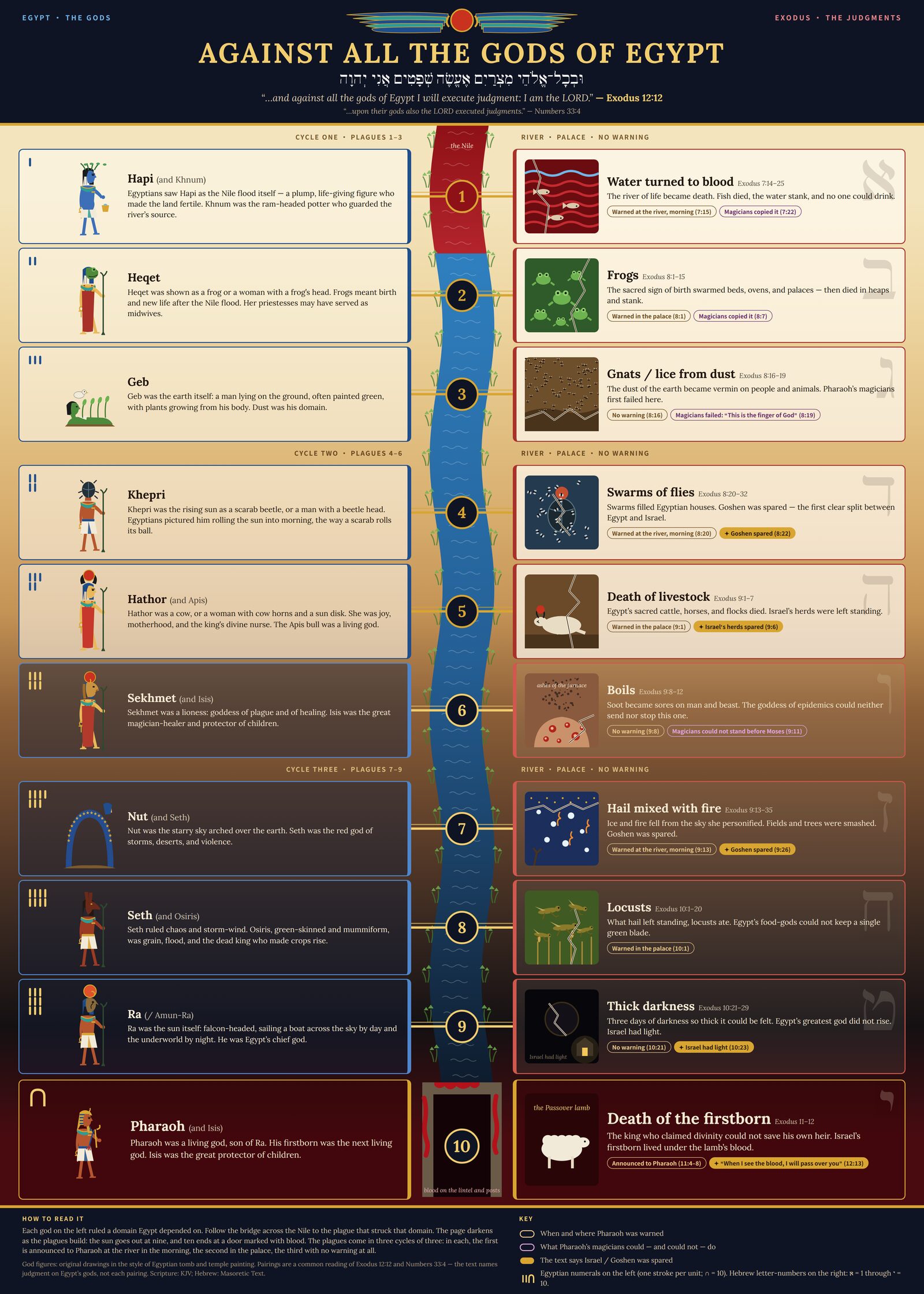
Pairs each of the ten plagues in Exodus with the Egyptian god it challenged, following the story down the Nile.
🔗 Own page, to share or bookmark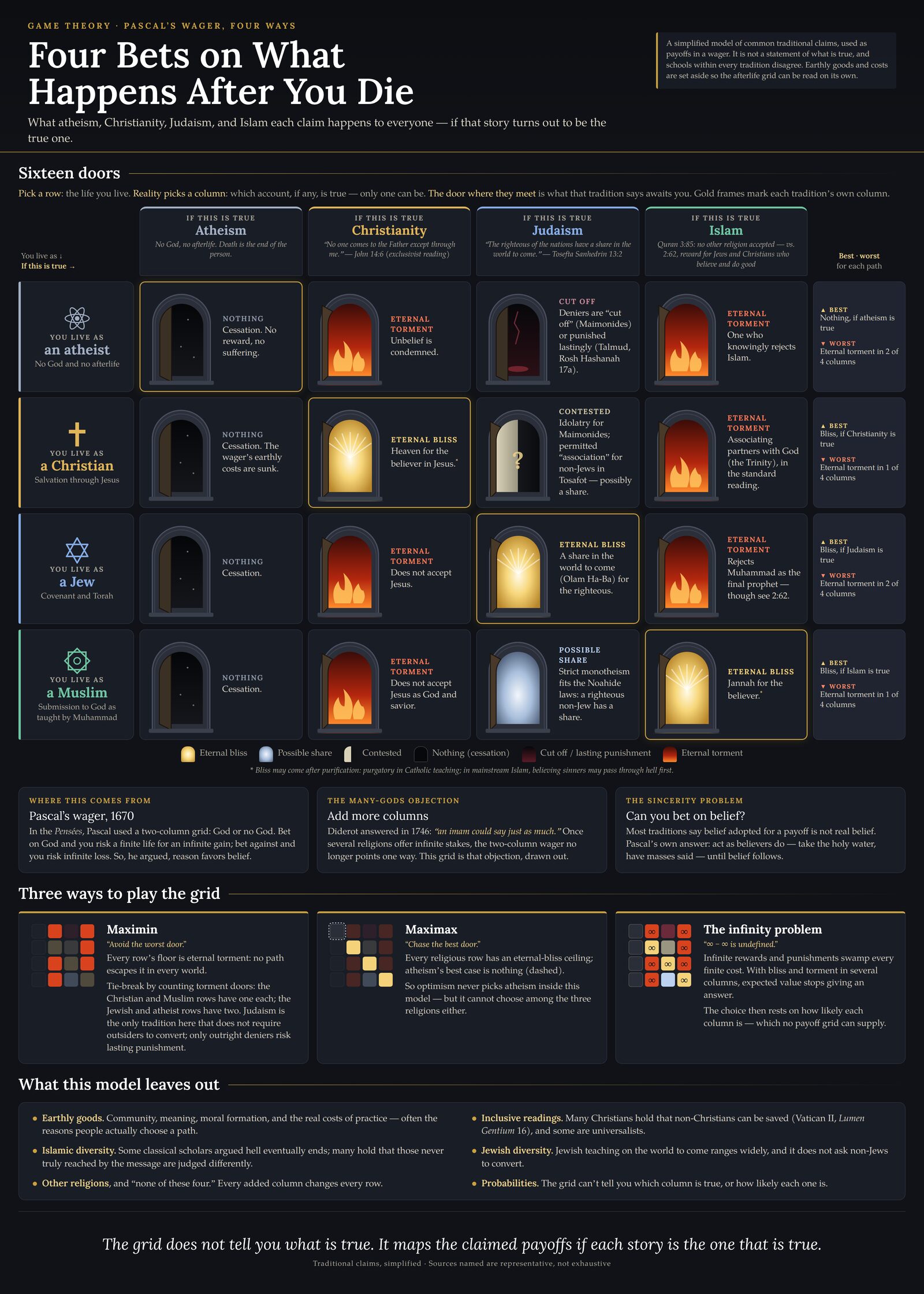
Pascal's wager as a grid: what atheism, Christianity, Judaism and Islam each say awaits you, depending on which one turns out to be true.
🔗 Own page, to share or bookmark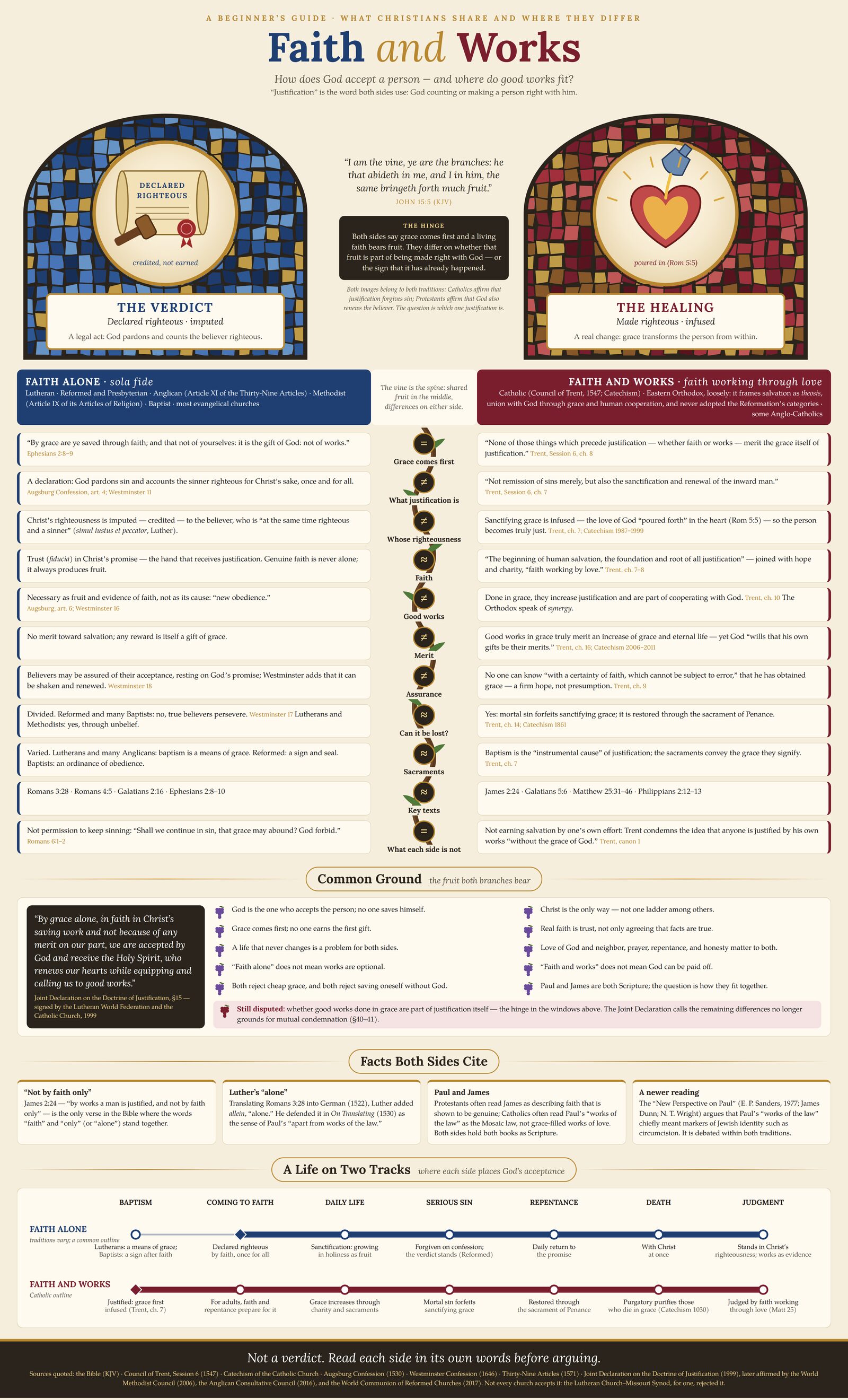
A beginner's guide to what Protestants and Catholics share and where they differ on justification, quoting each side's own sources.
🔗 Own page, to share or bookmark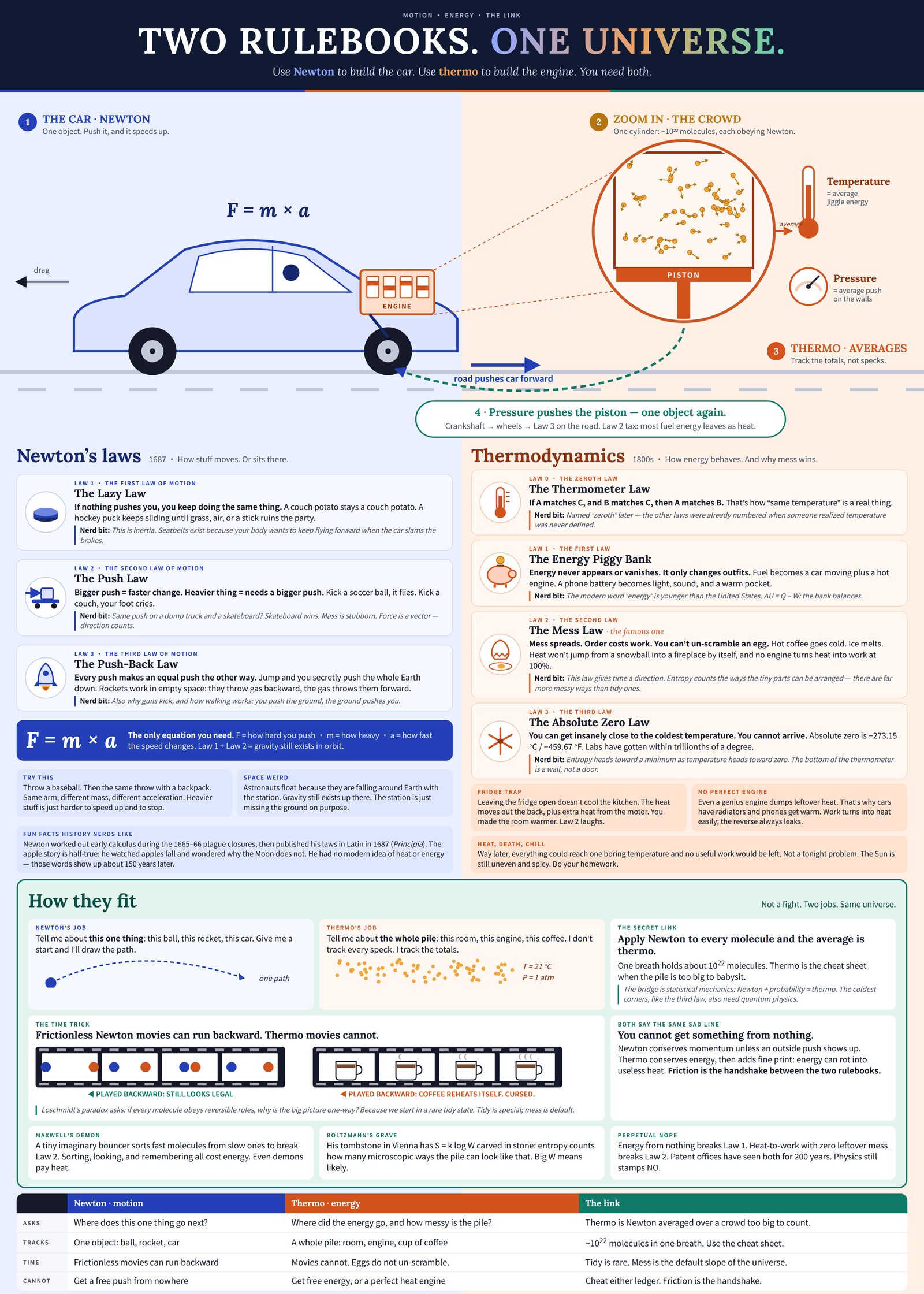
Newton's laws and thermodynamics explained with a car and its engine, and why describing one machine takes both rulebooks.
🔗 Own page, to share or bookmark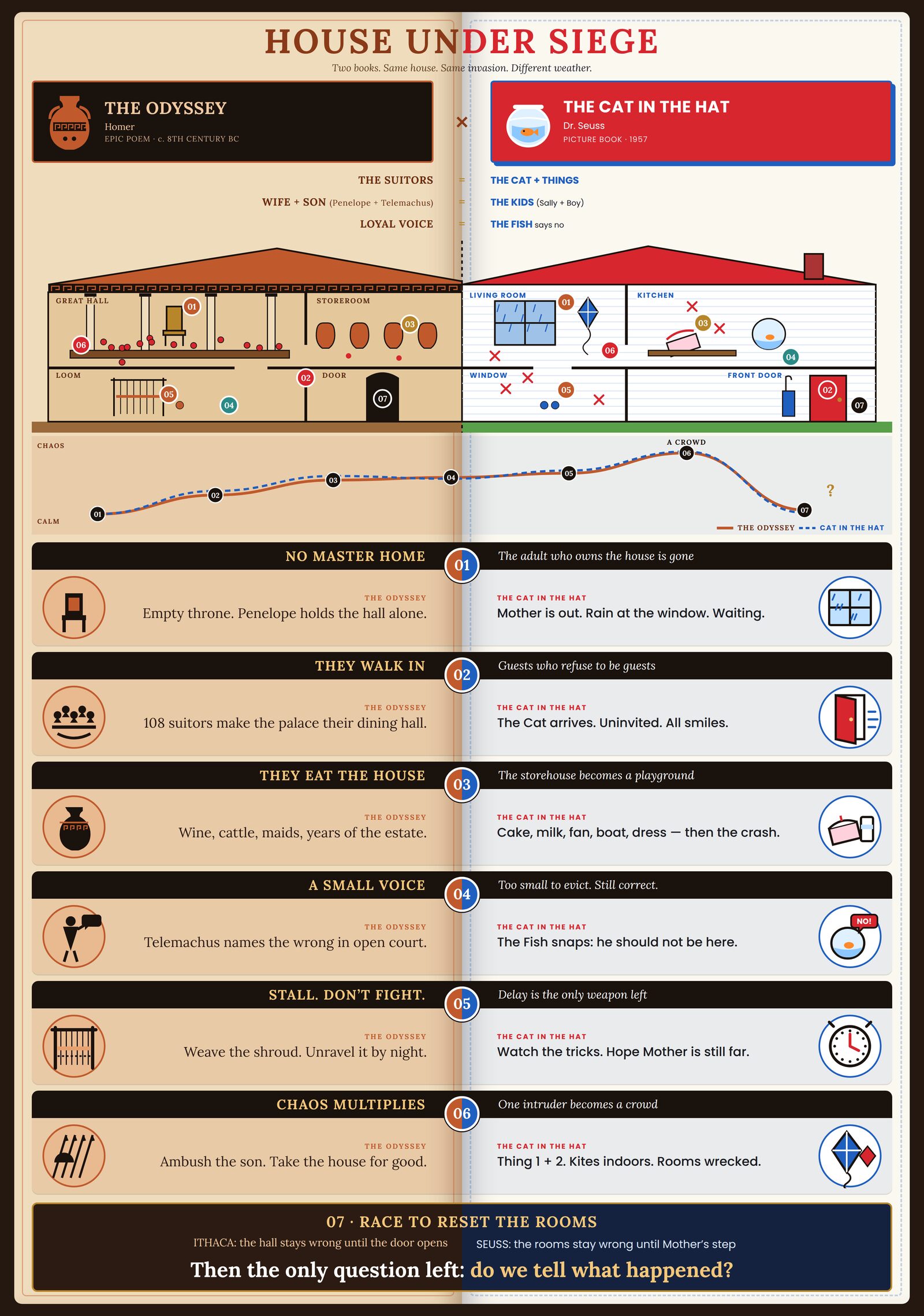
A playful comparison of the Odyssey and The Cat in the Hat: two stories about uninvited guests taking over a house while its master is away.
🔗 Own page, to share or bookmark 📚 The Odyssey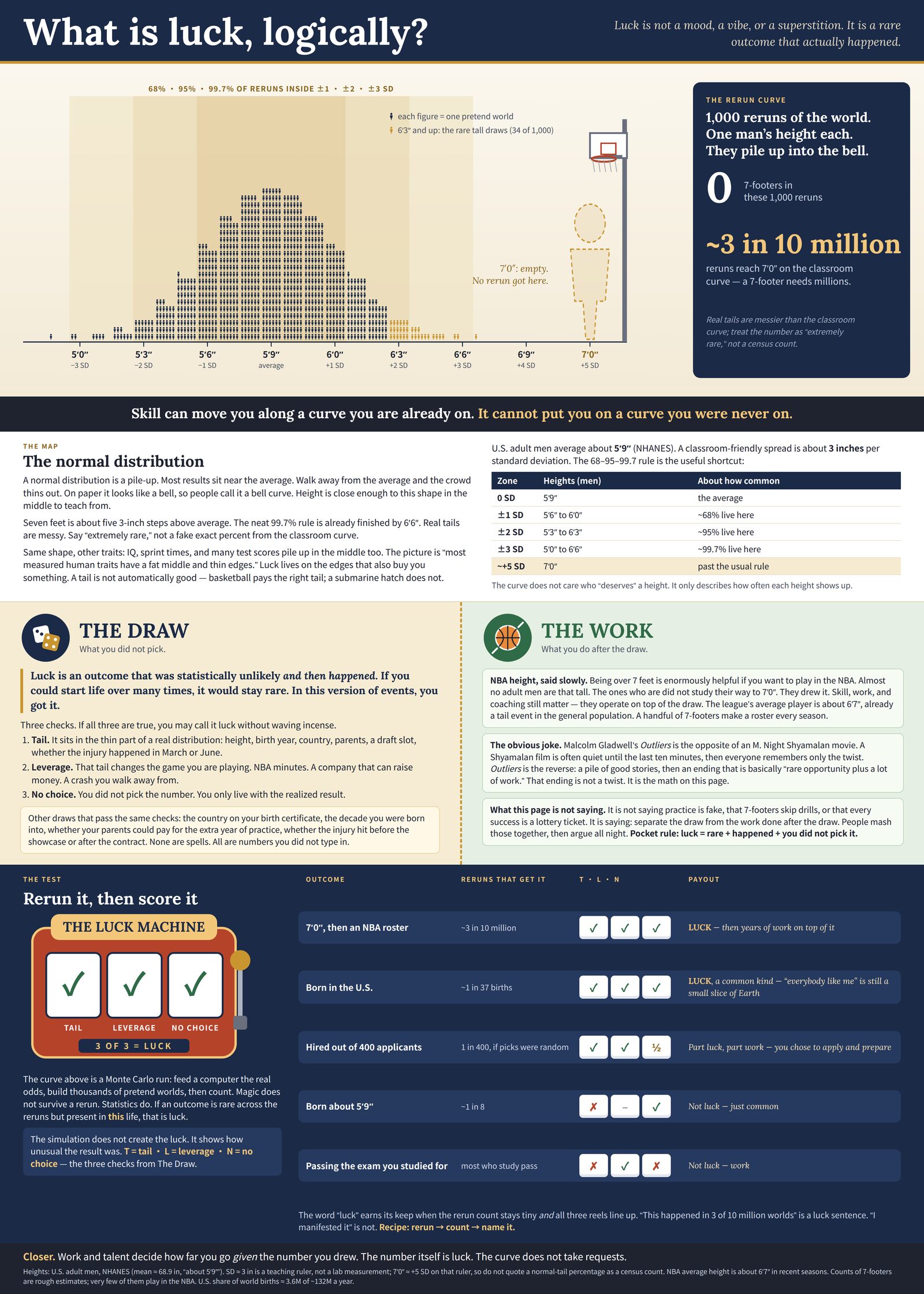
Uses the bell curve of human height to define luck as a rare outcome that actually happened, and to separate the draw from the work.
🔗 Own page, to share or bookmark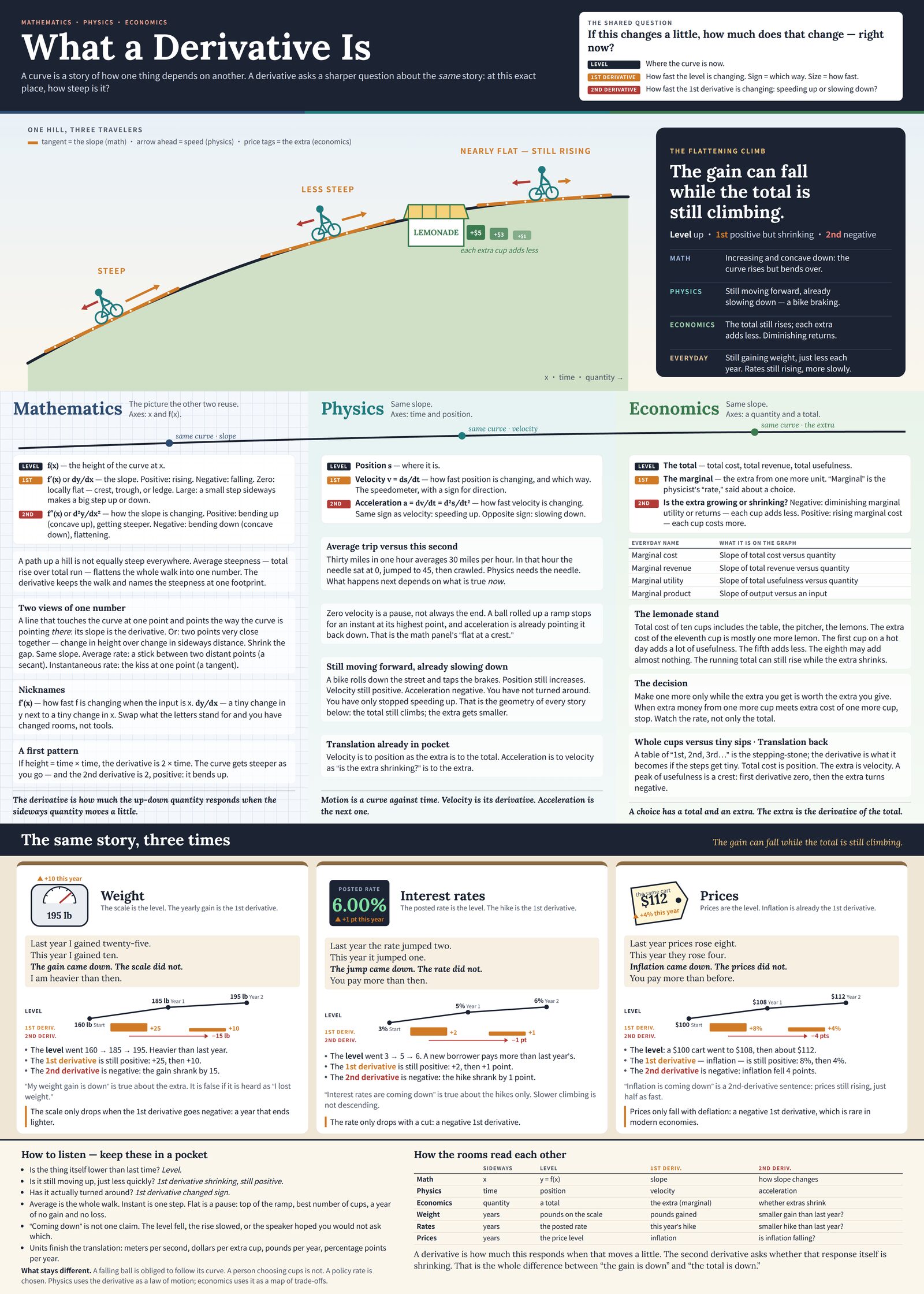
One idea seen three ways: the derivative as slope in math, as velocity in physics, and as the margin in economics.
🔗 Own page, to share or bookmark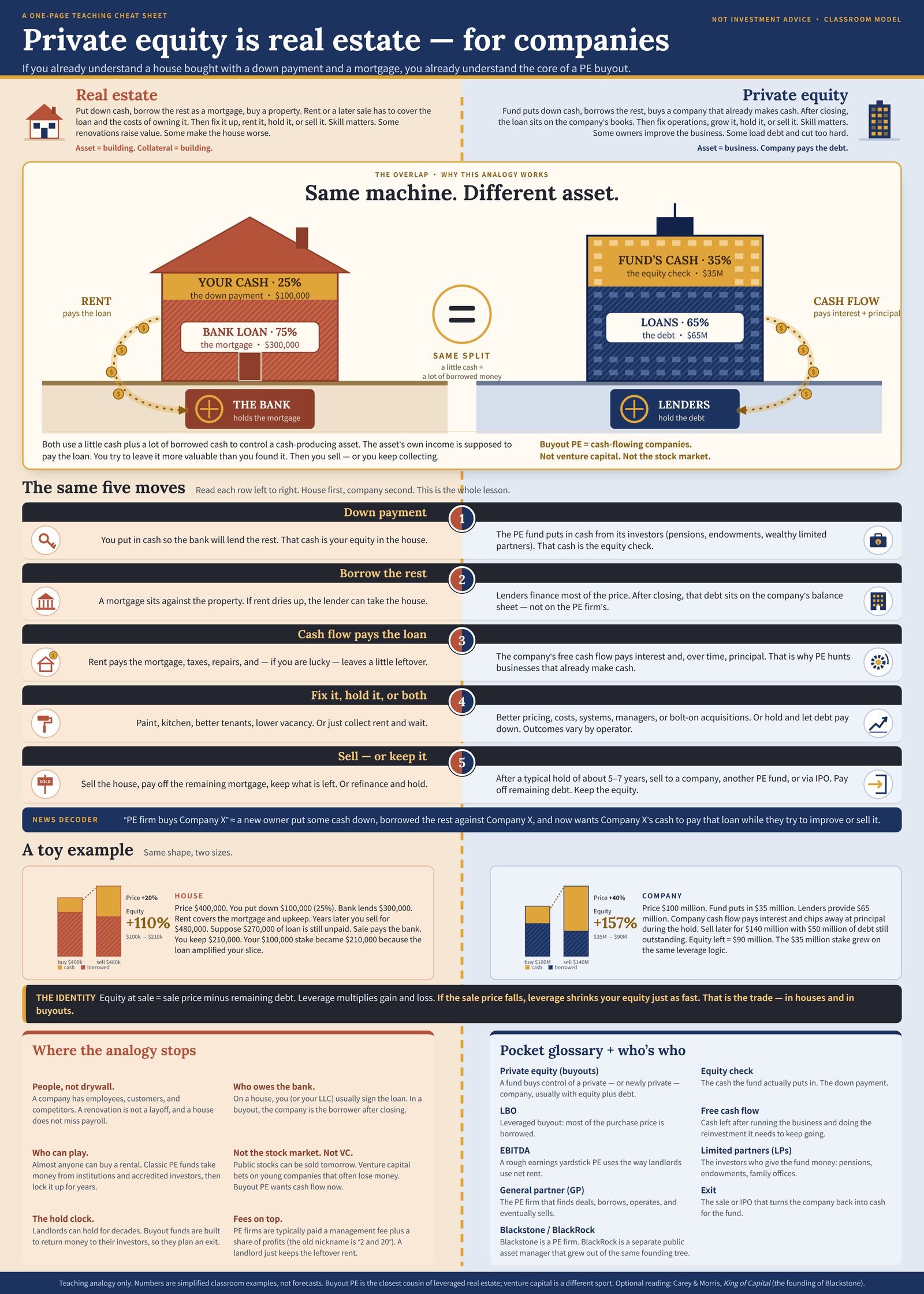
Explains a private equity buyout through something familiar: buying a rental house with a down payment and a mortgage. A teaching model, not investment advice.
🔗 Own page, to share or bookmark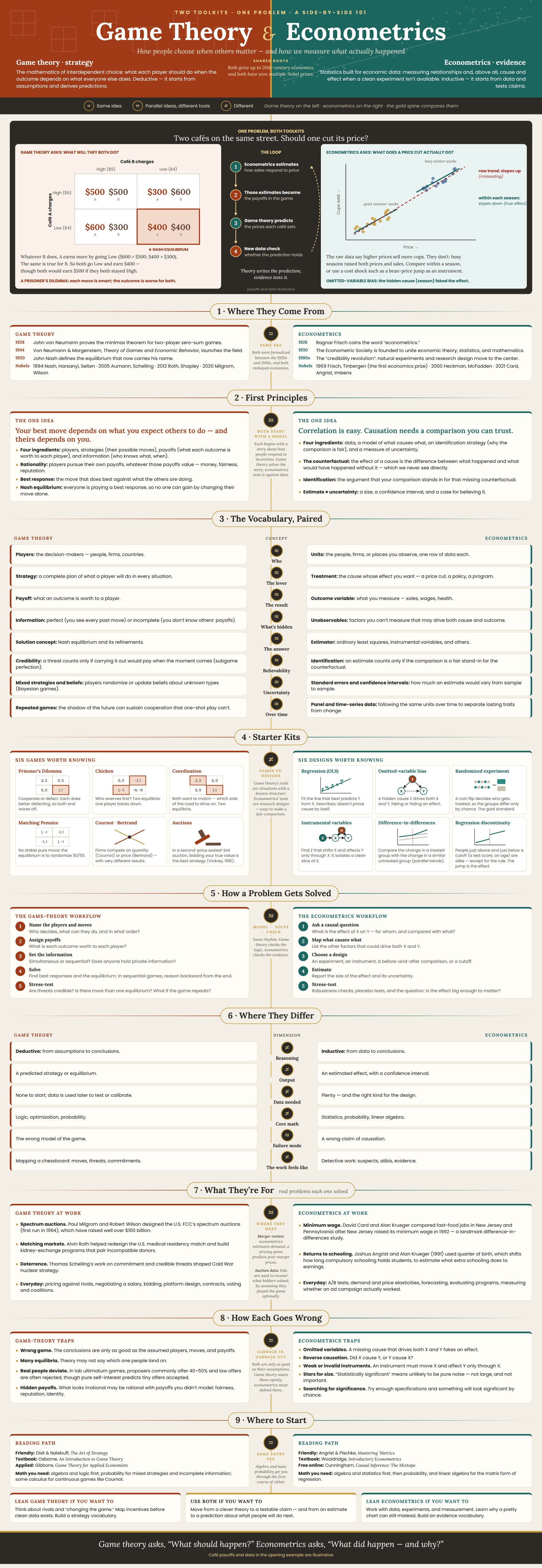
Game theory and econometrics side by side: how people choose when others' choices matter, and how economists measure what actually happened.
🔗 Own page, to share or bookmark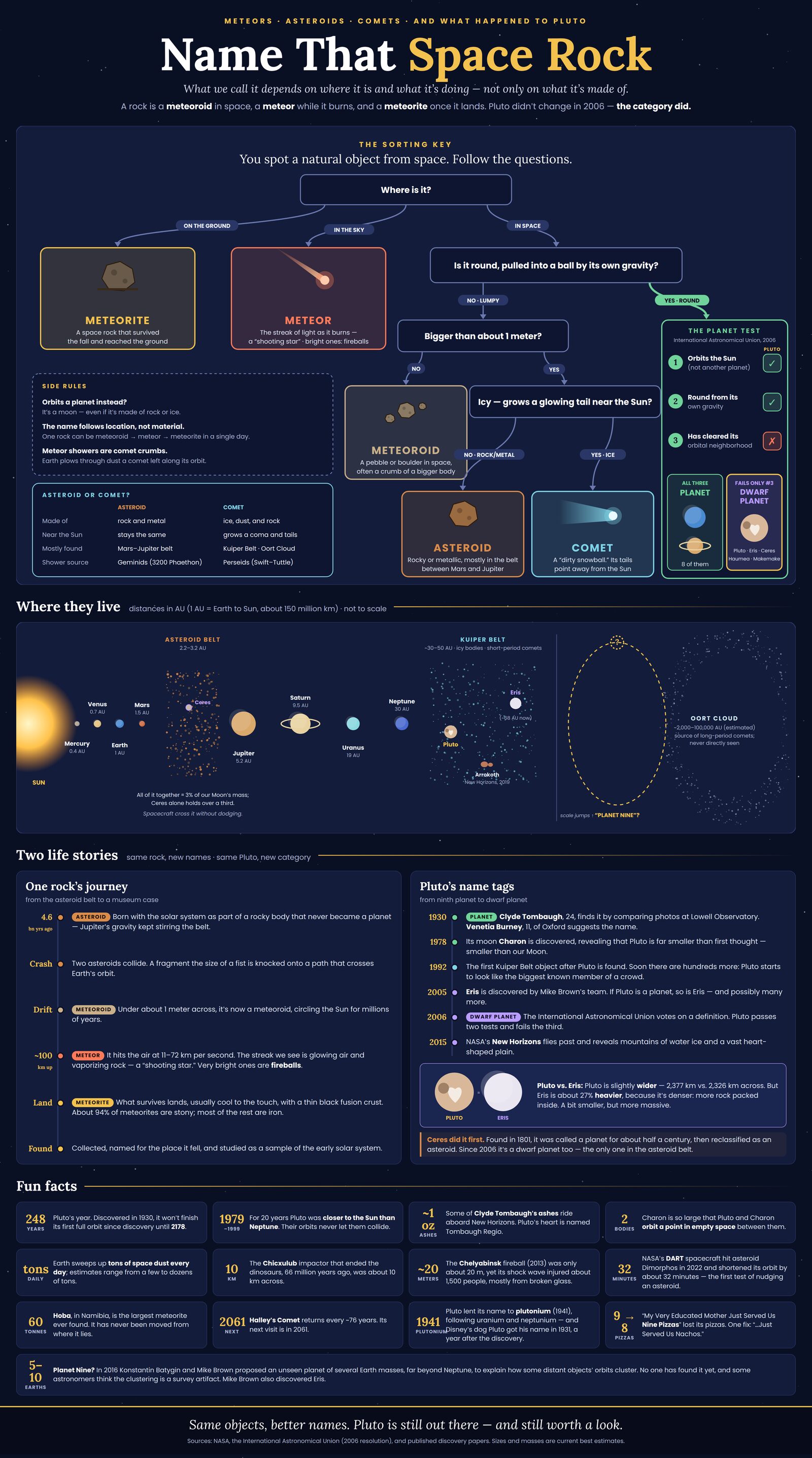
A sorting key for meteors, meteorites, asteroids, comets and planets, including why Pluto's category changed in 2006.
🔗 Own page, to share or bookmarkGreat Books reader’s maps
188 one-page maps, one for every work on the Great Books Ladder. Each is a no-spoilers sheet to keep beside the book: who’s who, how the work is built, where you are, and what the first readers already knew.
The Greeks 32 maps · the rungs →
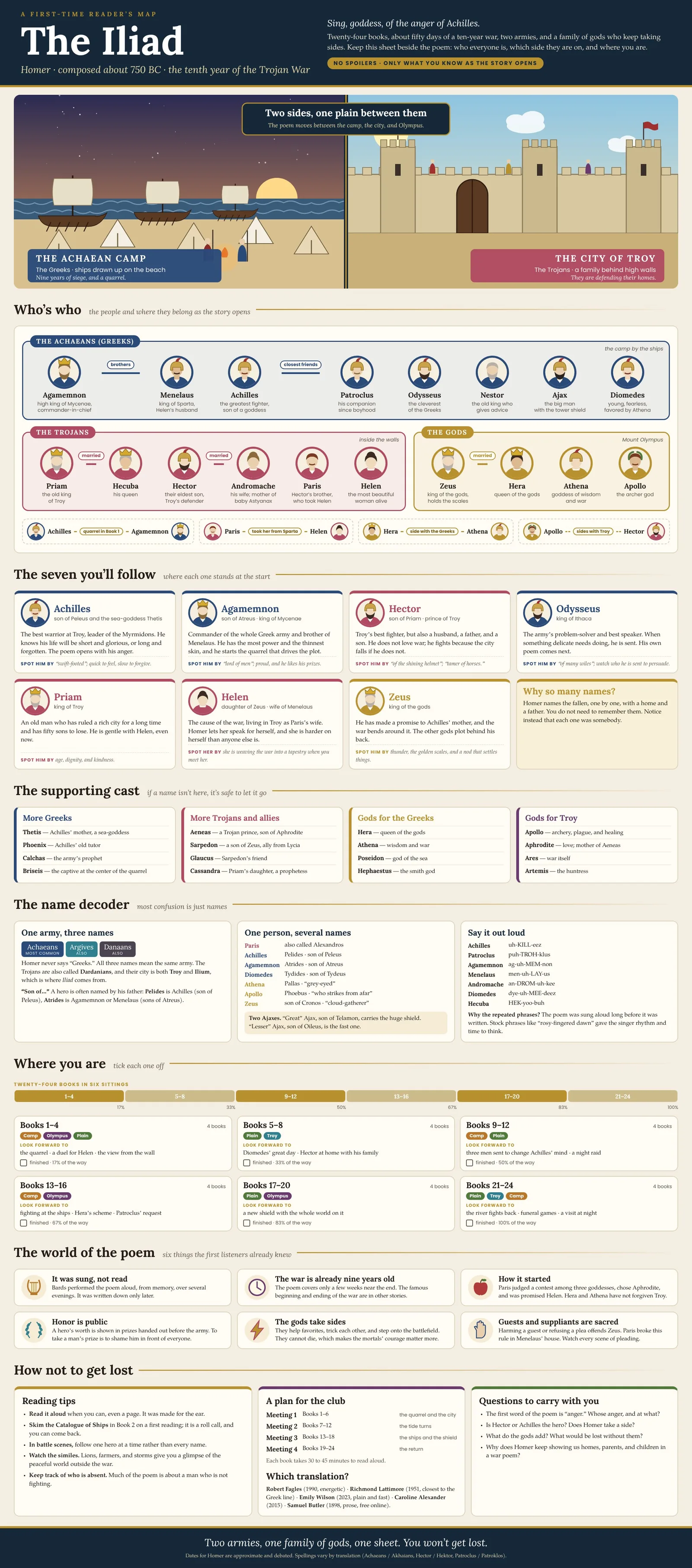
Twenty-four books, about fifty days of a ten-year war, two armies, and a family of gods who keep taking sides. Keep this sheet beside the poem: who everyone is, which side they are on, and where you are.
✨ Open this rung of the Great Books Ladder → 🔗 Own page, to share or bookmark 📚 The Iliad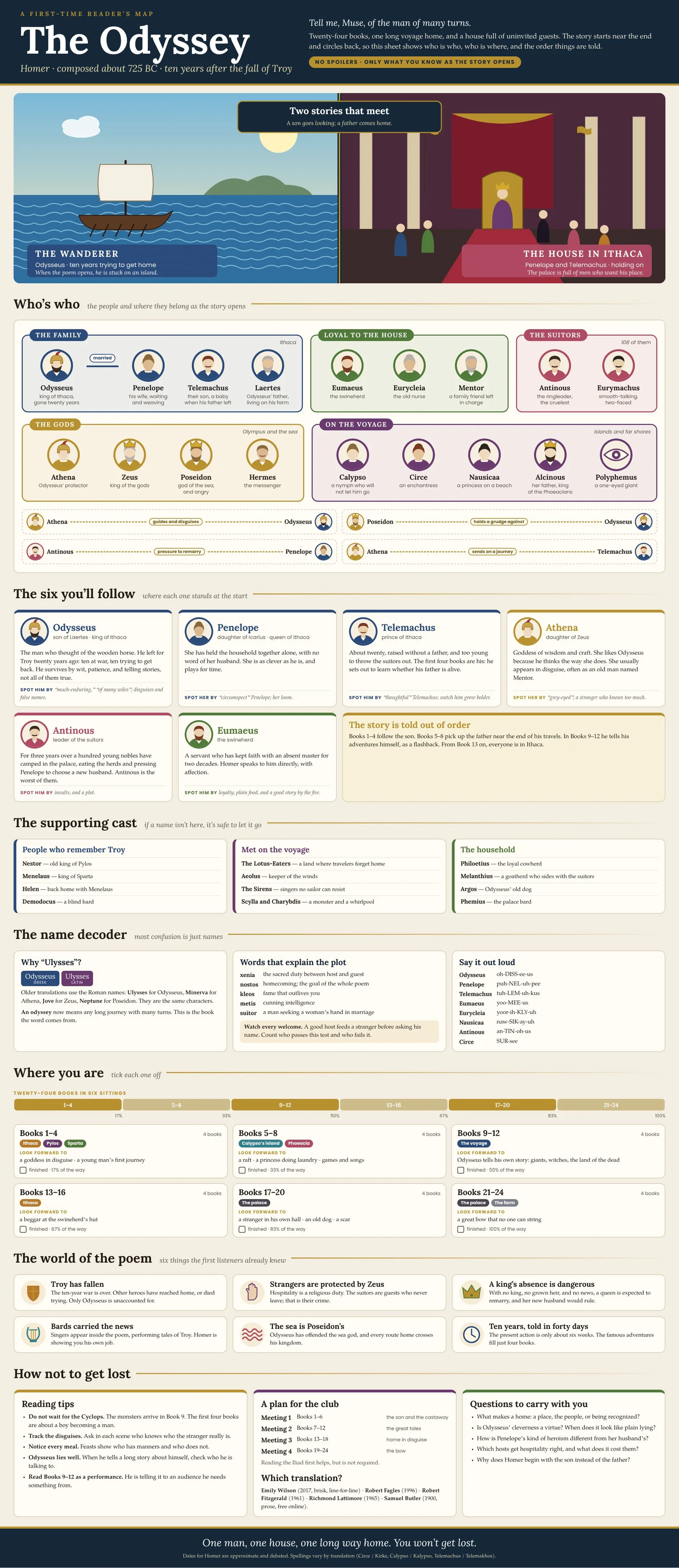
Twenty-four books, one long voyage home, and a house full of uninvited guests. The story starts near the end and circles back, so this sheet shows who is who, who is where, and the order things are told.
✨ Open this rung of the Great Books Ladder → 🔗 Own page, to share or bookmark 📚 The Odyssey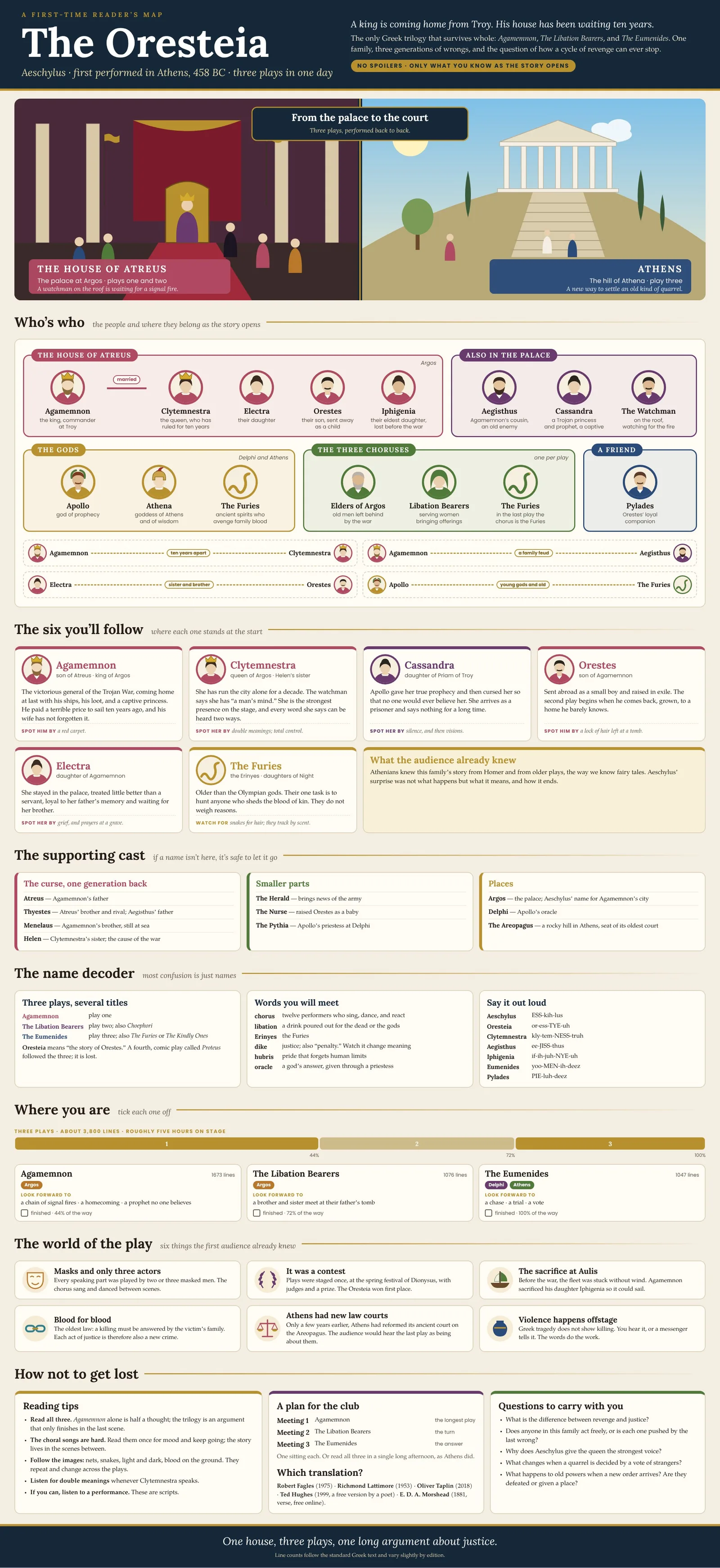
The only Greek trilogy that survives whole: Agamemnon, The Libation Bearers, and The Eumenides. One family, three generations of wrongs, and the question of how a cycle of revenge can ever stop.
✨ Open this rung of the Great Books Ladder → 🔗 Own page, to share or bookmark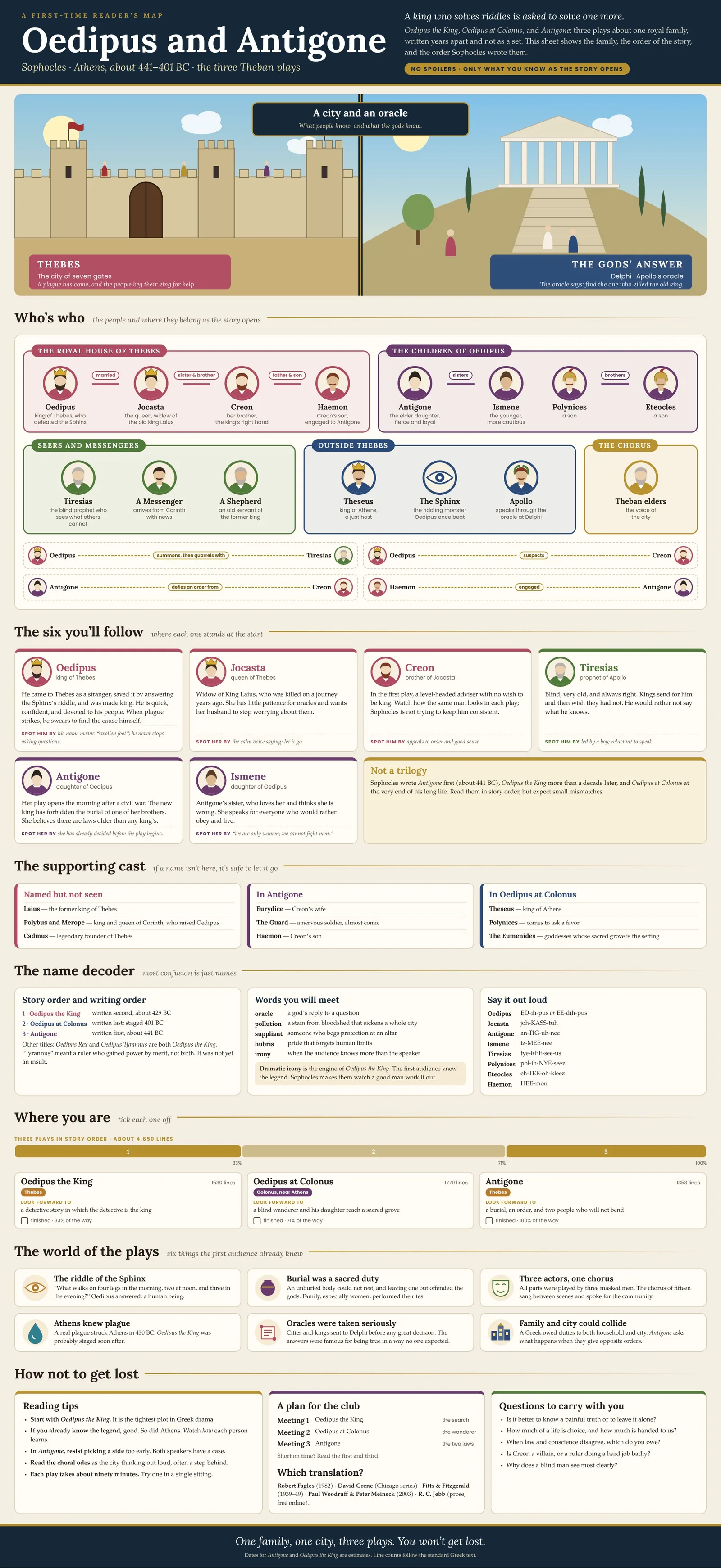
Oedipus the King, Oedipus at Colonus, and Antigone: three plays about one royal family, written years apart and not as a set. This sheet shows the family, the order of the story, and the order Sophocles wrote them.
✨ Open this rung of the Great Books Ladder → 🔗 Own page, to share or bookmark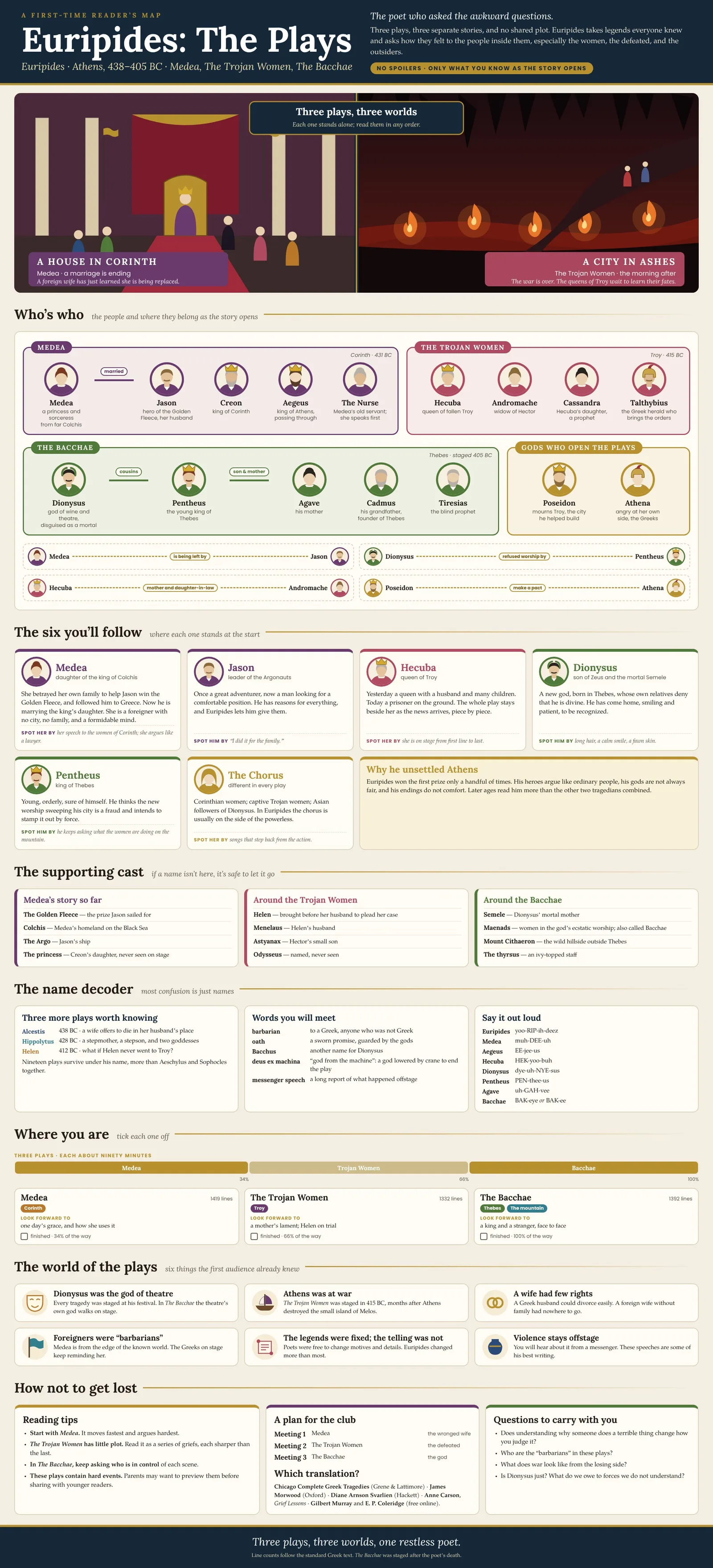
Three plays, three separate stories, and no shared plot. Euripides takes legends everyone knew and asks how they felt to the people inside them, especially the women, the defeated, and the outsiders.
✨ Open this rung of the Great Books Ladder → 🔗 Own page, to share or bookmark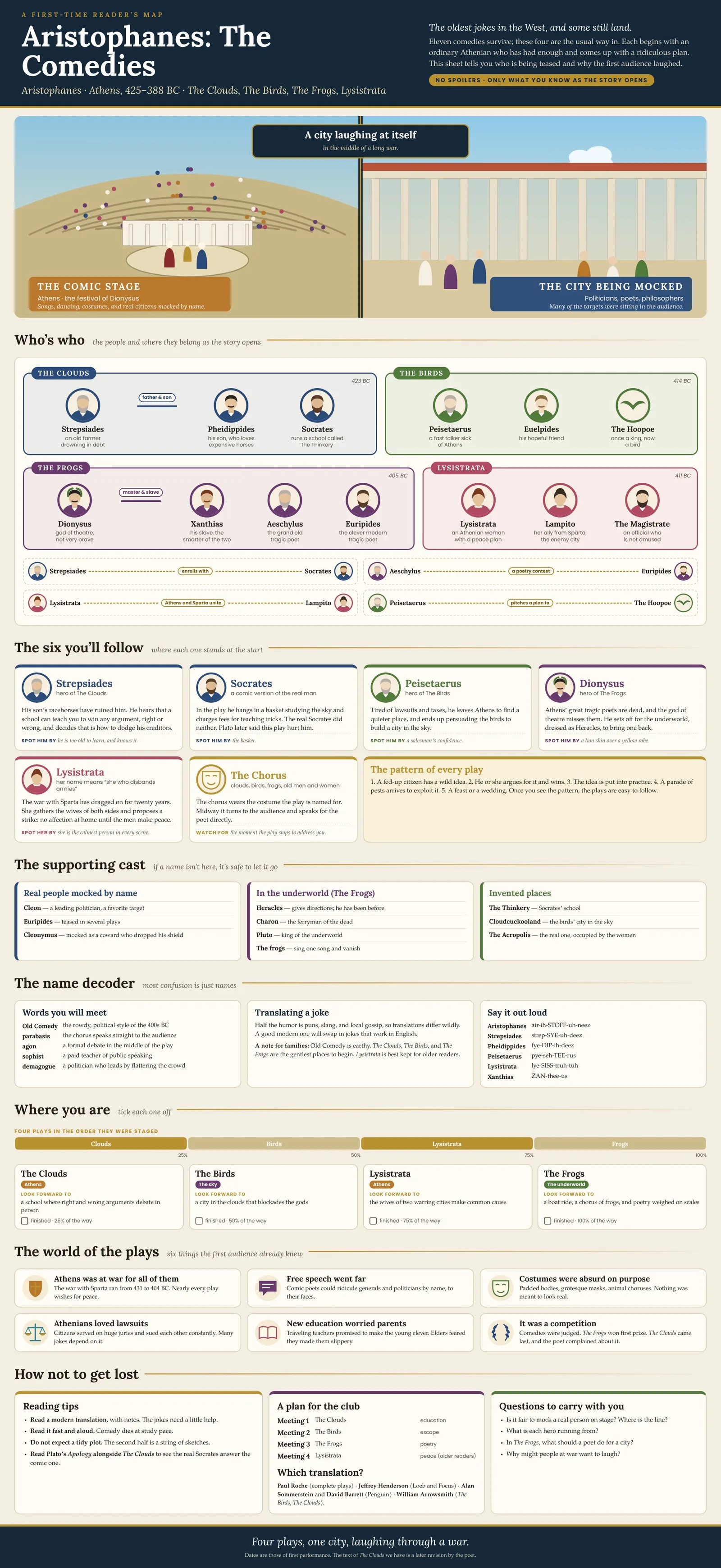
Eleven comedies survive; these four are the usual way in. Each begins with an ordinary Athenian who has had enough and comes up with a ridiculous plan. This sheet tells you who is being teased and why the first audience laughed.
✨ Open this rung of the Great Books Ladder → 🔗 Own page, to share or bookmark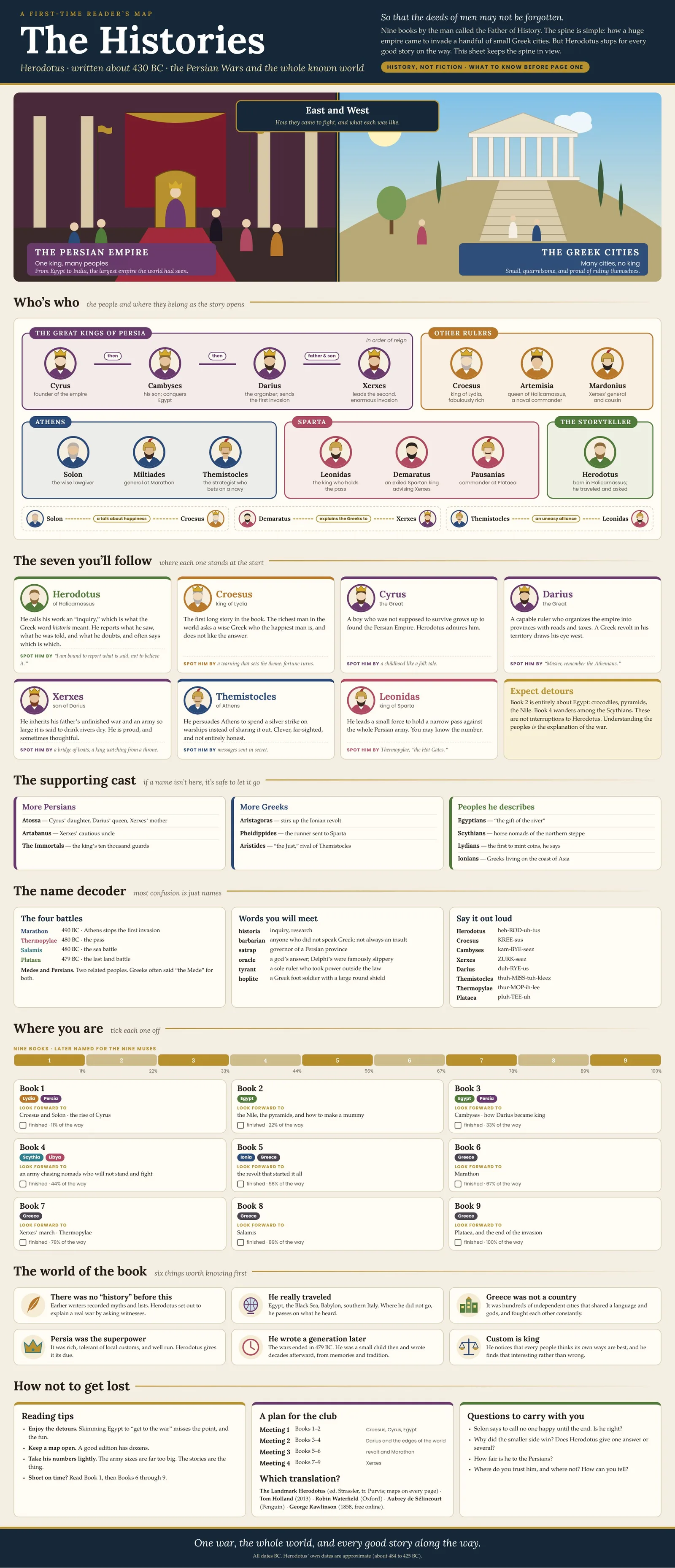
Nine books by the man called the Father of History. The spine is simple: how a huge empire came to invade a handful of small Greek cities. But Herodotus stops for every good story on the way. This sheet keeps the spine in view.
✨ Open this rung of the Great Books Ladder → 🔗 Own page, to share or bookmark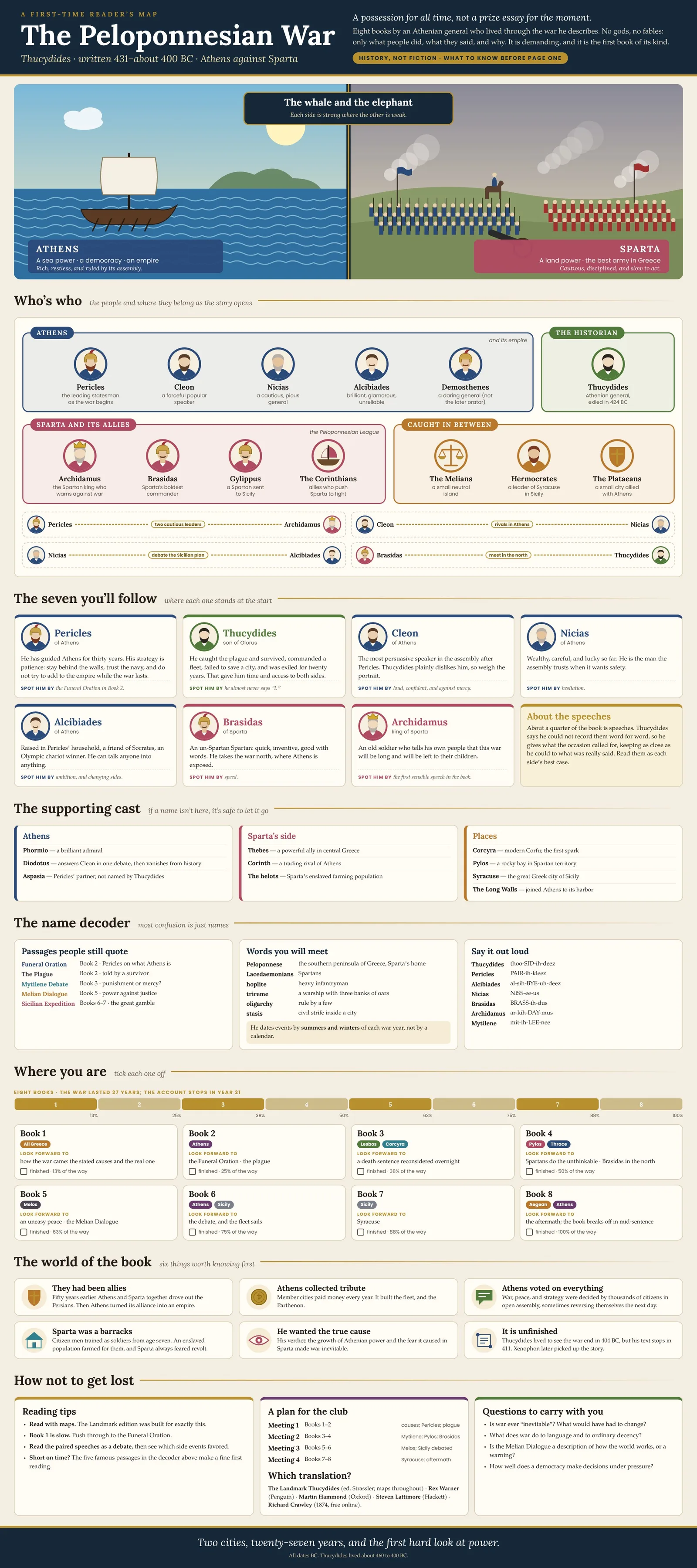
Eight books by an Athenian general who lived through the war he describes. No gods, no fables: only what people did, what they said, and why. It is demanding, and it is the first book of its kind.
✨ Open this rung of the Great Books Ladder → 🔗 Own page, to share or bookmark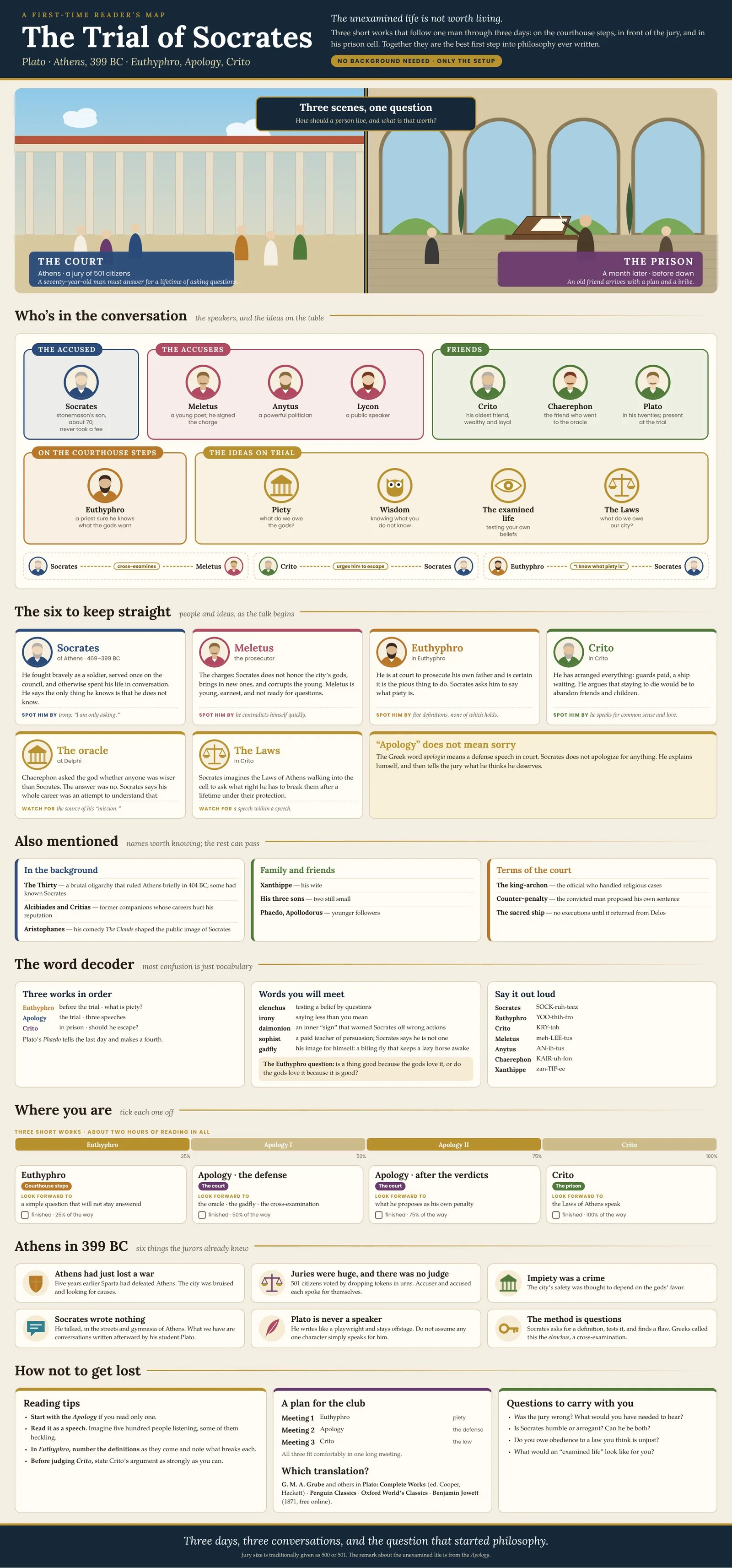
Three short works that follow one man through three days: on the courthouse steps, in front of the jury, and in his prison cell. Together they are the best first step into philosophy ever written.
✨ Open this rung of the Great Books Ladder → 🔗 Own page, to share or bookmark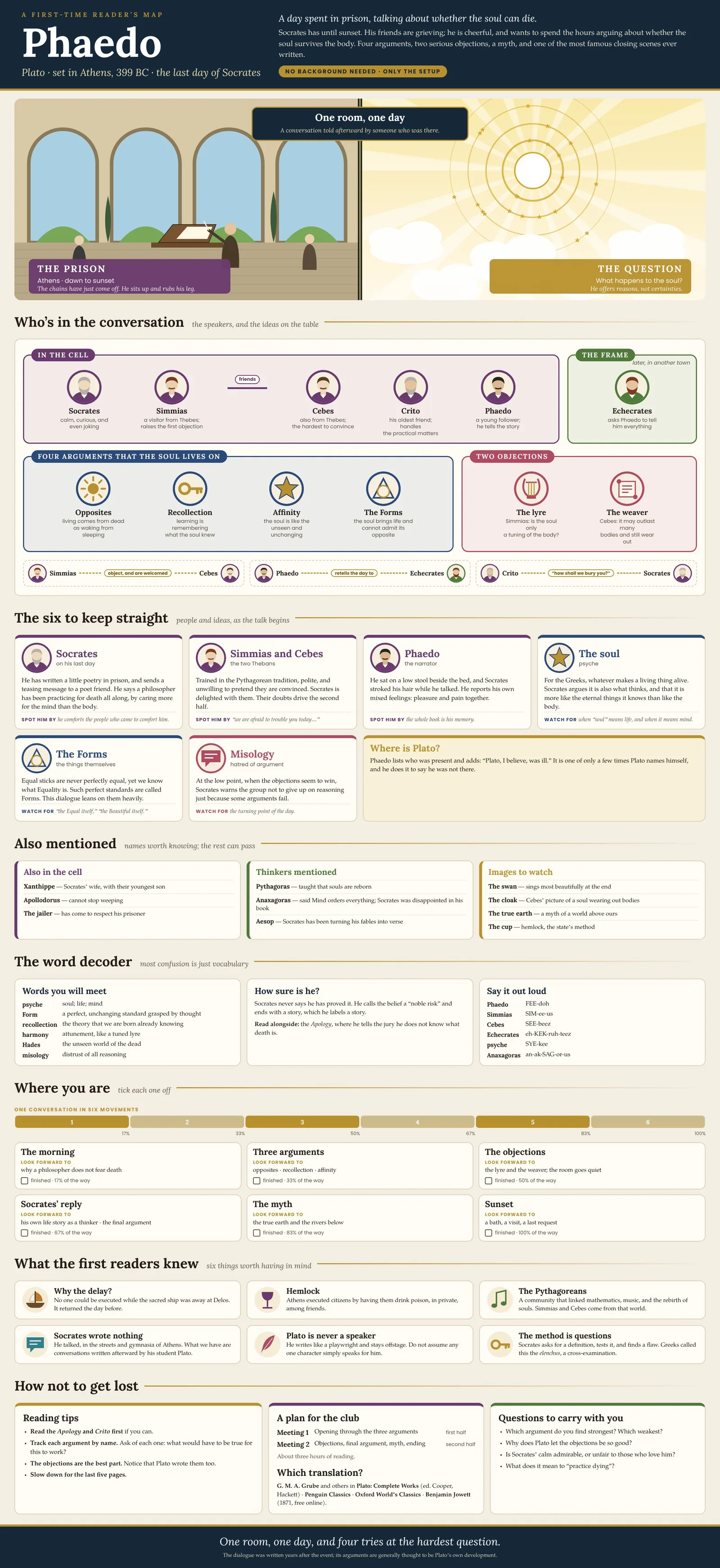
Socrates has until sunset. His friends are grieving; he is cheerful, and wants to spend the hours arguing about whether the soul survives the body. Four arguments, two serious objections, a myth, and one of the most famous closing scenes ever written.
✨ Open this rung of the Great Books Ladder → 🔗 Own page, to share or bookmark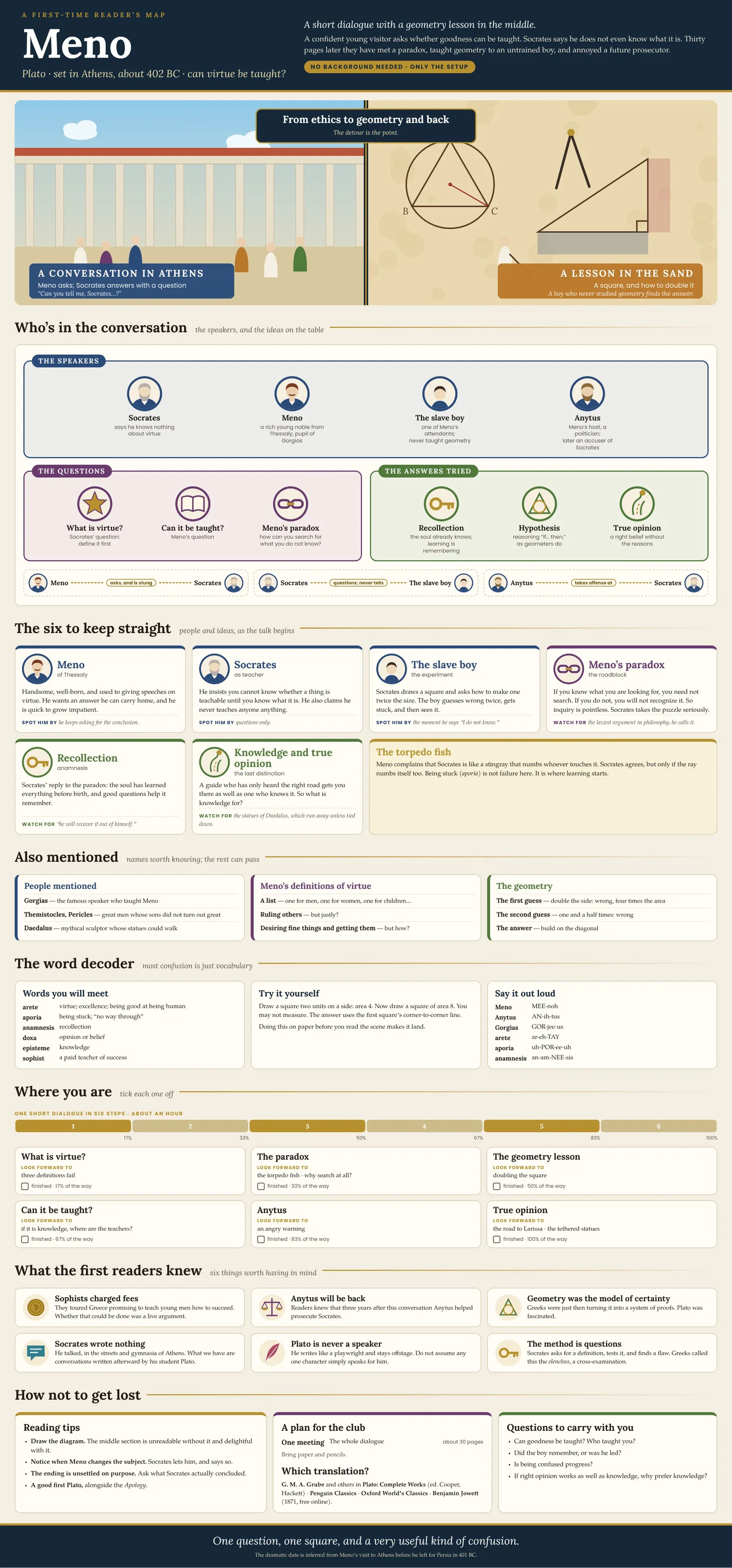
A confident young visitor asks whether goodness can be taught. Socrates says he does not even know what it is. Thirty pages later they have met a paradox, taught geometry to an untrained boy, and annoyed a future prosecutor.
✨ Open this rung of the Great Books Ladder → 🔗 Own page, to share or bookmark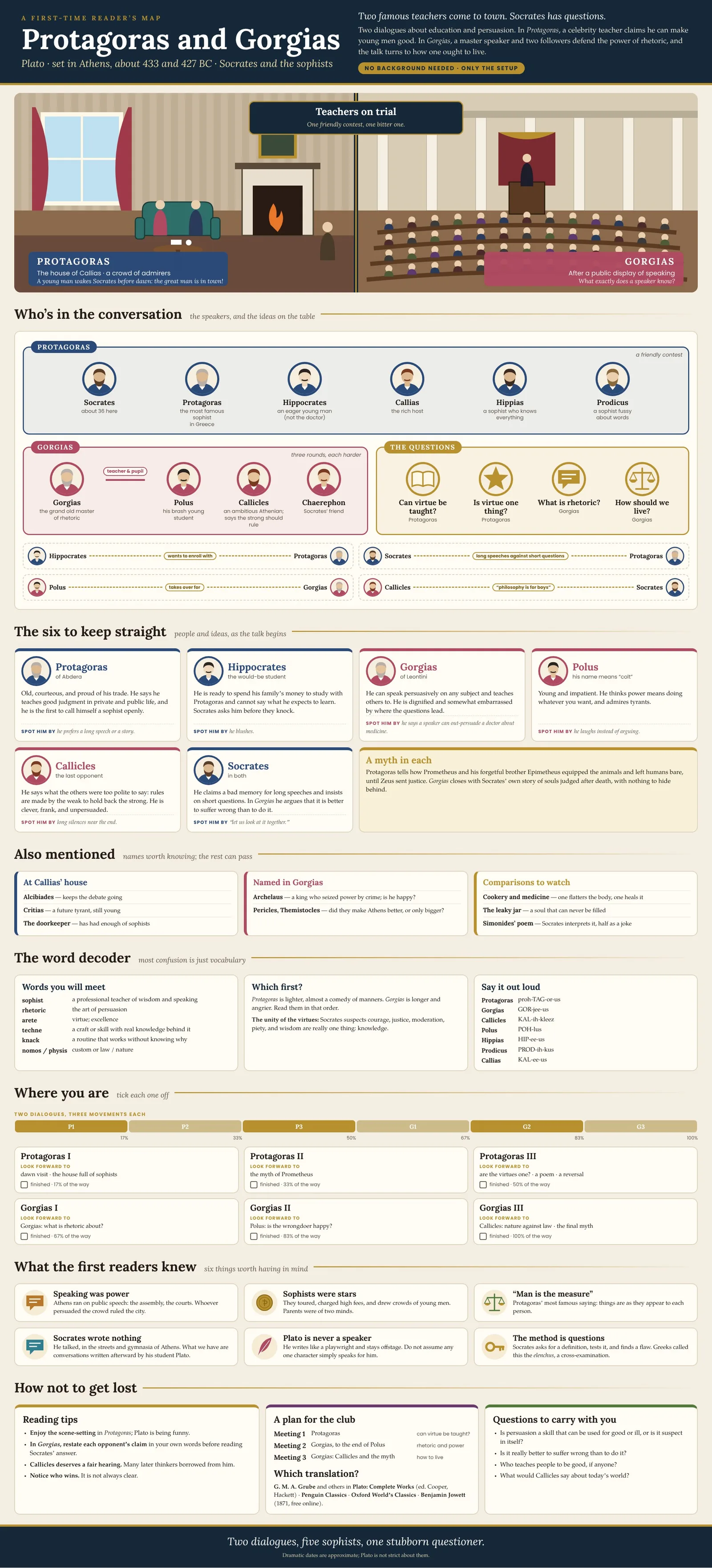
Two dialogues about education and persuasion. In Protagoras, a celebrity teacher claims he can make young men good. In Gorgias, a master speaker and two followers defend the power of rhetoric, and the talk turns to how one ought to live.
✨ Open this rung of the Great Books Ladder → 🔗 Own page, to share or bookmark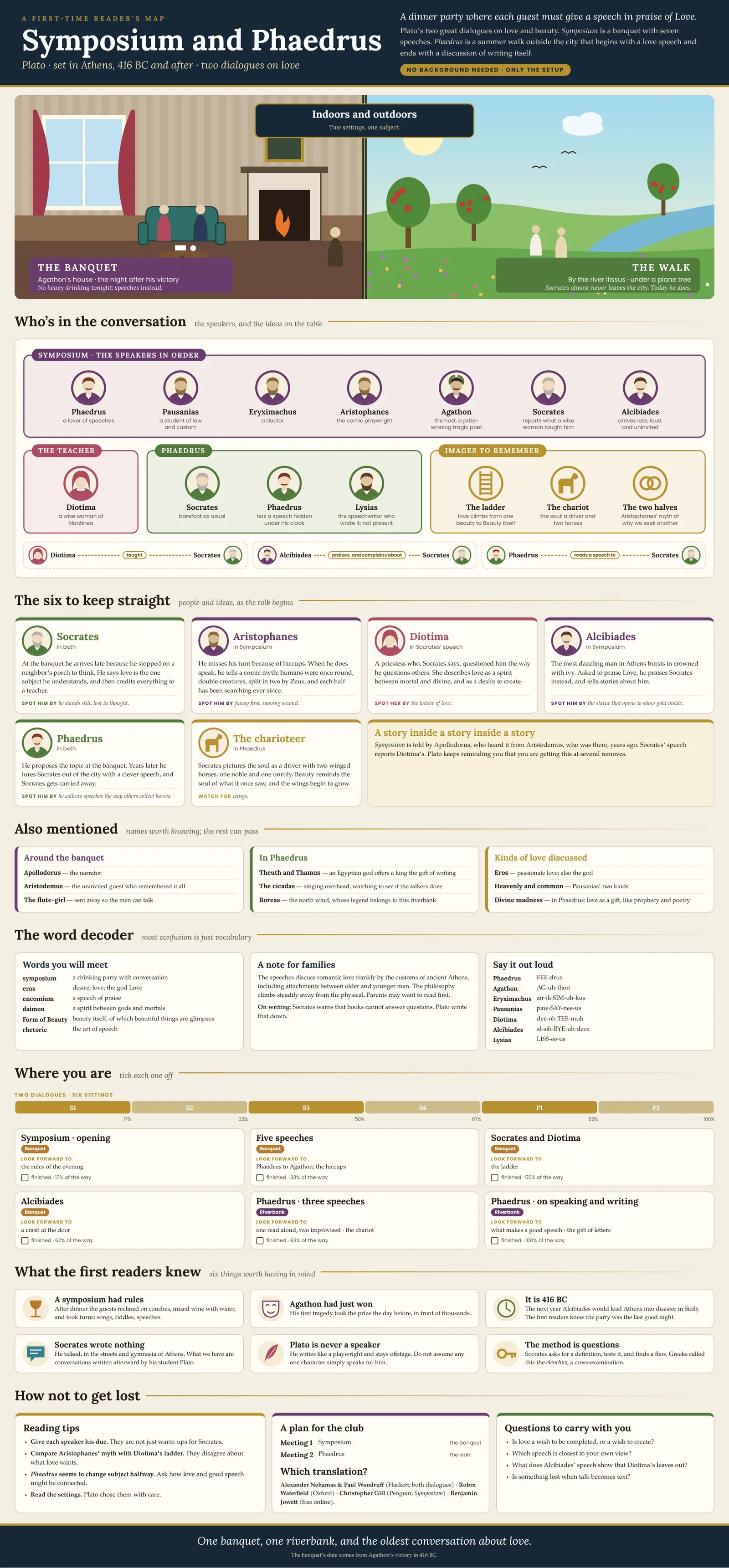
Plato’s two great dialogues on love and beauty. Symposium is a banquet with seven speeches. Phaedrus is a summer walk outside the city that begins with a love speech and ends with a discussion of writing itself.
✨ Open this rung of the Great Books Ladder → 🔗 Own page, to share or bookmark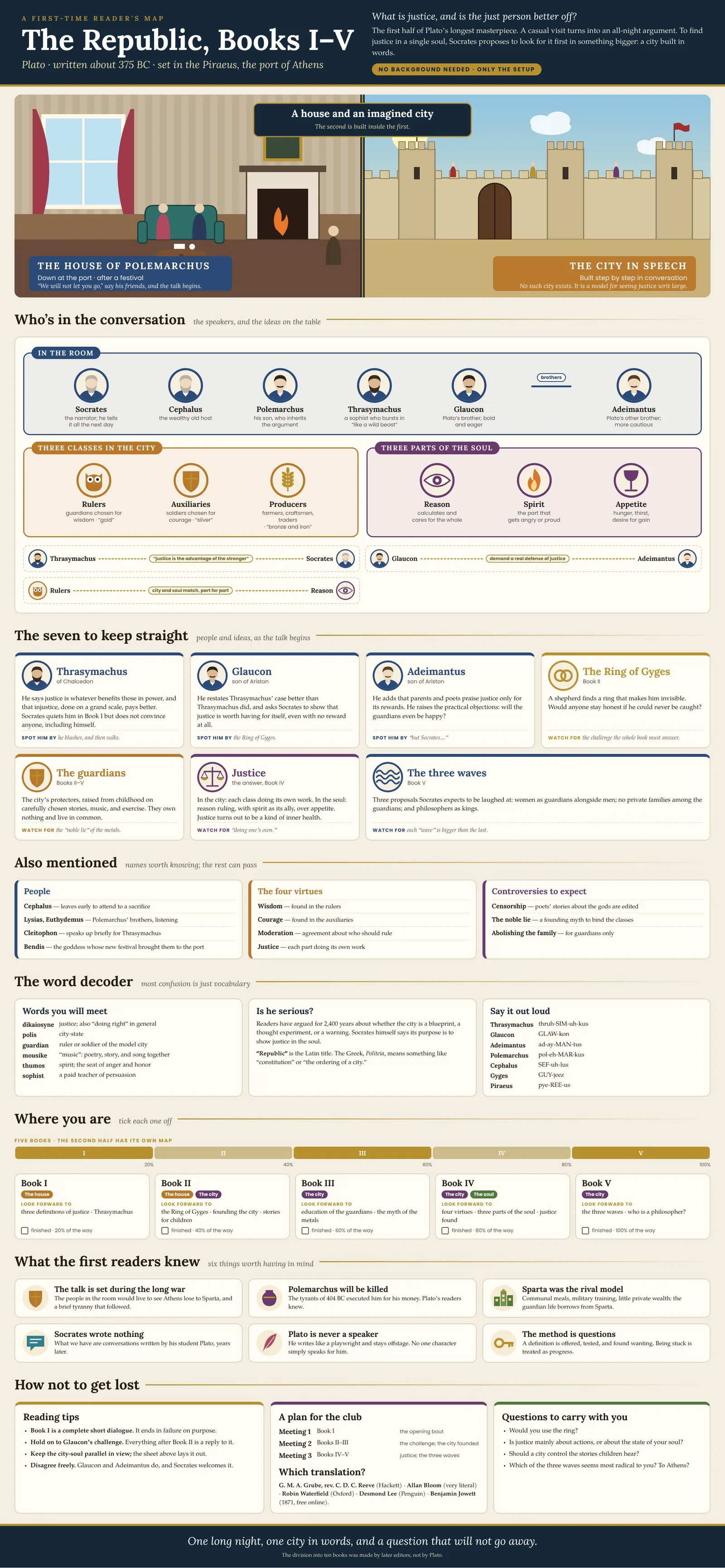
The first half of Plato’s longest masterpiece. A casual visit turns into an all-night argument. To find justice in a single soul, Socrates proposes to look for it first in something bigger: a city built in words.
✨ Open this rung of the Great Books Ladder → 🔗 Own page, to share or bookmark 📚 The Republic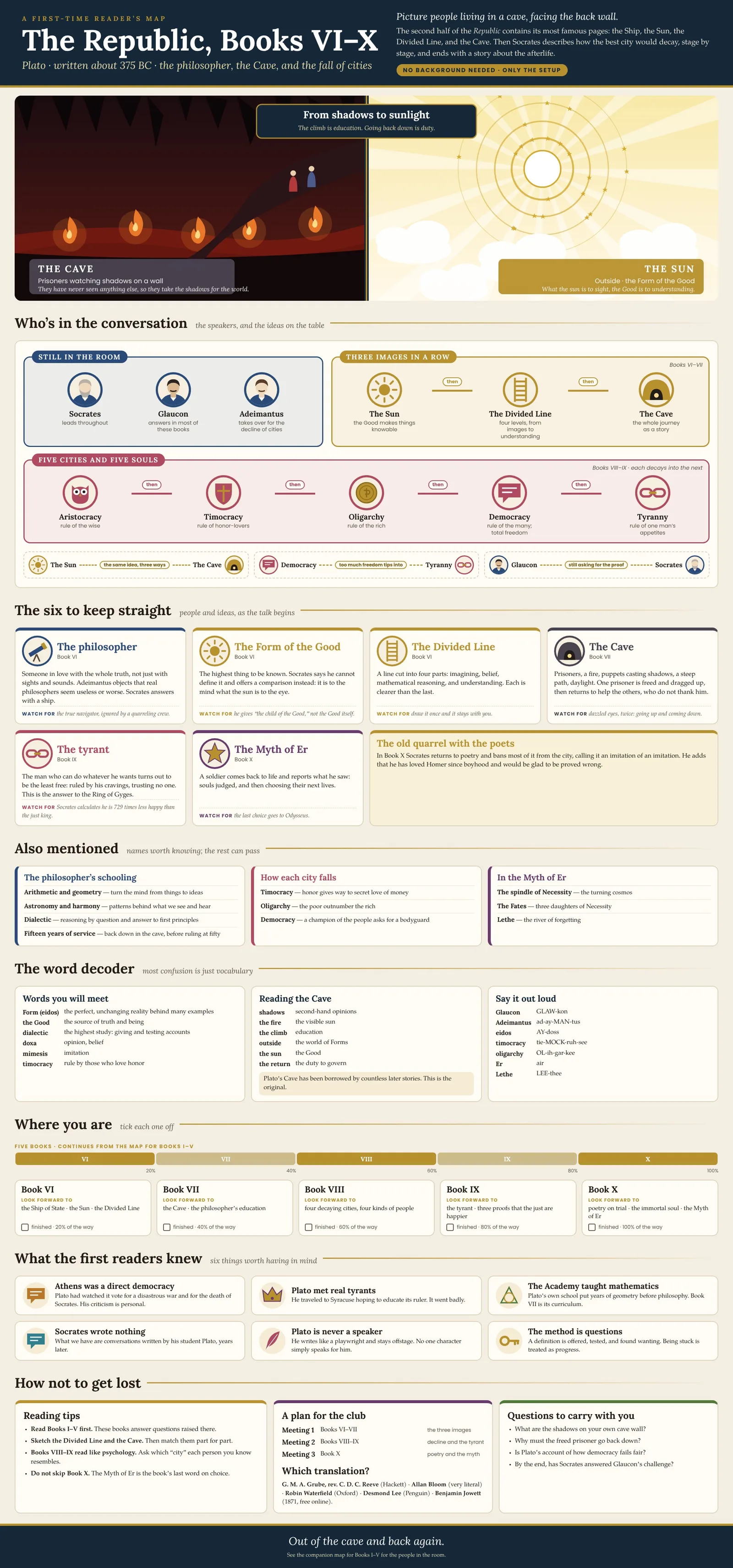
The second half of the Republic contains its most famous pages: the Ship, the Sun, the Divided Line, and the Cave. Then Socrates describes how the best city would decay, stage by stage, and ends with a story about the afterlife.
✨ Open this rung of the Great Books Ladder → 🔗 Own page, to share or bookmark 📚 The Republic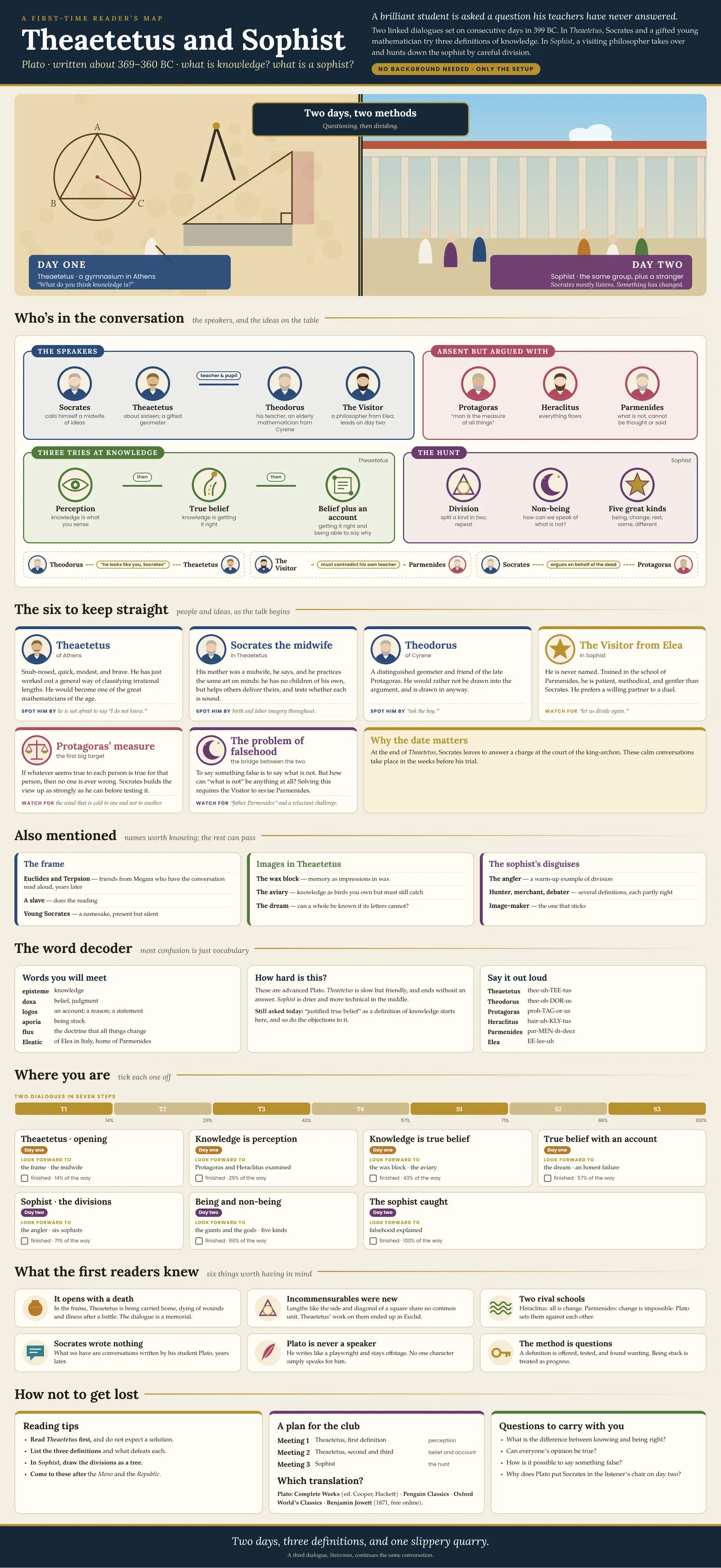
Two linked dialogues set on consecutive days in 399 BC. In Theaetetus, Socrates and a gifted young mathematician try three definitions of knowledge. In Sophist, a visiting philosopher takes over and hunts down the sophist by careful division.
✨ Open this rung of the Great Books Ladder → 🔗 Own page, to share or bookmark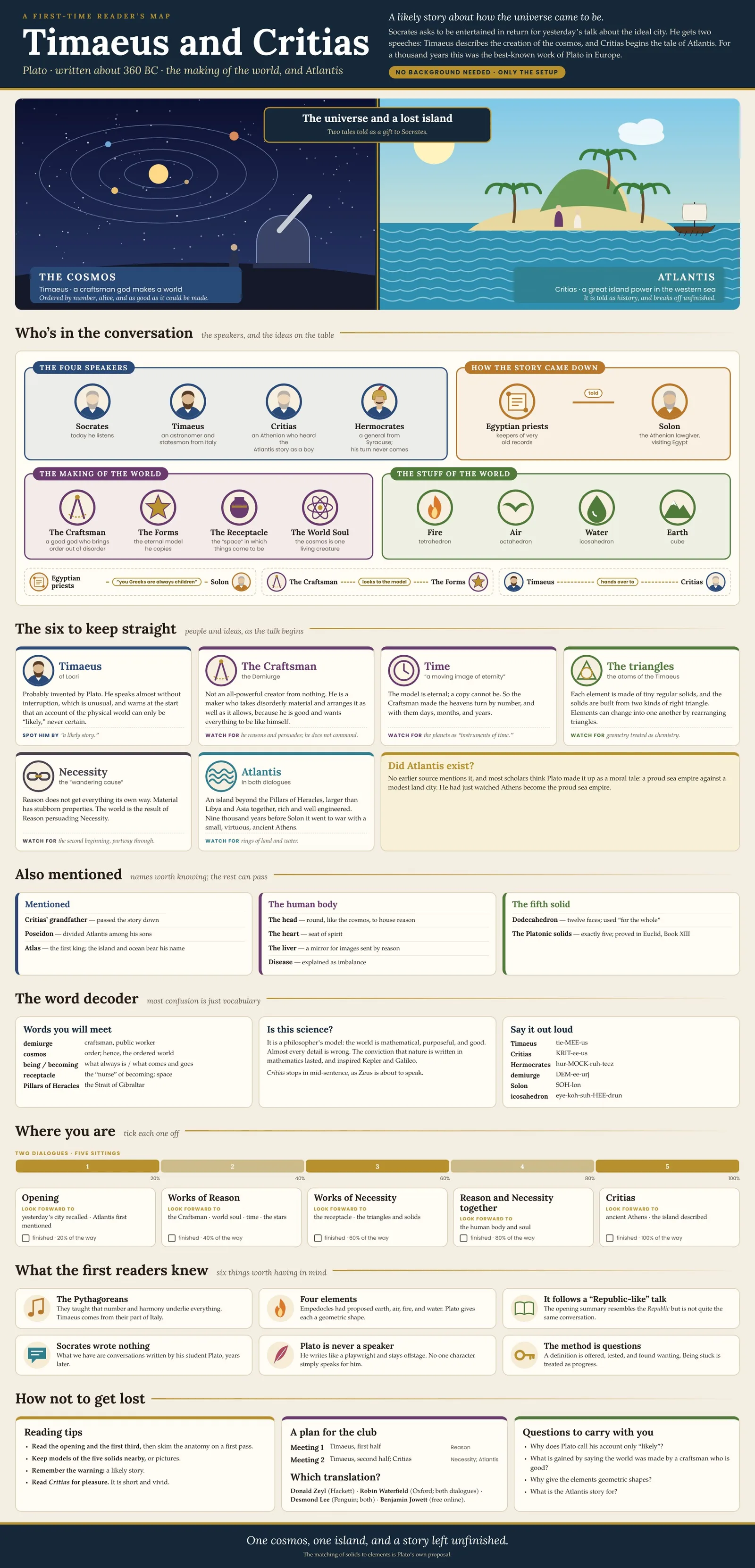
Socrates asks to be entertained in return for yesterday’s talk about the ideal city. He gets two speeches: Timaeus describes the creation of the cosmos, and Critias begins the tale of Atlantis. For a thousand years this was the best-known work of Plato in Europe.
✨ Open this rung of the Great Books Ladder → 🔗 Own page, to share or bookmark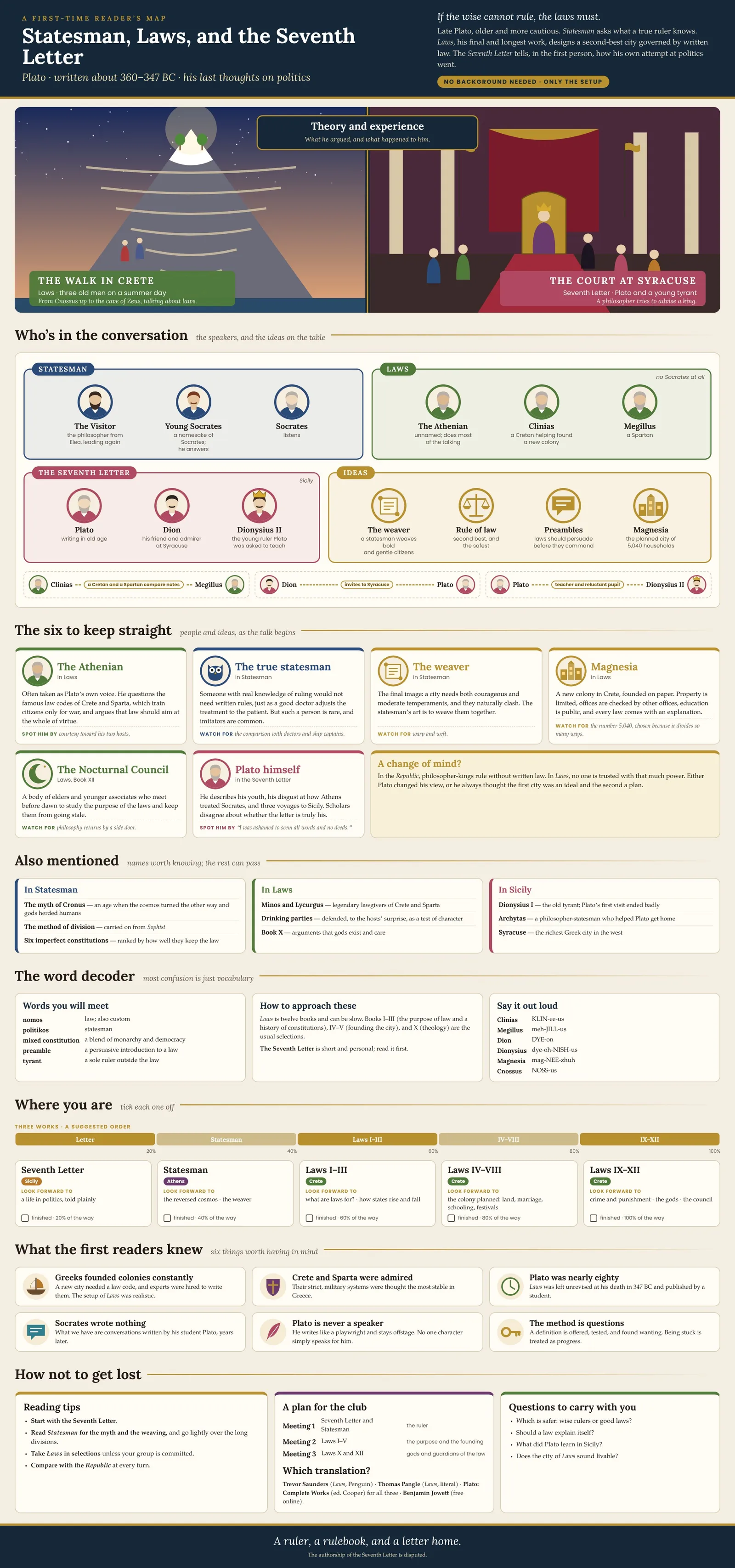
Late Plato, older and more cautious. Statesman asks what a true ruler knows. Laws, his final and longest work, designs a second-best city governed by written law. The Seventh Letter tells, in the first person, how his own attempt at politics went.
✨ Open this rung of the Great Books Ladder → 🔗 Own page, to share or bookmark 📚 On the Republic and On the Laws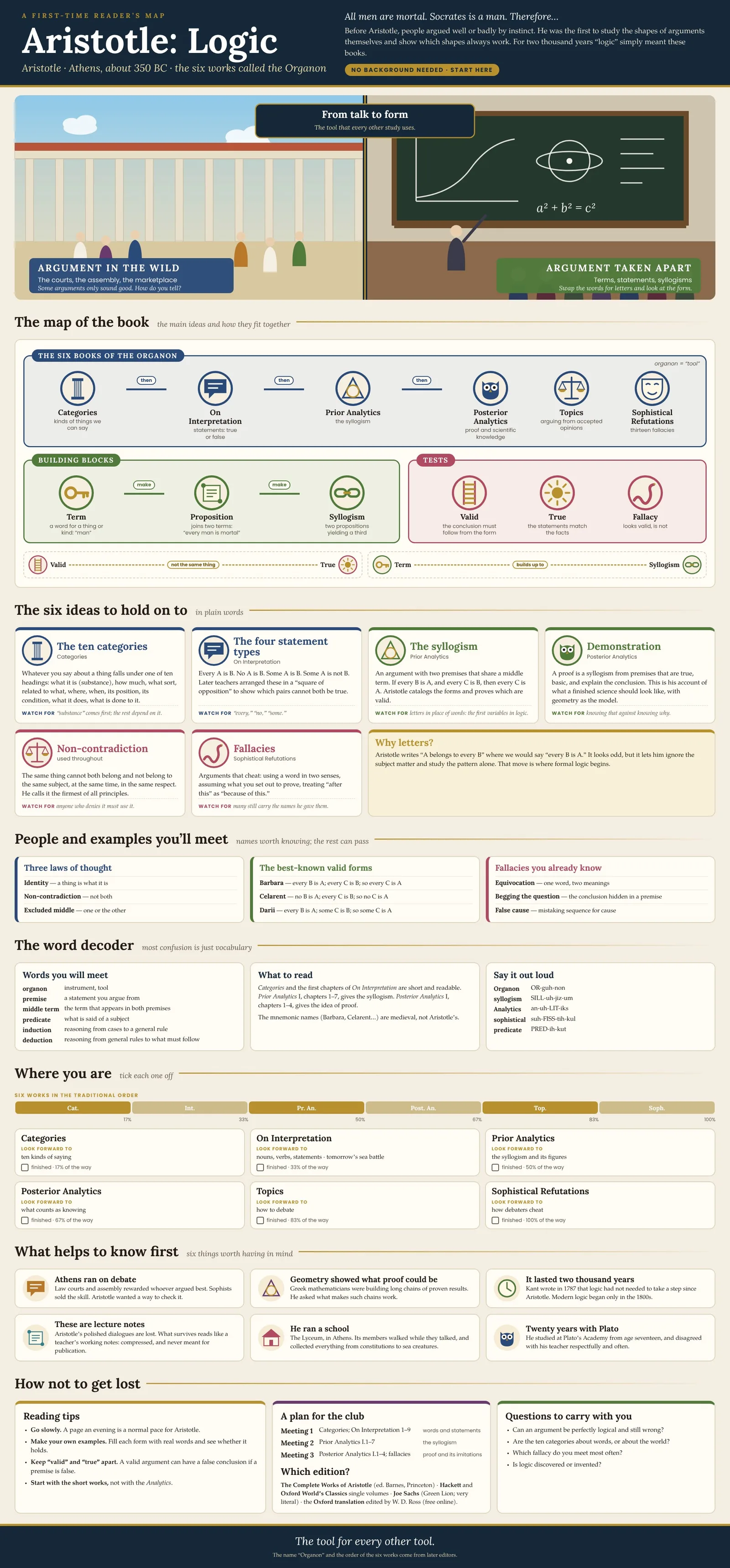
Before Aristotle, people argued well or badly by instinct. He was the first to study the shapes of arguments themselves and show which shapes always work. For two thousand years “logic” simply meant these books.
✨ Open this rung of the Great Books Ladder → 🔗 Own page, to share or bookmark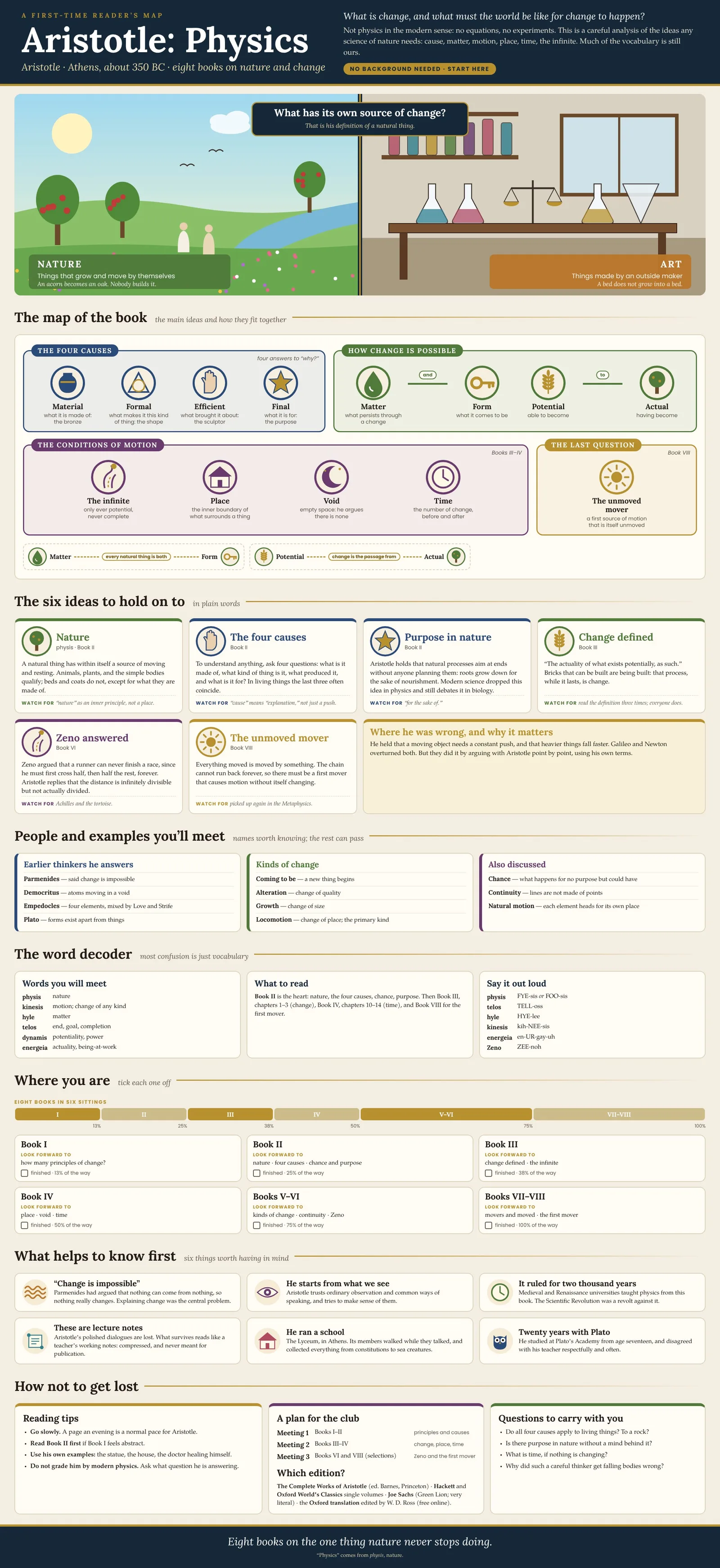
Not physics in the modern sense: no equations, no experiments. This is a careful analysis of the ideas any science of nature needs: cause, matter, motion, place, time, the infinite. Much of the vocabulary is still ours.
✨ Open this rung of the Great Books Ladder → 🔗 Own page, to share or bookmark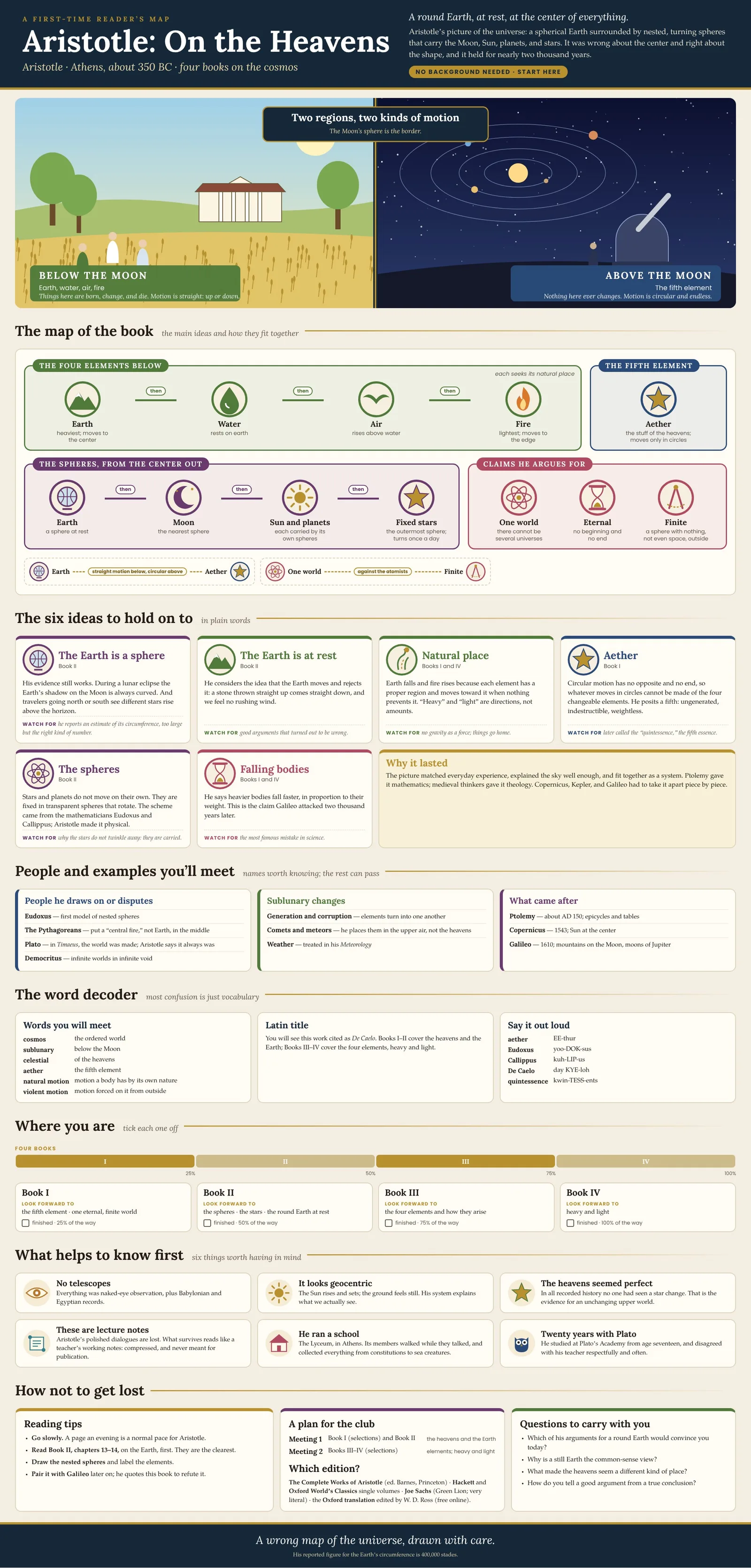
Aristotle’s picture of the universe: a spherical Earth surrounded by nested, turning spheres that carry the Moon, Sun, planets, and stars. It was wrong about the center and right about the shape, and it held for nearly two thousand years.
✨ Open this rung of the Great Books Ladder → 🔗 Own page, to share or bookmark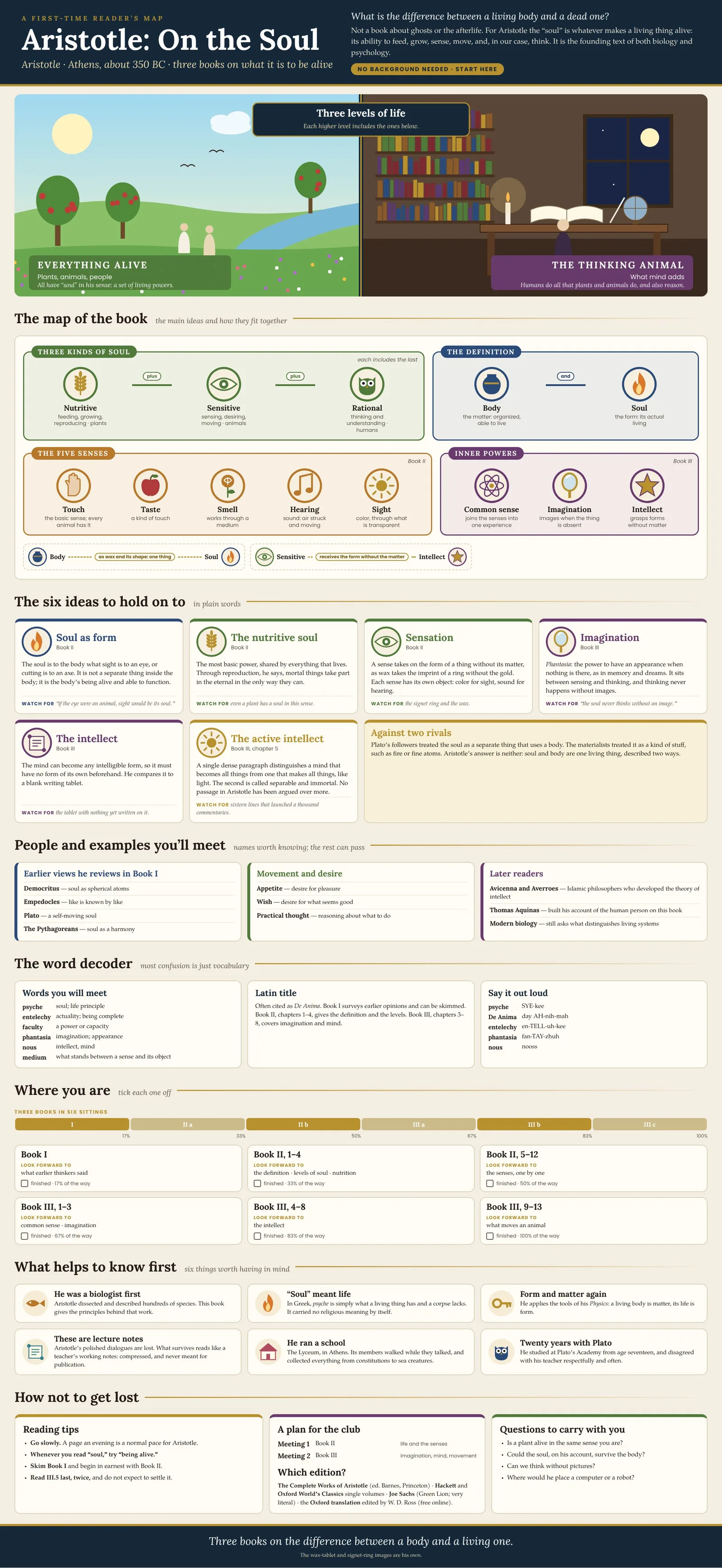
Not a book about ghosts or the afterlife. For Aristotle the “soul” is whatever makes a living thing alive: its ability to feed, grow, sense, move, and, in our case, think. It is the founding text of both biology and psychology.
✨ Open this rung of the Great Books Ladder → 🔗 Own page, to share or bookmark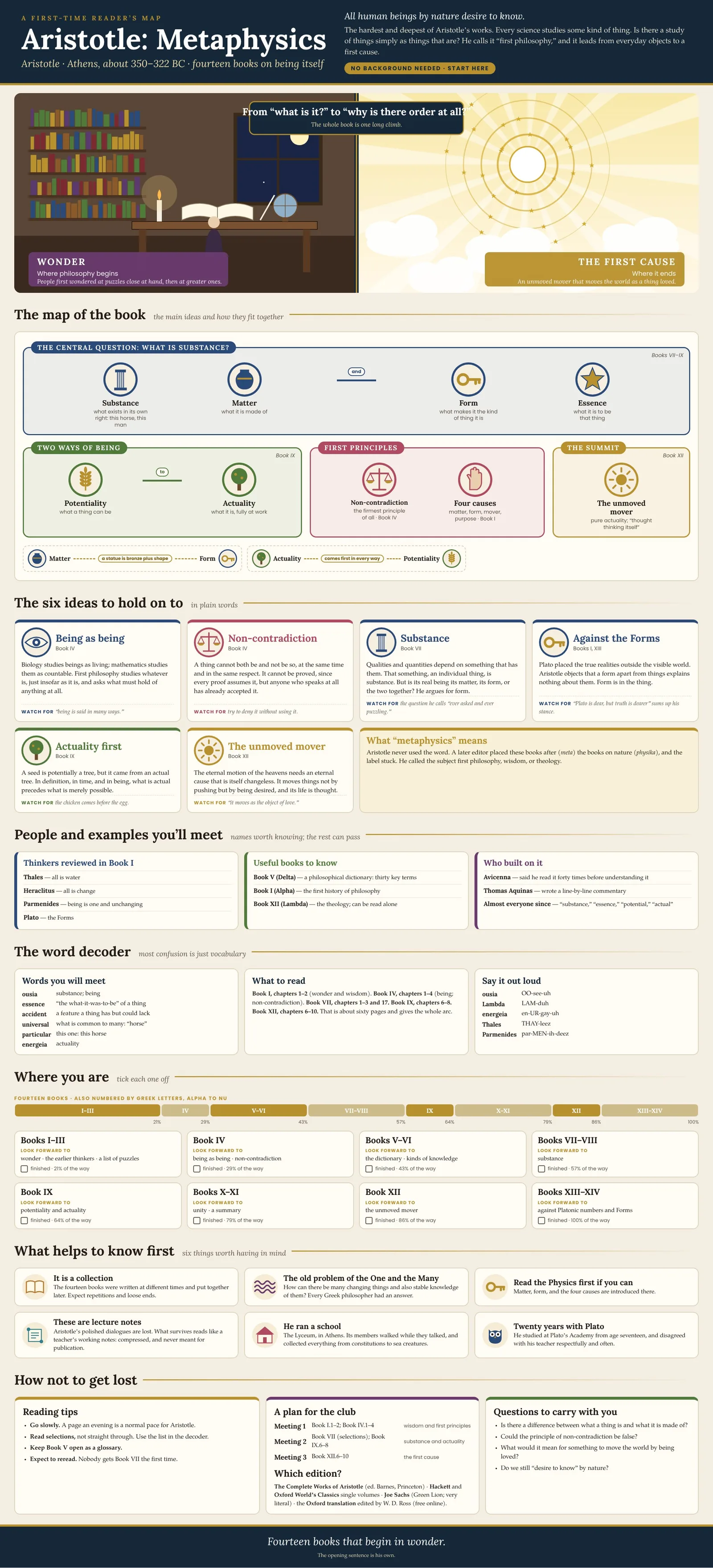
The hardest and deepest of Aristotle’s works. Every science studies some kind of thing. Is there a study of things simply as things that are? He calls it “first philosophy,” and it leads from everyday objects to a first cause.
✨ Open this rung of the Great Books Ladder → 🔗 Own page, to share or bookmark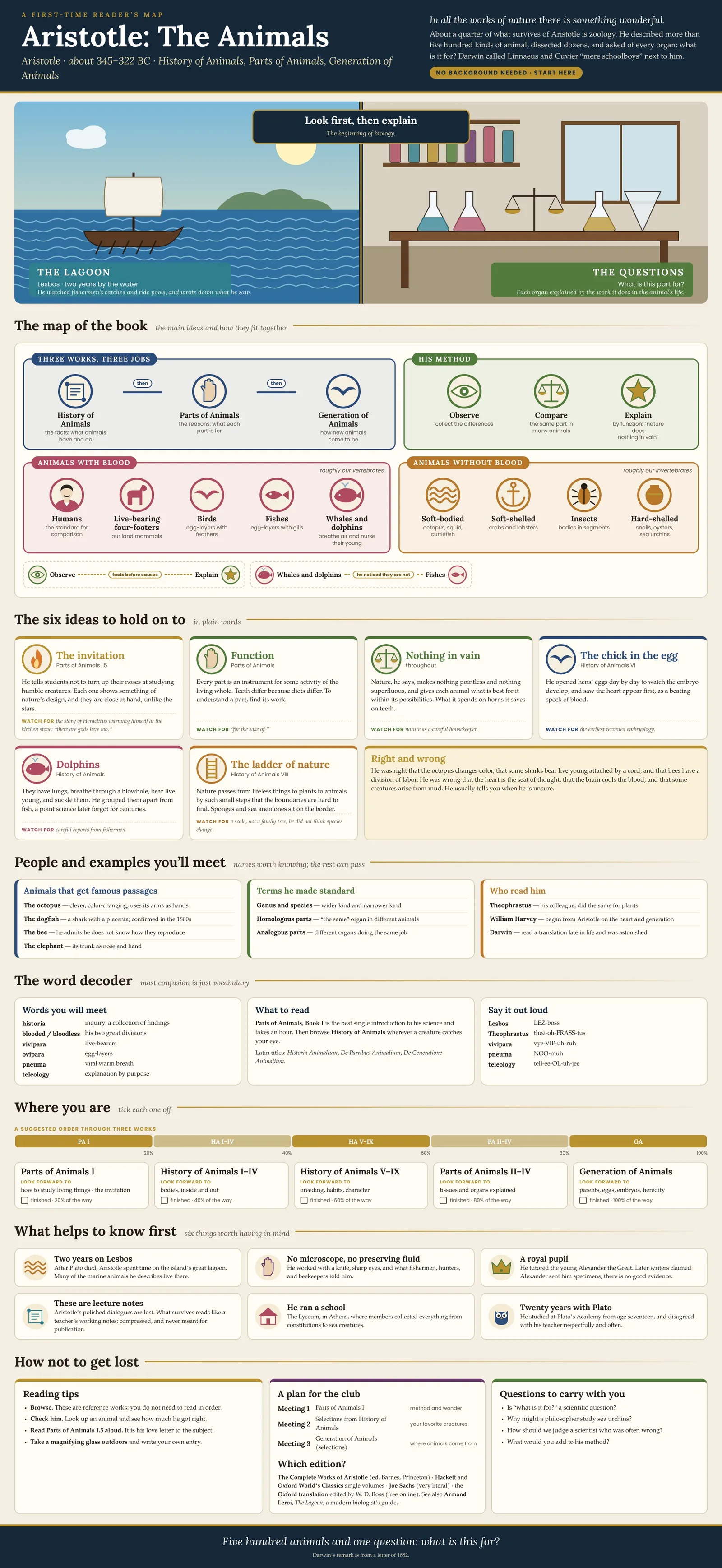
About a quarter of what survives of Aristotle is zoology. He described more than five hundred kinds of animal, dissected dozens, and asked of every organ: what is it for? Darwin called Linnaeus and Cuvier “mere schoolboys” next to him.
✨ Open this rung of the Great Books Ladder → 🔗 Own page, to share or bookmark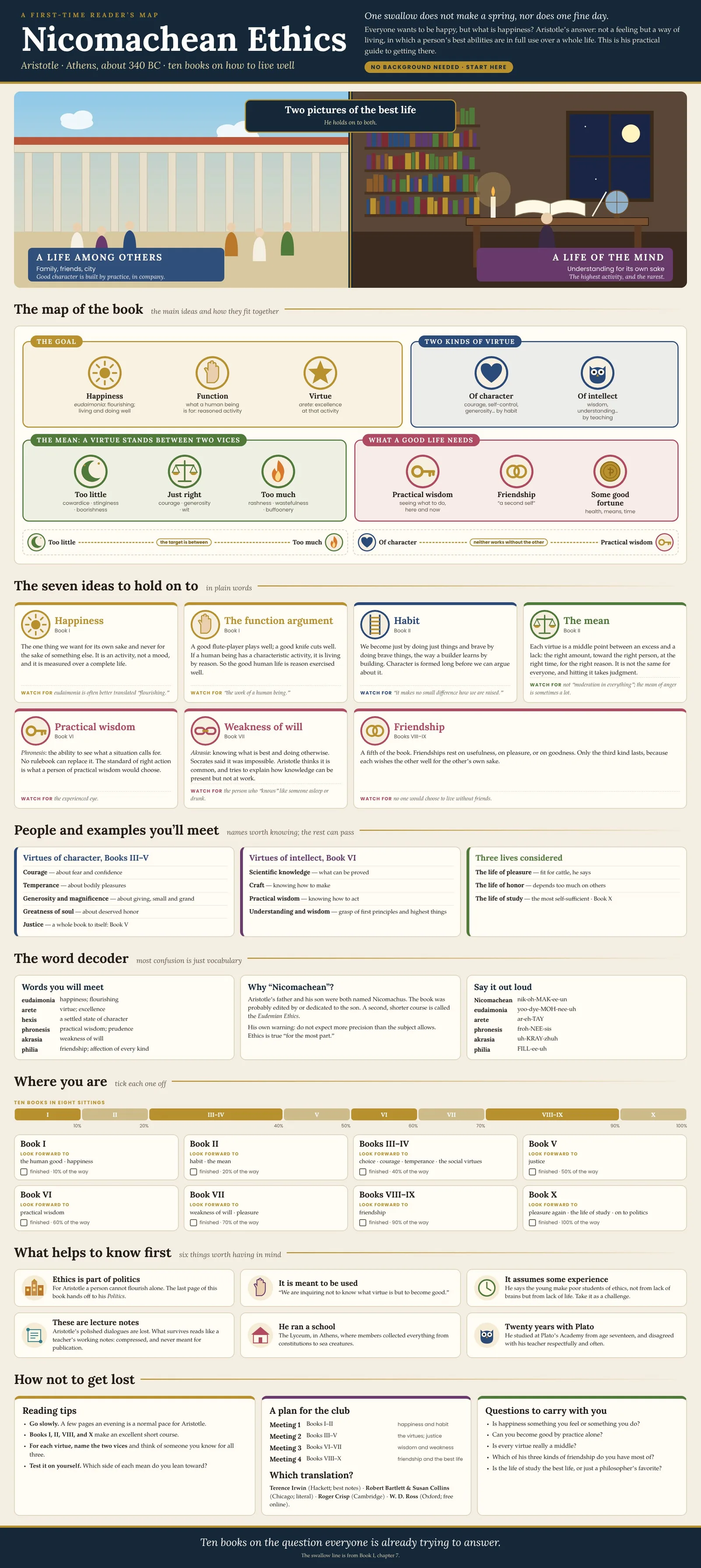
Everyone wants to be happy, but what is happiness? Aristotle’s answer: not a feeling but a way of living, in which a person’s best abilities are in full use over a whole life. This is his practical guide to getting there.
✨ Open this rung of the Great Books Ladder → 🔗 Own page, to share or bookmark 📚 Nicomachean Ethics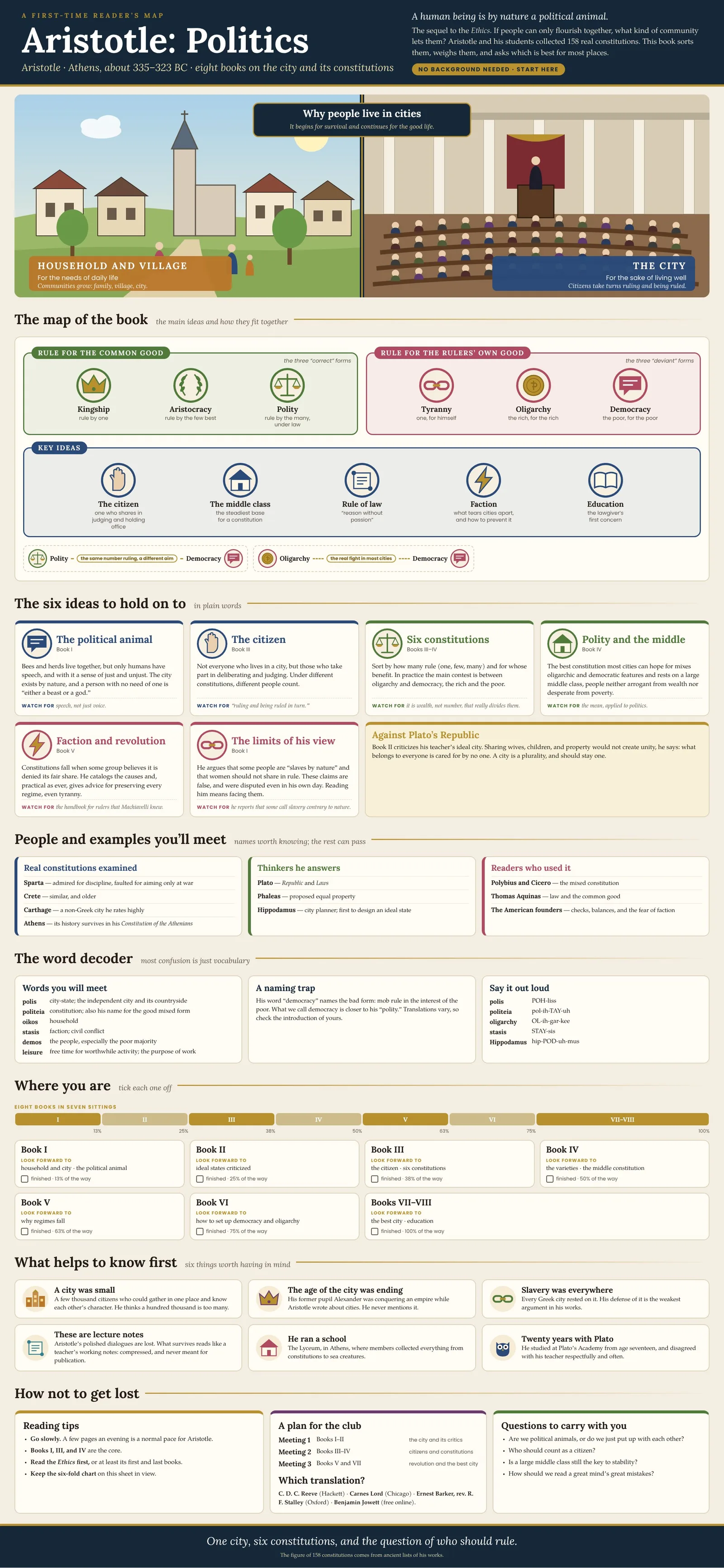
The sequel to the Ethics. If people can only flourish together, what kind of community lets them? Aristotle and his students collected 158 real constitutions. This book sorts them, weighs them, and asks which is best for most places.
✨ Open this rung of the Great Books Ladder → 🔗 Own page, to share or bookmark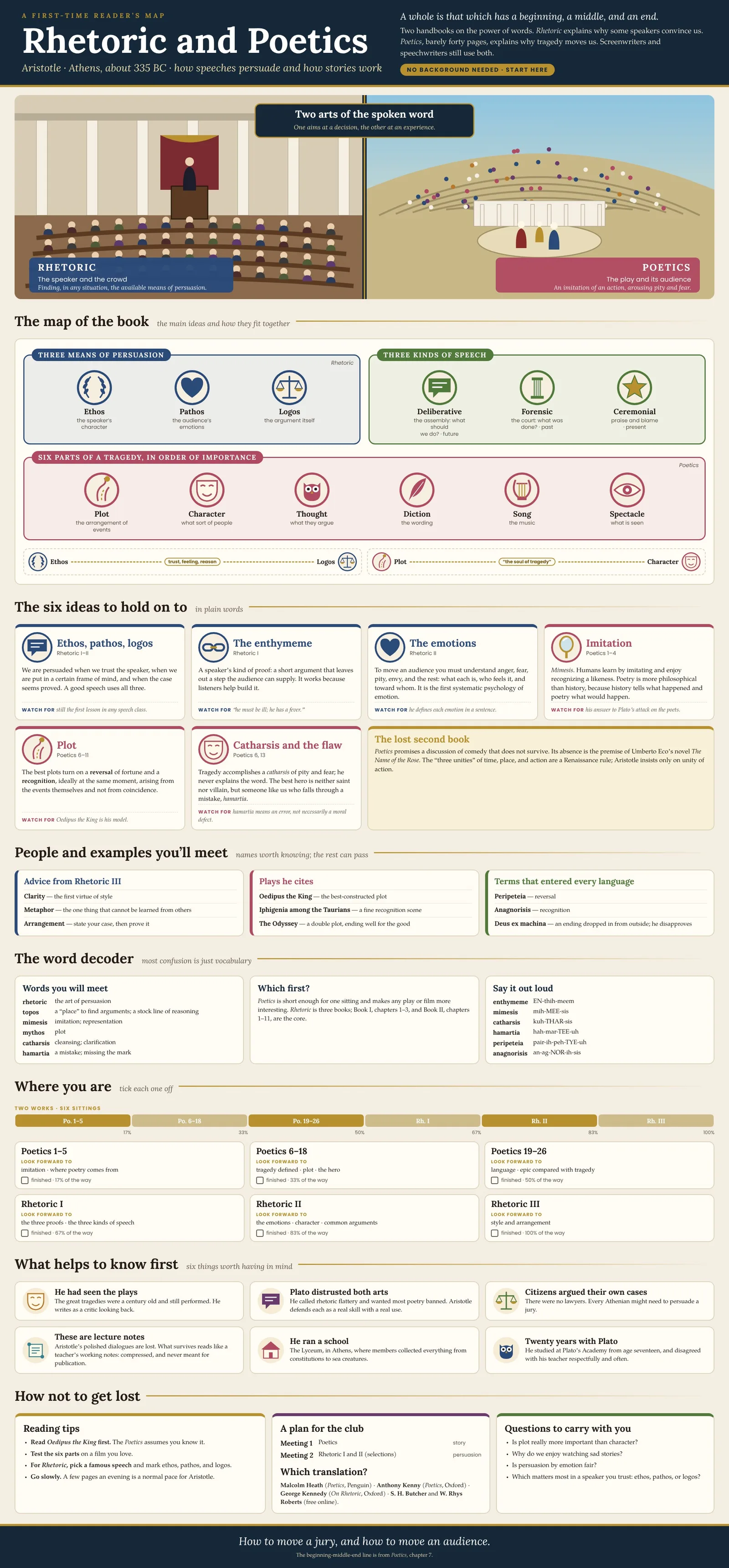
Two handbooks on the power of words. Rhetoric explains why some speakers convince us. Poetics, barely forty pages, explains why tragedy moves us. Screenwriters and speechwriters still use both.
✨ Open this rung of the Great Books Ladder → 🔗 Own page, to share or bookmark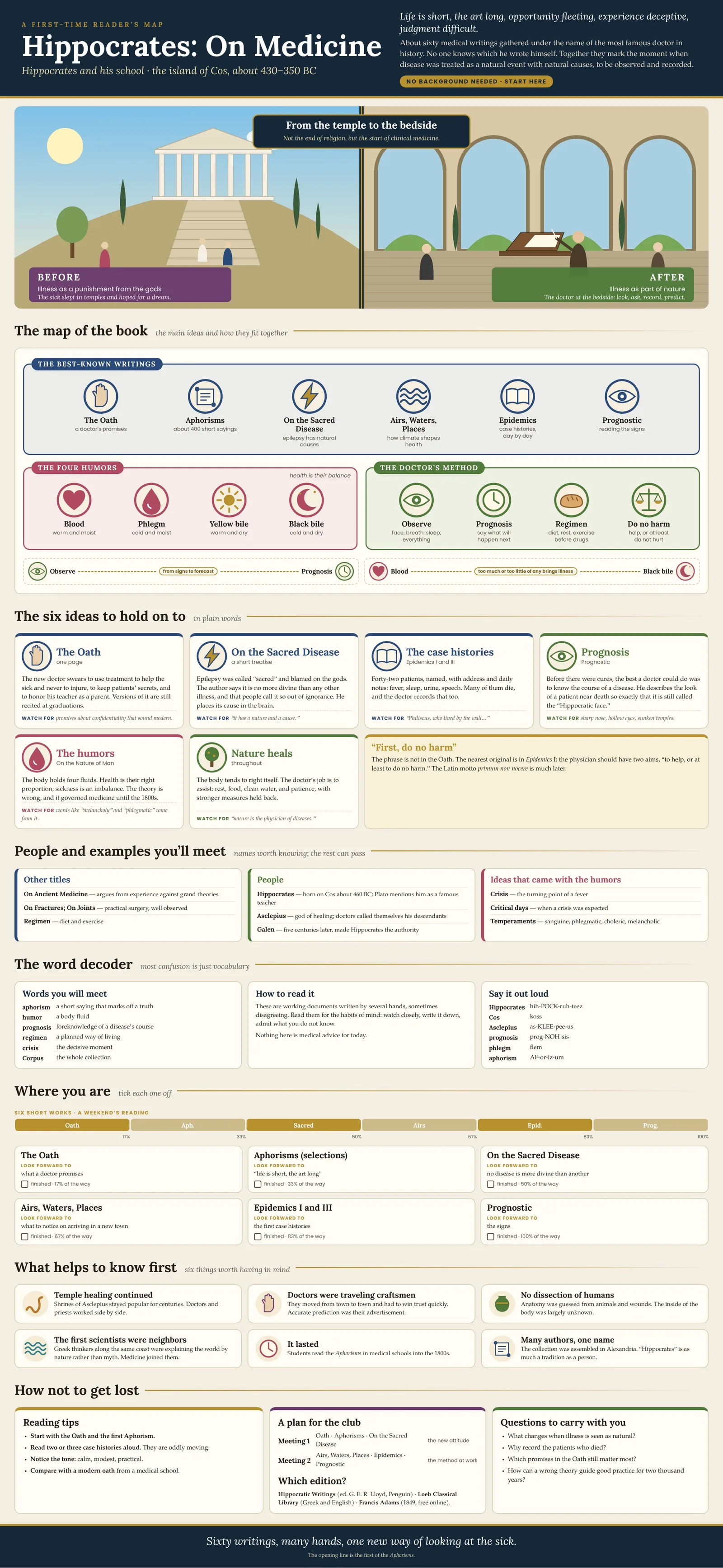
About sixty medical writings gathered under the name of the most famous doctor in history. No one knows which he wrote himself. Together they mark the moment when disease was treated as a natural event with natural causes, to be observed and recorded.
✨ Open this rung of the Great Books Ladder → 🔗 Own page, to share or bookmark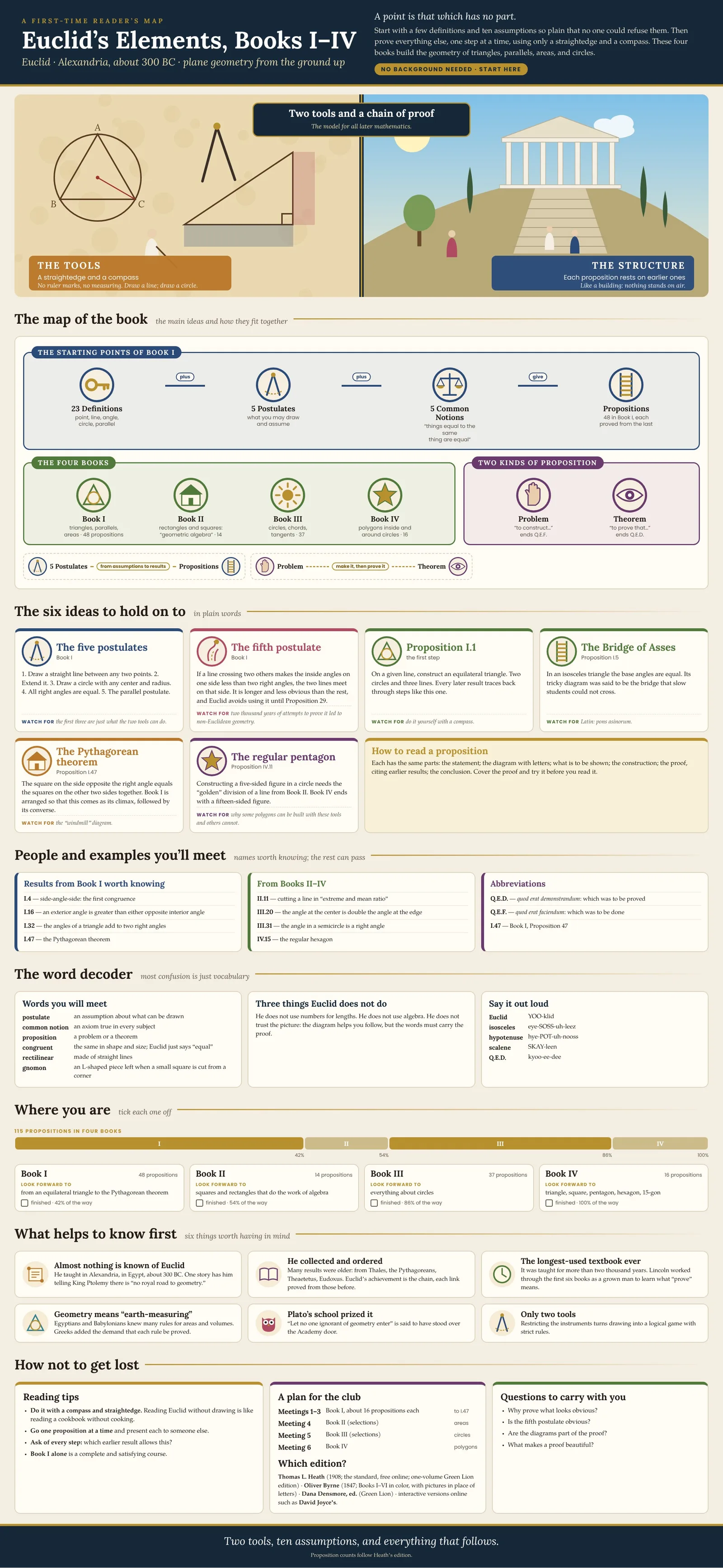
Start with a few definitions and ten assumptions so plain that no one could refuse them. Then prove everything else, one step at a time, using only a straightedge and a compass. These four books build the geometry of triangles, parallels, areas, and circles.
✨ Open this rung of the Great Books Ladder → 🔗 Own page, to share or bookmark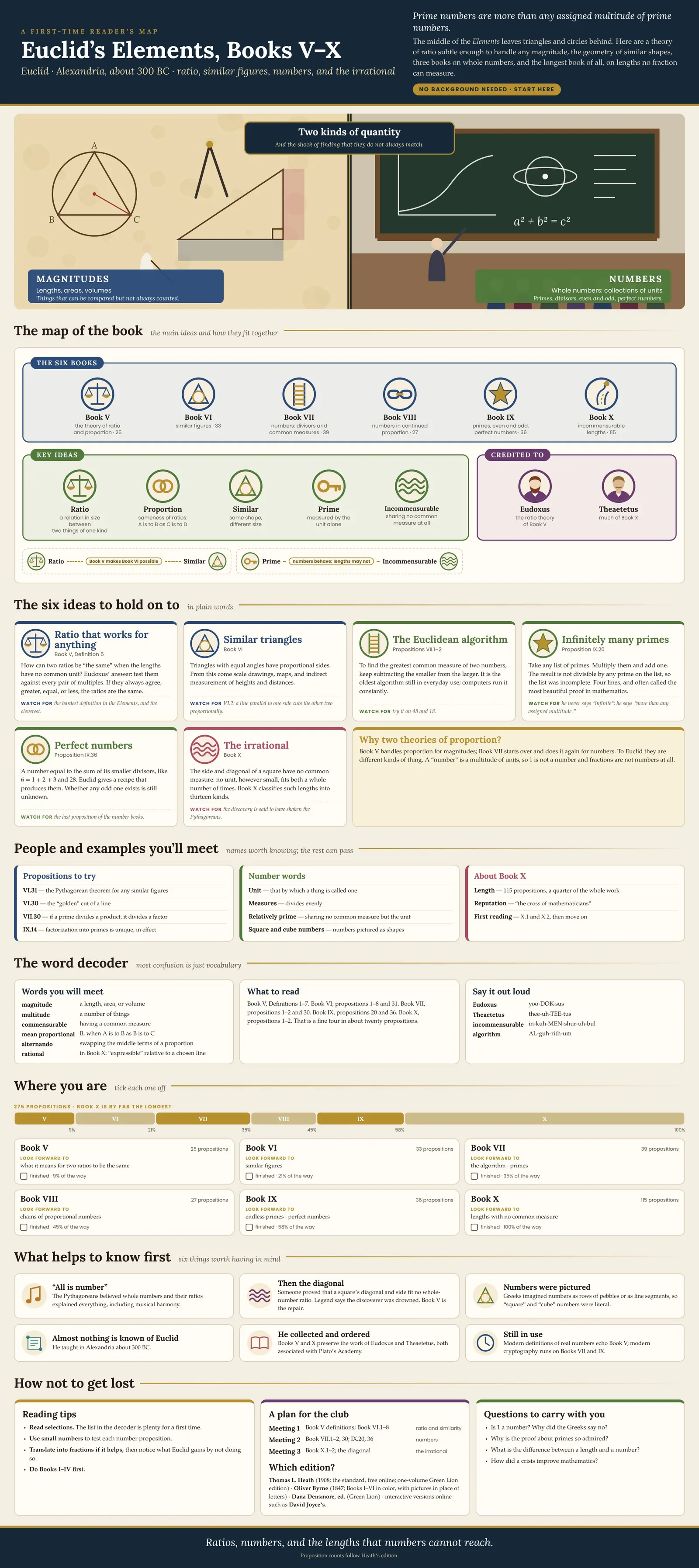
The middle of the Elements leaves triangles and circles behind. Here are a theory of ratio subtle enough to handle any magnitude, the geometry of similar shapes, three books on whole numbers, and the longest book of all, on lengths no fraction can measure.
✨ Open this rung of the Great Books Ladder → 🔗 Own page, to share or bookmark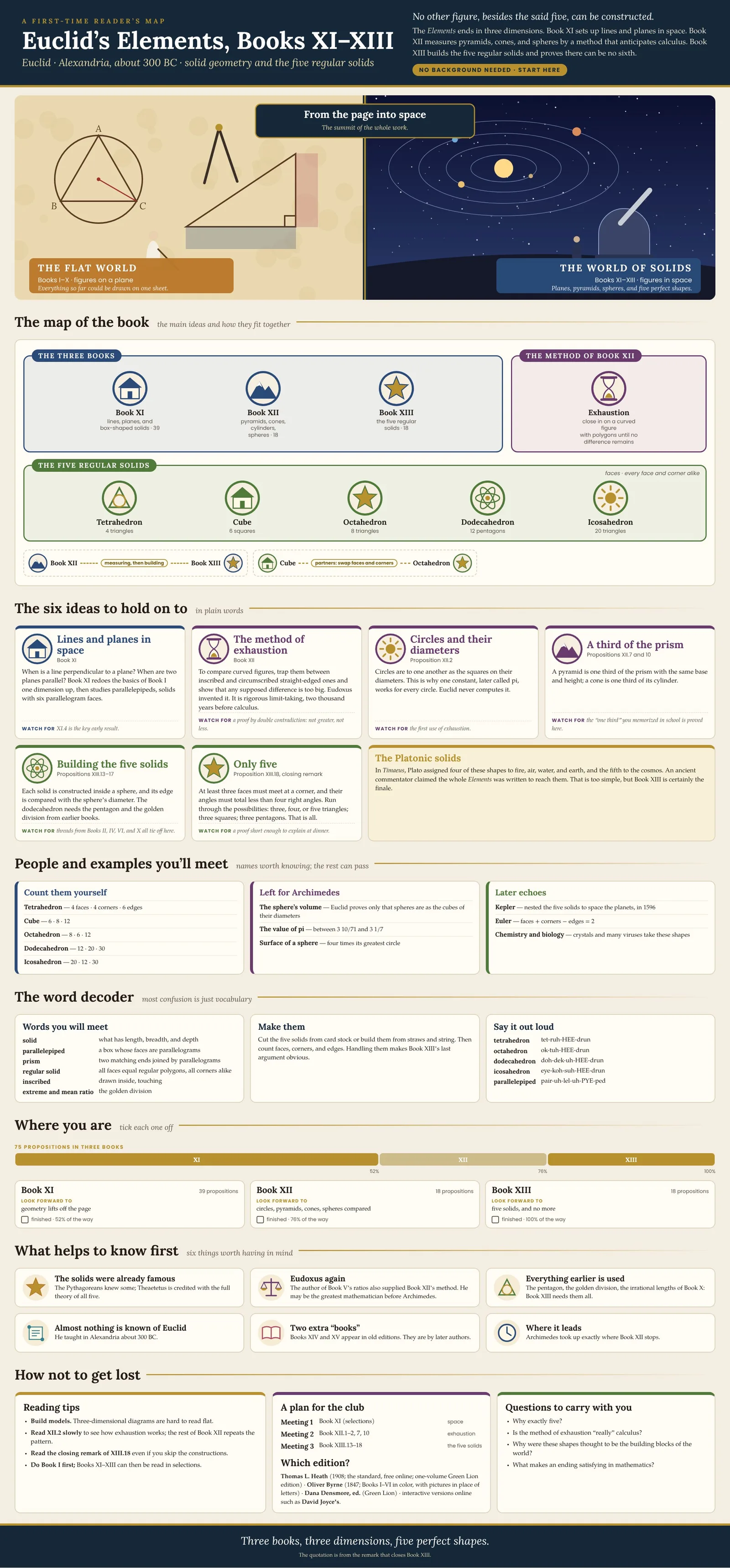
The Elements ends in three dimensions. Book XI sets up lines and planes in space. Book XII measures pyramids, cones, and spheres by a method that anticipates calculus. Book XIII builds the five regular solids and proves there can be no sixth.
✨ Open this rung of the Great Books Ladder → 🔗 Own page, to share or bookmark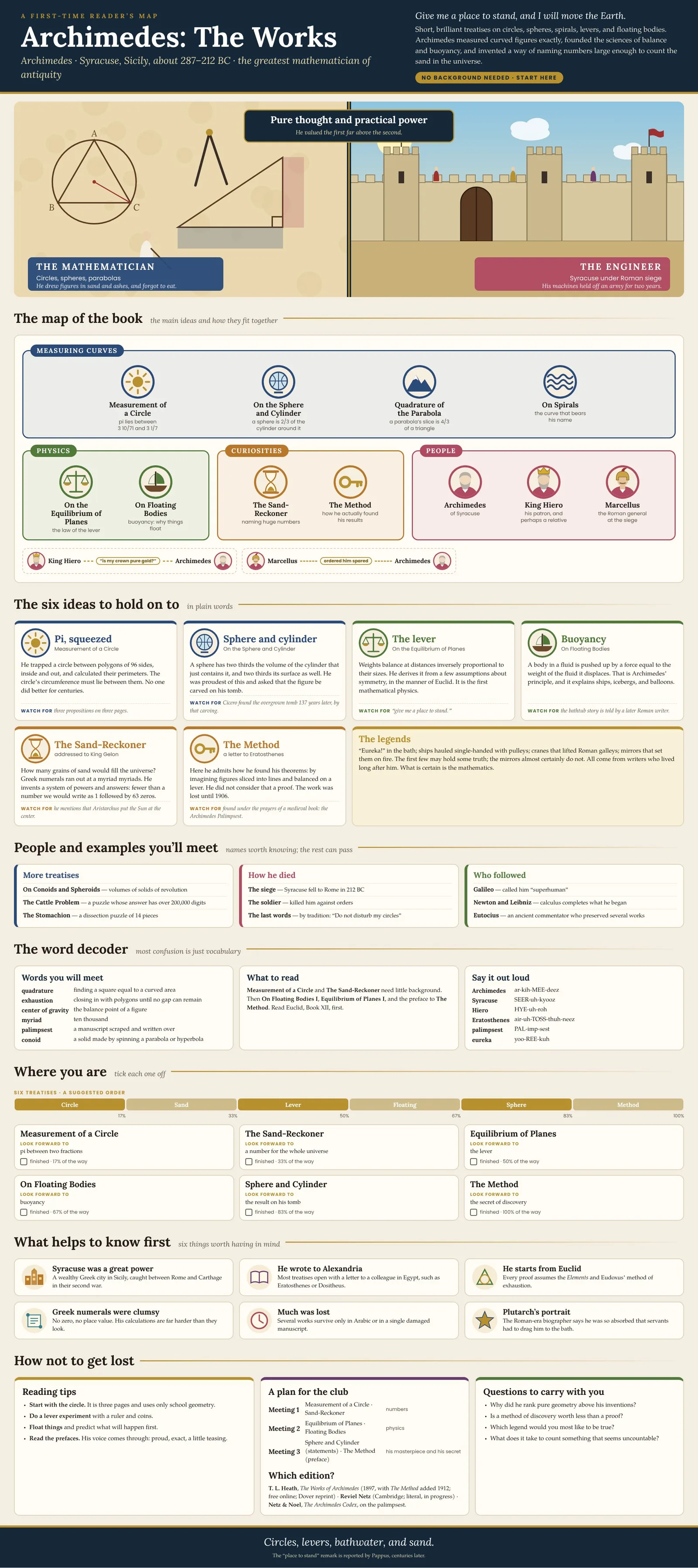
Short, brilliant treatises on circles, spheres, spirals, levers, and floating bodies. Archimedes measured curved figures exactly, founded the sciences of balance and buoyancy, and invented a way of naming numbers large enough to count the sand in the universe.
✨ Open this rung of the Great Books Ladder → 🔗 Own page, to share or bookmarkRome and Late Antiquity 15 maps · the rungs →
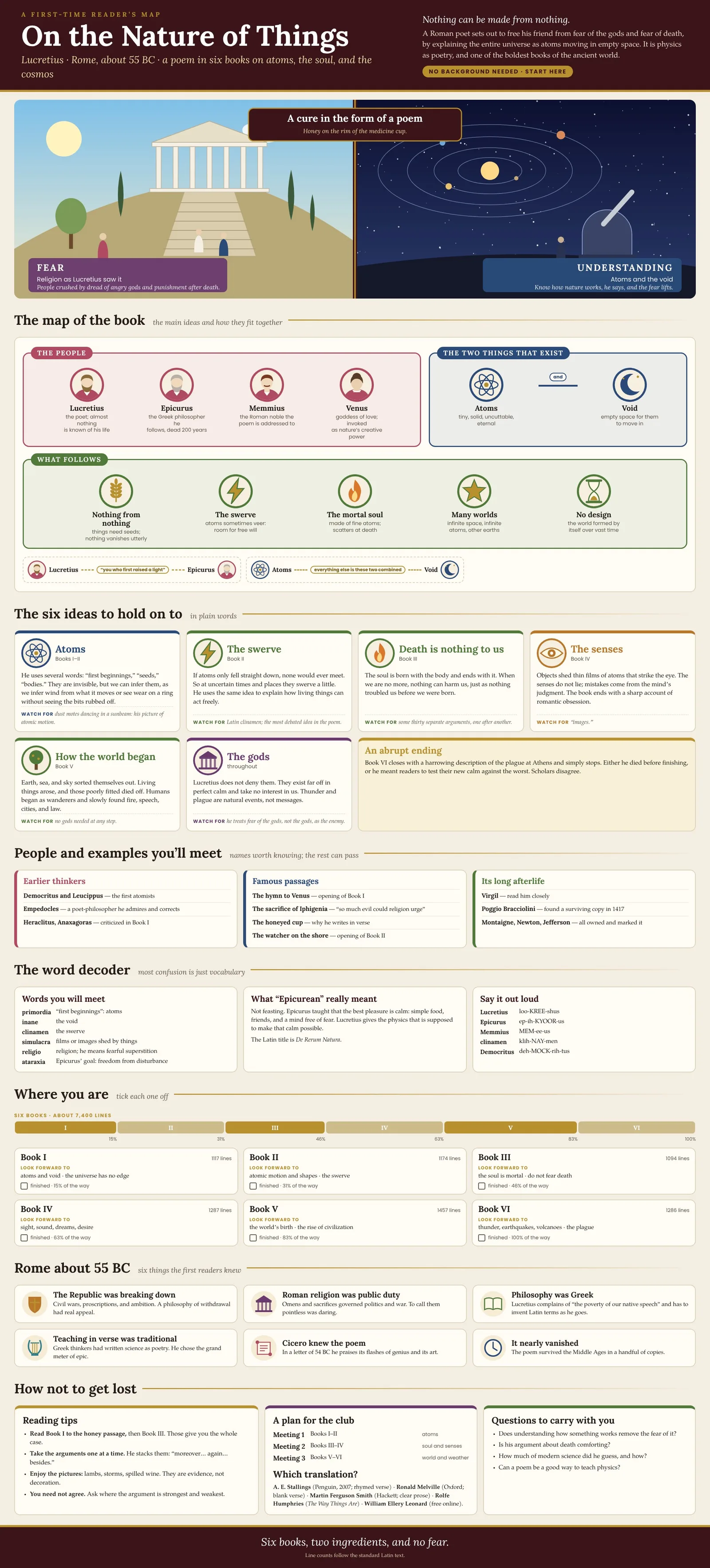
A Roman poet sets out to free his friend from fear of the gods and fear of death, by explaining the entire universe as atoms moving in empty space. It is physics as poetry, and one of the boldest books of the ancient world.
✨ Open this rung of the Great Books Ladder → 🔗 Own page, to share or bookmark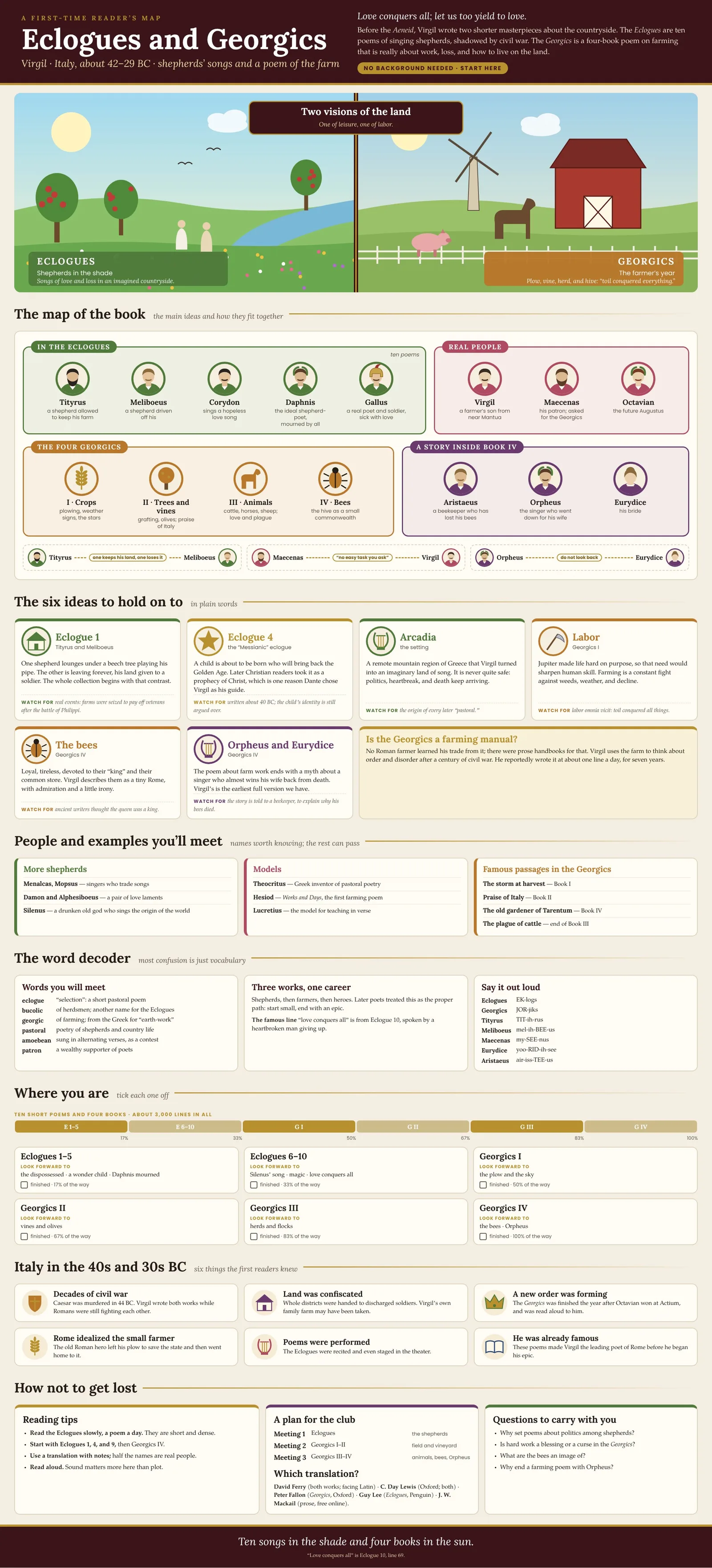
Before the Aeneid, Virgil wrote two shorter masterpieces about the countryside. The Eclogues are ten poems of singing shepherds, shadowed by civil war. The Georgics is a four-book poem on farming that is really about work, loss, and how to live on the land.
✨ Open this rung of the Great Books Ladder → 🔗 Own page, to share or bookmark 📚 Eclogues and Georgics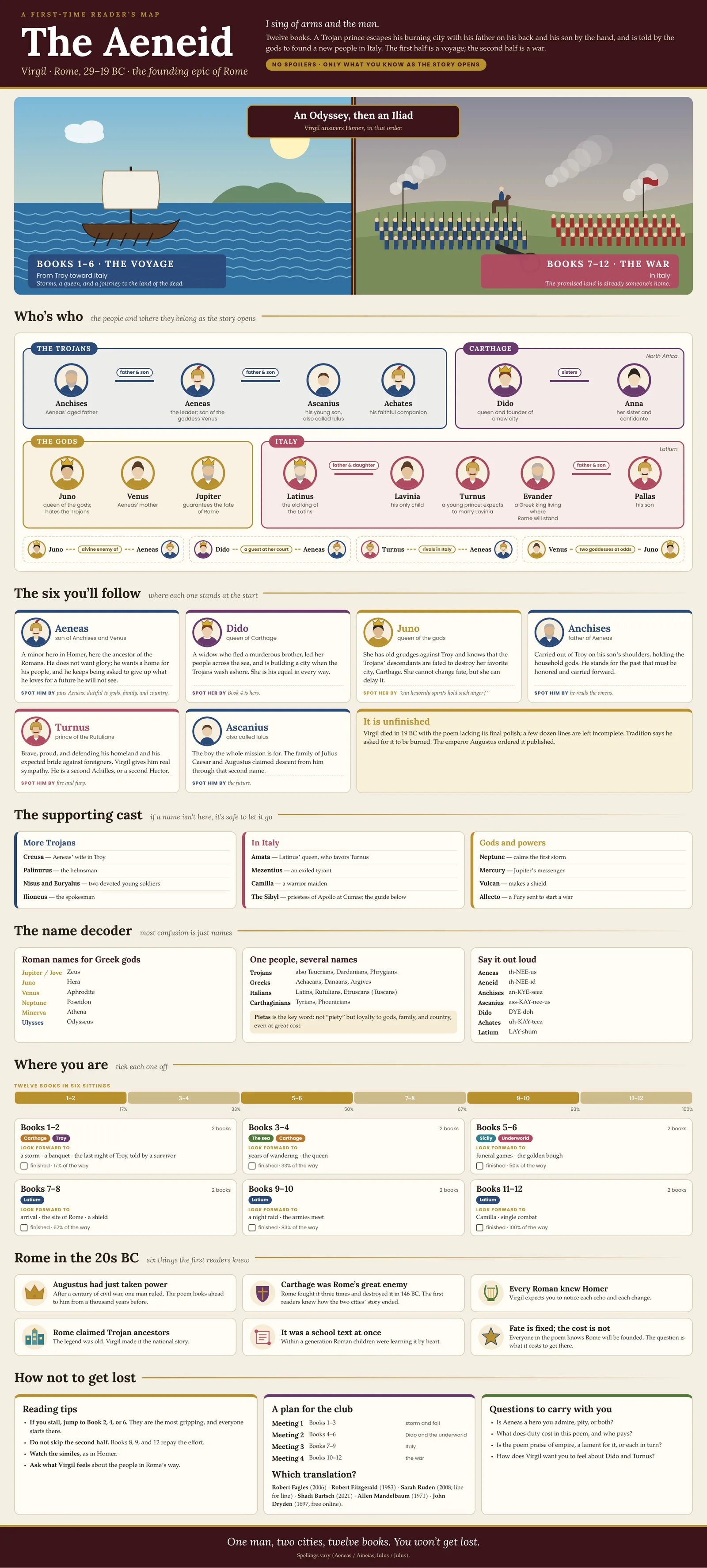
Twelve books. A Trojan prince escapes his burning city with his father on his back and his son by the hand, and is told by the gods to found a new people in Italy. The first half is a voyage; the second half is a war.
✨ Open this rung of the Great Books Ladder → 🔗 Own page, to share or bookmark 📚 The Aeneid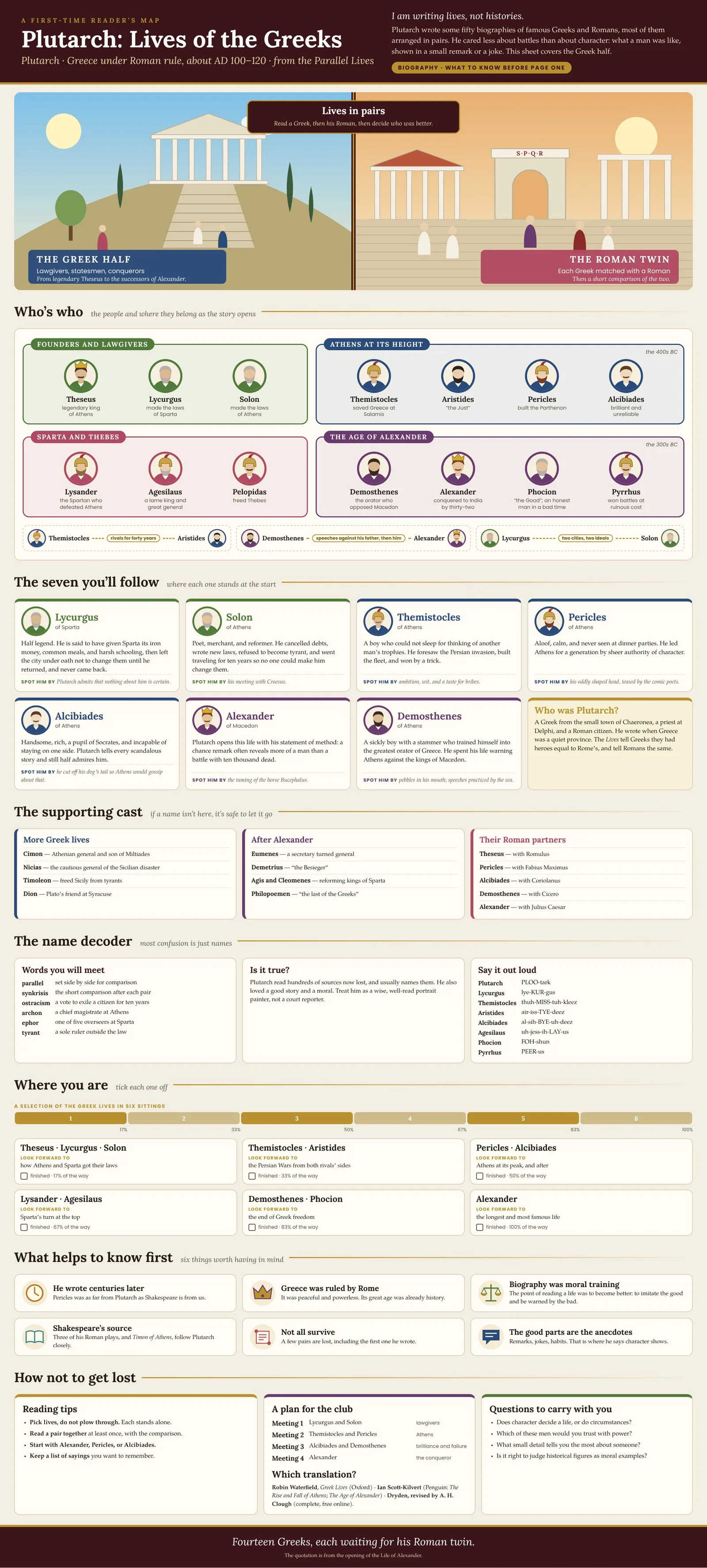
Plutarch wrote some fifty biographies of famous Greeks and Romans, most of them arranged in pairs. He cared less about battles than about character: what a man was like, shown in a small remark or a joke. This sheet covers the Greek half.
✨ Open this rung of the Great Books Ladder → 🔗 Own page, to share or bookmark 📚 Plutarch's Lives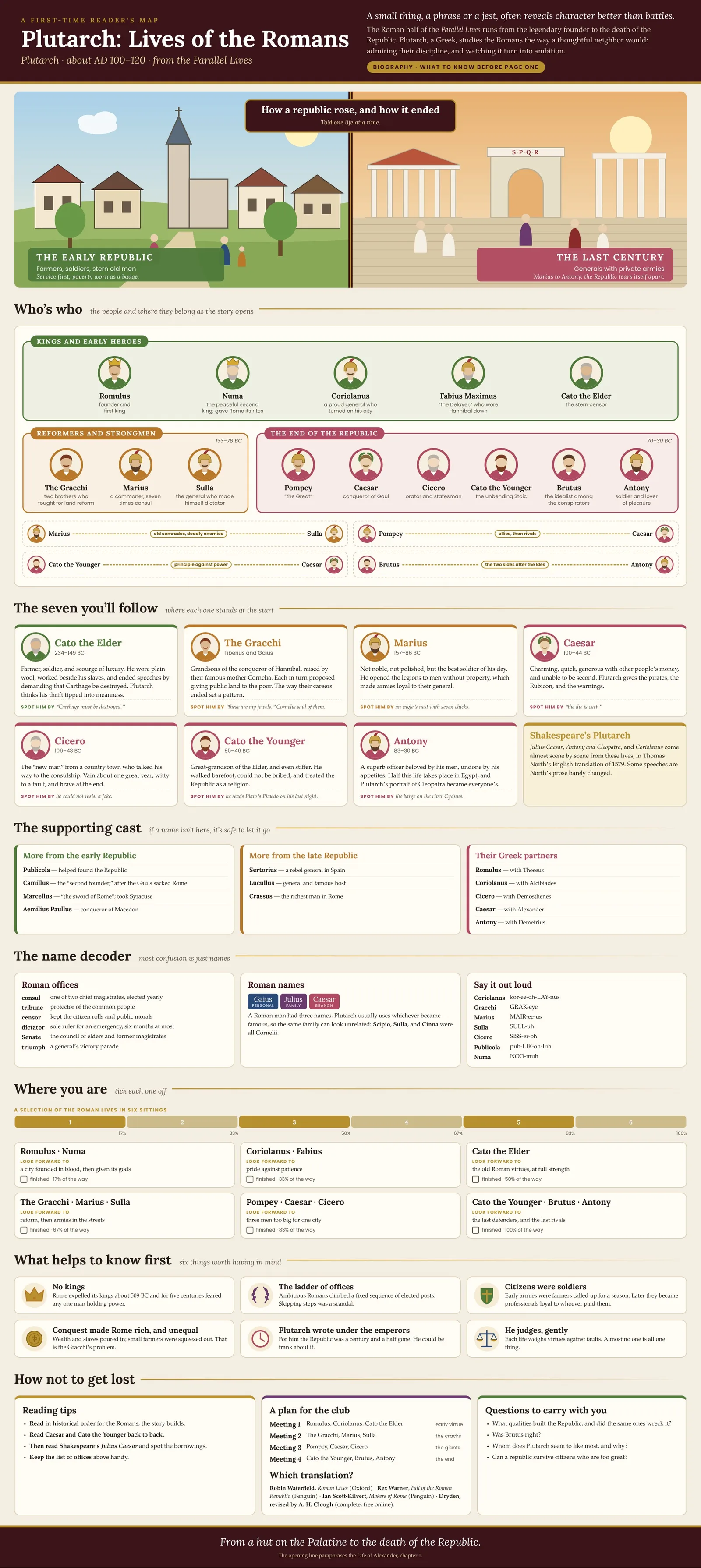
The Roman half of the Parallel Lives runs from the legendary founder to the death of the Republic. Plutarch, a Greek, studies the Romans the way a thoughtful neighbor would: admiring their discipline, and watching it turn into ambition.
✨ Open this rung of the Great Books Ladder → 🔗 Own page, to share or bookmark 📚 Plutarch's Lives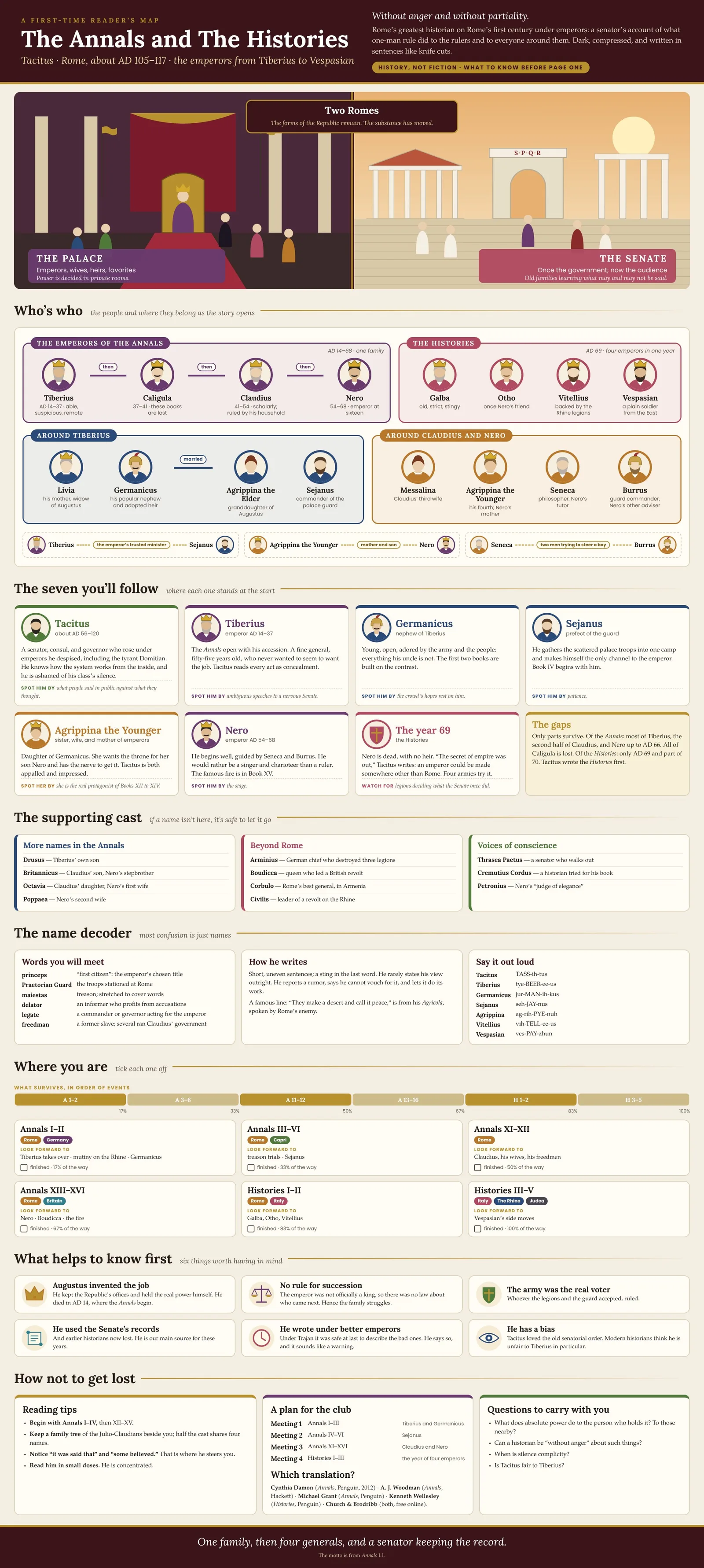
Rome’s greatest historian on Rome’s first century under emperors: a senator’s account of what one-man rule did to the rulers and to everyone around them. Dark, compressed, and written in sentences like knife cuts.
✨ Open this rung of the Great Books Ladder → 🔗 Own page, to share or bookmark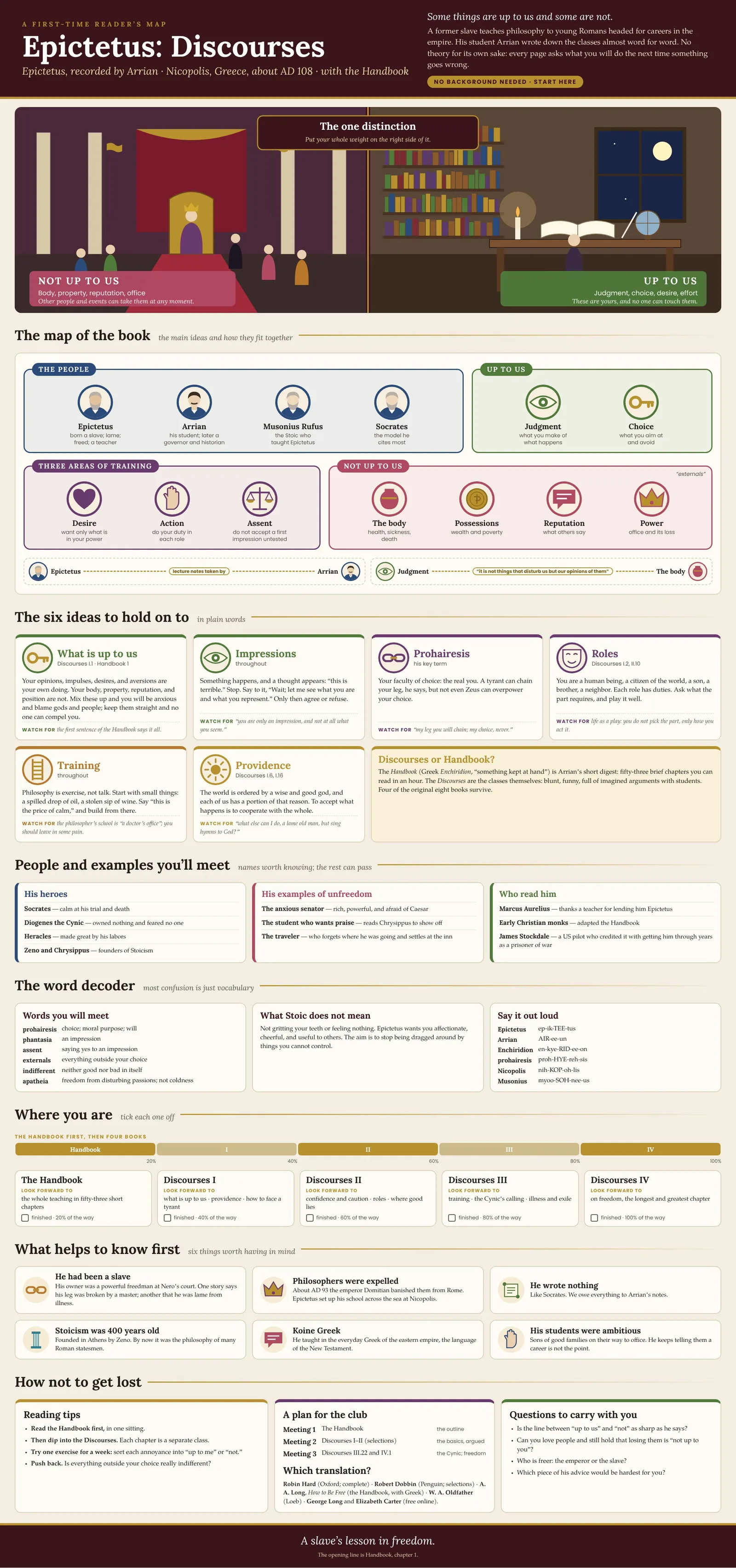
A former slave teaches philosophy to young Romans headed for careers in the empire. His student Arrian wrote down the classes almost word for word. No theory for its own sake: every page asks what you will do the next time something goes wrong.
✨ Open this rung of the Great Books Ladder → 🔗 Own page, to share or bookmark 📚 Moral Letters to Lucilius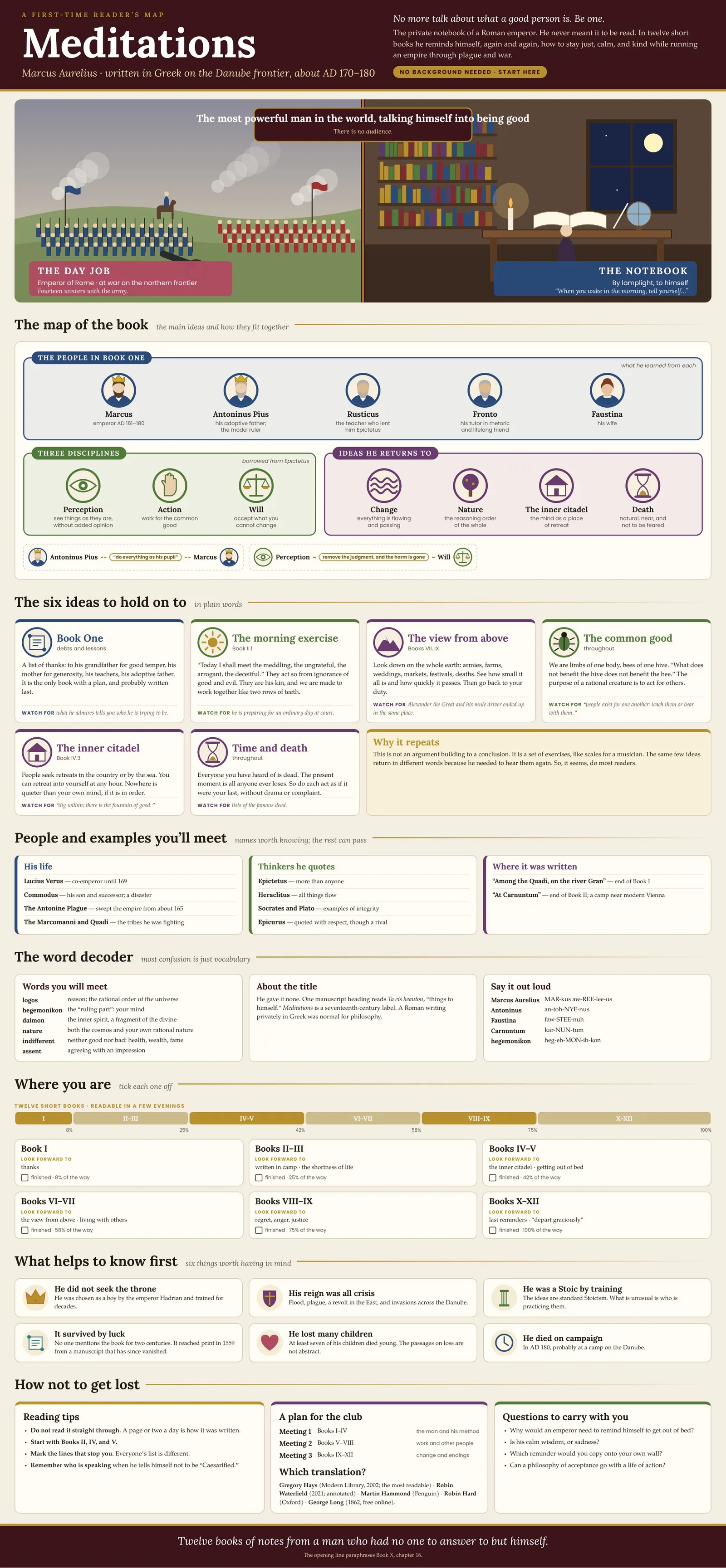
The private notebook of a Roman emperor. He never meant it to be read. In twelve short books he reminds himself, again and again, how to stay just, calm, and kind while running an empire through plague and war.
✨ Open this rung of the Great Books Ladder → 🔗 Own page, to share or bookmark 📚 Meditations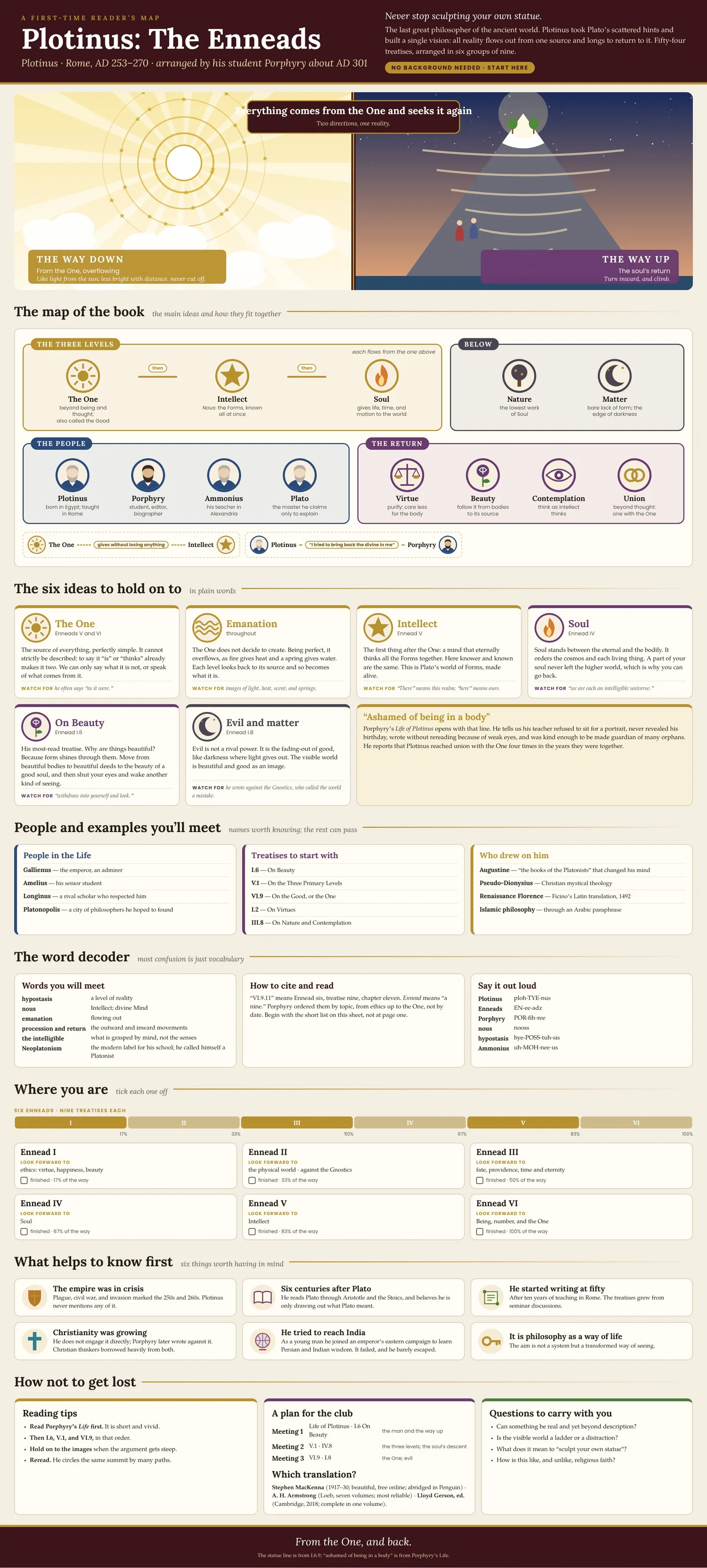
The last great philosopher of the ancient world. Plotinus took Plato’s scattered hints and built a single vision: all reality flows out from one source and longs to return to it. Fifty-four treatises, arranged in six groups of nine.
✨ Open this rung of the Great Books Ladder → 🔗 Own page, to share or bookmark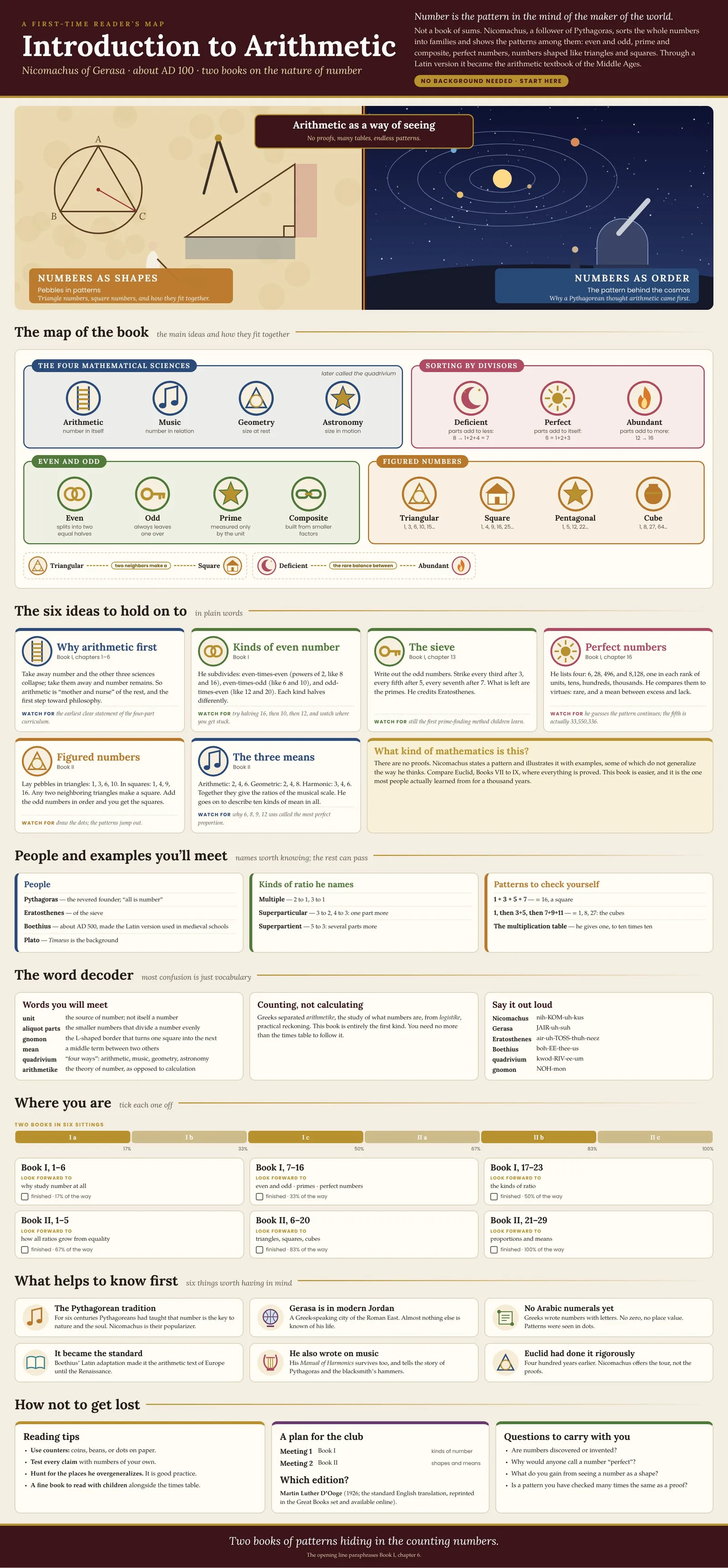
Not a book of sums. Nicomachus, a follower of Pythagoras, sorts the whole numbers into families and shows the patterns among them: even and odd, prime and composite, perfect numbers, numbers shaped like triangles and squares. Through a Latin version it became the arithmetic textbook of the Middle Ages.
✨ Open this rung of the Great Books Ladder → 🔗 Own page, to share or bookmark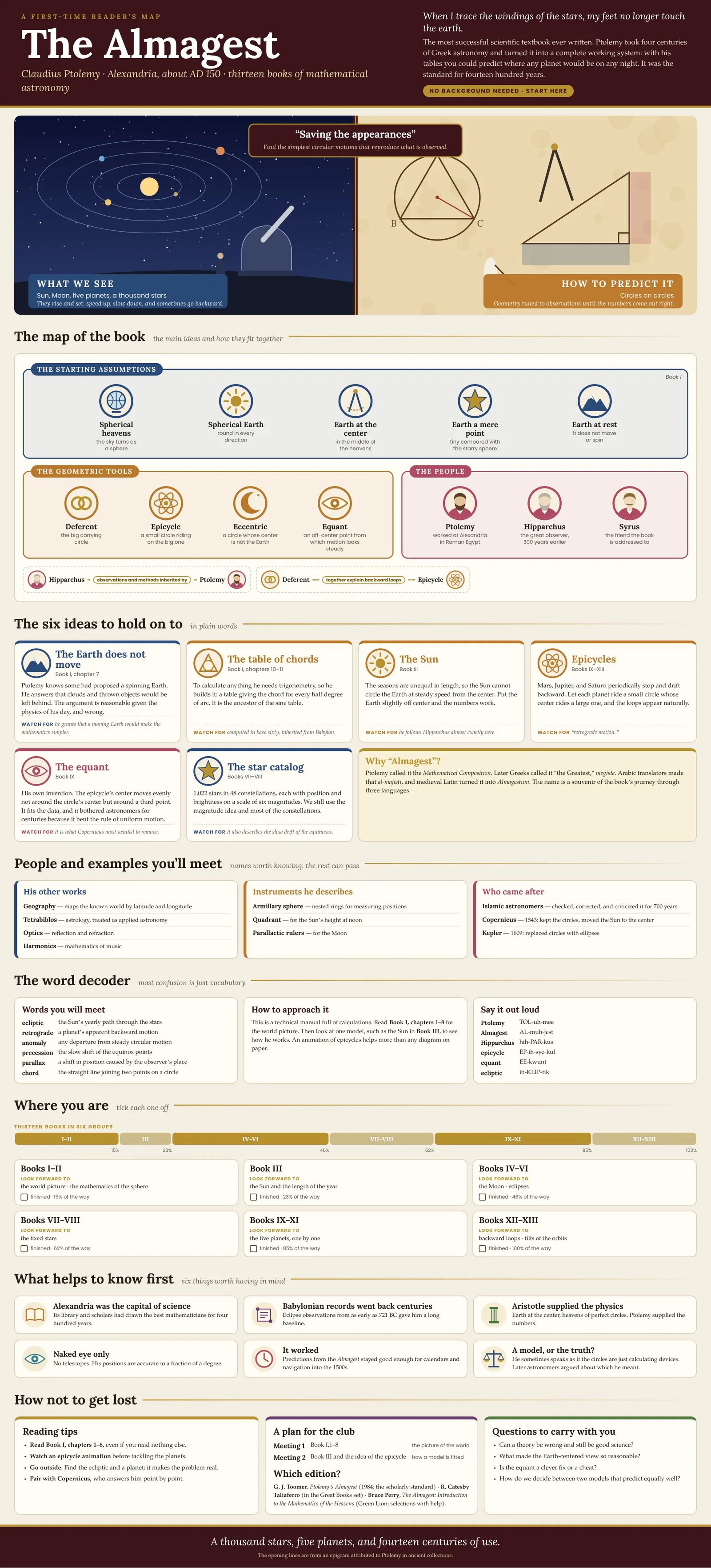
The most successful scientific textbook ever written. Ptolemy took four centuries of Greek astronomy and turned it into a complete working system: with his tables you could predict where any planet would be on any night. It was the standard for fourteen hundred years.
✨ Open this rung of the Great Books Ladder → 🔗 Own page, to share or bookmark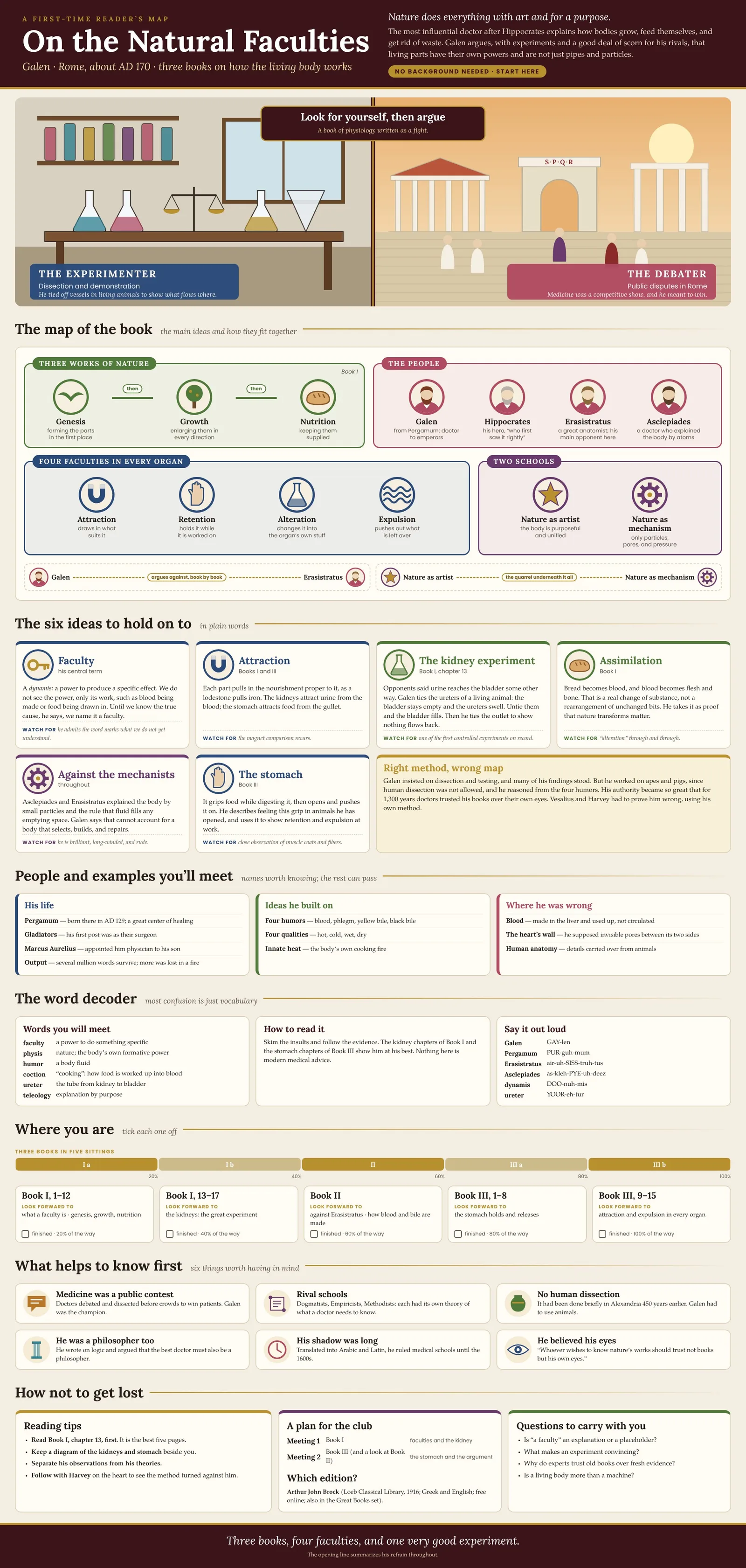
The most influential doctor after Hippocrates explains how bodies grow, feed themselves, and get rid of waste. Galen argues, with experiments and a good deal of scorn for his rivals, that living parts have their own powers and are not just pipes and particles.
✨ Open this rung of the Great Books Ladder → 🔗 Own page, to share or bookmark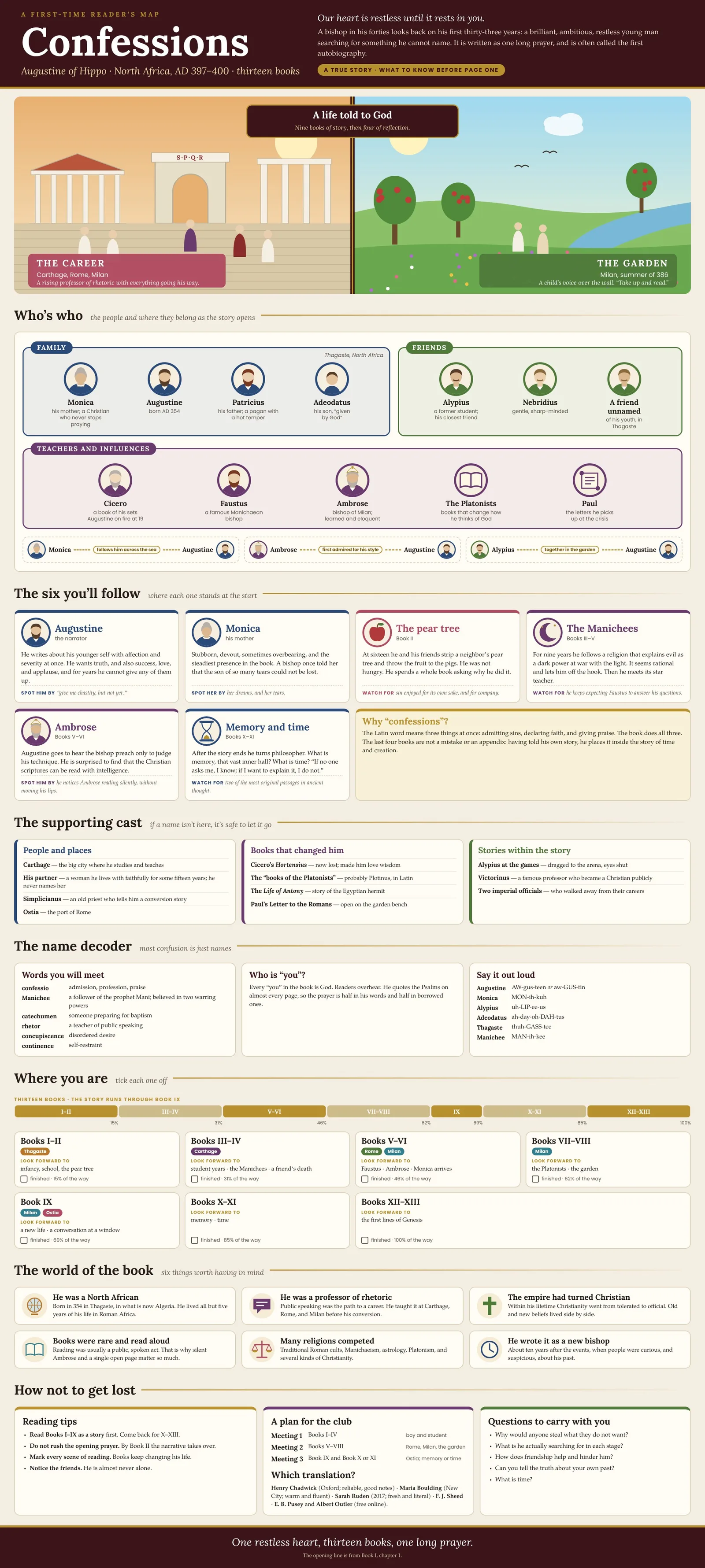
A bishop in his forties looks back on his first thirty-three years: a brilliant, ambitious, restless young man searching for something he cannot name. It is written as one long prayer, and is often called the first autobiography.
✨ Open this rung of the Great Books Ladder → 🔗 Own page, to share or bookmark 📚 Confessions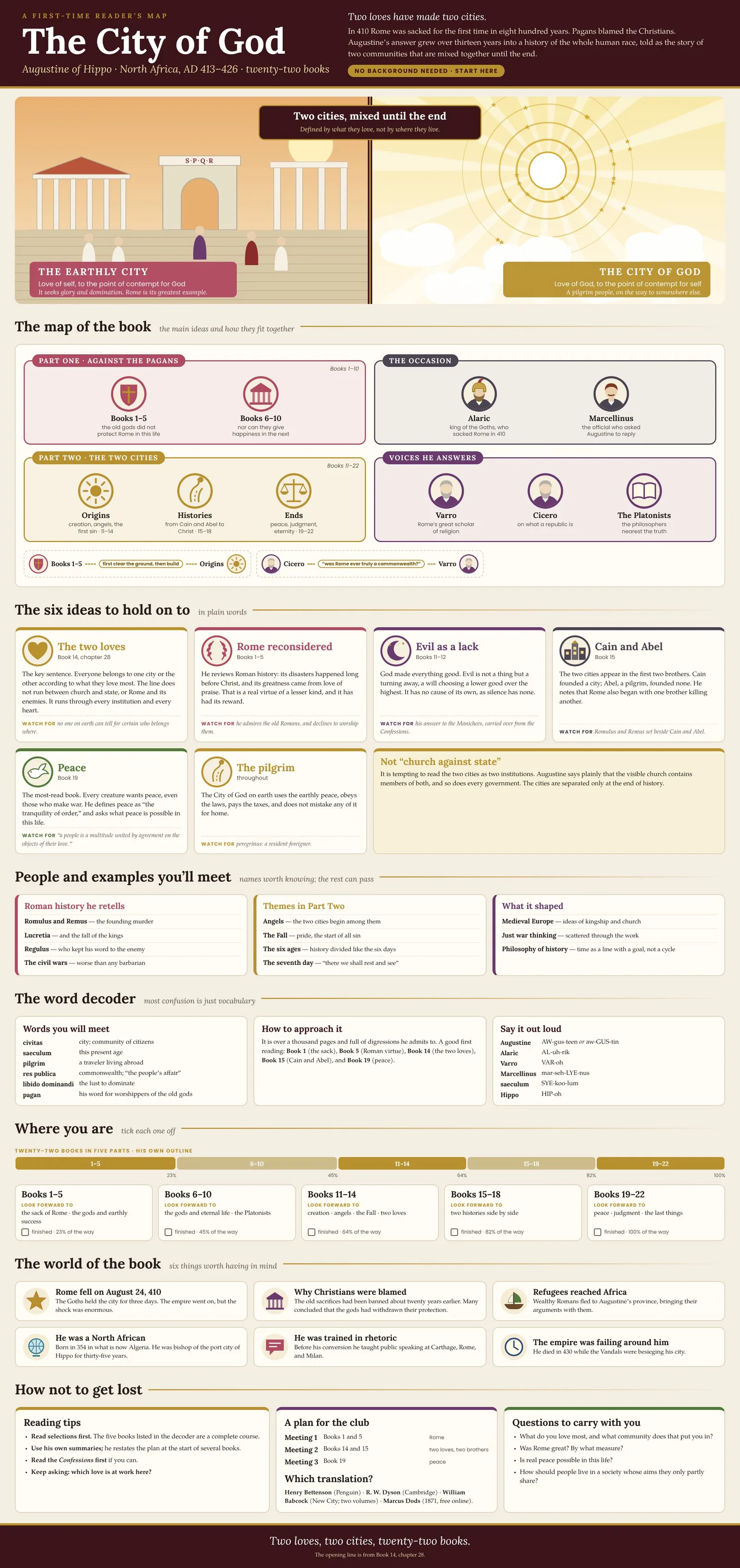
In 410 Rome was sacked for the first time in eight hundred years. Pagans blamed the Christians. Augustine’s answer grew over thirteen years into a history of the whole human race, told as the story of two communities that are mixed together until the end.
✨ Open this rung of the Great Books Ladder → 🔗 Own page, to share or bookmark 📚 City of God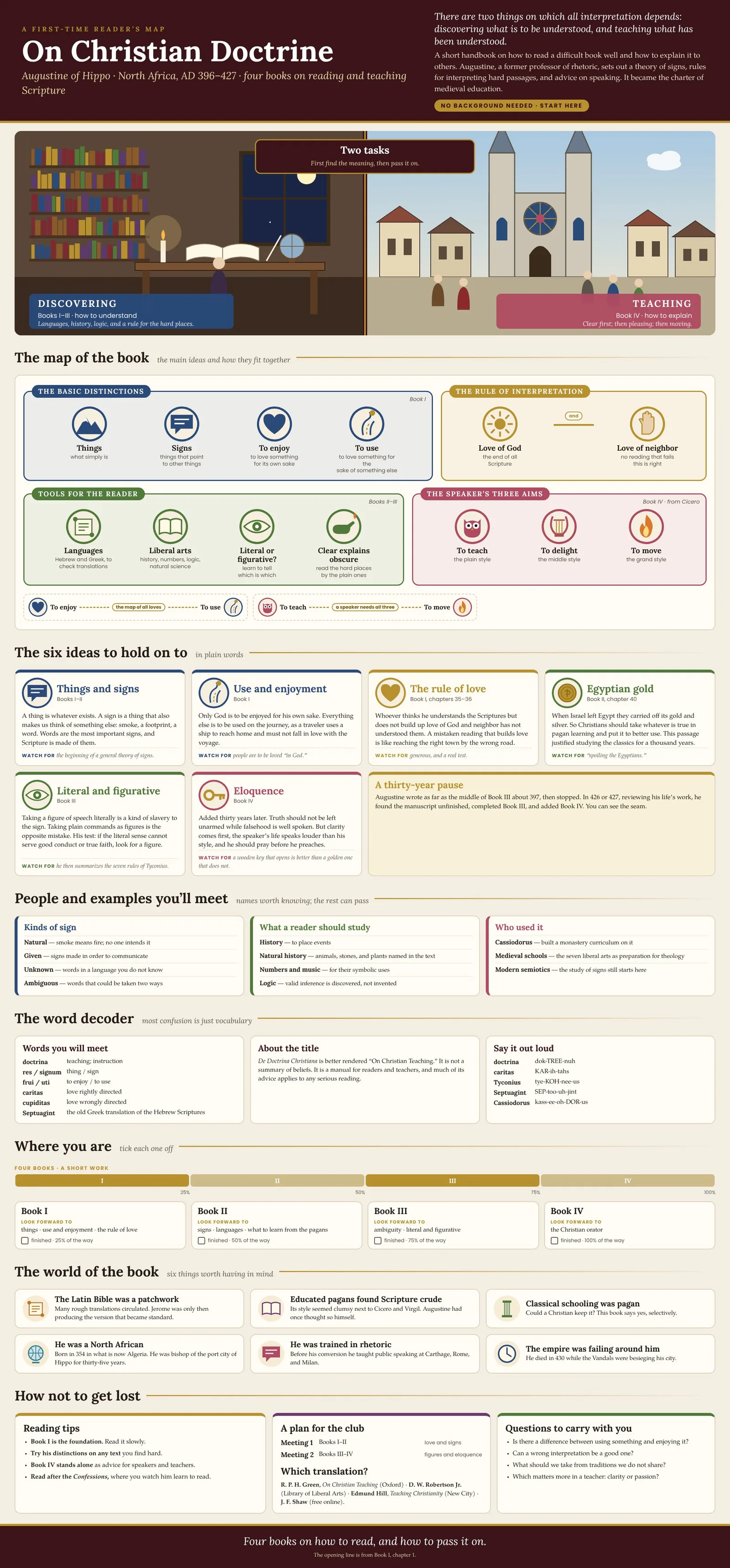
A short handbook on how to read a difficult book well and how to explain it to others. Augustine, a former professor of rhetoric, sets out a theory of signs, rules for interpreting hard passages, and advice on speaking. It became the charter of medieval education.
✨ Open this rung of the Great Books Ladder → 🔗 Own page, to share or bookmarkThe Middle Ages 8 maps · the rungs →
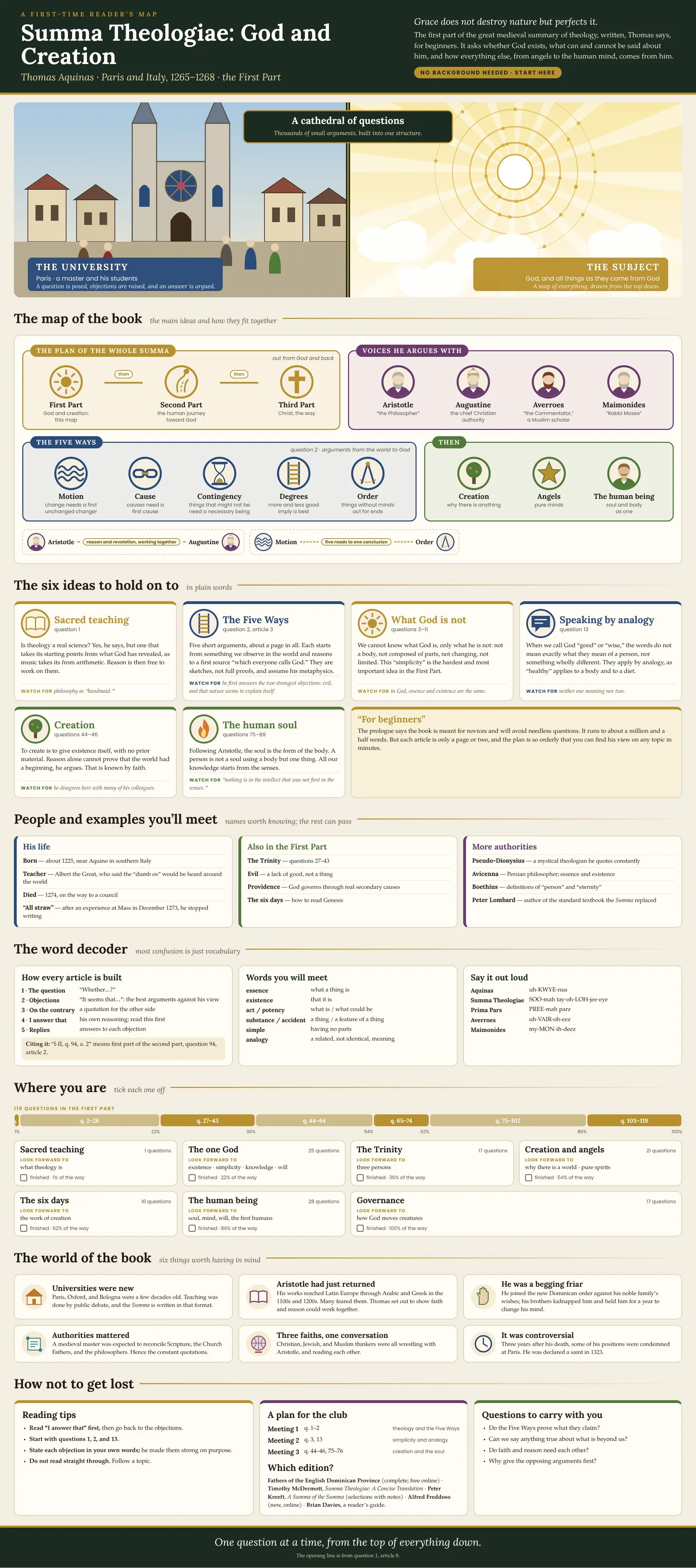
The first part of the great medieval summary of theology, written, Thomas says, for beginners. It asks whether God exists, what can and cannot be said about him, and how everything else, from angels to the human mind, comes from him.
✨ Open this rung of the Great Books Ladder → 🔗 Own page, to share or bookmark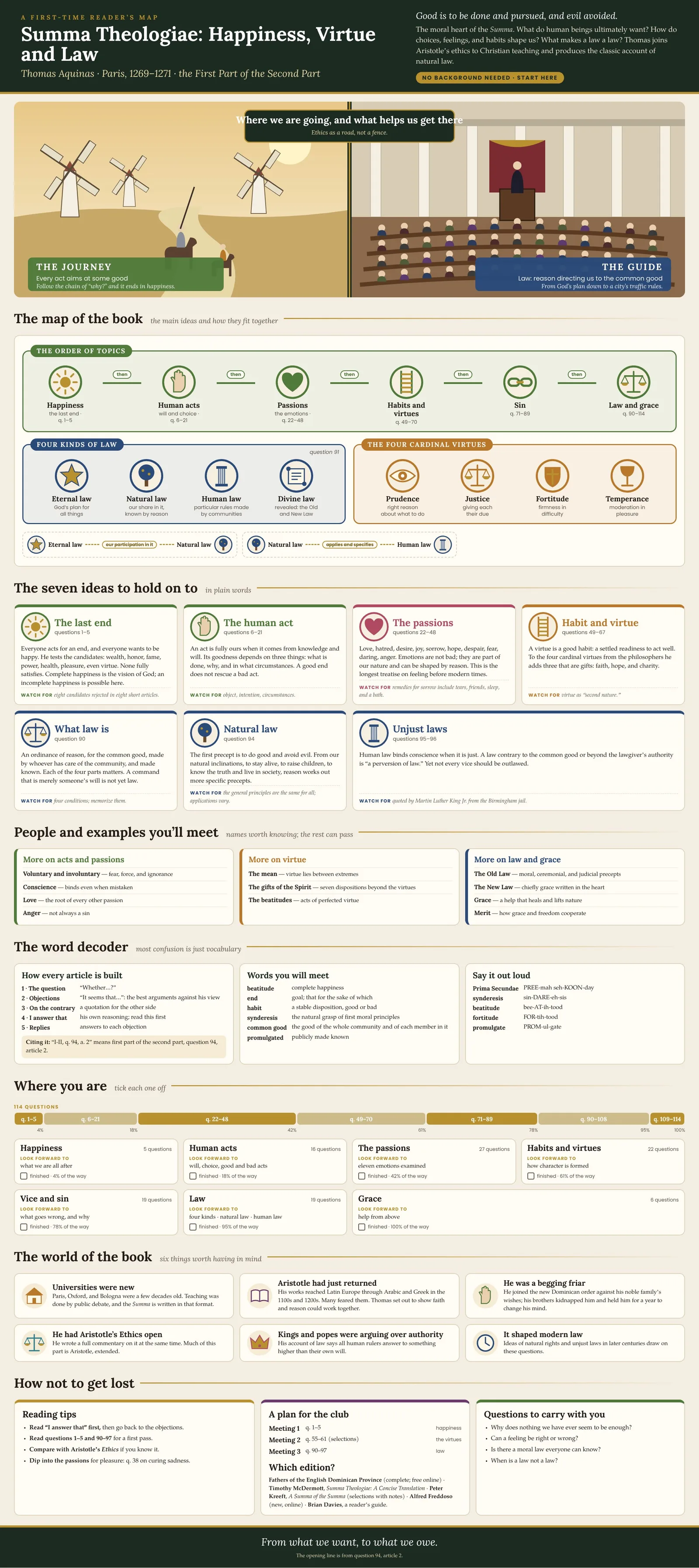
The moral heart of the Summa. What do human beings ultimately want? How do choices, feelings, and habits shape us? What makes a law a law? Thomas joins Aristotle’s ethics to Christian teaching and produces the classic account of natural law.
✨ Open this rung of the Great Books Ladder → 🔗 Own page, to share or bookmark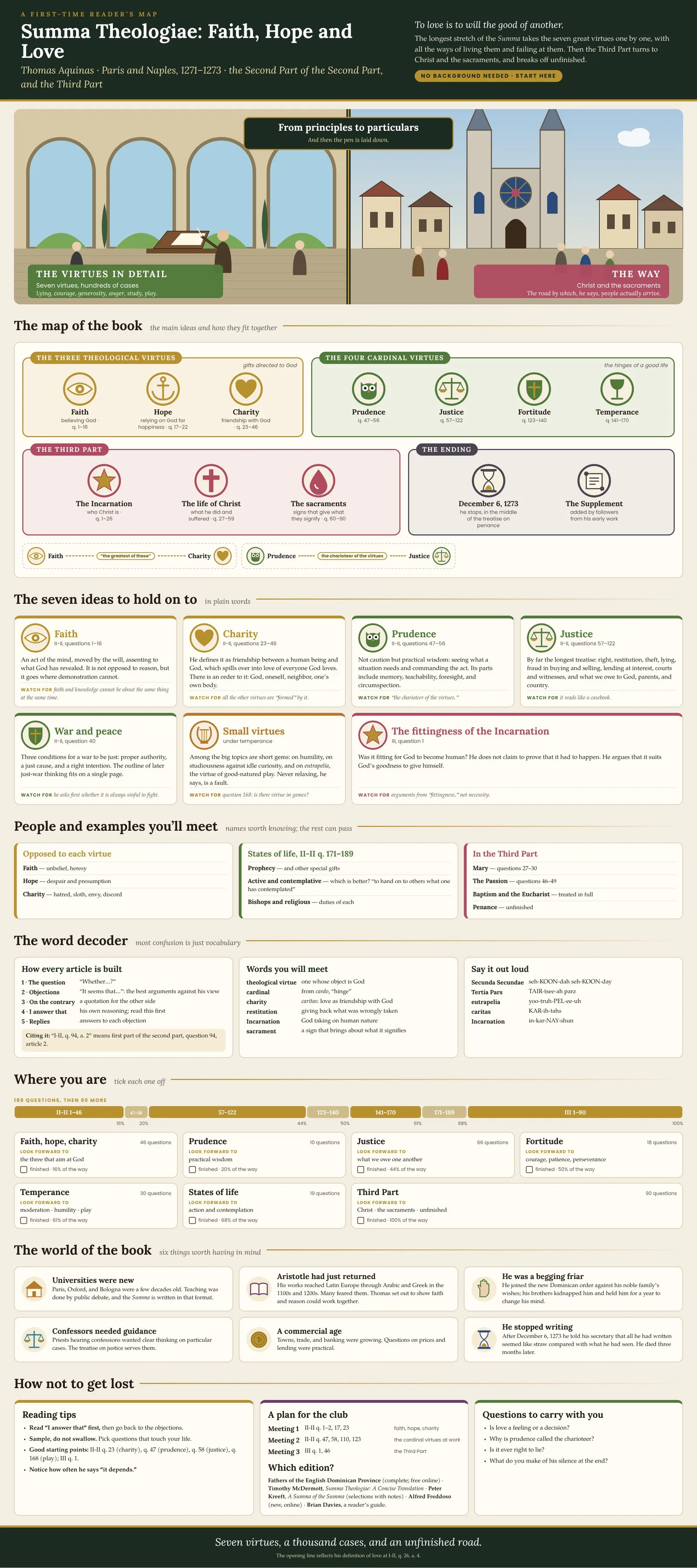
The longest stretch of the Summa takes the seven great virtues one by one, with all the ways of living them and failing at them. Then the Third Part turns to Christ and the sacraments, and breaks off unfinished.
✨ Open this rung of the Great Books Ladder → 🔗 Own page, to share or bookmark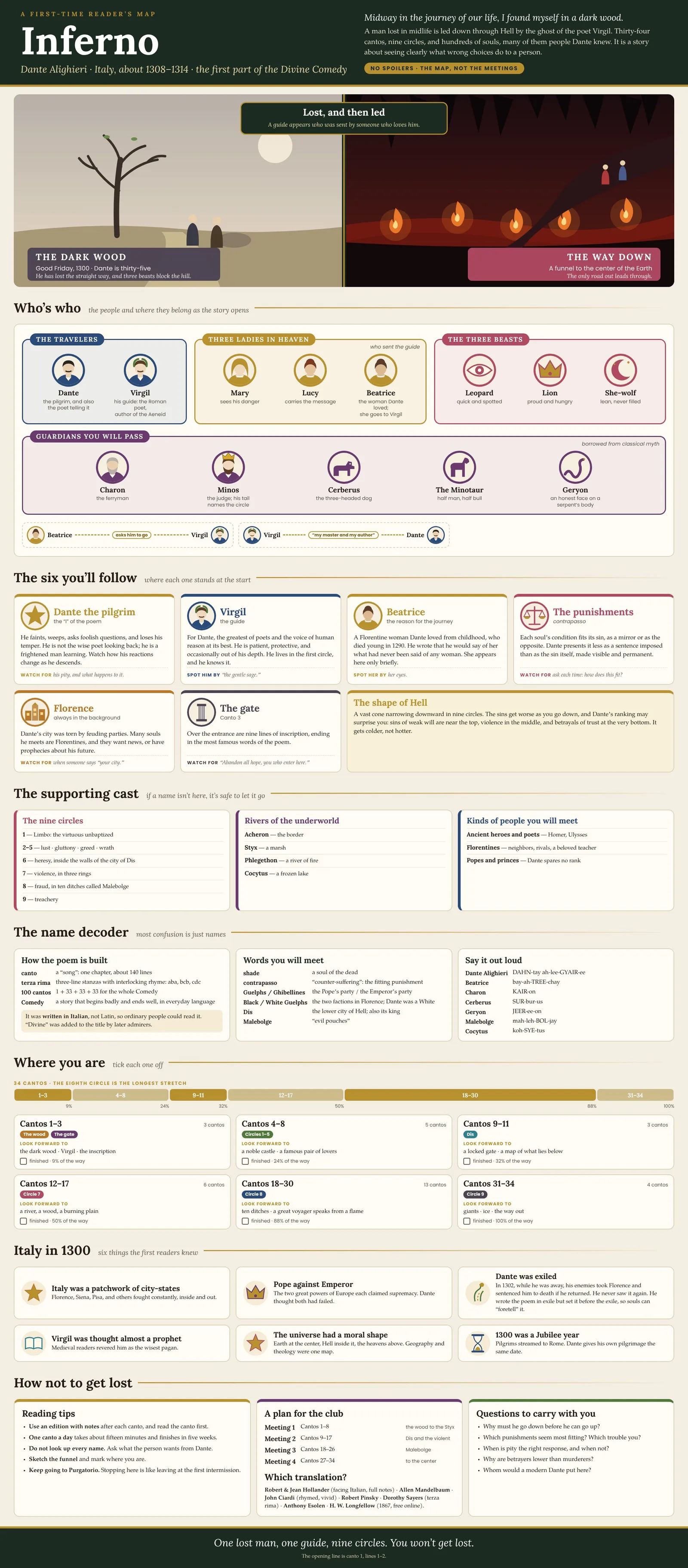
A man lost in midlife is led down through Hell by the ghost of the poet Virgil. Thirty-four cantos, nine circles, and hundreds of souls, many of them people Dante knew. It is a story about seeing clearly what wrong choices do to a person.
✨ Open this rung of the Great Books Ladder → 🔗 Own page, to share or bookmark 📚 The Divine Comedy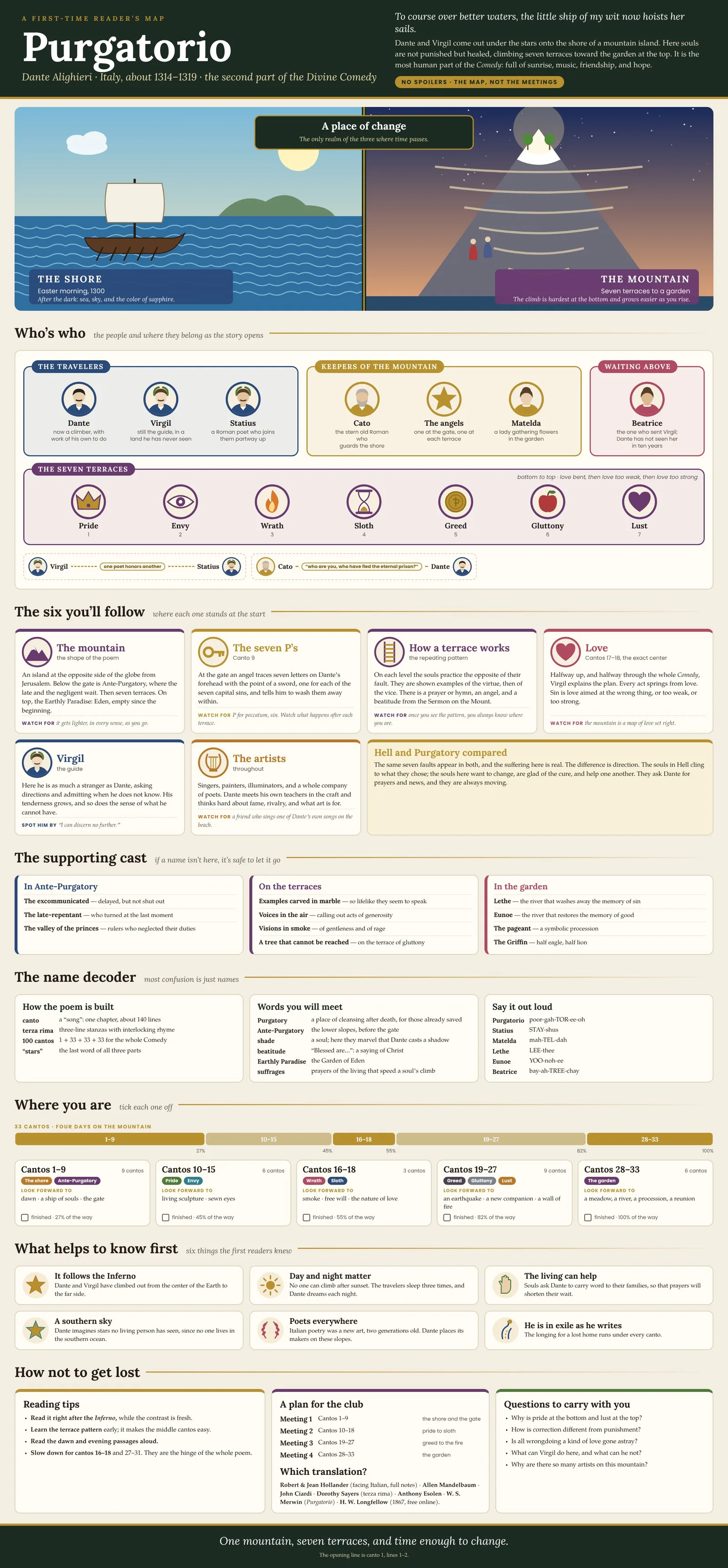
Dante and Virgil come out under the stars onto the shore of a mountain island. Here souls are not punished but healed, climbing seven terraces toward the garden at the top. It is the most human part of the Comedy: full of sunrise, music, friendship, and hope.
✨ Open this rung of the Great Books Ladder → 🔗 Own page, to share or bookmark 📚 The Divine Comedy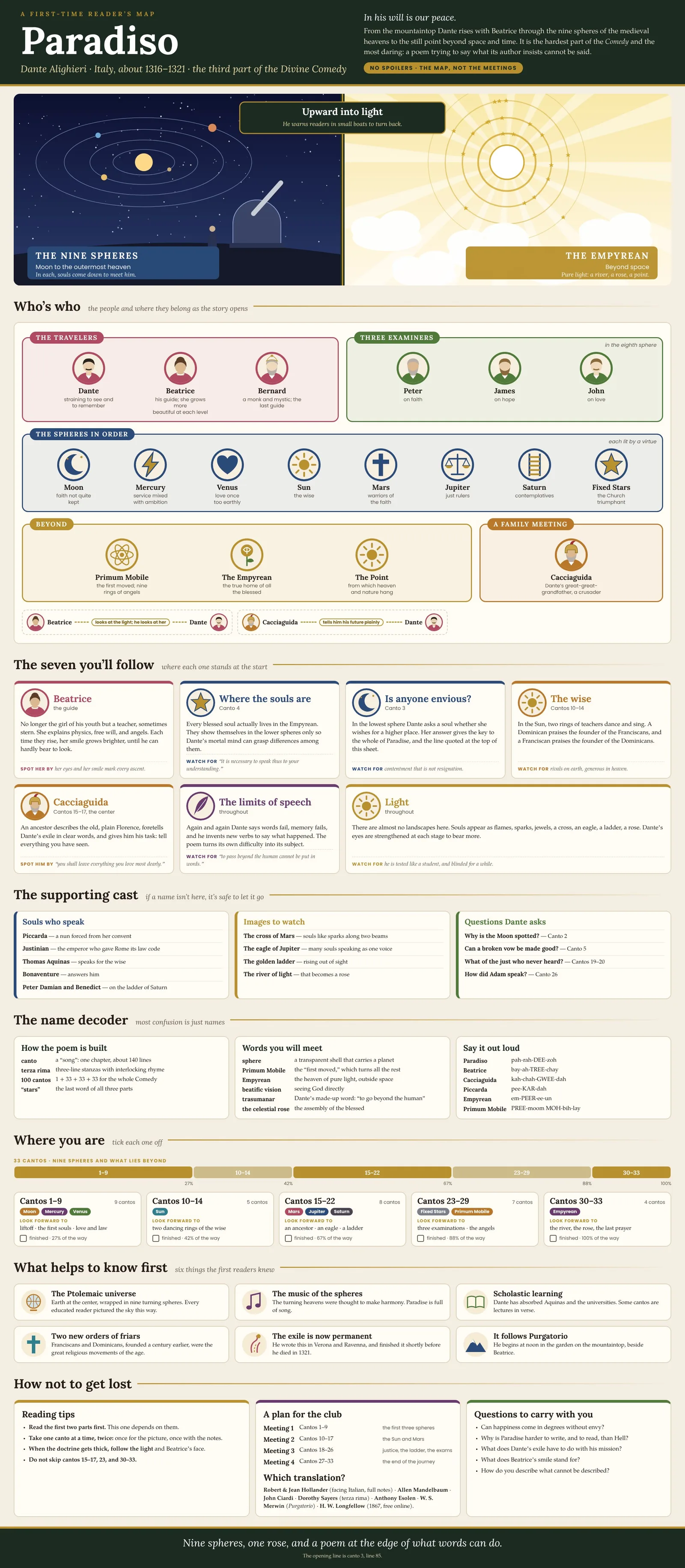
From the mountaintop Dante rises with Beatrice through the nine spheres of the medieval heavens to the still point beyond space and time. It is the hardest part of the Comedy and the most daring: a poem trying to say what its author insists cannot be said.
✨ Open this rung of the Great Books Ladder → 🔗 Own page, to share or bookmark 📚 The Divine Comedy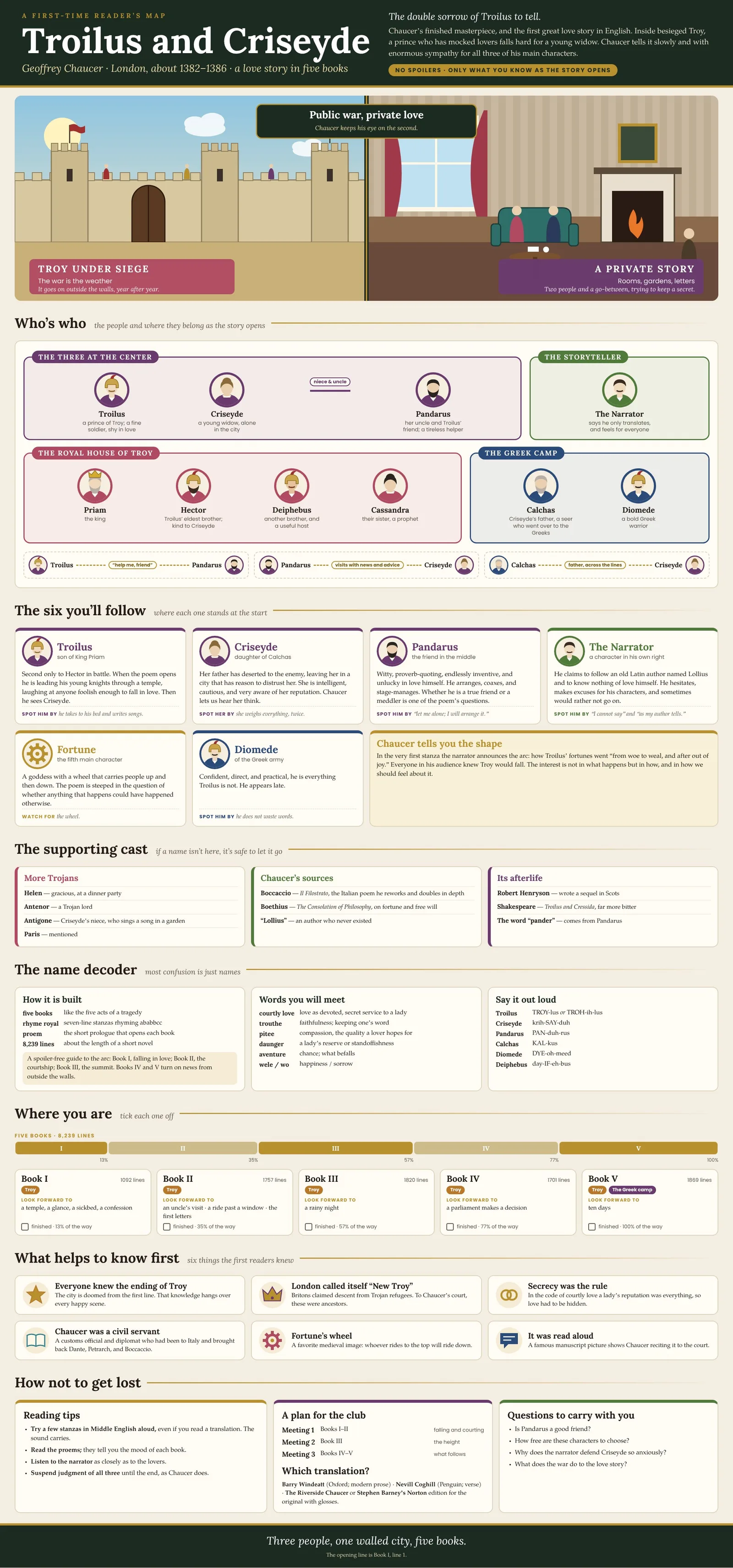
Chaucer’s finished masterpiece, and the first great love story in English. Inside besieged Troy, a prince who has mocked lovers falls hard for a young widow. Chaucer tells it slowly and with enormous sympathy for all three of his main characters.
✨ Open this rung of the Great Books Ladder → 🔗 Own page, to share or bookmark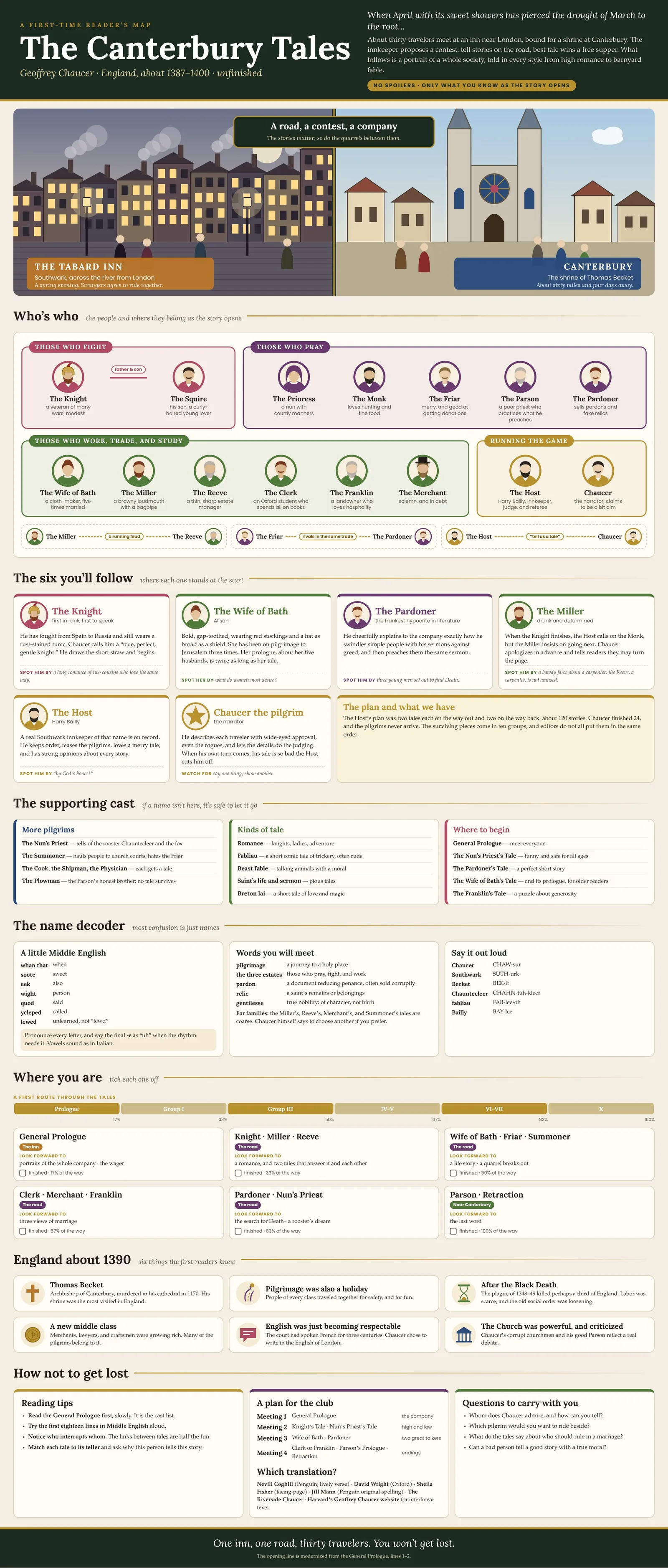
About thirty travelers meet at an inn near London, bound for a shrine at Canterbury. The innkeeper proposes a contest: tell stories on the road, best tale wins a free supper. What follows is a portrait of a whole society, told in every style from high romance to barnyard fable.
✨ Open this rung of the Great Books Ladder → 🔗 Own page, to share or bookmark 📚 The Canterbury TalesRenaissance and Reformation 18 maps · the rungs →
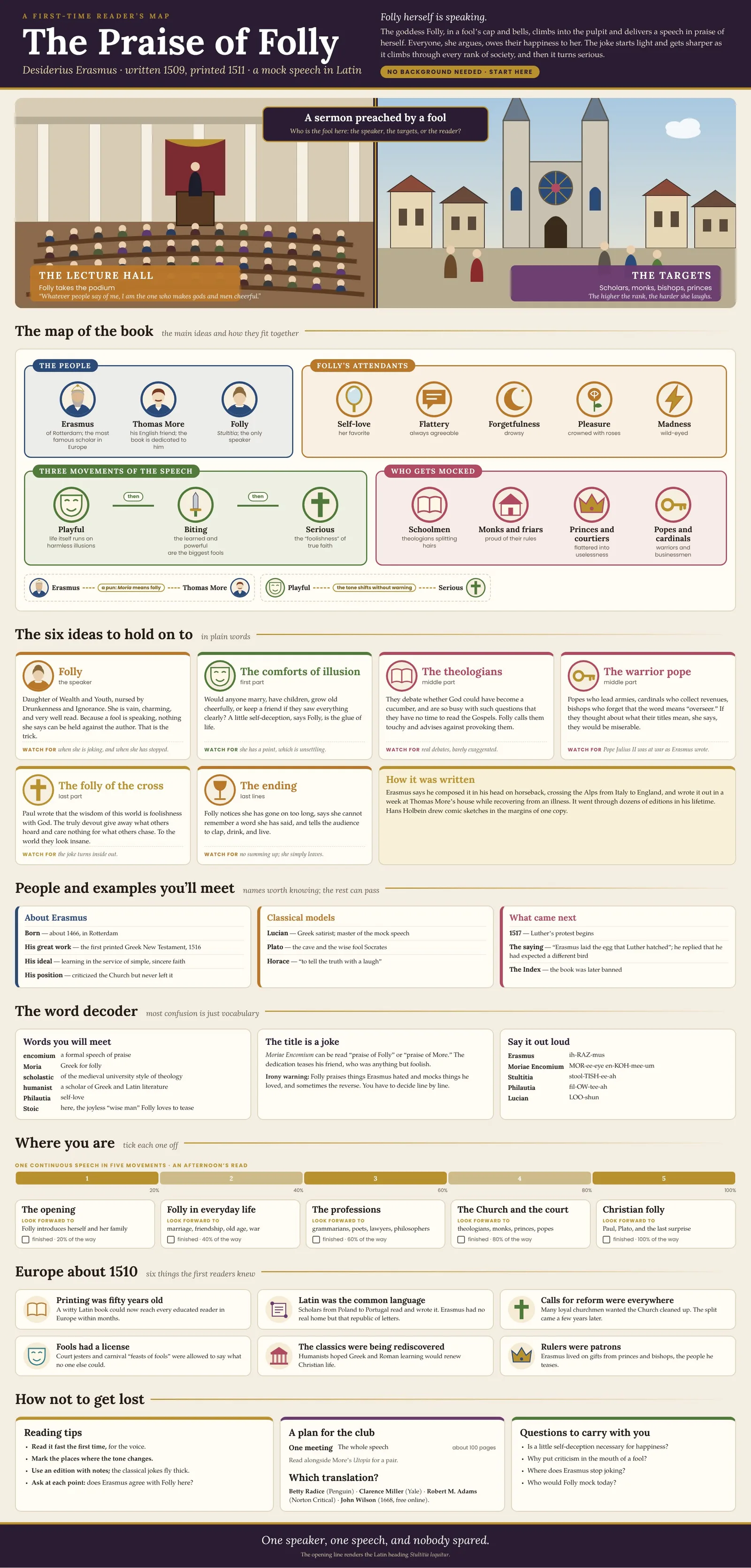
The goddess Folly, in a fool’s cap and bells, climbs into the pulpit and delivers a speech in praise of herself. Everyone, she argues, owes their happiness to her. The joke starts light and gets sharper as it climbs through every rank of society, and then it turns serious.
✨ Open this rung of the Great Books Ladder → 🔗 Own page, to share or bookmark 📚 Utopia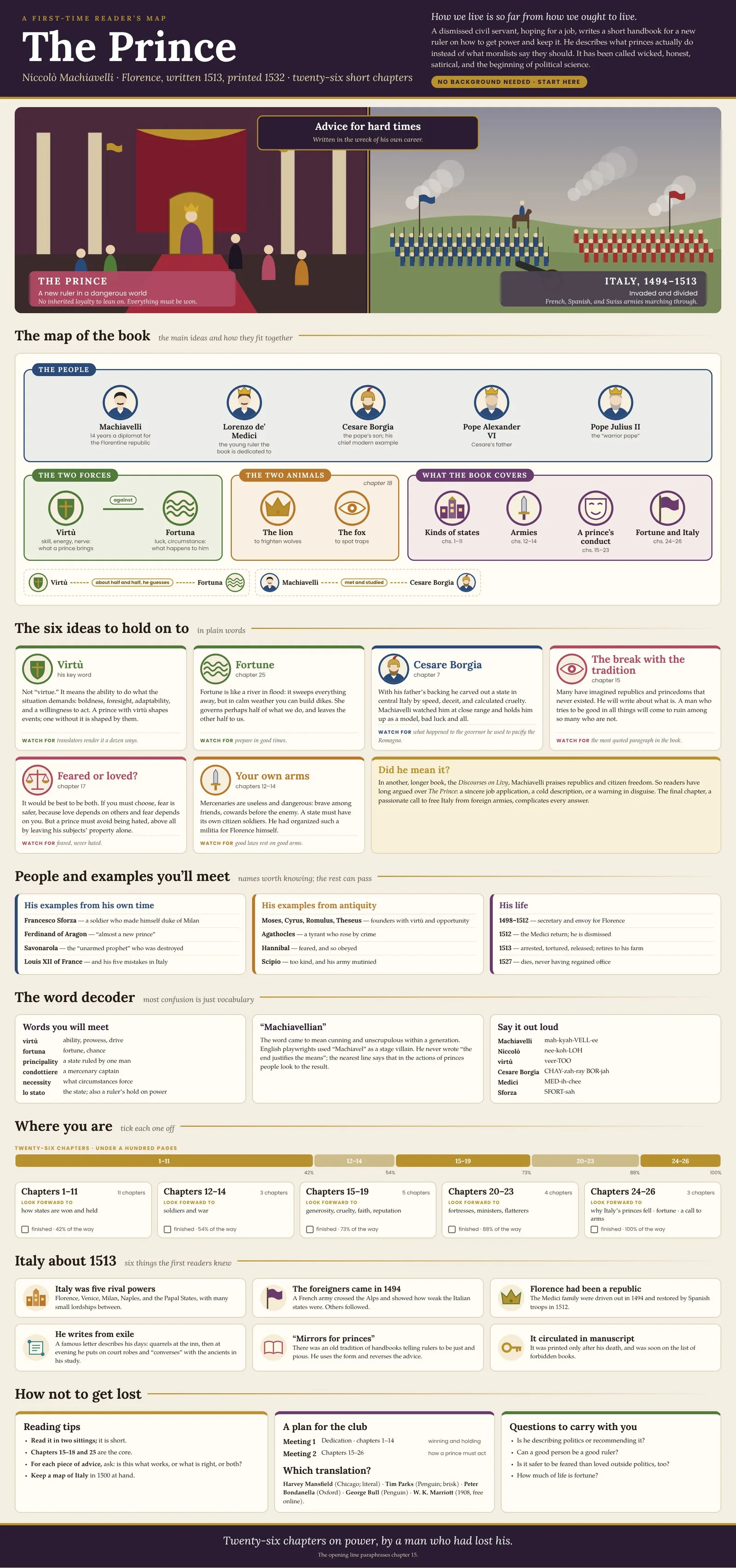
A dismissed civil servant, hoping for a job, writes a short handbook for a new ruler on how to get power and keep it. He describes what princes actually do instead of what moralists say they should. It has been called wicked, honest, satirical, and the beginning of political science.
✨ Open this rung of the Great Books Ladder → 🔗 Own page, to share or bookmark 📚 The Prince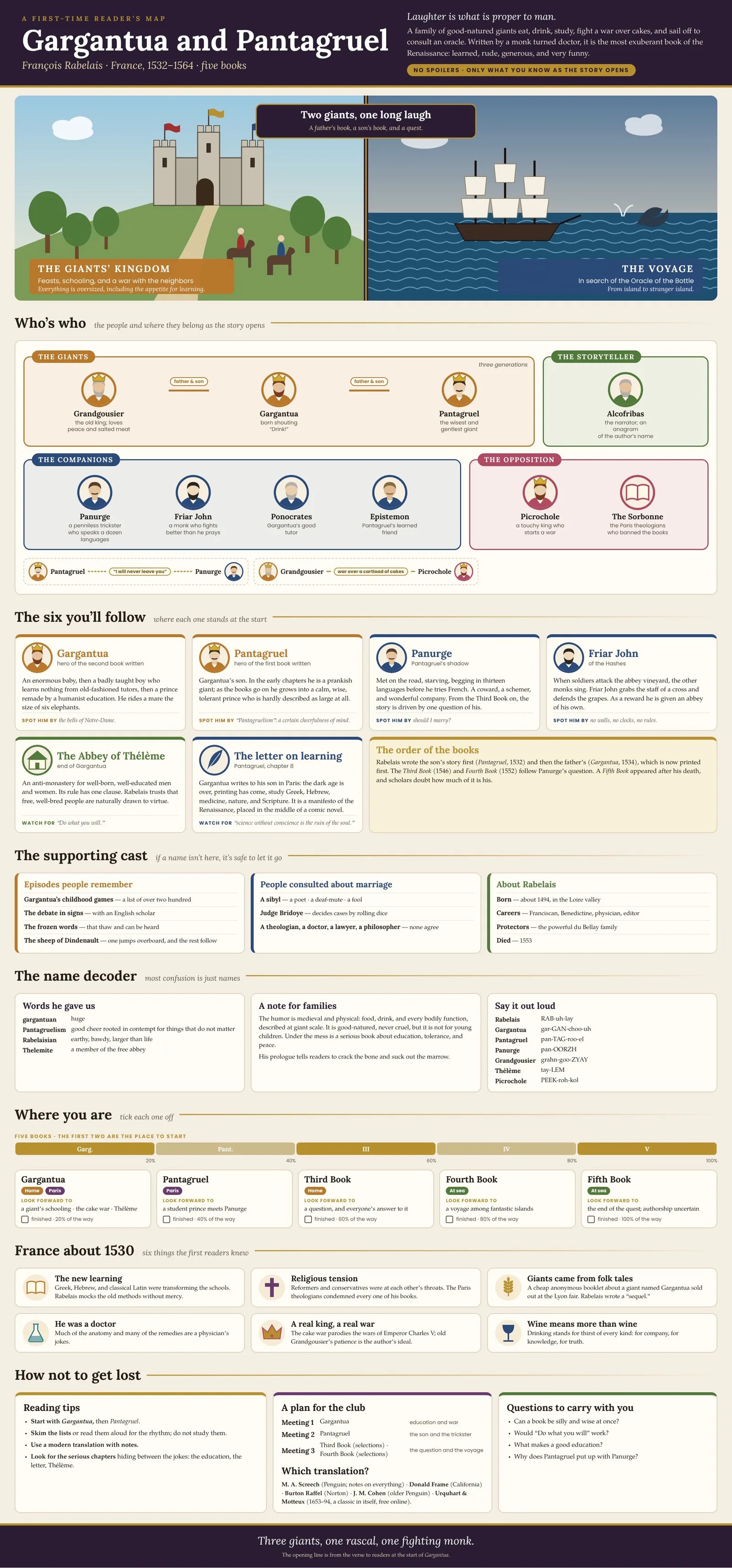
A family of good-natured giants eat, drink, study, fight a war over cakes, and sail off to consult an oracle. Written by a monk turned doctor, it is the most exuberant book of the Renaissance: learned, rude, generous, and very funny.
✨ Open this rung of the Great Books Ladder → 🔗 Own page, to share or bookmark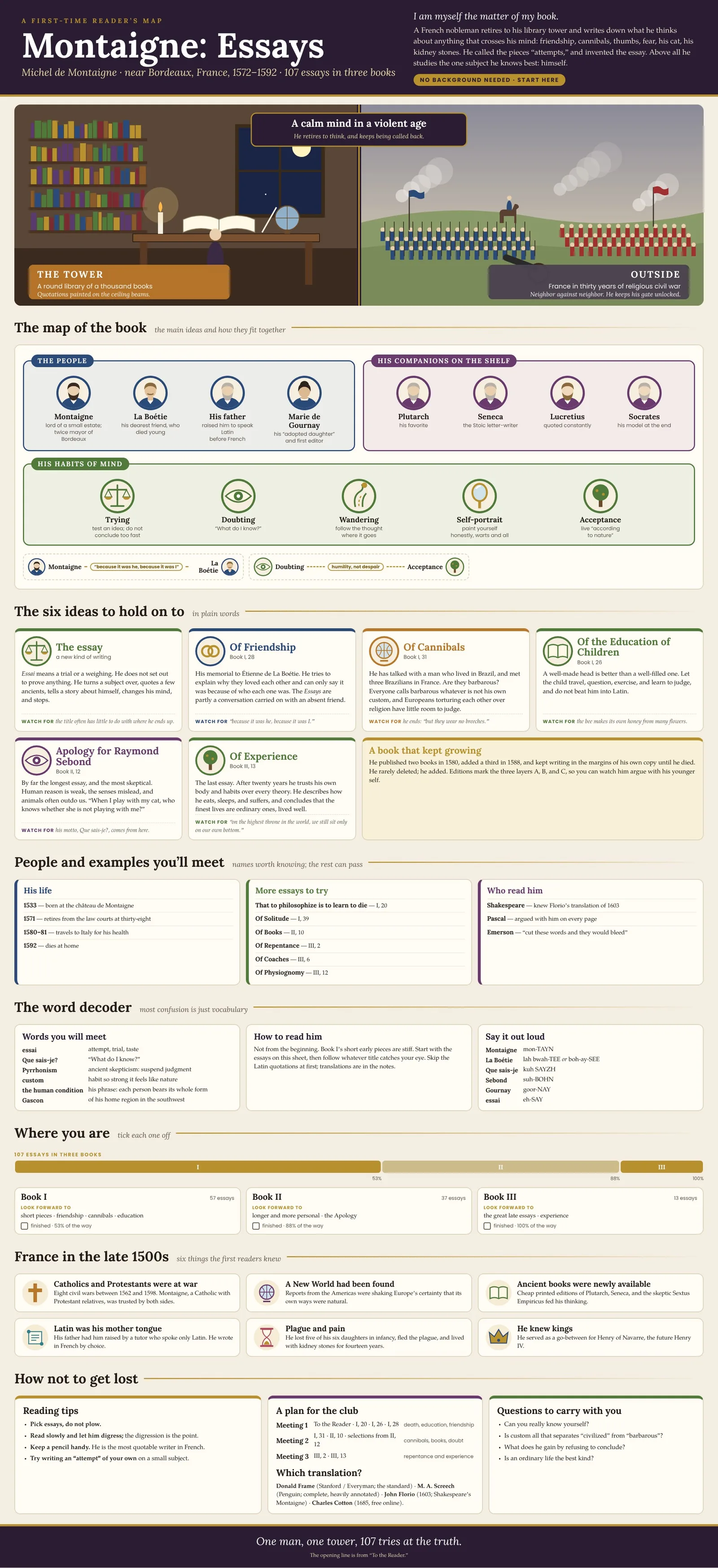
A French nobleman retires to his library tower and writes down what he thinks about anything that crosses his mind: friendship, cannibals, thumbs, fear, his cat, his kidney stones. He called the pieces “attempts,” and invented the essay. Above all he studies the one subject he knows best: himself.
✨ Open this rung of the Great Books Ladder → 🔗 Own page, to share or bookmark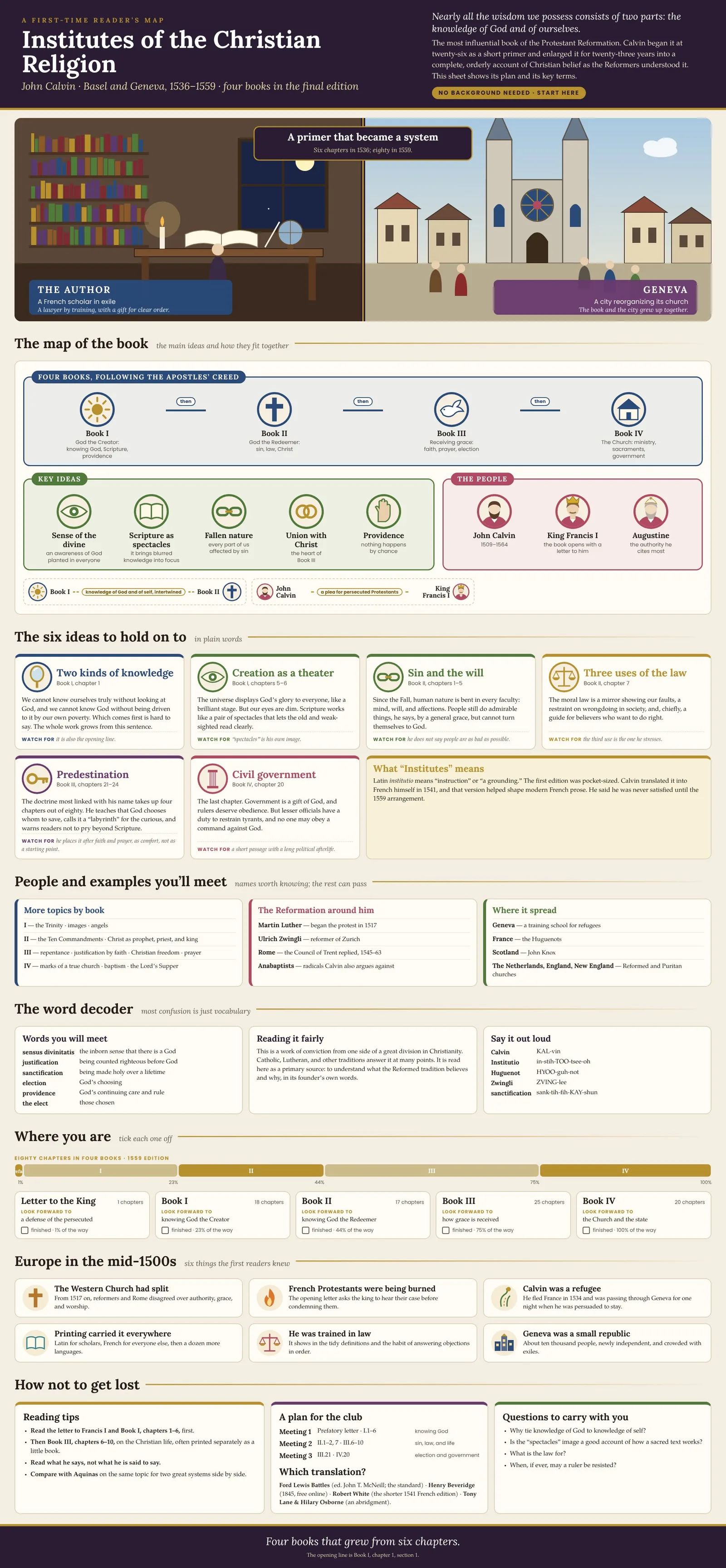
The most influential book of the Protestant Reformation. Calvin began it at twenty-six as a short primer and enlarged it for twenty-three years into a complete, orderly account of Christian belief as the Reformers understood it. This sheet shows its plan and its key terms.
✨ Open this rung of the Great Books Ladder → 🔗 Own page, to share or bookmark 📚 Institutes of the Christian Religion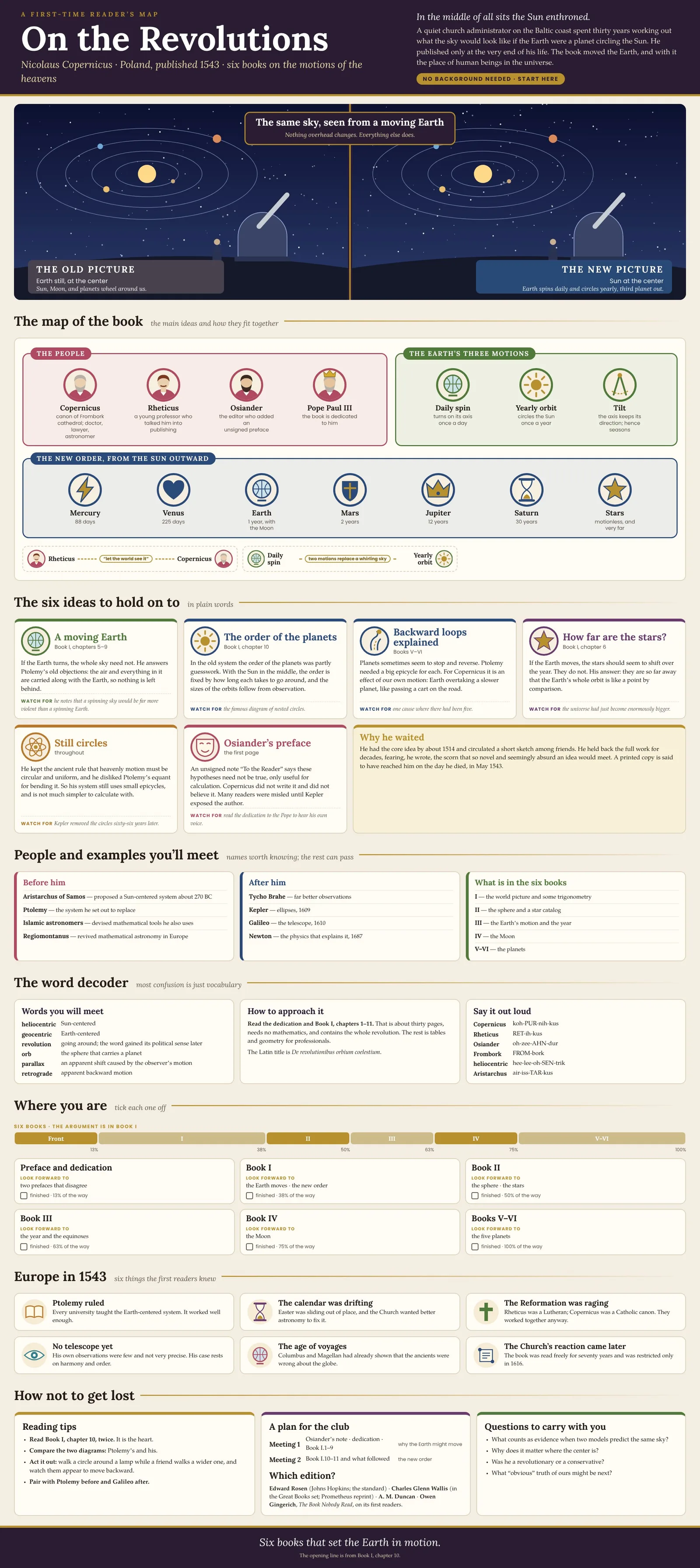
A quiet church administrator on the Baltic coast spent thirty years working out what the sky would look like if the Earth were a planet circling the Sun. He published only at the very end of his life. The book moved the Earth, and with it the place of human beings in the universe.
✨ Open this rung of the Great Books Ladder → 🔗 Own page, to share or bookmark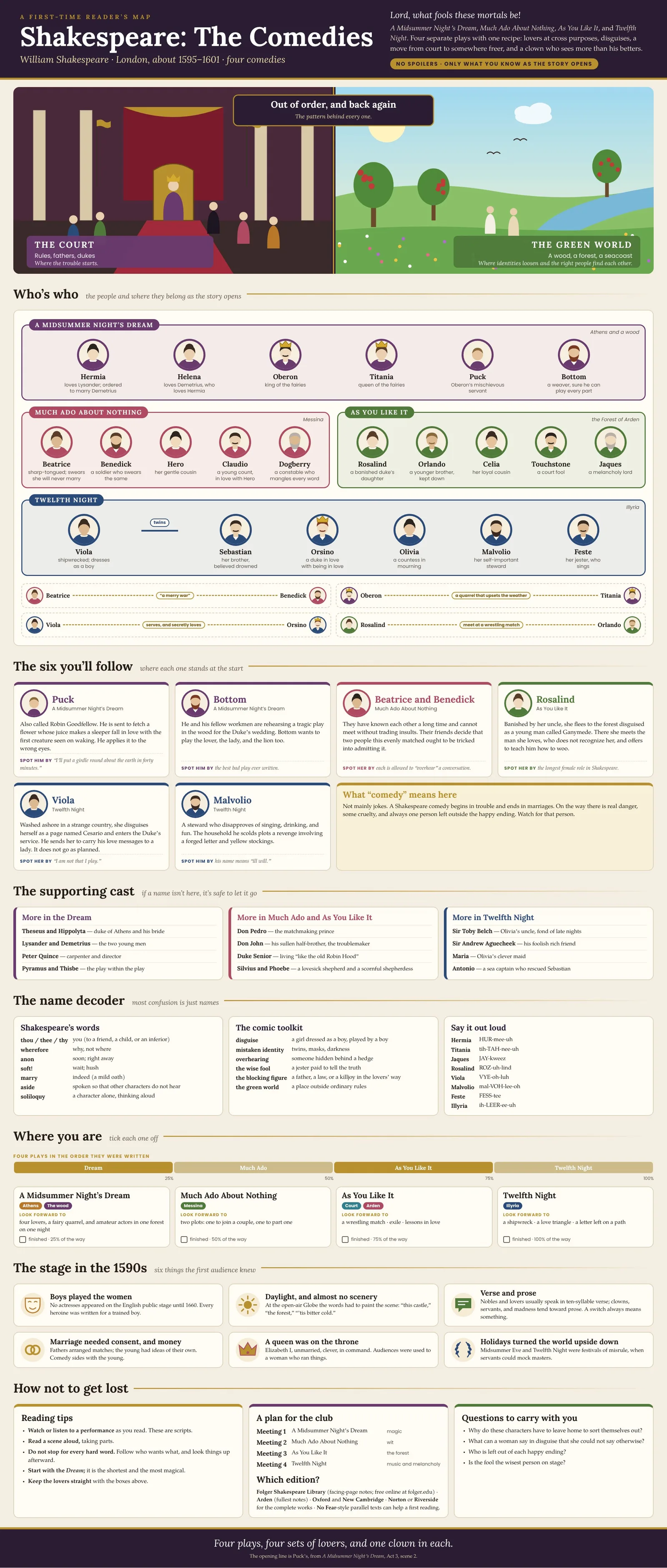
A Midsummer Night’s Dream, Much Ado About Nothing, As You Like It, and Twelfth Night. Four separate plays with one recipe: lovers at cross purposes, disguises, a move from court to somewhere freer, and a clown who sees more than his betters.
✨ Open this rung of the Great Books Ladder → 🔗 Own page, to share or bookmark 📚 The Complete Works of William Shakespeare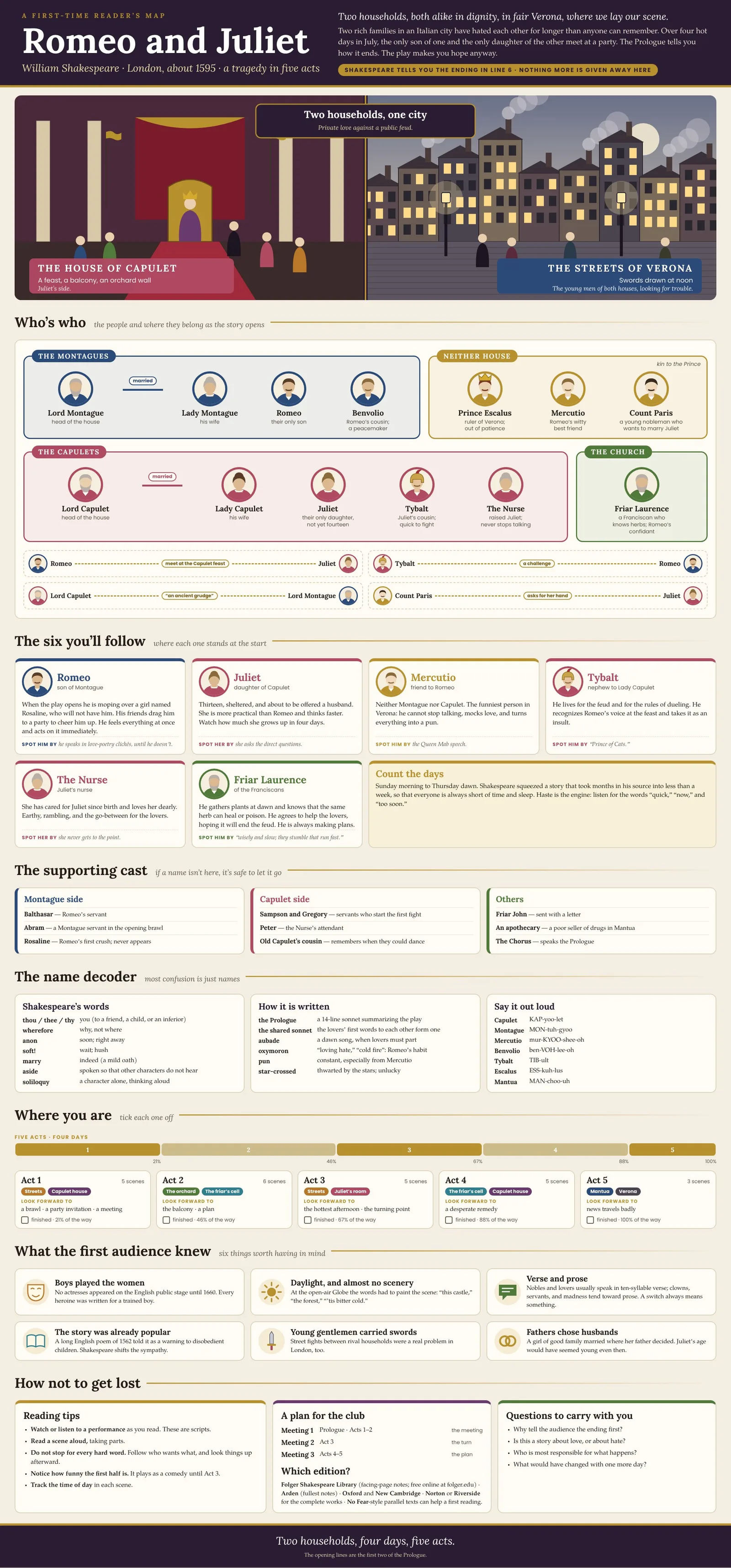
Two rich families in an Italian city have hated each other for longer than anyone can remember. Over four hot days in July, the only son of one and the only daughter of the other meet at a party. The Prologue tells you how it ends. The play makes you hope anyway.
✨ Open this rung of the Great Books Ladder → 🔗 Own page, to share or bookmark 📚 The Complete Works of William Shakespeare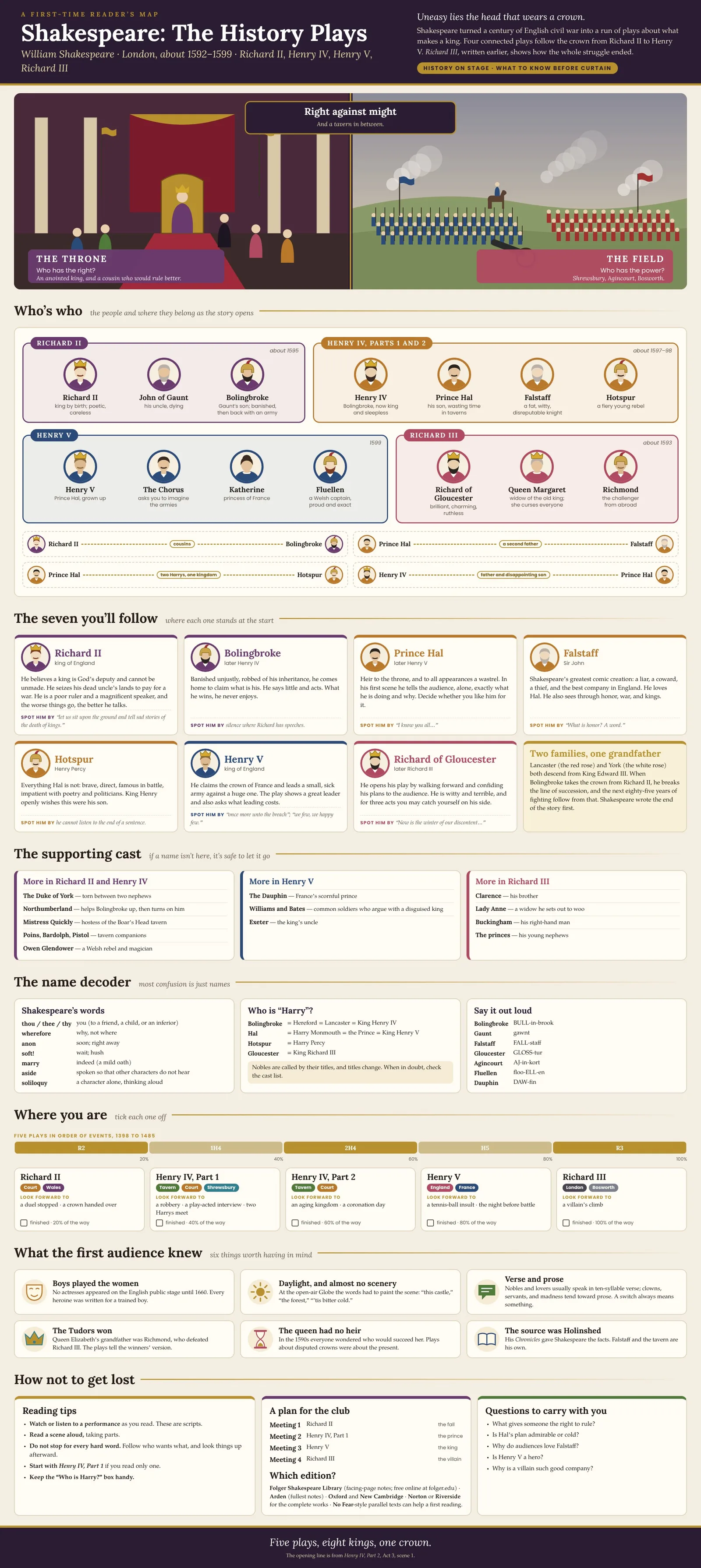
Shakespeare turned a century of English civil war into a run of plays about what makes a king. Four connected plays follow the crown from Richard II to Henry V. Richard III, written earlier, shows how the whole struggle ended.
✨ Open this rung of the Great Books Ladder → 🔗 Own page, to share or bookmark 📚 The Complete Works of William Shakespeare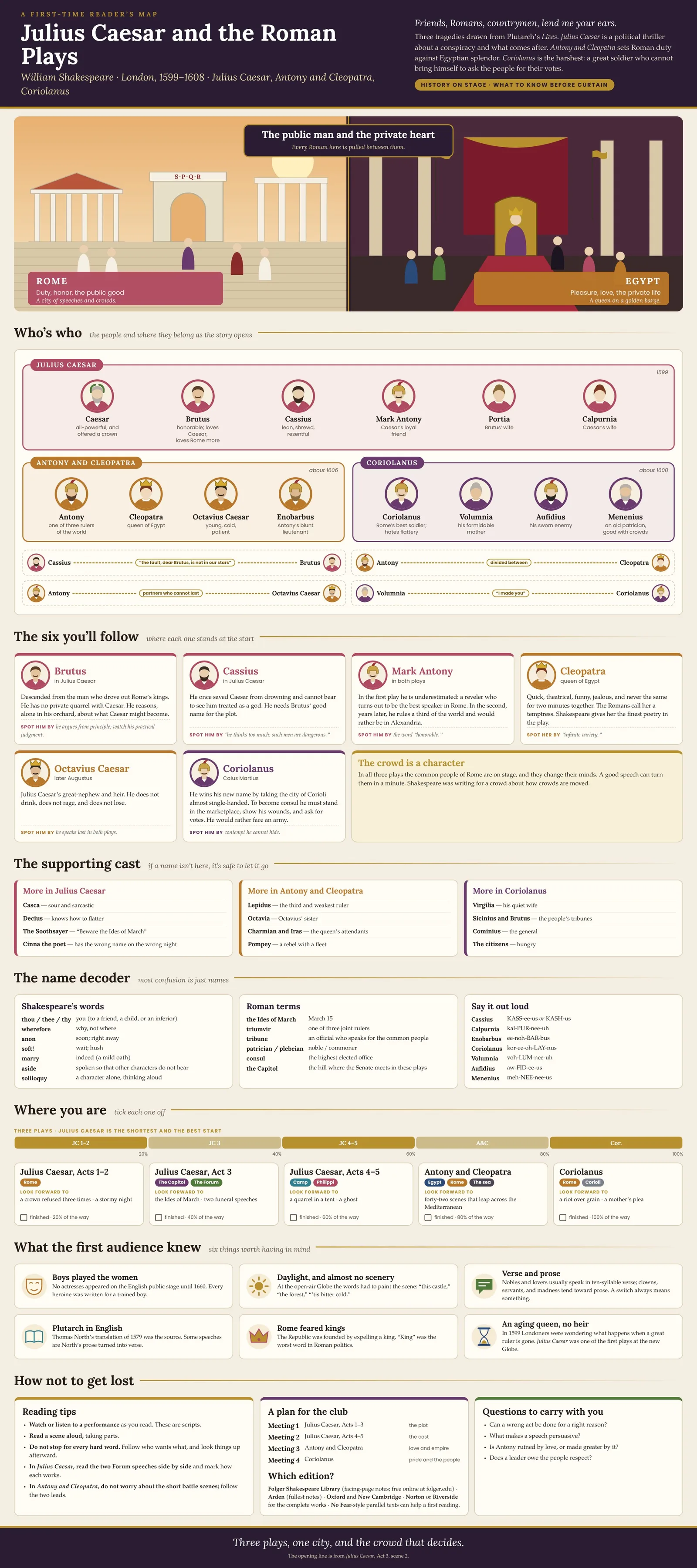
Three tragedies drawn from Plutarch’s Lives. Julius Caesar is a political thriller about a conspiracy and what comes after. Antony and Cleopatra sets Roman duty against Egyptian splendor. Coriolanus is the harshest: a great soldier who cannot bring himself to ask the people for their votes.
✨ Open this rung of the Great Books Ladder → 🔗 Own page, to share or bookmark 📚 Plutarch's Lives · The Complete Works of William Shakespeare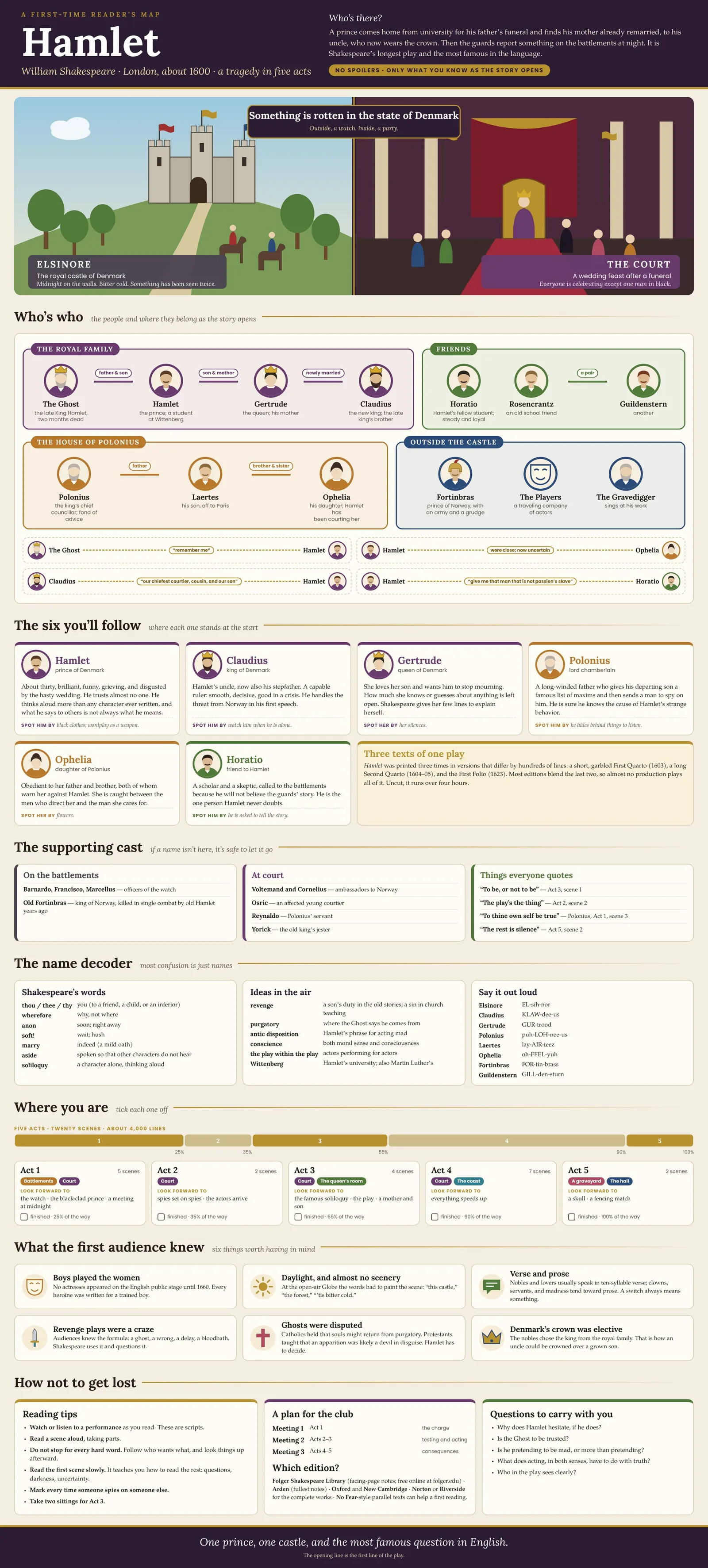
A prince comes home from university for his father’s funeral and finds his mother already remarried, to his uncle, who now wears the crown. Then the guards report something on the battlements at night. It is Shakespeare’s longest play and the most famous in the language.
✨ Open this rung of the Great Books Ladder → 🔗 Own page, to share or bookmark 📚 Hamlet · The Complete Works of William Shakespeare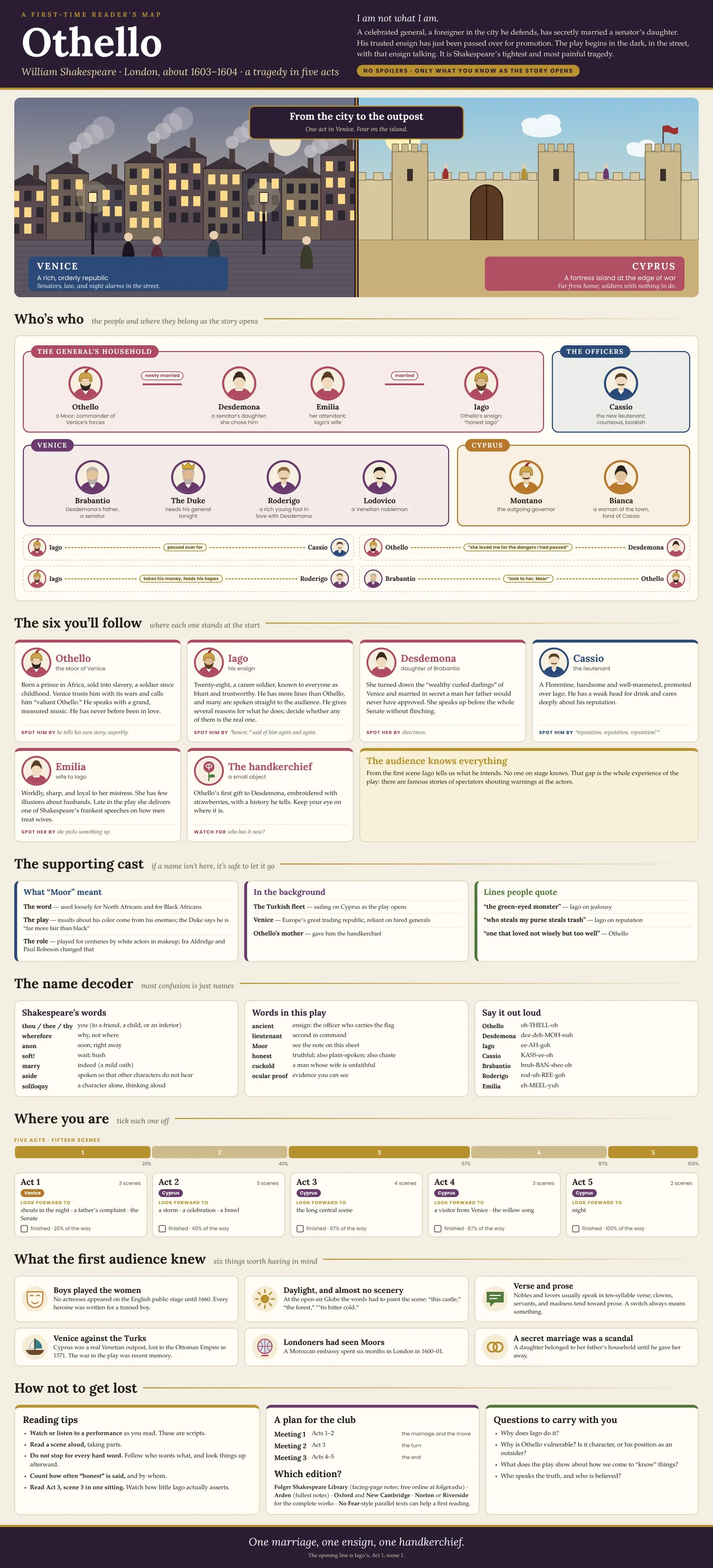
A celebrated general, a foreigner in the city he defends, has secretly married a senator’s daughter. His trusted ensign has just been passed over for promotion. The play begins in the dark, in the street, with that ensign talking. It is Shakespeare’s tightest and most painful tragedy.
✨ Open this rung of the Great Books Ladder → 🔗 Own page, to share or bookmark 📚 The Complete Works of William Shakespeare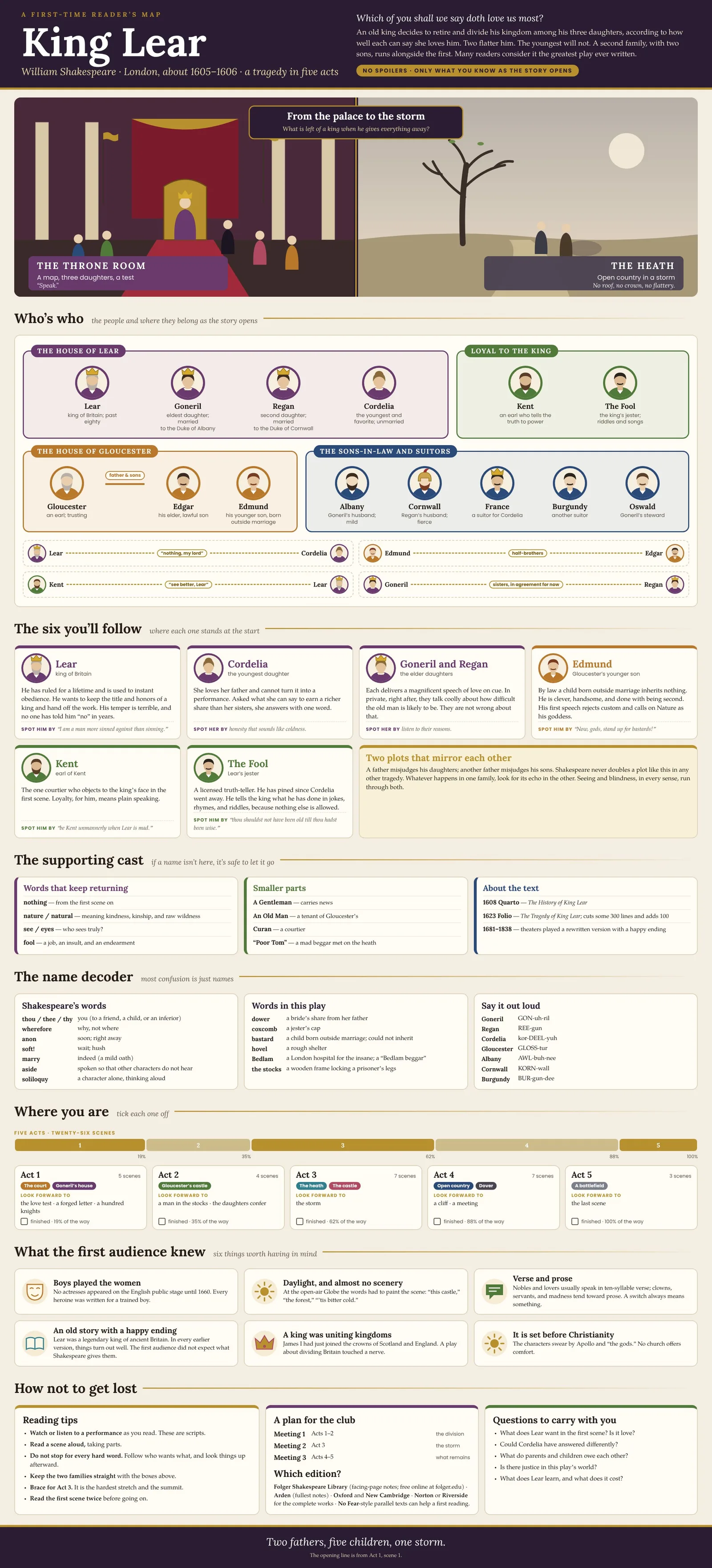
An old king decides to retire and divide his kingdom among his three daughters, according to how well each can say she loves him. Two flatter him. The youngest will not. A second family, with two sons, runs alongside the first. Many readers consider it the greatest play ever written.
✨ Open this rung of the Great Books Ladder → 🔗 Own page, to share or bookmark 📚 The Complete Works of William Shakespeare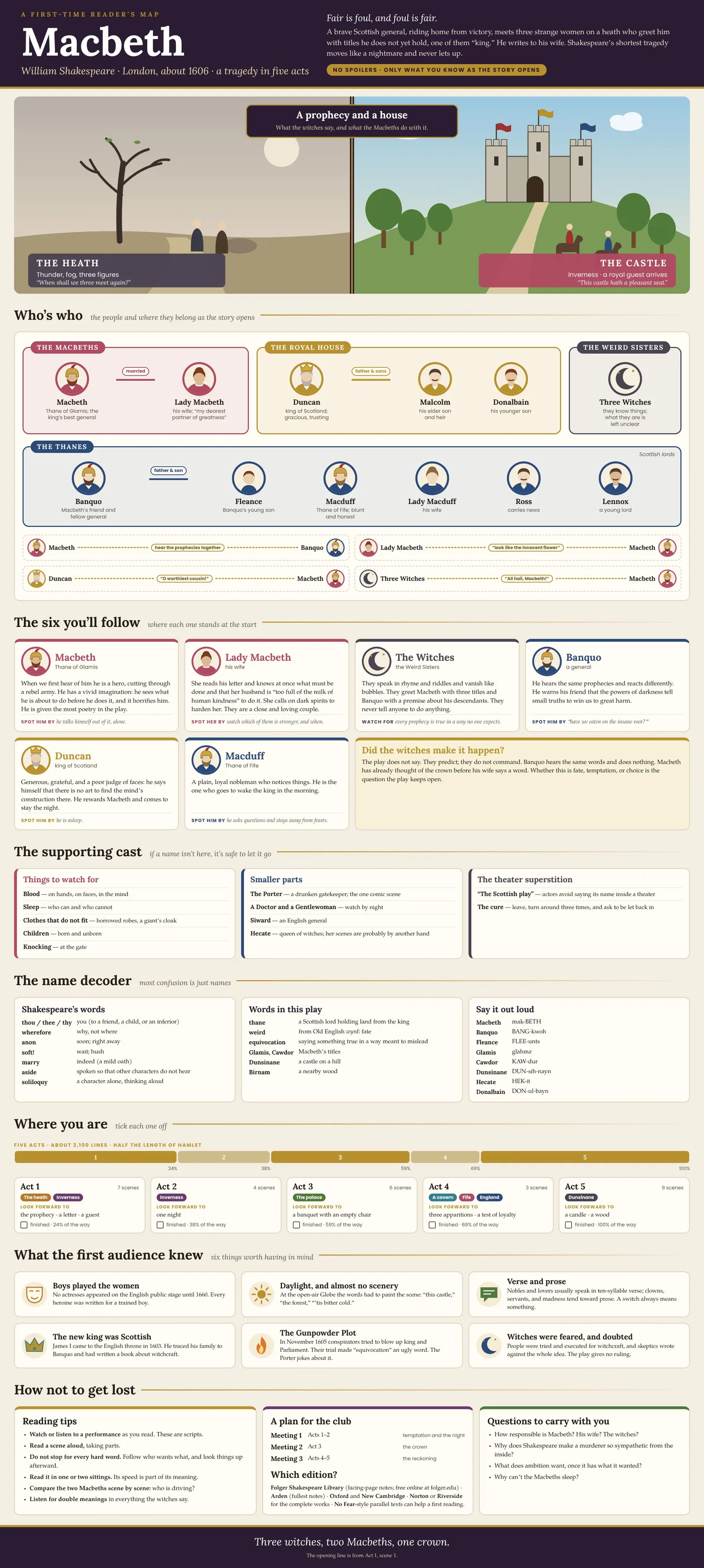
A brave Scottish general, riding home from victory, meets three strange women on a heath who greet him with titles he does not yet hold, one of them “king.” He writes to his wife. Shakespeare’s shortest tragedy moves like a nightmare and never lets up.
✨ Open this rung of the Great Books Ladder → 🔗 Own page, to share or bookmark 📚 Macbeth · The Complete Works of William Shakespeare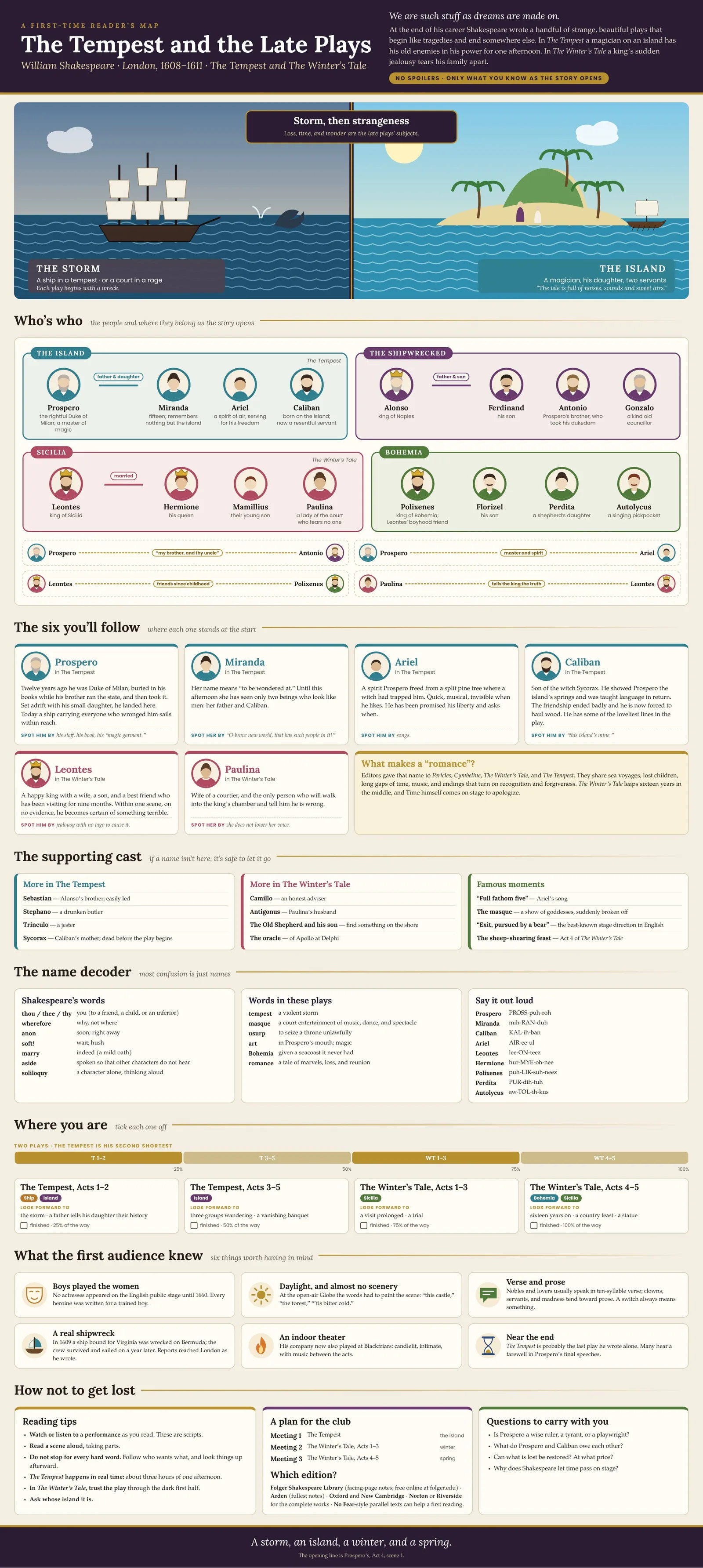
At the end of his career Shakespeare wrote a handful of strange, beautiful plays that begin like tragedies and end somewhere else. In The Tempest a magician on an island has his old enemies in his power for one afternoon. In The Winter’s Tale a king’s sudden jealousy tears his family apart.
✨ Open this rung of the Great Books Ladder → 🔗 Own page, to share or bookmark 📚 The Complete Works of William Shakespeare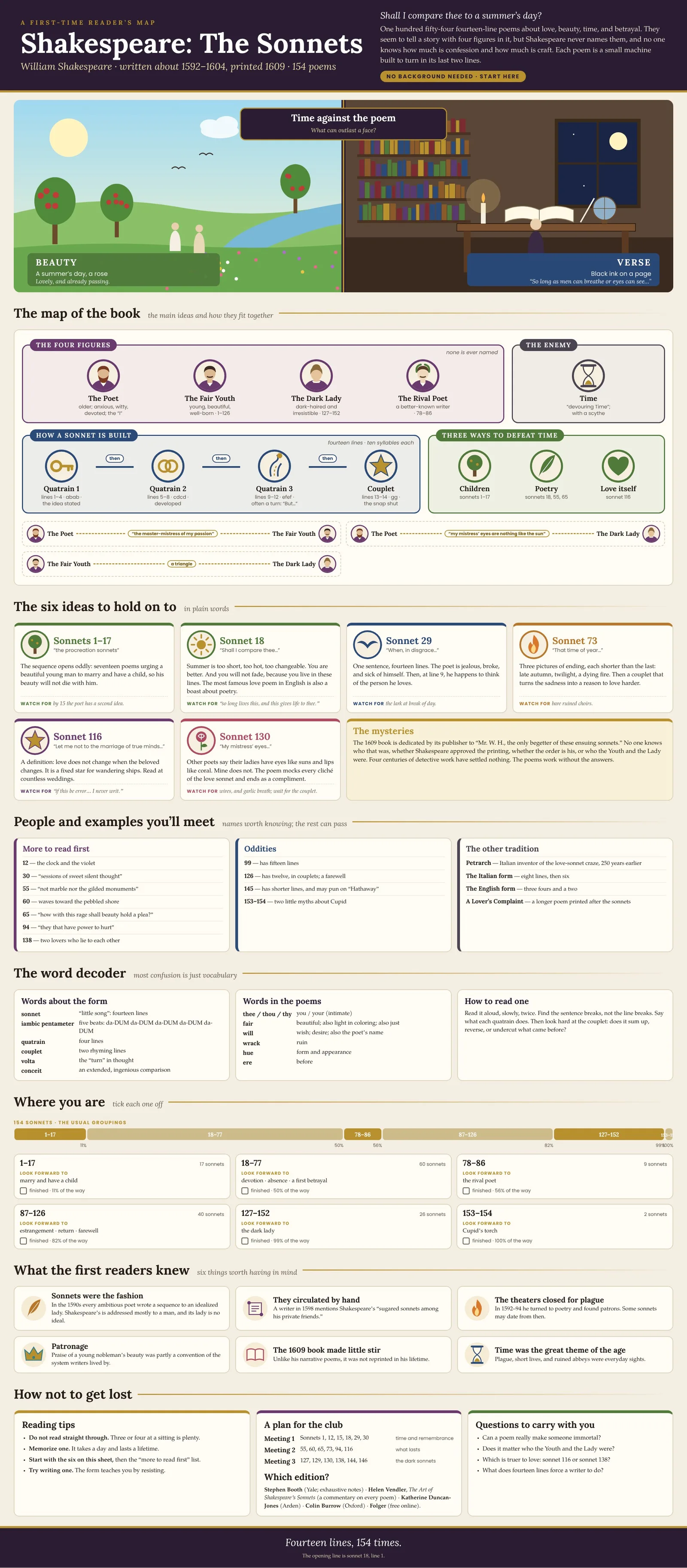
One hundred fifty-four fourteen-line poems about love, beauty, time, and betrayal. They seem to tell a story with four figures in it, but Shakespeare never names them, and no one knows how much is confession and how much is craft. Each poem is a small machine built to turn in its last two lines.
✨ Open this rung of the Great Books Ladder → 🔗 Own page, to share or bookmark 📚 The Complete Works of William Shakespeare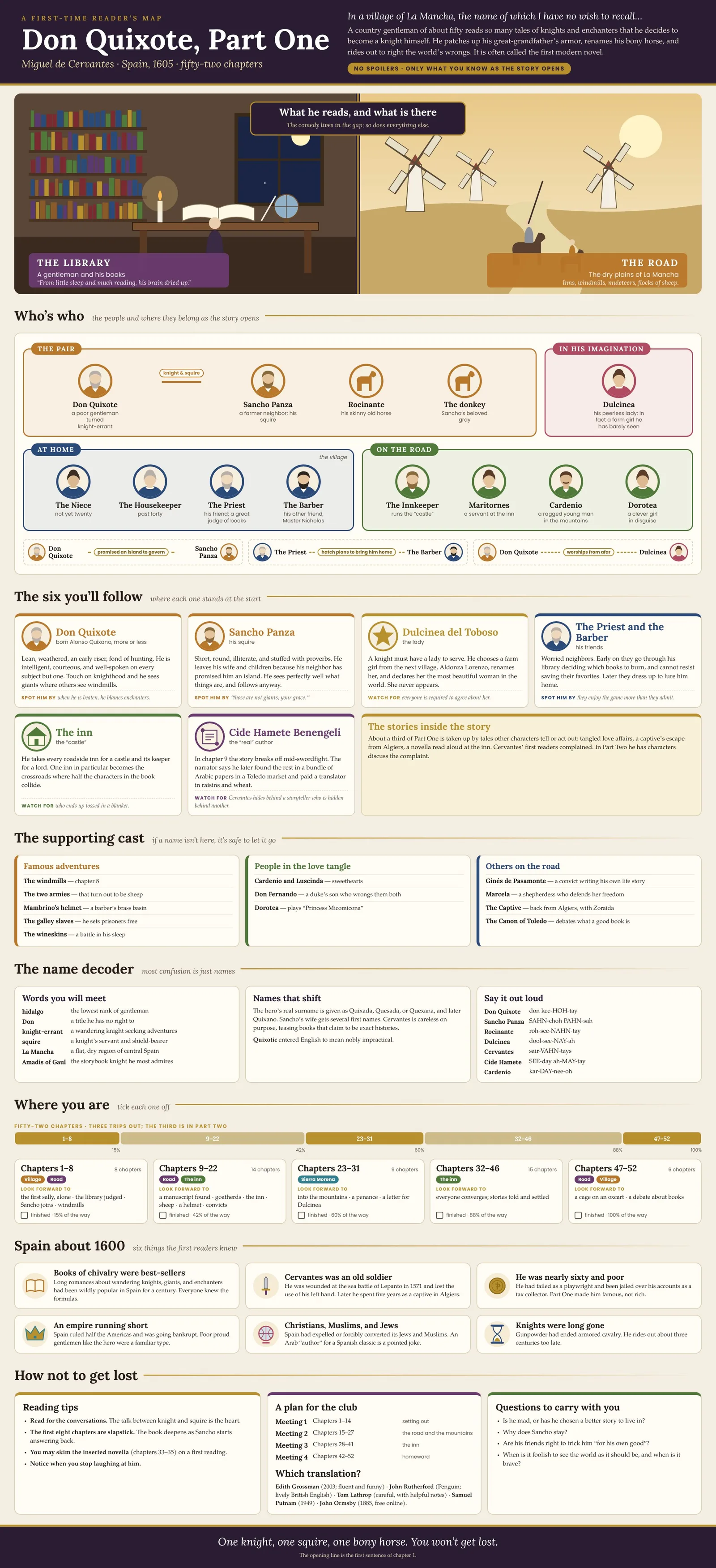
A country gentleman of about fifty reads so many tales of knights and enchanters that he decides to become a knight himself. He patches up his great-grandfather’s armor, renames his bony horse, and rides out to right the world’s wrongs. It is often called the first modern novel.
✨ Open this rung of the Great Books Ladder → 🔗 Own page, to share or bookmark 📚 Don Quixote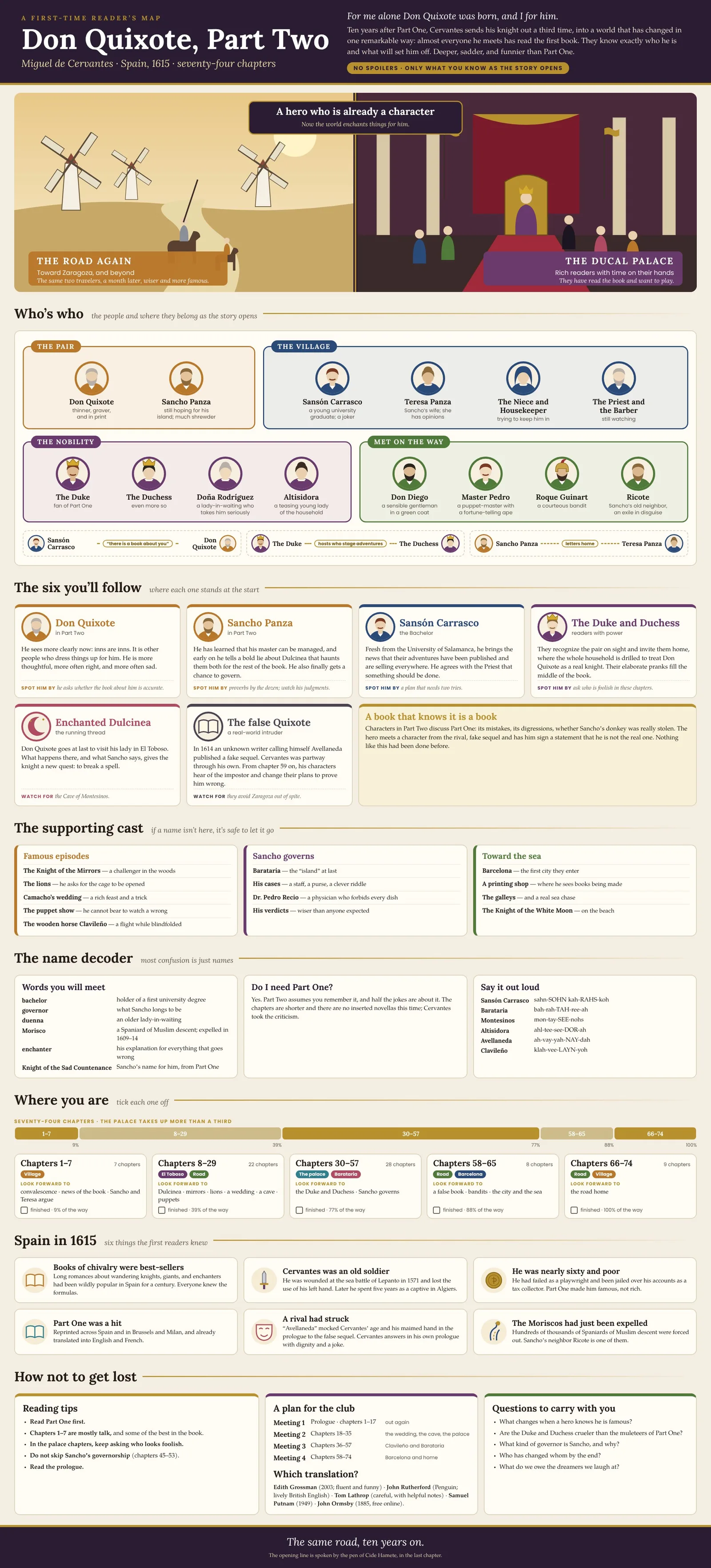
Ten years after Part One, Cervantes sends his knight out a third time, into a world that has changed in one remarkable way: almost everyone he meets has read the first book. They know exactly who he is and what will set him off. Deeper, sadder, and funnier than Part One.
✨ Open this rung of the Great Books Ladder → 🔗 Own page, to share or bookmark 📚 Don QuixoteThe Age of Reason 24 maps · the rungs →
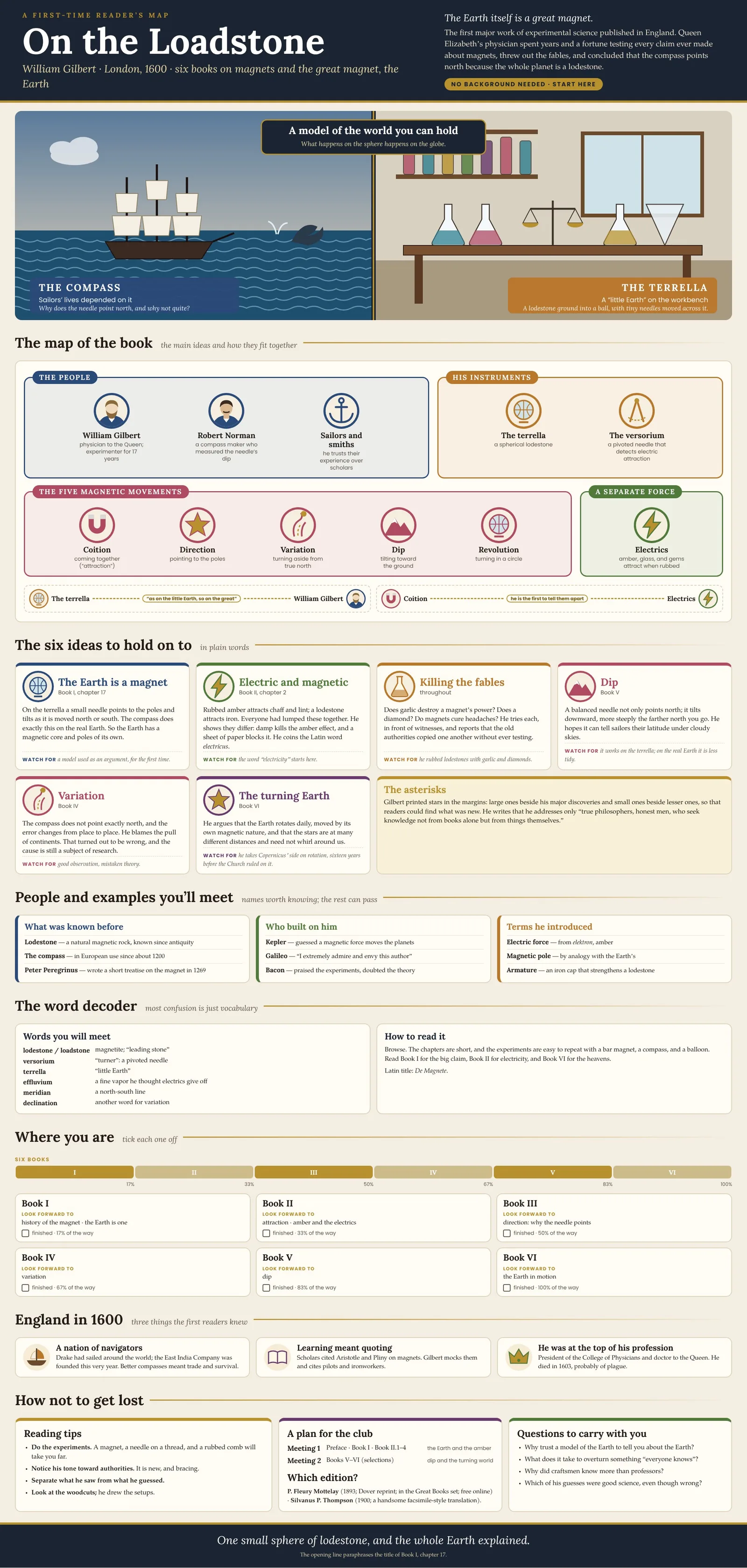
The first major work of experimental science published in England. Queen Elizabeth’s physician spent years and a fortune testing every claim ever made about magnets, threw out the fables, and concluded that the compass points north because the whole planet is a lodestone.
✨ Open this rung of the Great Books Ladder → 🔗 Own page, to share or bookmark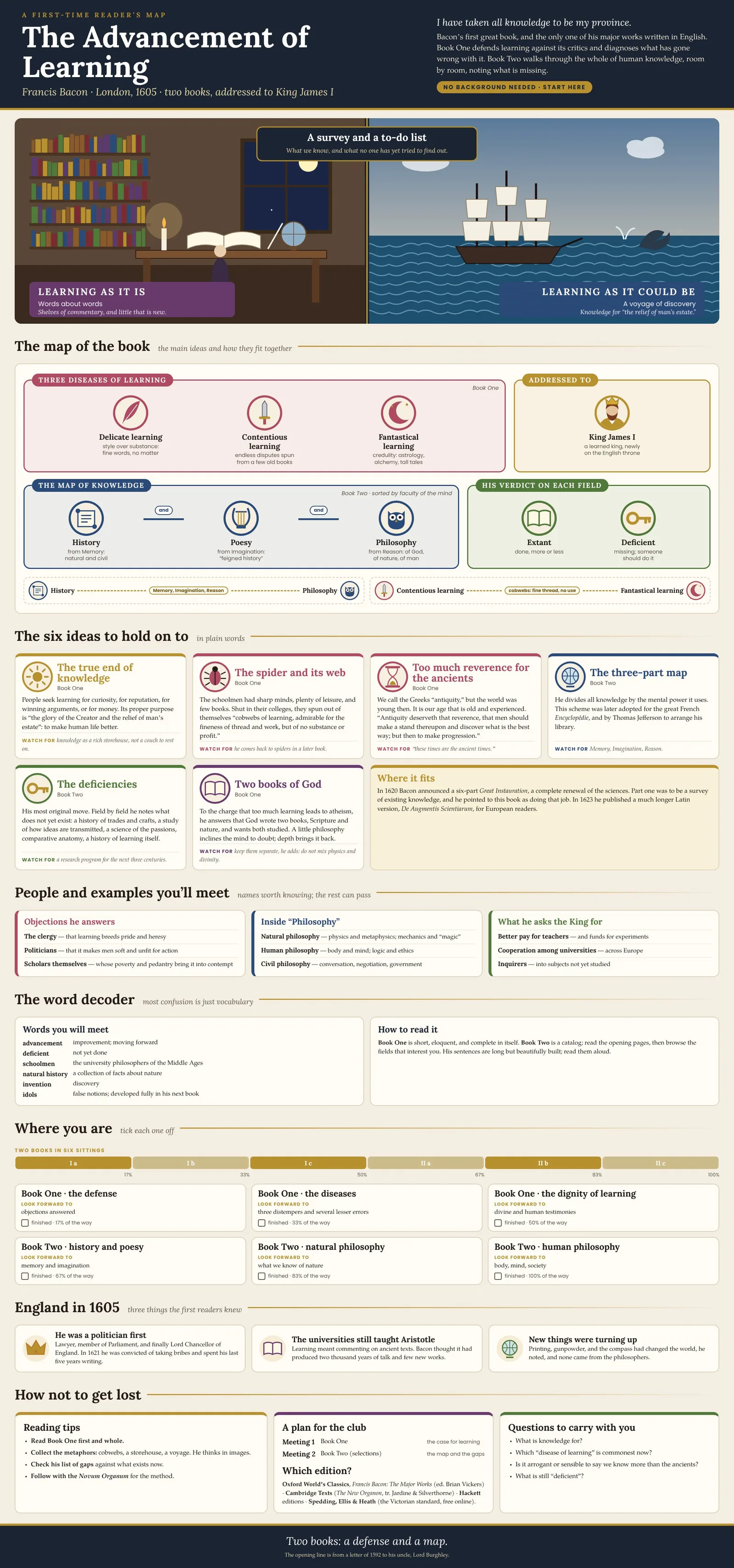
Bacon’s first great book, and the only one of his major works written in English. Book One defends learning against its critics and diagnoses what has gone wrong with it. Book Two walks through the whole of human knowledge, room by room, noting what is missing.
✨ Open this rung of the Great Books Ladder → 🔗 Own page, to share or bookmark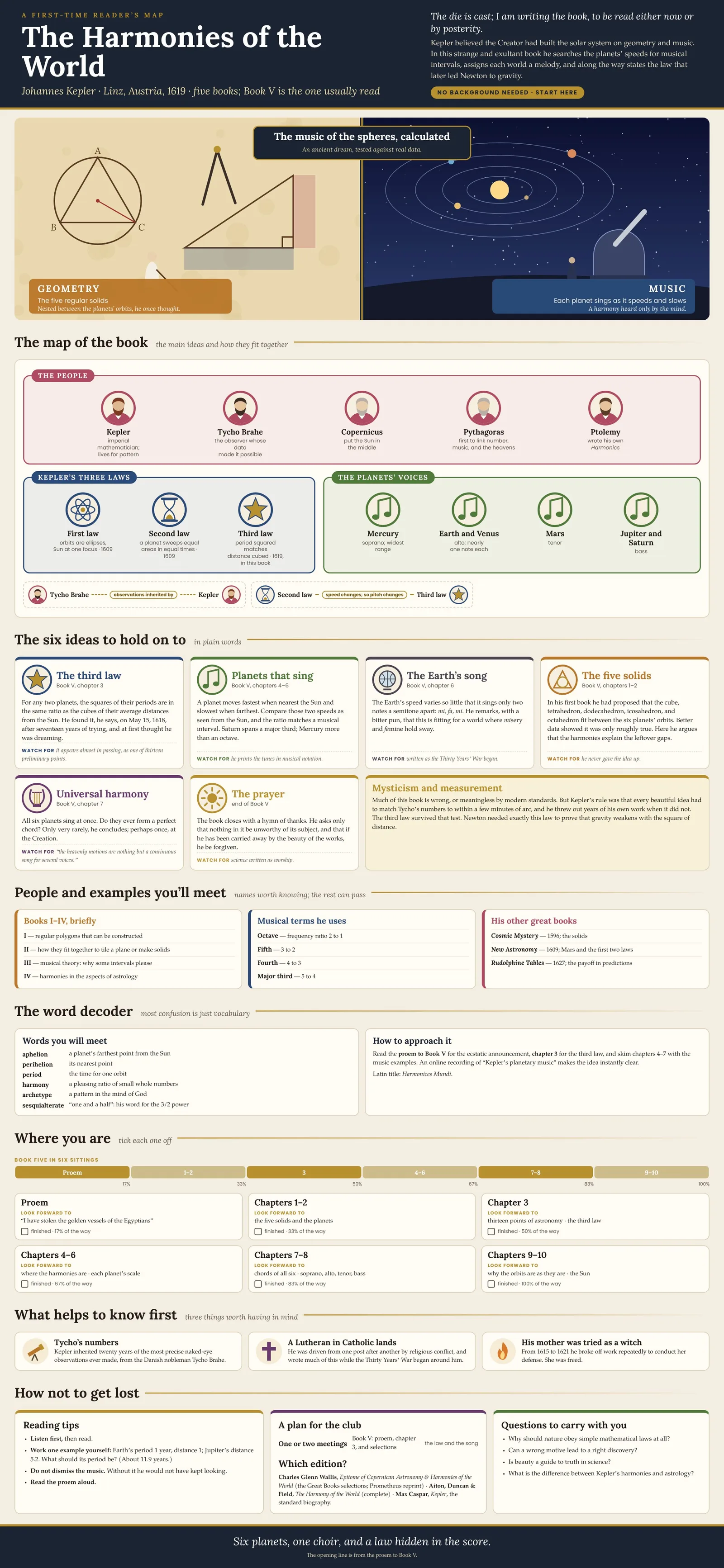
Kepler believed the Creator had built the solar system on geometry and music. In this strange and exultant book he searches the planets’ speeds for musical intervals, assigns each world a melody, and along the way states the law that later led Newton to gravity.
✨ Open this rung of the Great Books Ladder → 🔗 Own page, to share or bookmark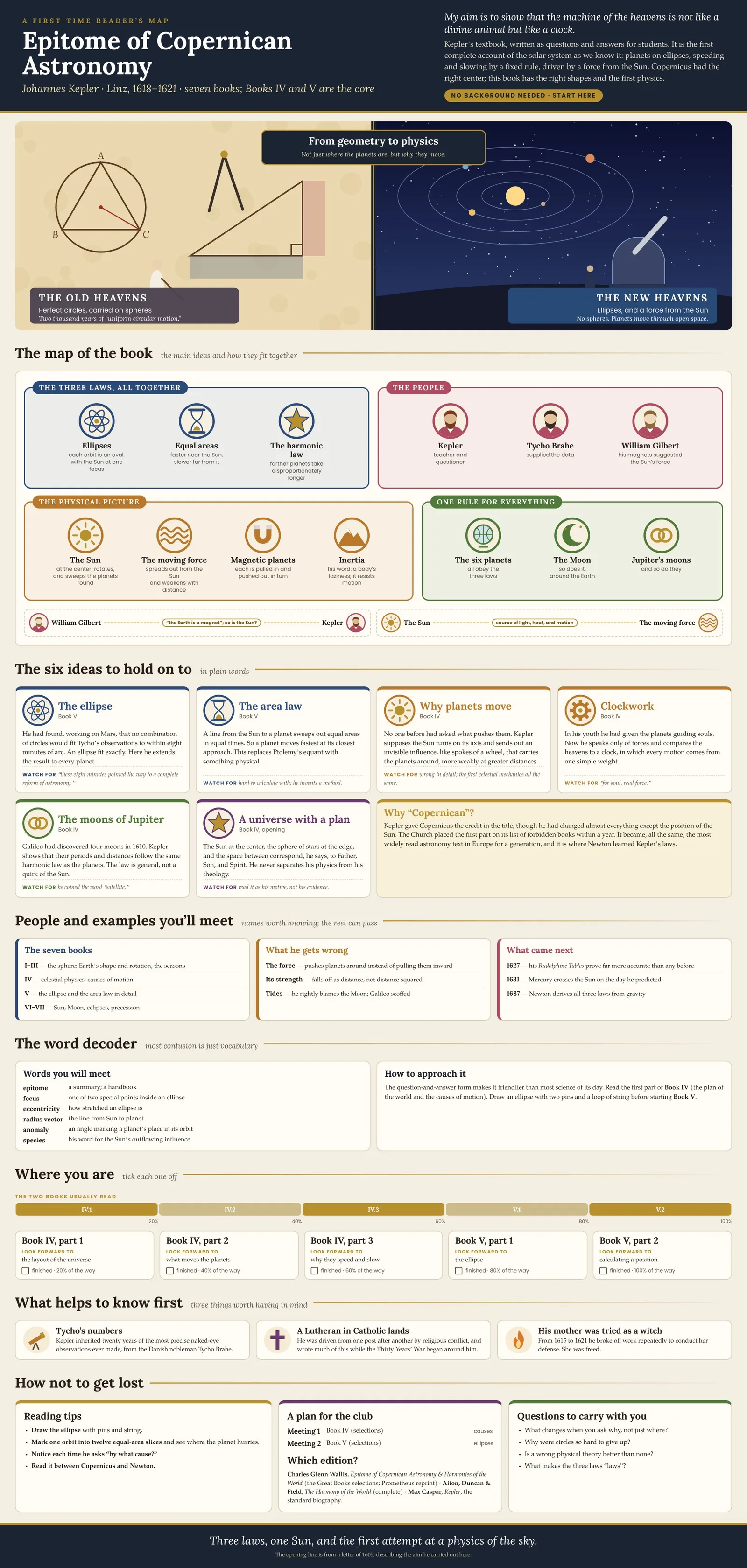
Kepler’s textbook, written as questions and answers for students. It is the first complete account of the solar system as we know it: planets on ellipses, speeding and slowing by a fixed rule, driven by a force from the Sun. Copernicus had the right center; this book has the right shapes and the first physics.
✨ Open this rung of the Great Books Ladder → 🔗 Own page, to share or bookmark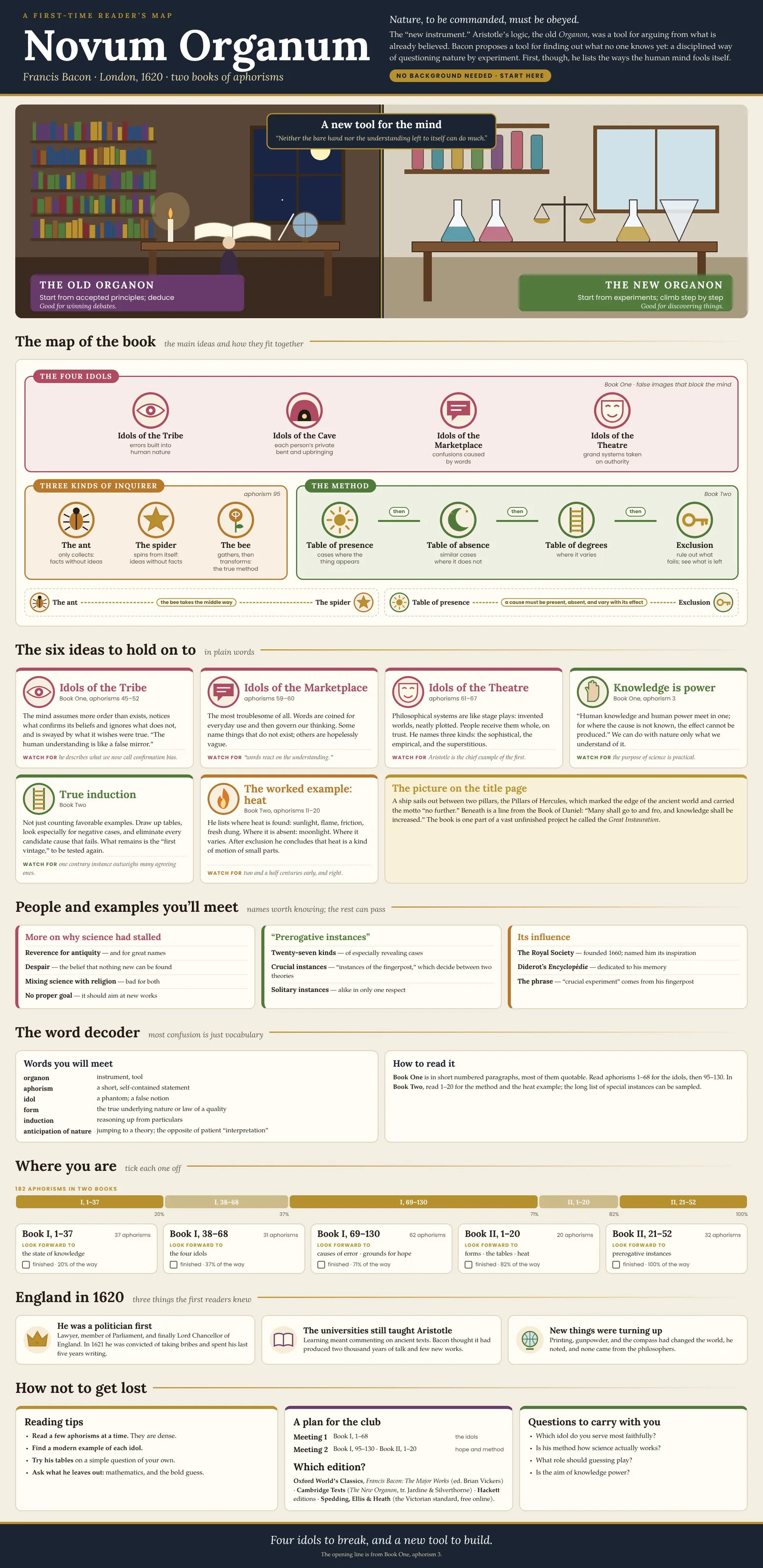
The “new instrument.” Aristotle’s logic, the old Organon, was a tool for arguing from what is already believed. Bacon proposes a tool for finding out what no one knows yet: a disciplined way of questioning nature by experiment. First, though, he lists the ways the human mind fools itself.
✨ Open this rung of the Great Books Ladder → 🔗 Own page, to share or bookmark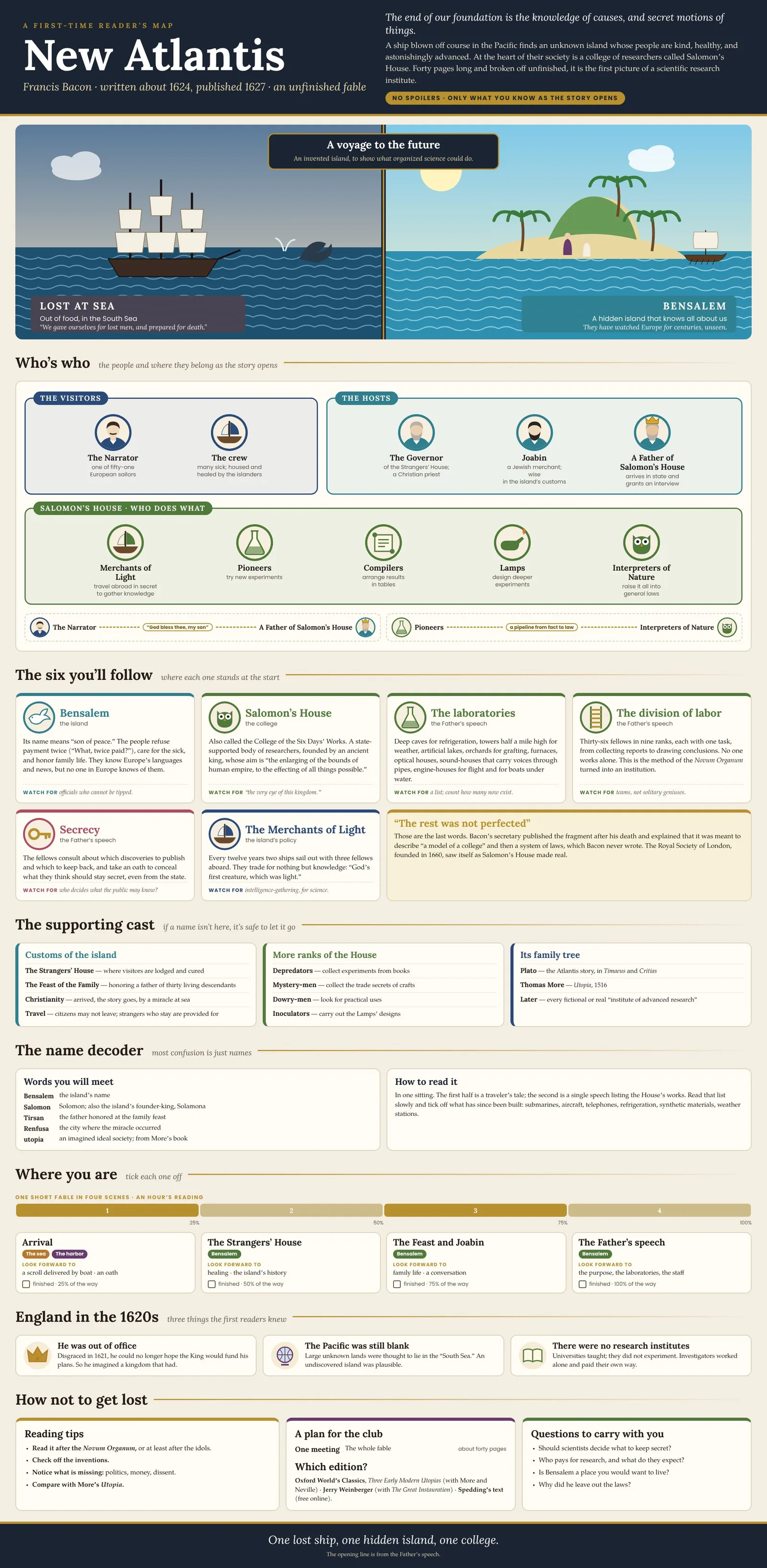
A ship blown off course in the Pacific finds an unknown island whose people are kind, healthy, and astonishingly advanced. At the heart of their society is a college of researchers called Salomon’s House. Forty pages long and broken off unfinished, it is the first picture of a scientific research institute.
✨ Open this rung of the Great Books Ladder → 🔗 Own page, to share or bookmark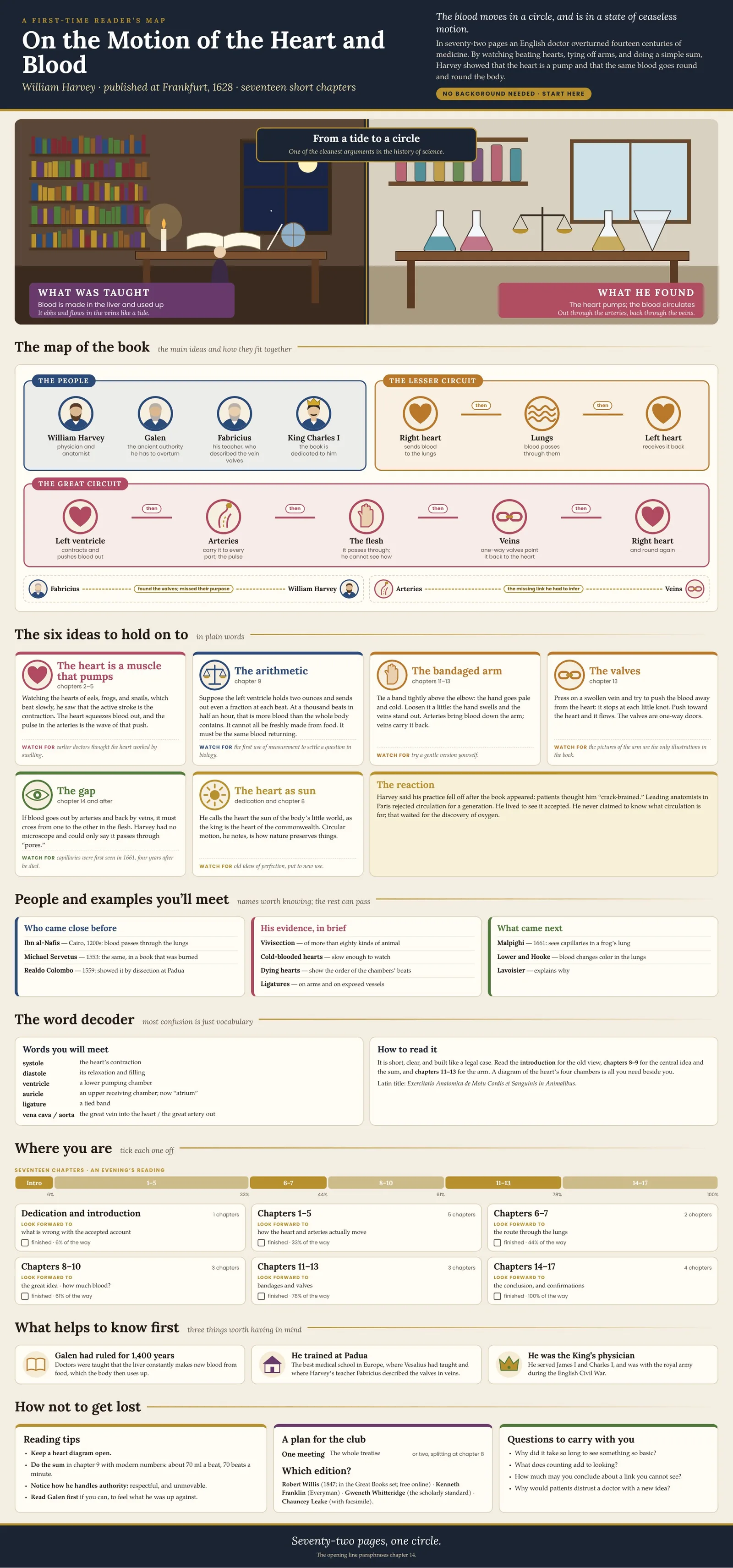
In seventy-two pages an English doctor overturned fourteen centuries of medicine. By watching beating hearts, tying off arms, and doing a simple sum, Harvey showed that the heart is a pump and that the same blood goes round and round the body.
✨ Open this rung of the Great Books Ladder → 🔗 Own page, to share or bookmark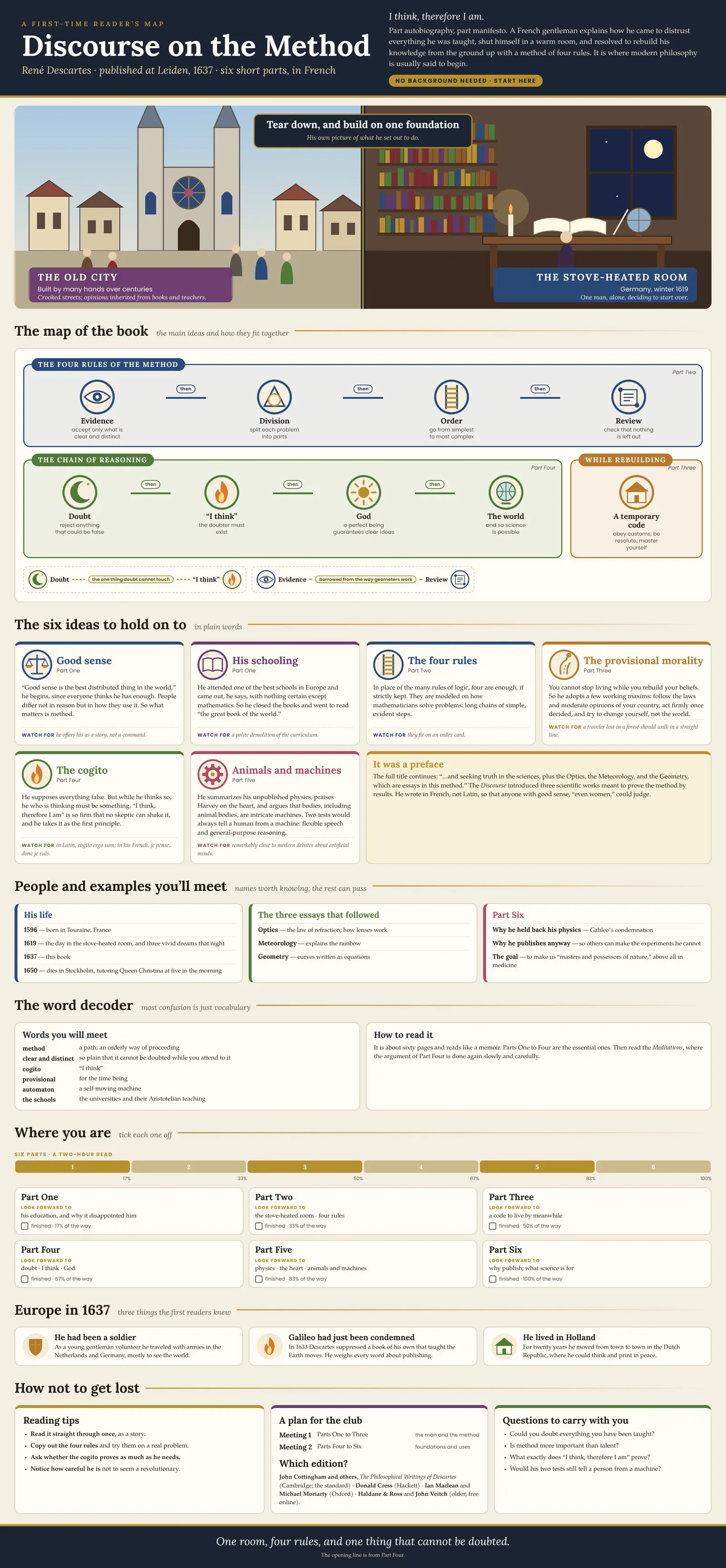
Part autobiography, part manifesto. A French gentleman explains how he came to distrust everything he was taught, shut himself in a warm room, and resolved to rebuild his knowledge from the ground up with a method of four rules. It is where modern philosophy is usually said to begin.
✨ Open this rung of the Great Books Ladder → 🔗 Own page, to share or bookmark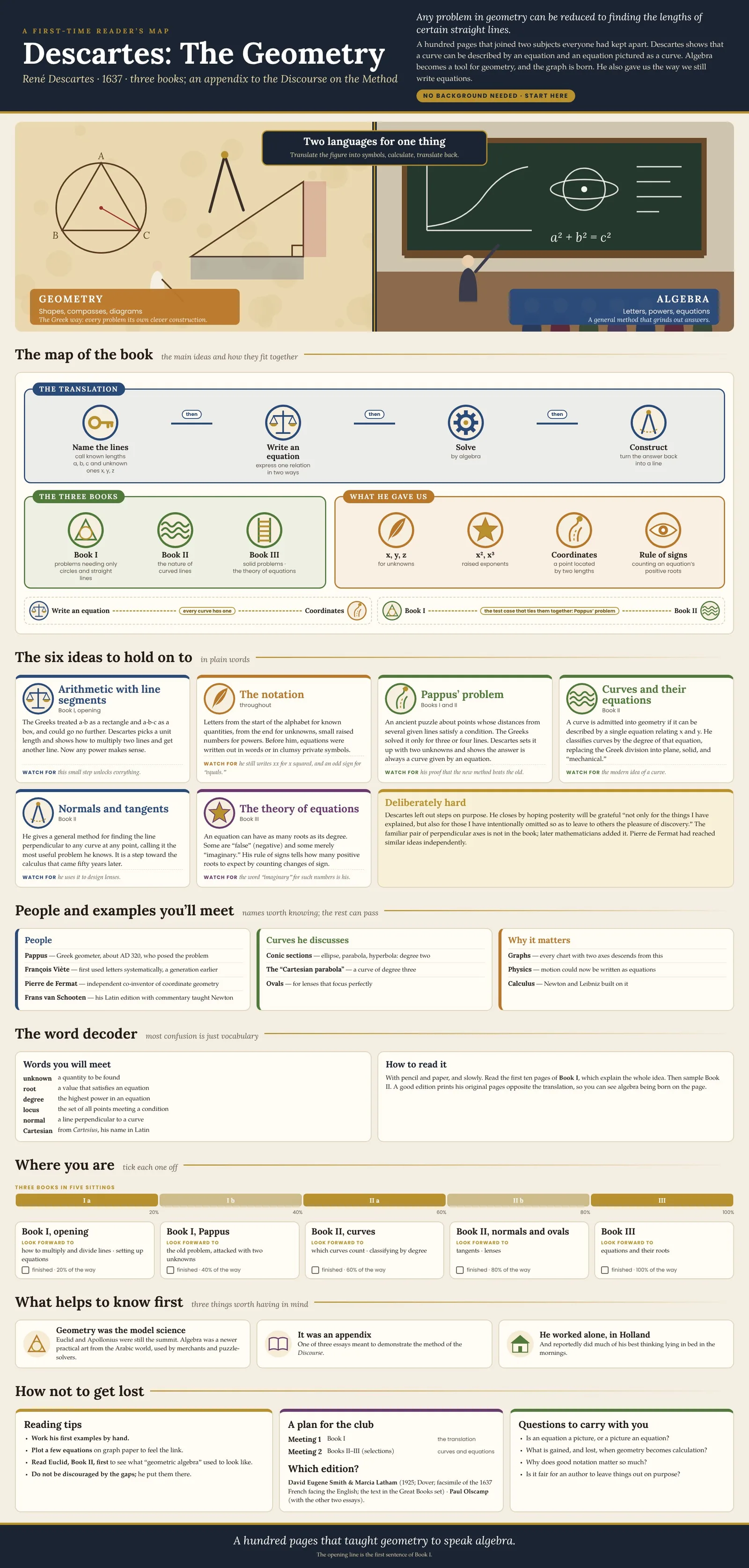
A hundred pages that joined two subjects everyone had kept apart. Descartes shows that a curve can be described by an equation and an equation pictured as a curve. Algebra becomes a tool for geometry, and the graph is born. He also gave us the way we still write equations.
✨ Open this rung of the Great Books Ladder → 🔗 Own page, to share or bookmark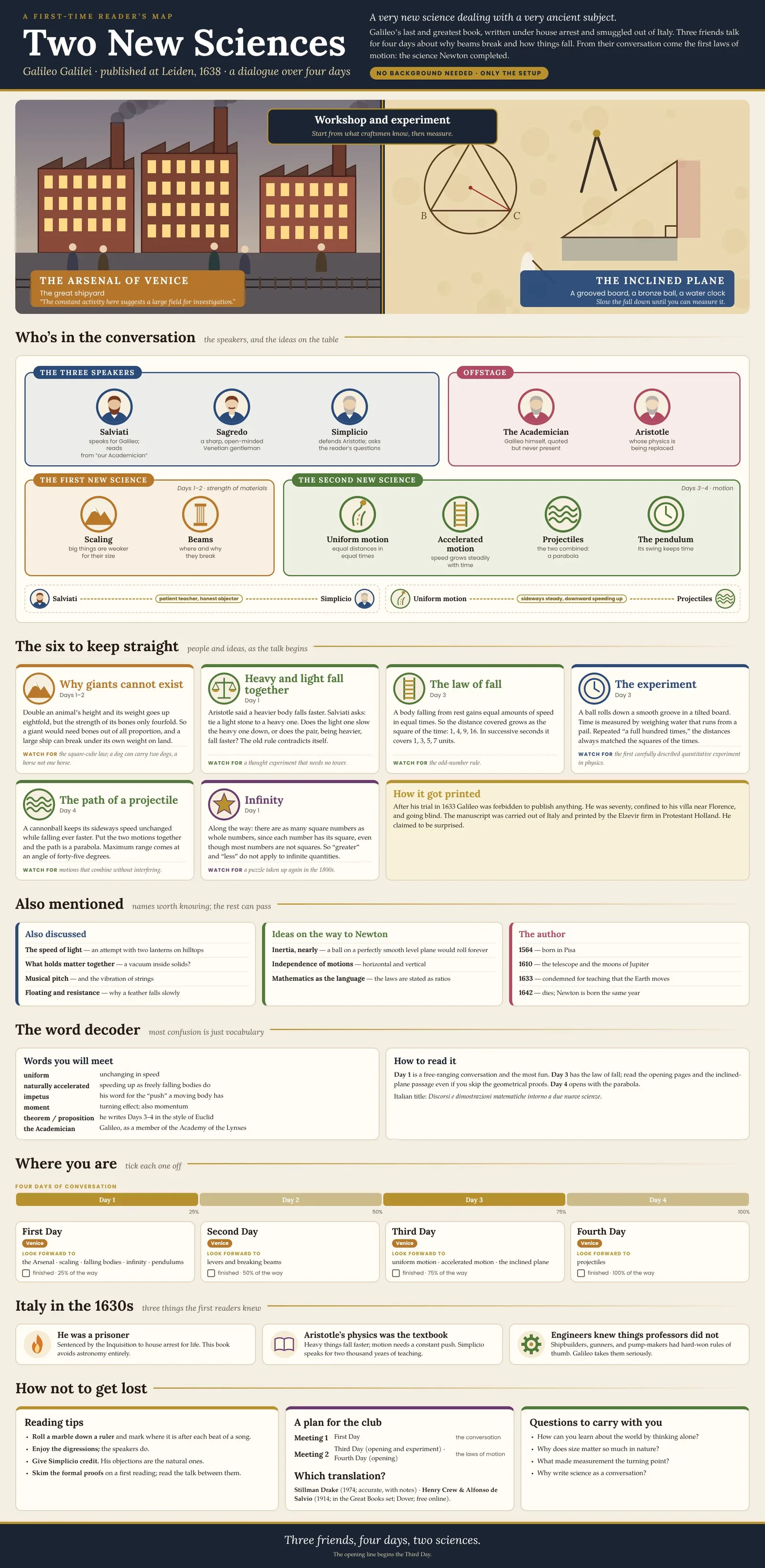
Galileo’s last and greatest book, written under house arrest and smuggled out of Italy. Three friends talk for four days about why beams break and how things fall. From their conversation come the first laws of motion: the science Newton completed.
✨ Open this rung of the Great Books Ladder → 🔗 Own page, to share or bookmark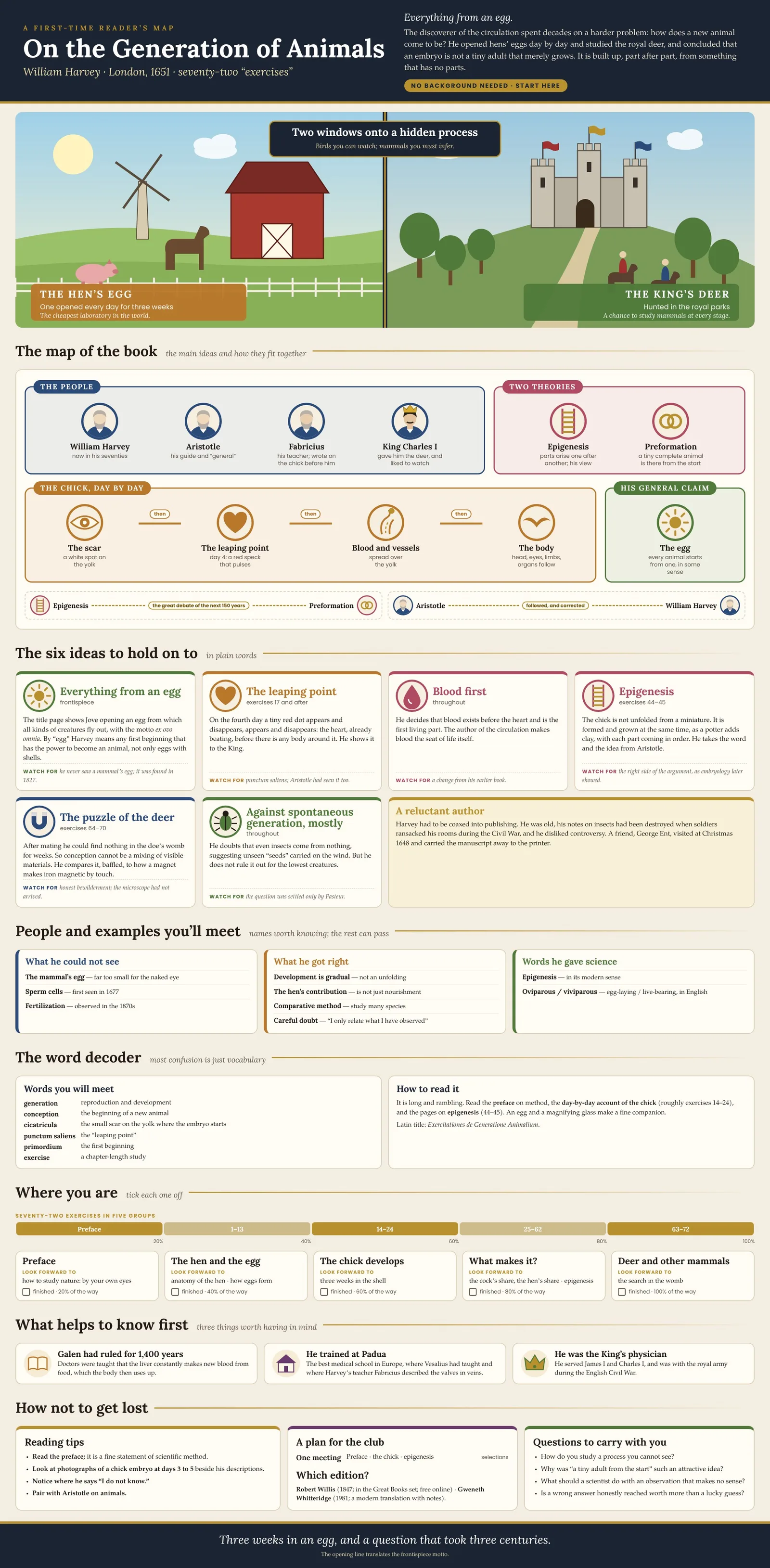
The discoverer of the circulation spent decades on a harder problem: how does a new animal come to be? He opened hens’ eggs day by day and studied the royal deer, and concluded that an embryo is not a tiny adult that merely grows. It is built up, part after part, from something that has no parts.
✨ Open this rung of the Great Books Ladder → 🔗 Own page, to share or bookmark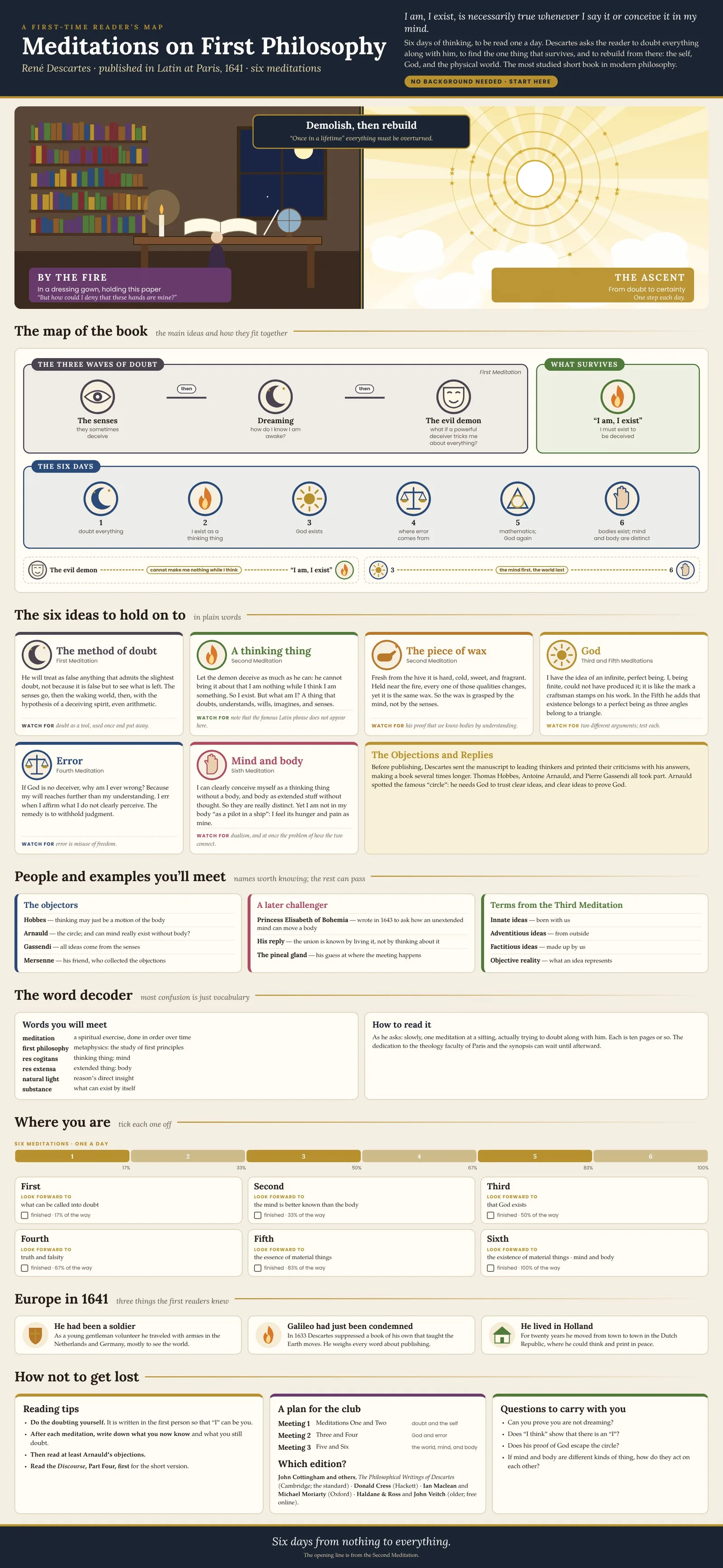
Six days of thinking, to be read one a day. Descartes asks the reader to doubt everything along with him, to find the one thing that survives, and to rebuild from there: the self, God, and the physical world. The most studied short book in modern philosophy.
✨ Open this rung of the Great Books Ladder → 🔗 Own page, to share or bookmark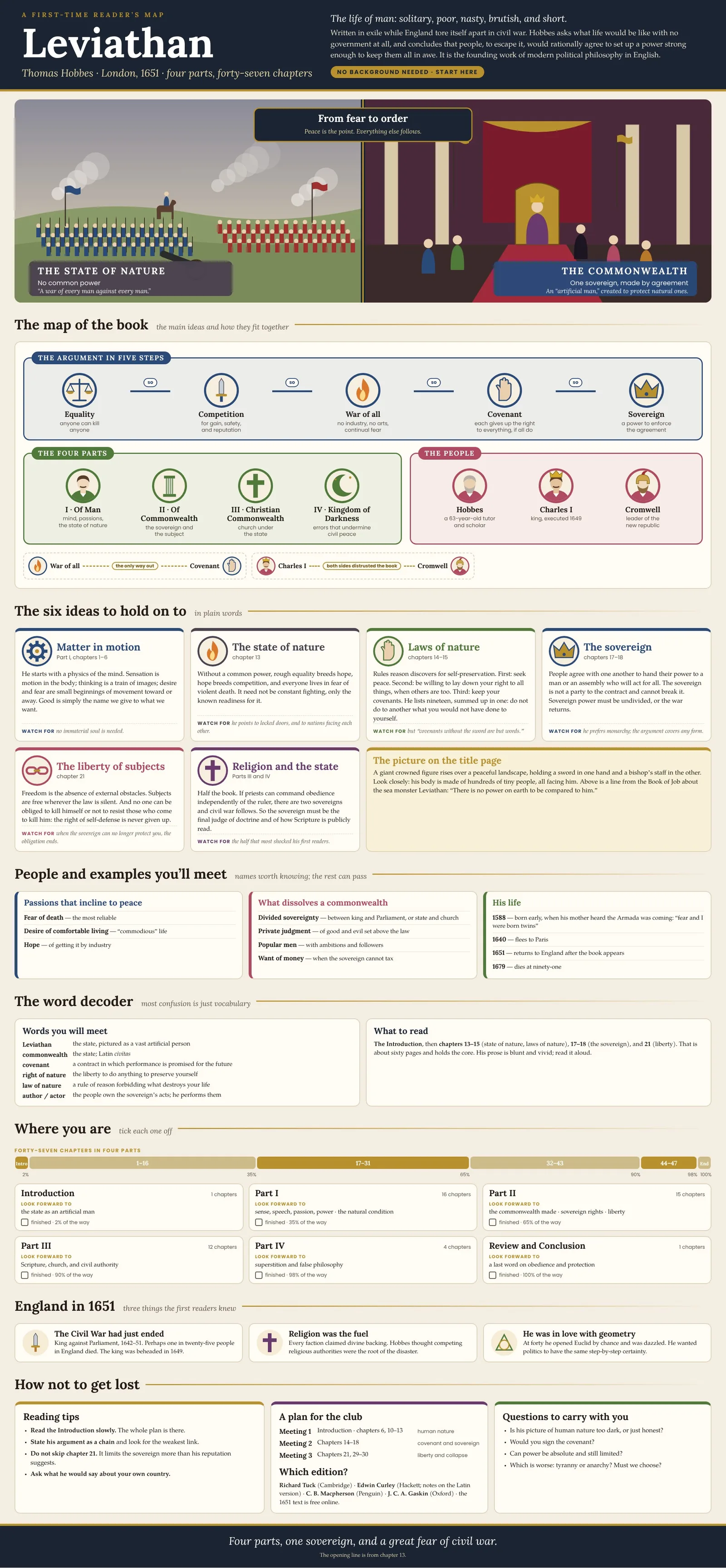
Written in exile while England tore itself apart in civil war. Hobbes asks what life would be like with no government at all, and concludes that people, to escape it, would rationally agree to set up a power strong enough to keep them all in awe. It is the founding work of modern political philosophy in English.
✨ Open this rung of the Great Books Ladder → 🔗 Own page, to share or bookmark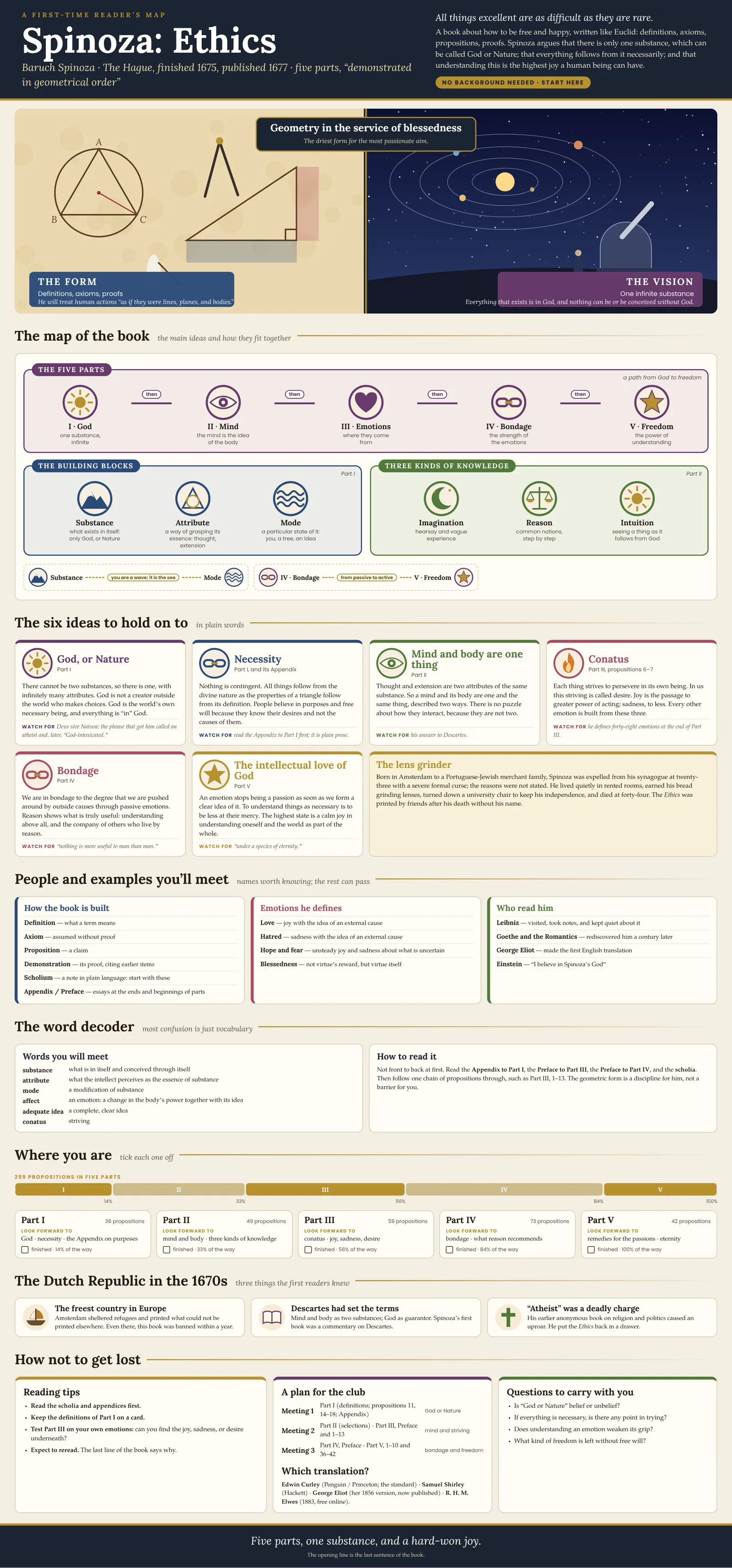
A book about how to be free and happy, written like Euclid: definitions, axioms, propositions, proofs. Spinoza argues that there is only one substance, which can be called God or Nature; that everything follows from it necessarily; and that understanding this is the highest joy a human being can have.
✨ Open this rung of the Great Books Ladder → 🔗 Own page, to share or bookmark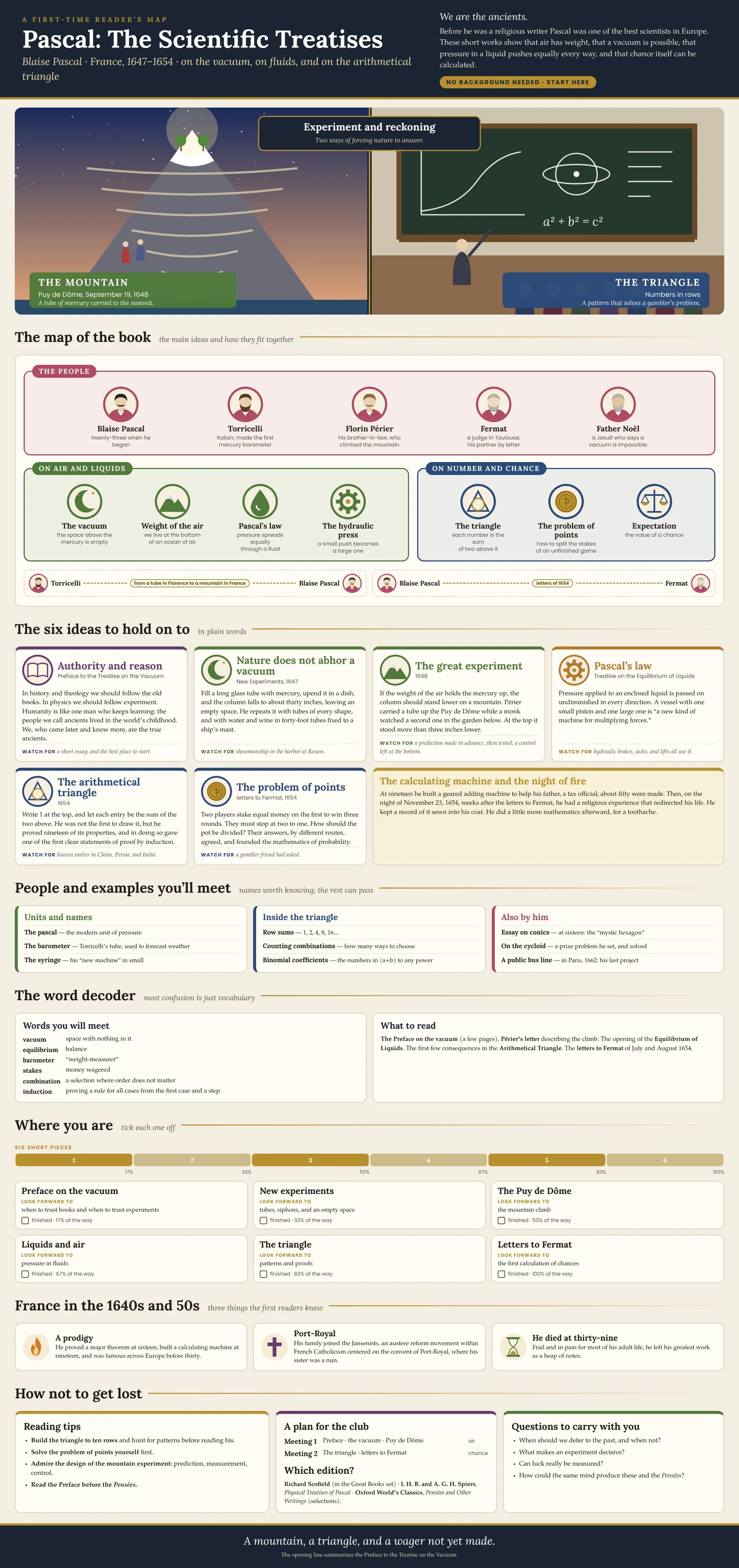
Before he was a religious writer Pascal was one of the best scientists in Europe. These short works show that air has weight, that a vacuum is possible, that pressure in a liquid pushes equally every way, and that chance itself can be calculated.
✨ Open this rung of the Great Books Ladder → 🔗 Own page, to share or bookmark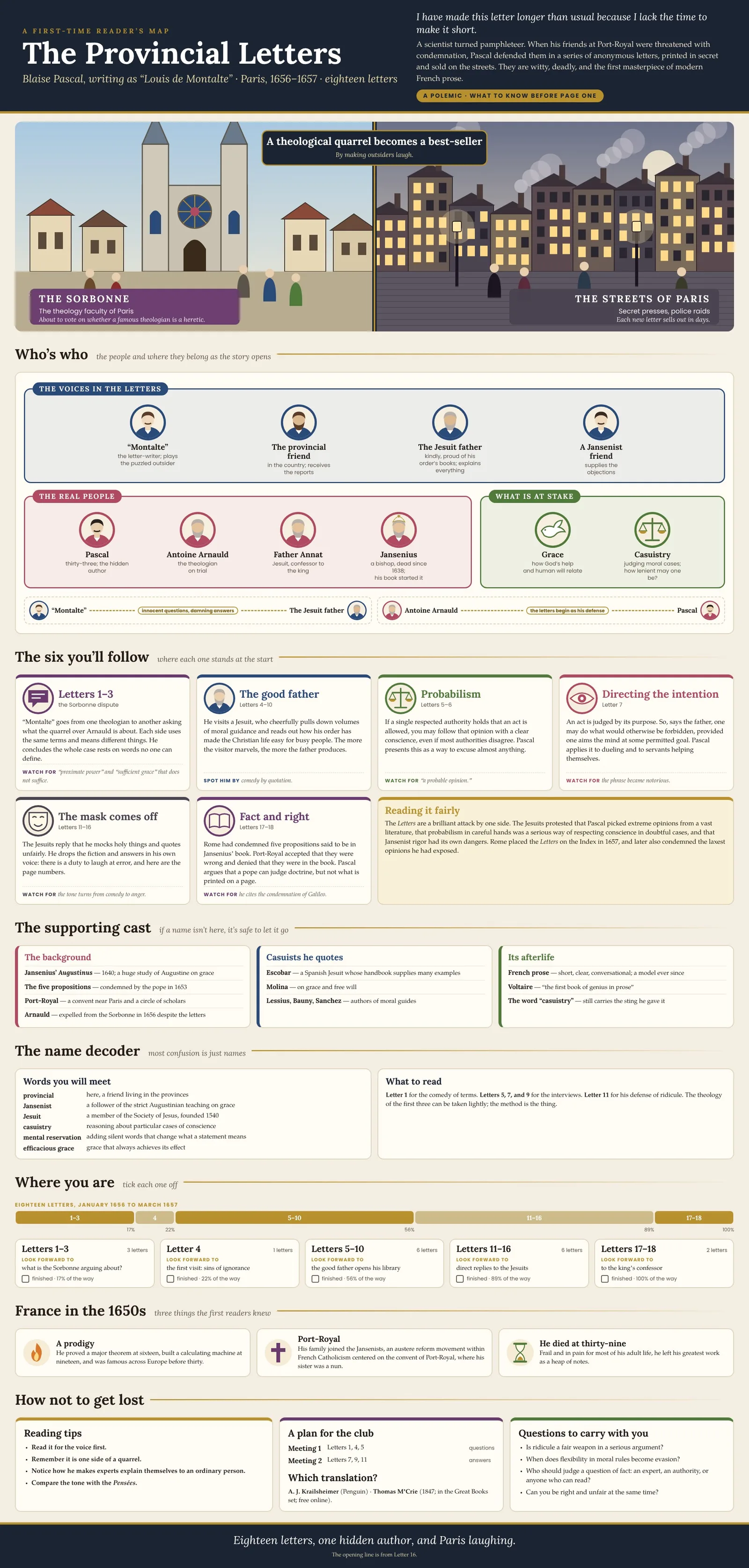
A scientist turned pamphleteer. When his friends at Port-Royal were threatened with condemnation, Pascal defended them in a series of anonymous letters, printed in secret and sold on the streets. They are witty, deadly, and the first masterpiece of modern French prose.
✨ Open this rung of the Great Books Ladder → 🔗 Own page, to share or bookmark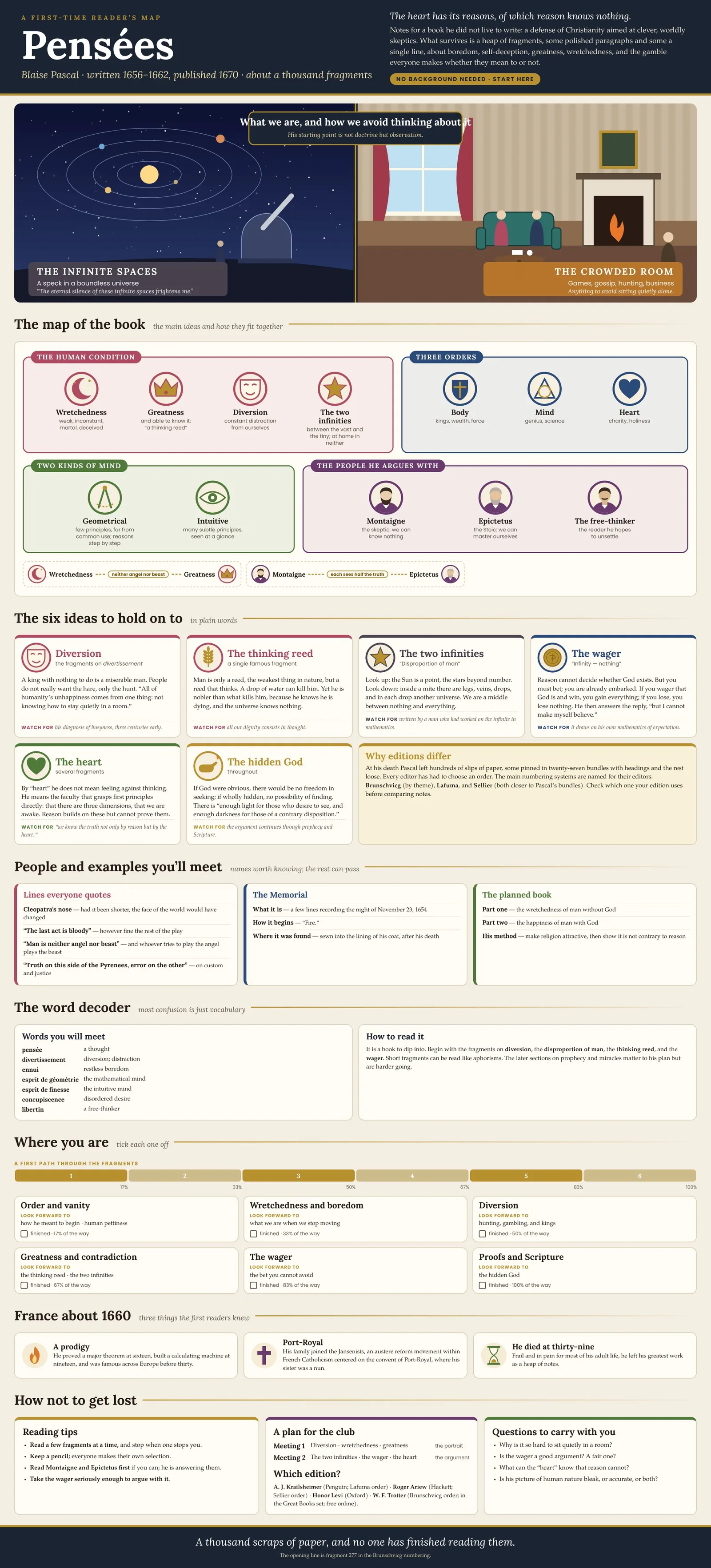
Notes for a book he did not live to write: a defense of Christianity aimed at clever, worldly skeptics. What survives is a heap of fragments, some polished paragraphs and some a single line, about boredom, self-deception, greatness, wretchedness, and the gamble everyone makes whether they mean to or not.
✨ Open this rung of the Great Books Ladder → 🔗 Own page, to share or bookmark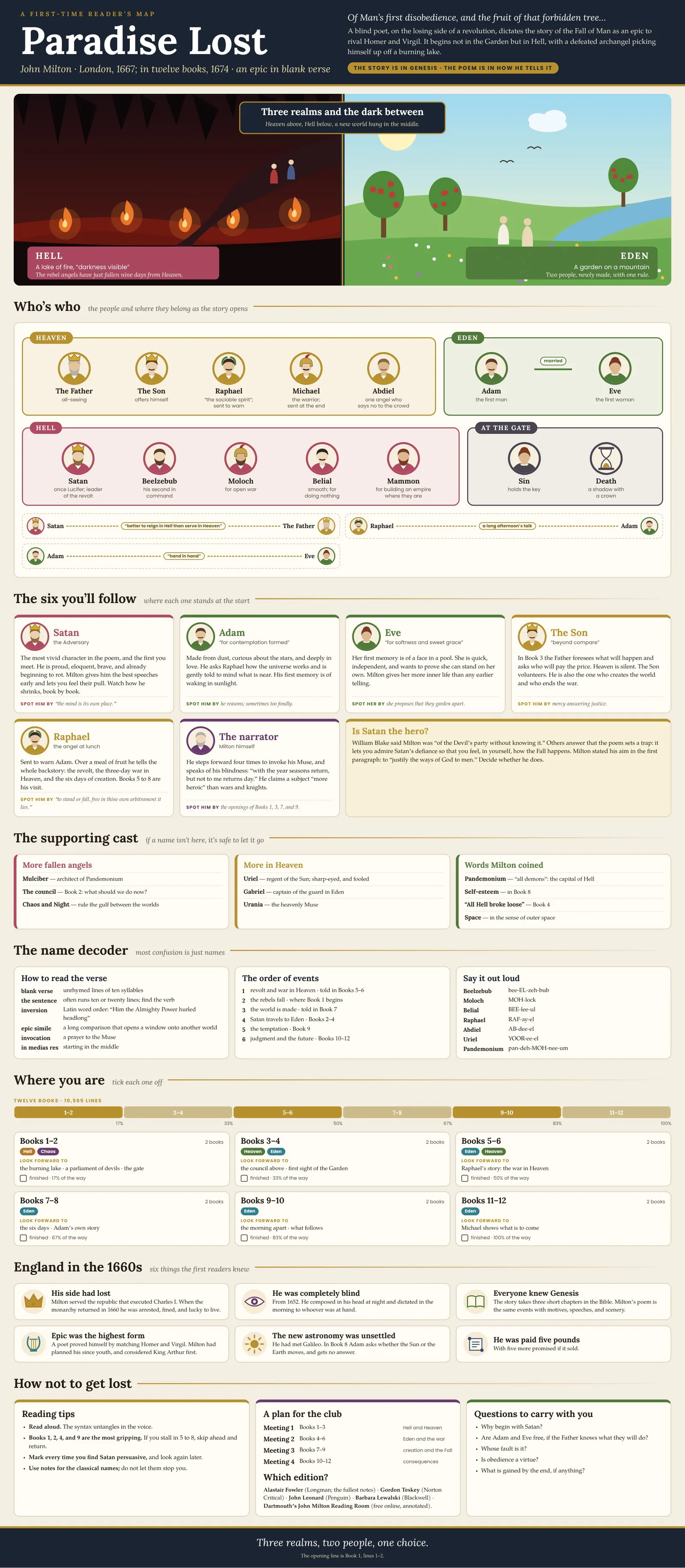
A blind poet, on the losing side of a revolution, dictates the story of the Fall of Man as an epic to rival Homer and Virgil. It begins not in the Garden but in Hell, with a defeated archangel picking himself up off a burning lake.
✨ Open this rung of the Great Books Ladder → 🔗 Own page, to share or bookmark 📚 Paradise Lost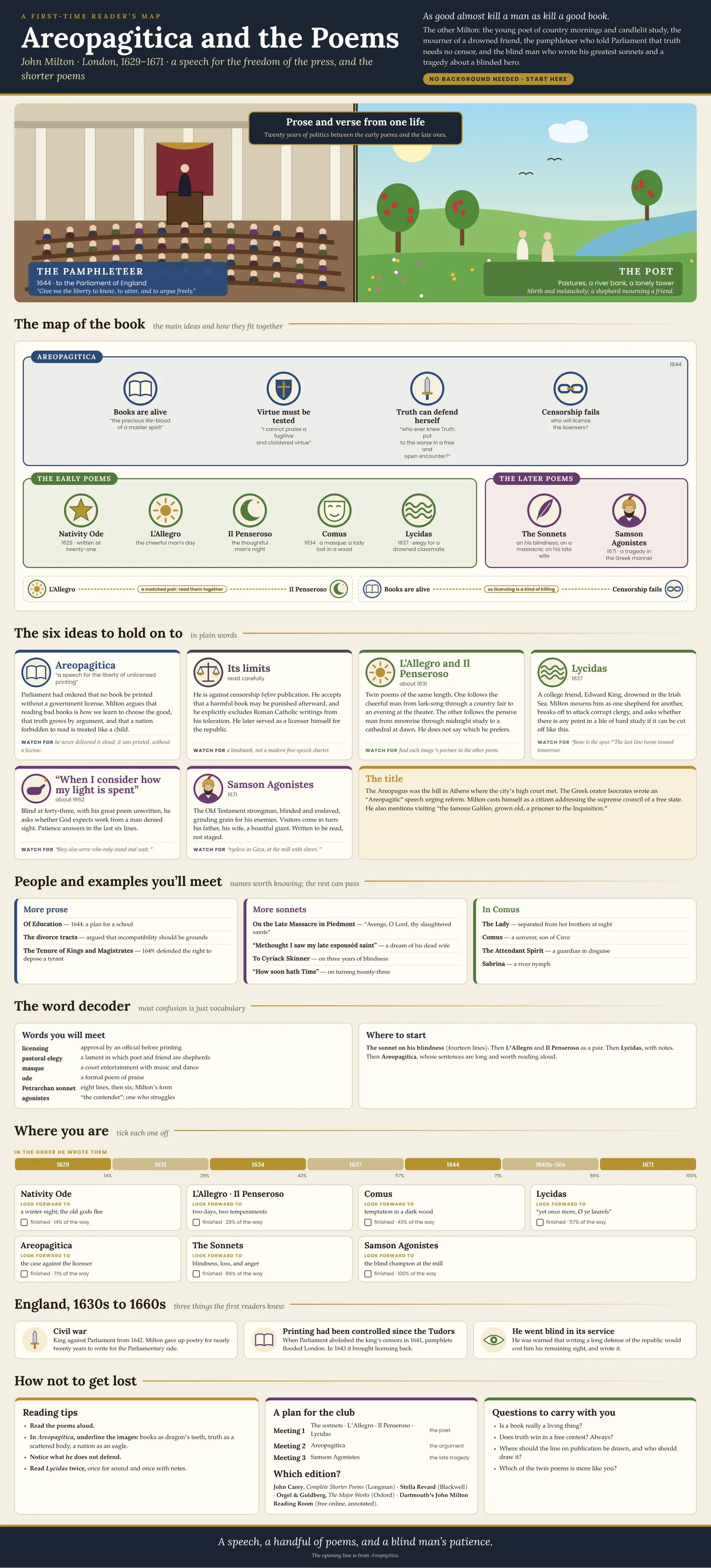
The other Milton: the young poet of country mornings and candlelit study, the mourner of a drowned friend, the pamphleteer who told Parliament that truth needs no censor, and the blind man who wrote his greatest sonnets and a tragedy about a blinded hero.
✨ Open this rung of the Great Books Ladder → 🔗 Own page, to share or bookmark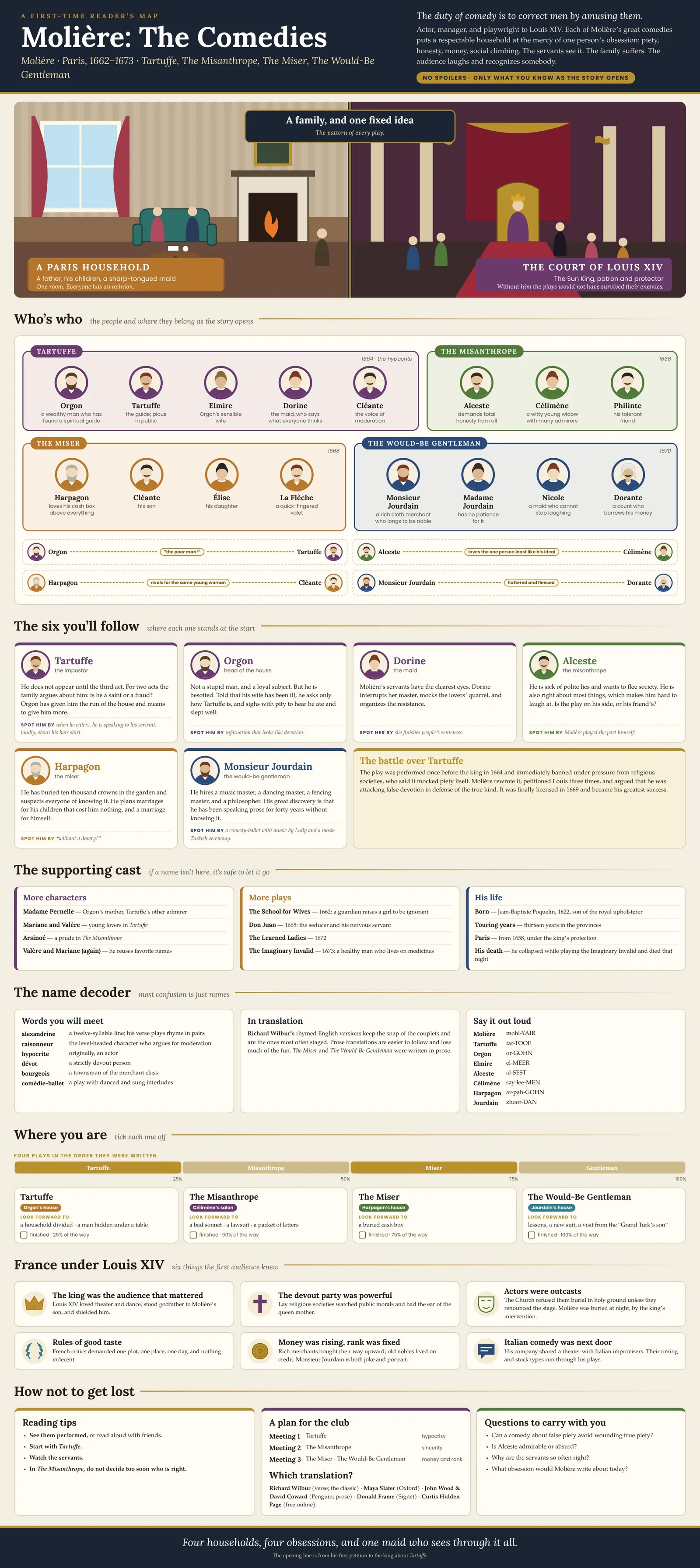
Actor, manager, and playwright to Louis XIV. Each of Molière’s great comedies puts a respectable household at the mercy of one person’s obsession: piety, honesty, money, social climbing. The servants see it. The family suffers. The audience laughs and recognizes somebody.
✨ Open this rung of the Great Books Ladder → 🔗 Own page, to share or bookmark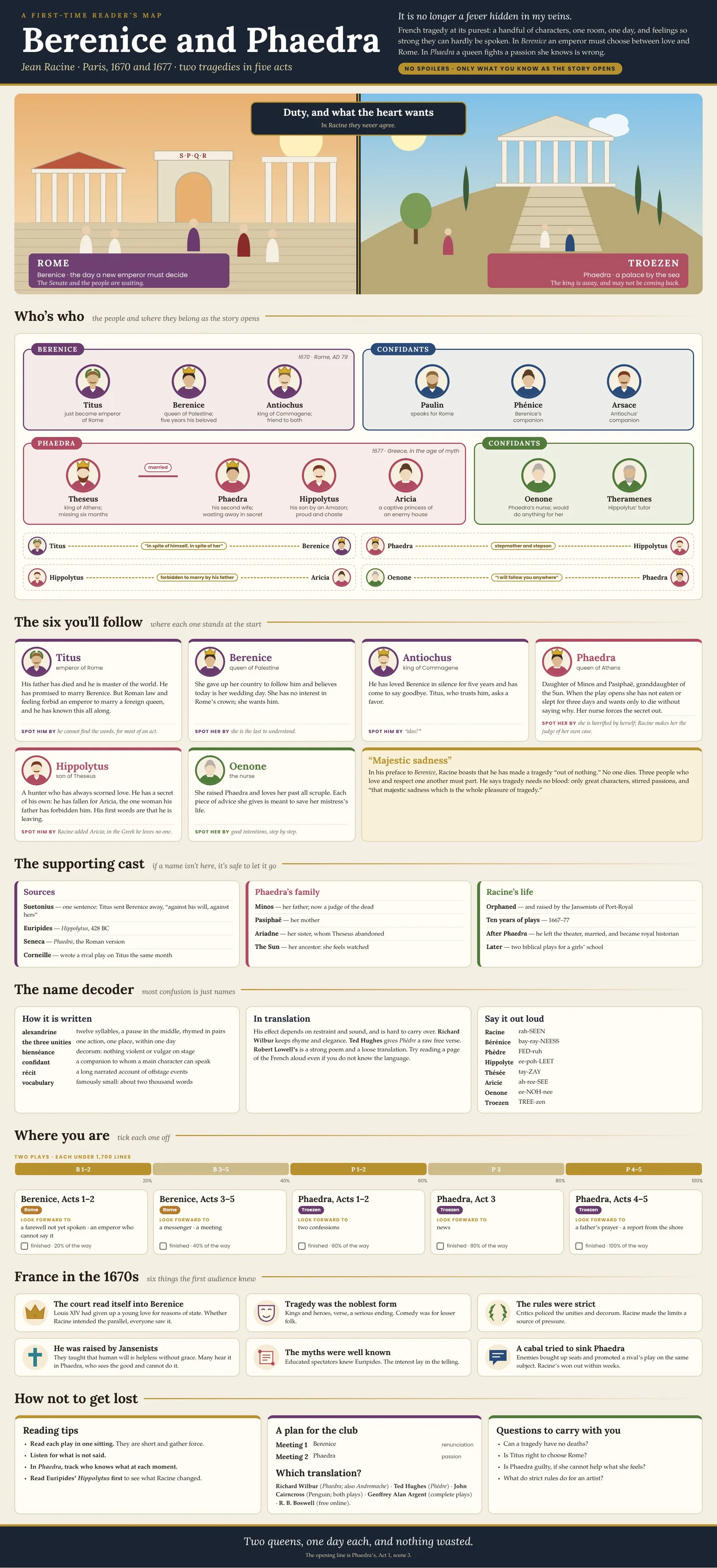
French tragedy at its purest: a handful of characters, one room, one day, and feelings so strong they can hardly be spoken. In Berenice an emperor must choose between love and Rome. In Phaedra a queen fights a passion she knows is wrong.
✨ Open this rung of the Great Books Ladder → 🔗 Own page, to share or bookmark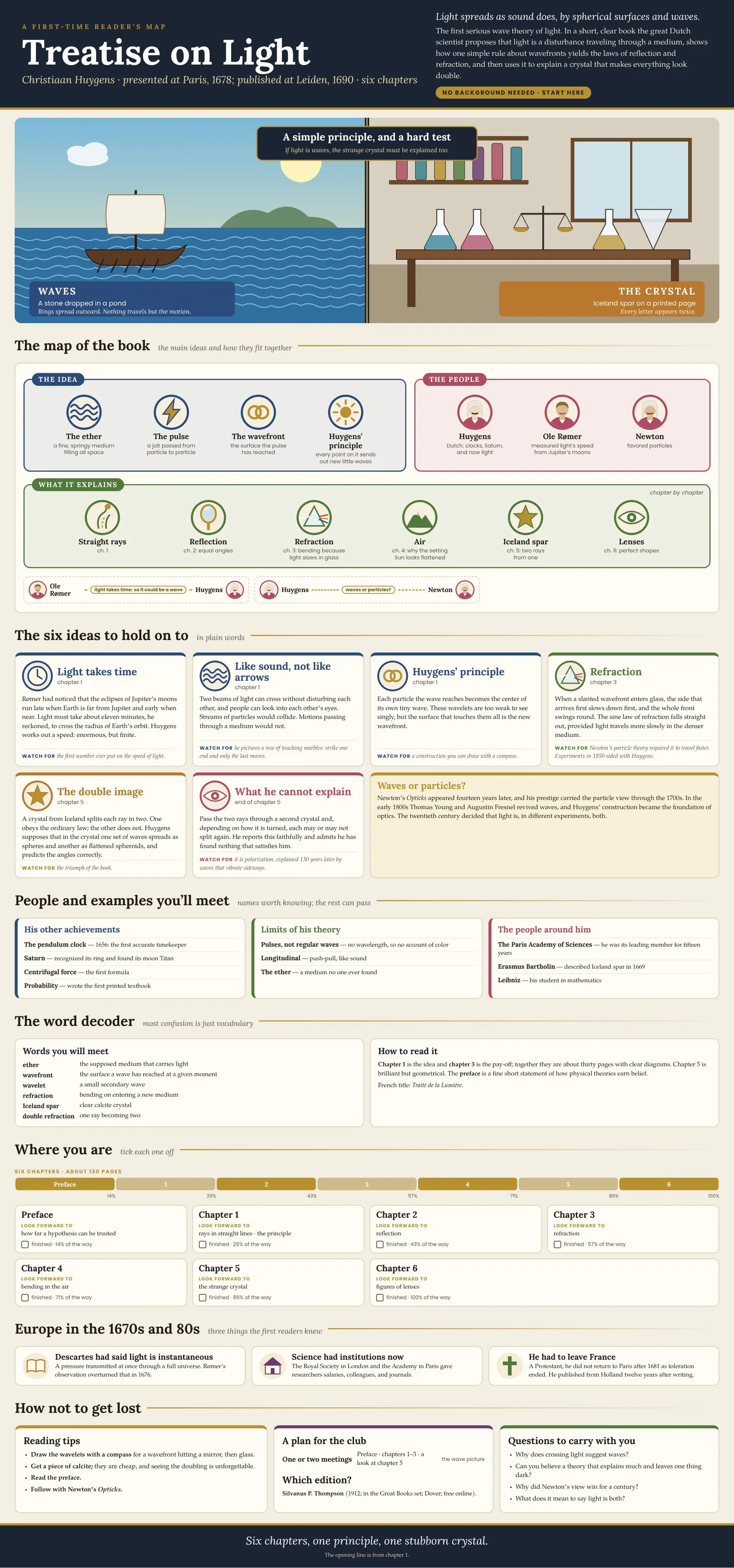
The first serious wave theory of light. In a short, clear book the great Dutch scientist proposes that light is a disturbance traveling through a medium, shows how one simple rule about wavefronts yields the laws of reflection and refraction, and then uses it to explain a crystal that makes everything look double.
✨ Open this rung of the Great Books Ladder → 🔗 Own page, to share or bookmark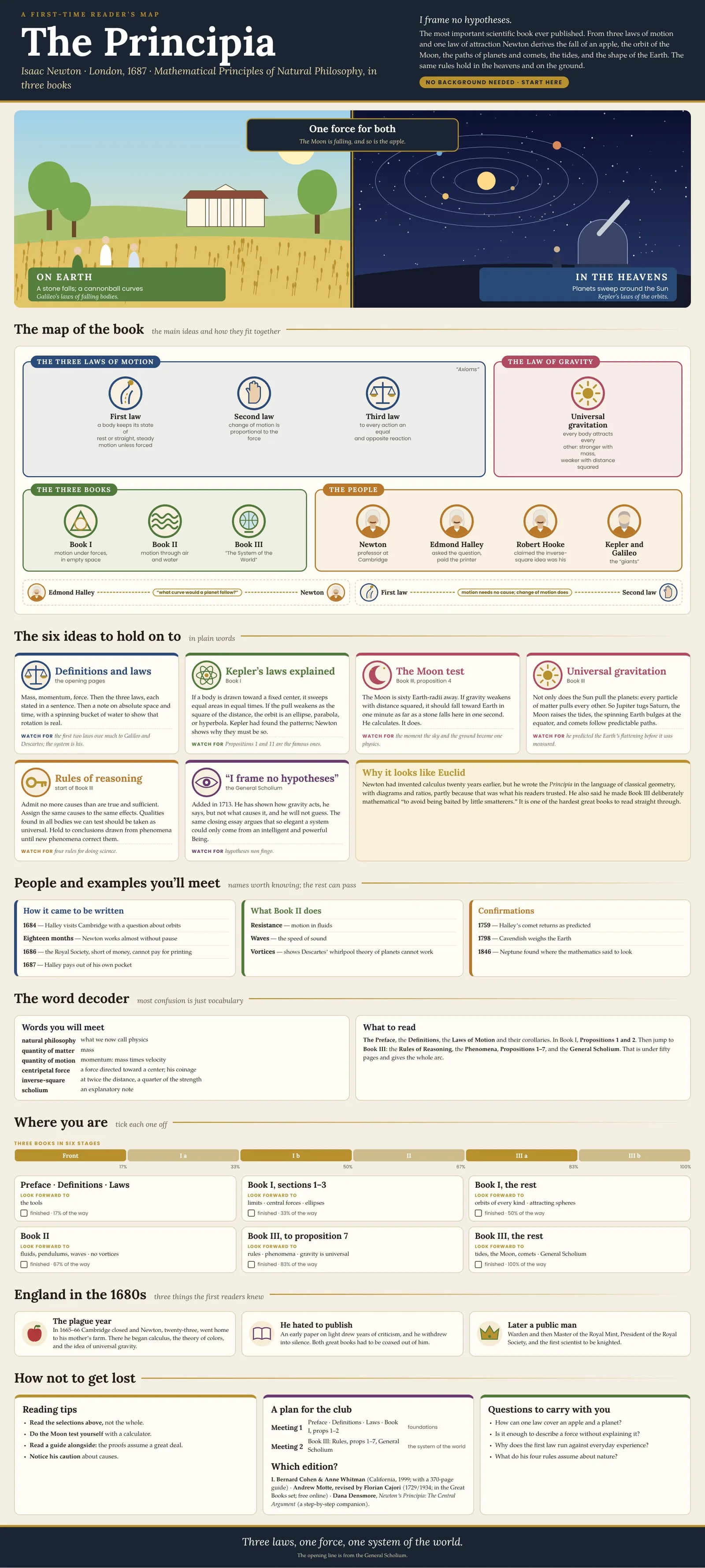
The most important scientific book ever published. From three laws of motion and one law of attraction Newton derives the fall of an apple, the orbit of the Moon, the paths of planets and comets, the tides, and the shape of the Earth. The same rules hold in the heavens and on the ground.
✨ Open this rung of the Great Books Ladder → 🔗 Own page, to share or bookmark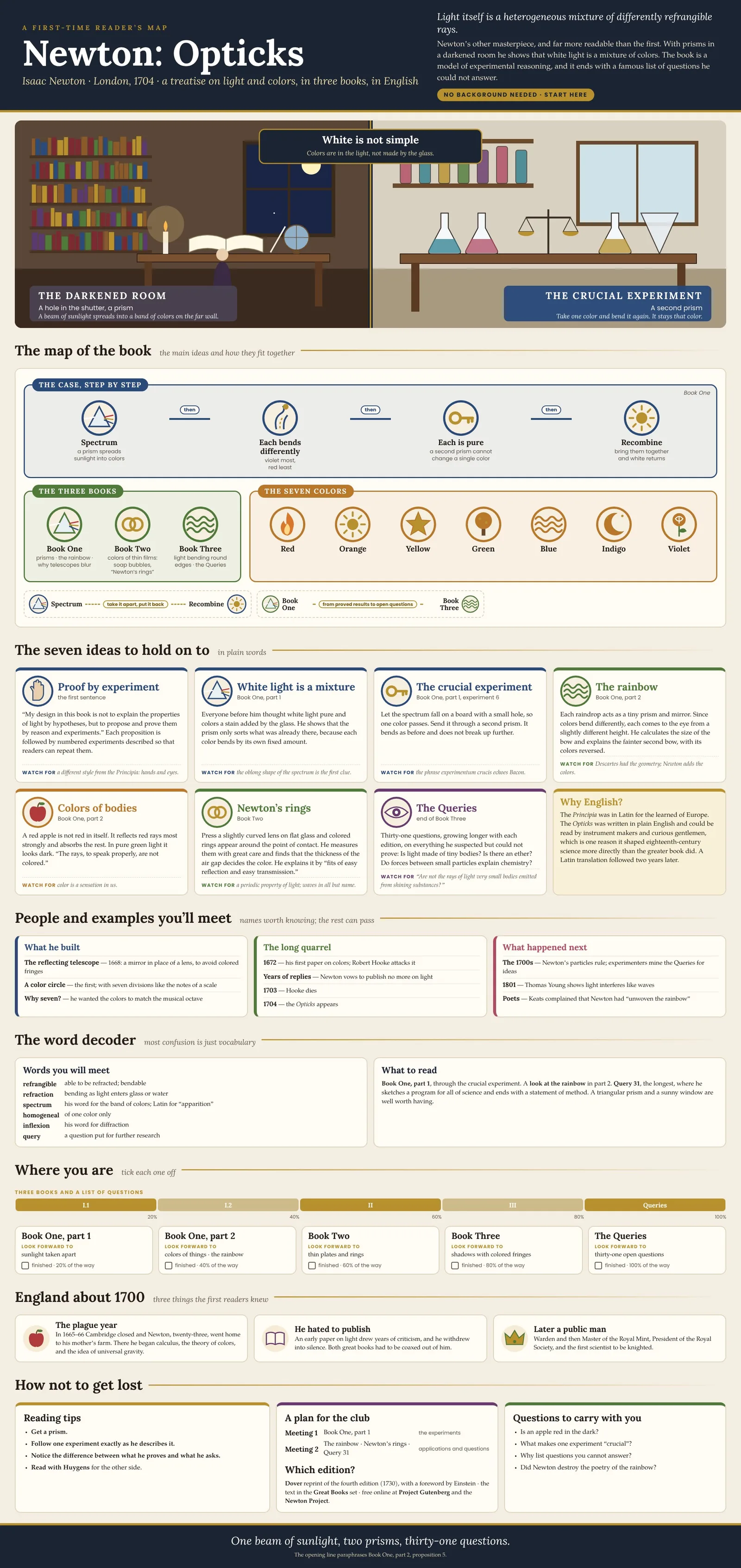
Newton’s other masterpiece, and far more readable than the first. With prisms in a darkened room he shows that white light is a mixture of colors. The book is a model of experimental reasoning, and it ends with a famous list of questions he could not answer.
✨ Open this rung of the Great Books Ladder → 🔗 Own page, to share or bookmarkThe Enlightenment 20 maps · the rungs →
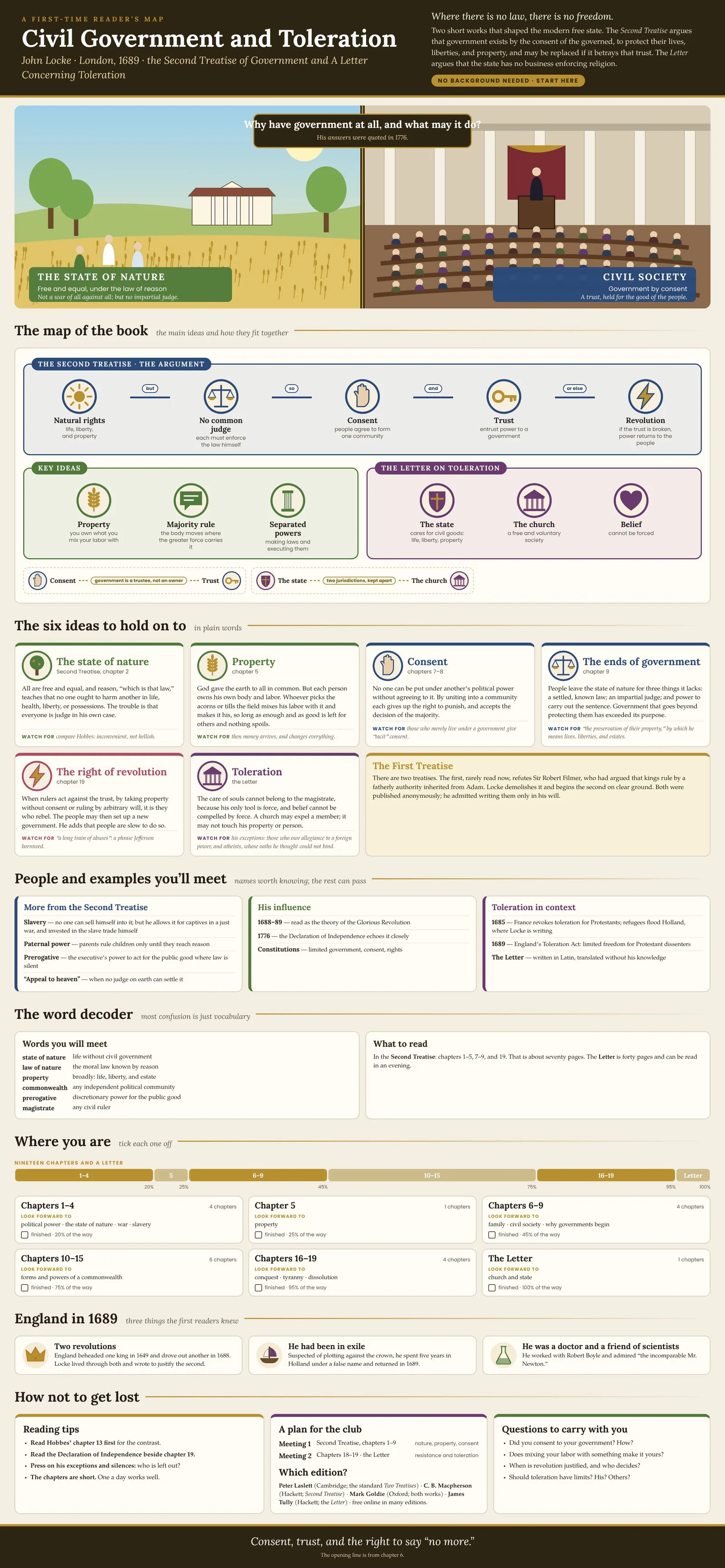
Two short works that shaped the modern free state. The Second Treatise argues that government exists by the consent of the governed, to protect their lives, liberties, and property, and may be replaced if it betrays that trust. The Letter argues that the state has no business enforcing religion.
✨ Open this rung of the Great Books Ladder → 🔗 Own page, to share or bookmark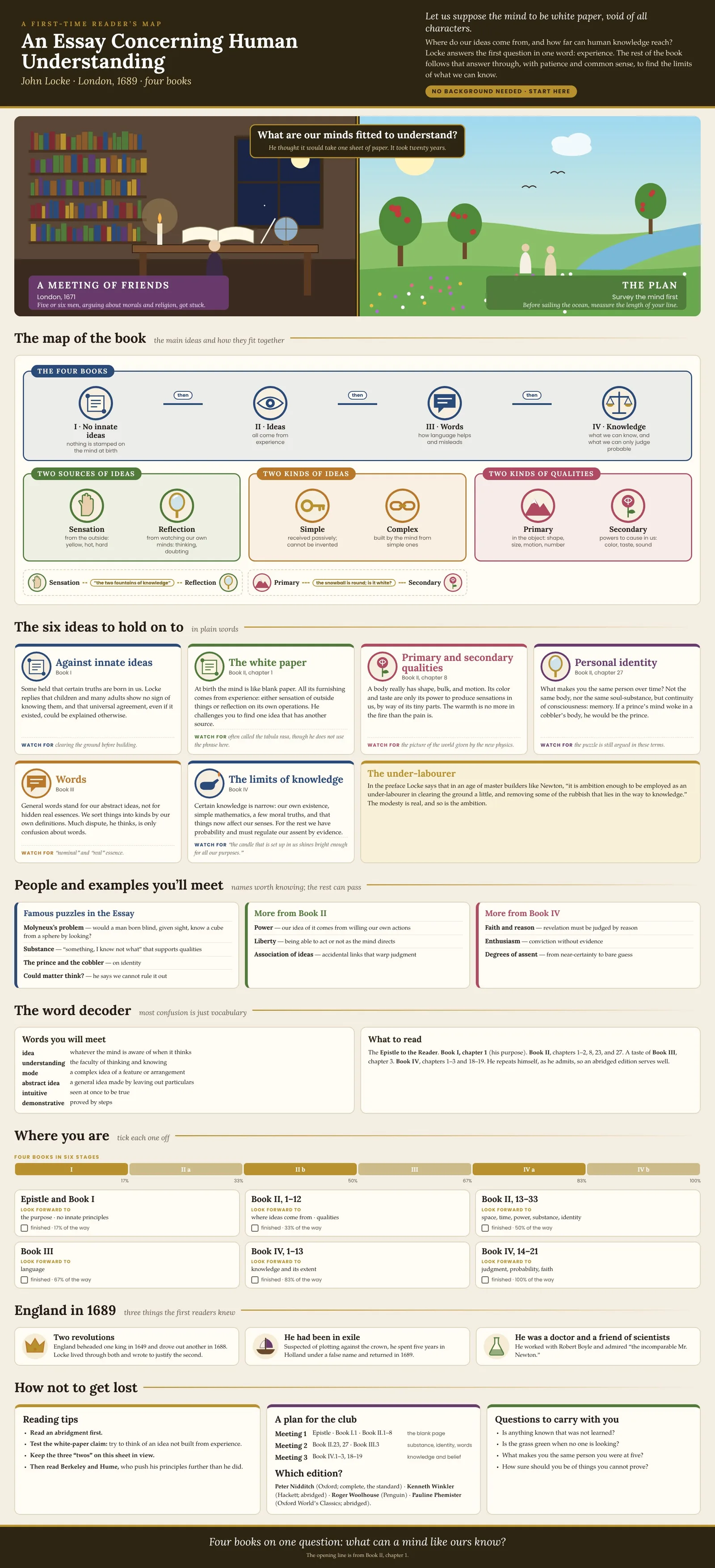
Where do our ideas come from, and how far can human knowledge reach? Locke answers the first question in one word: experience. The rest of the book follows that answer through, with patience and common sense, to find the limits of what we can know.
✨ Open this rung of the Great Books Ladder → 🔗 Own page, to share or bookmark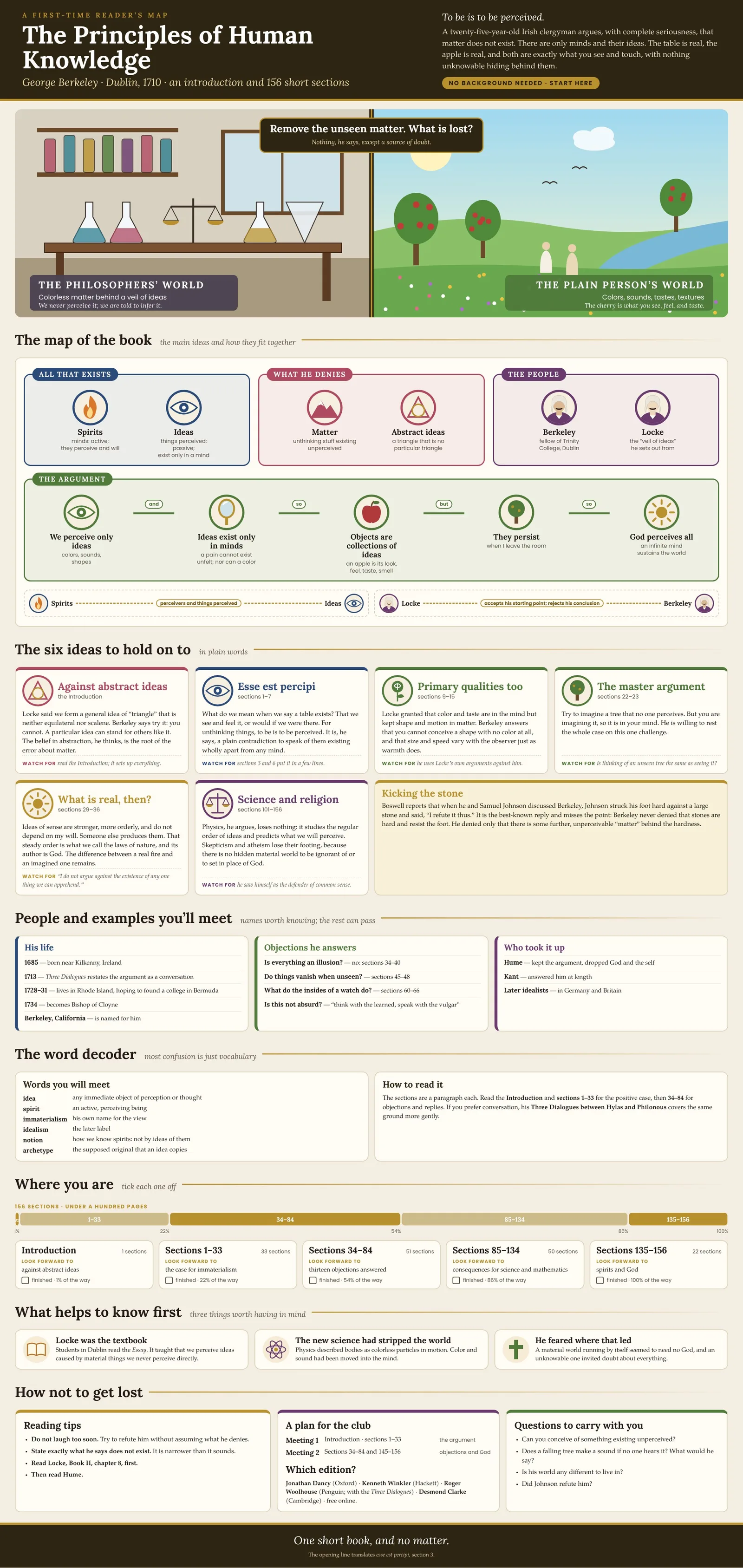
A twenty-five-year-old Irish clergyman argues, with complete seriousness, that matter does not exist. There are only minds and their ideas. The table is real, the apple is real, and both are exactly what you see and touch, with nothing unknowable hiding behind them.
✨ Open this rung of the Great Books Ladder → 🔗 Own page, to share or bookmark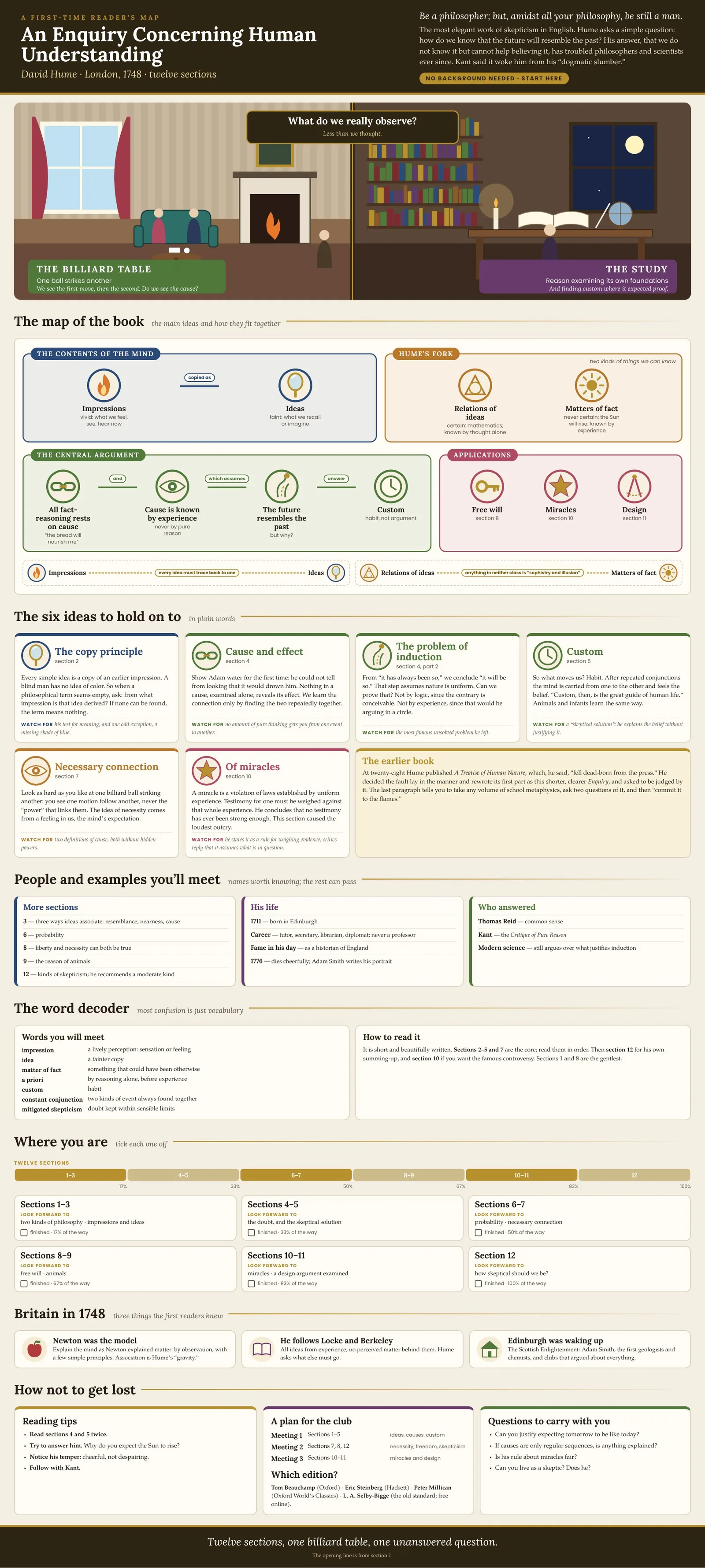
The most elegant work of skepticism in English. Hume asks a simple question: how do we know that the future will resemble the past? His answer, that we do not know it but cannot help believing it, has troubled philosophers and scientists ever since. Kant said it woke him from his “dogmatic slumber.”
✨ Open this rung of the Great Books Ladder → 🔗 Own page, to share or bookmark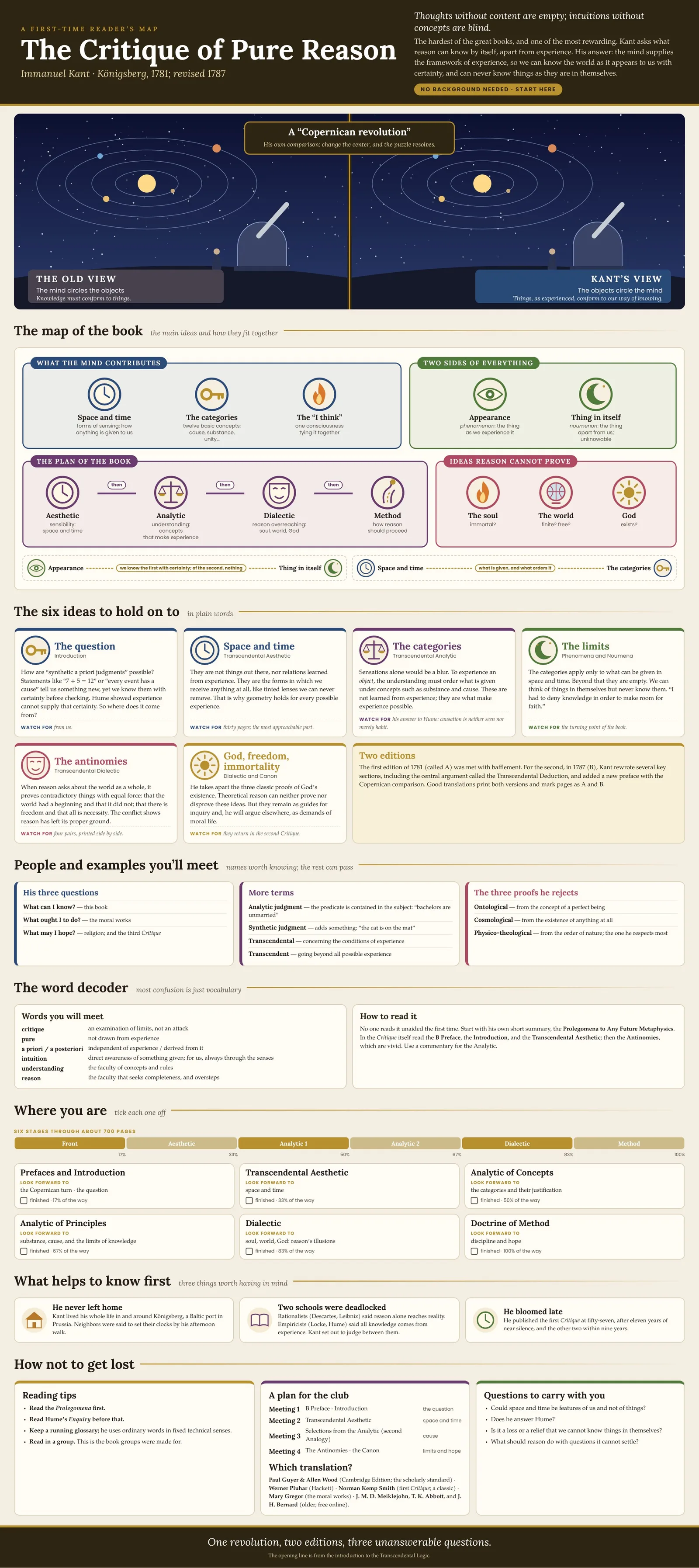
The hardest of the great books, and one of the most rewarding. Kant asks what reason can know by itself, apart from experience. His answer: the mind supplies the framework of experience, so we can know the world as it appears to us with certainty, and can never know things as they are in themselves.
✨ Open this rung of the Great Books Ladder → 🔗 Own page, to share or bookmark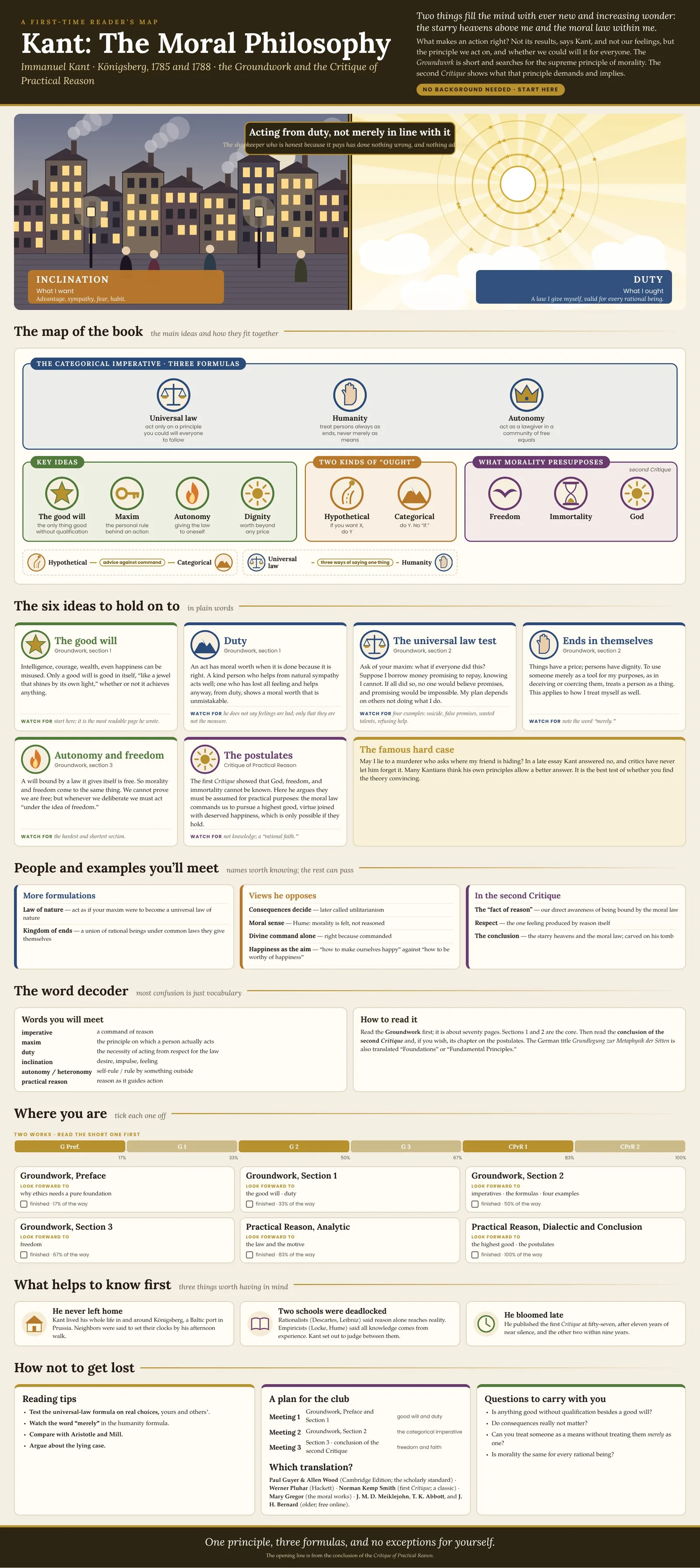
What makes an action right? Not its results, says Kant, and not our feelings, but the principle we act on, and whether we could will it for everyone. The Groundwork is short and searches for the supreme principle of morality. The second Critique shows what that principle demands and implies.
✨ Open this rung of the Great Books Ladder → 🔗 Own page, to share or bookmark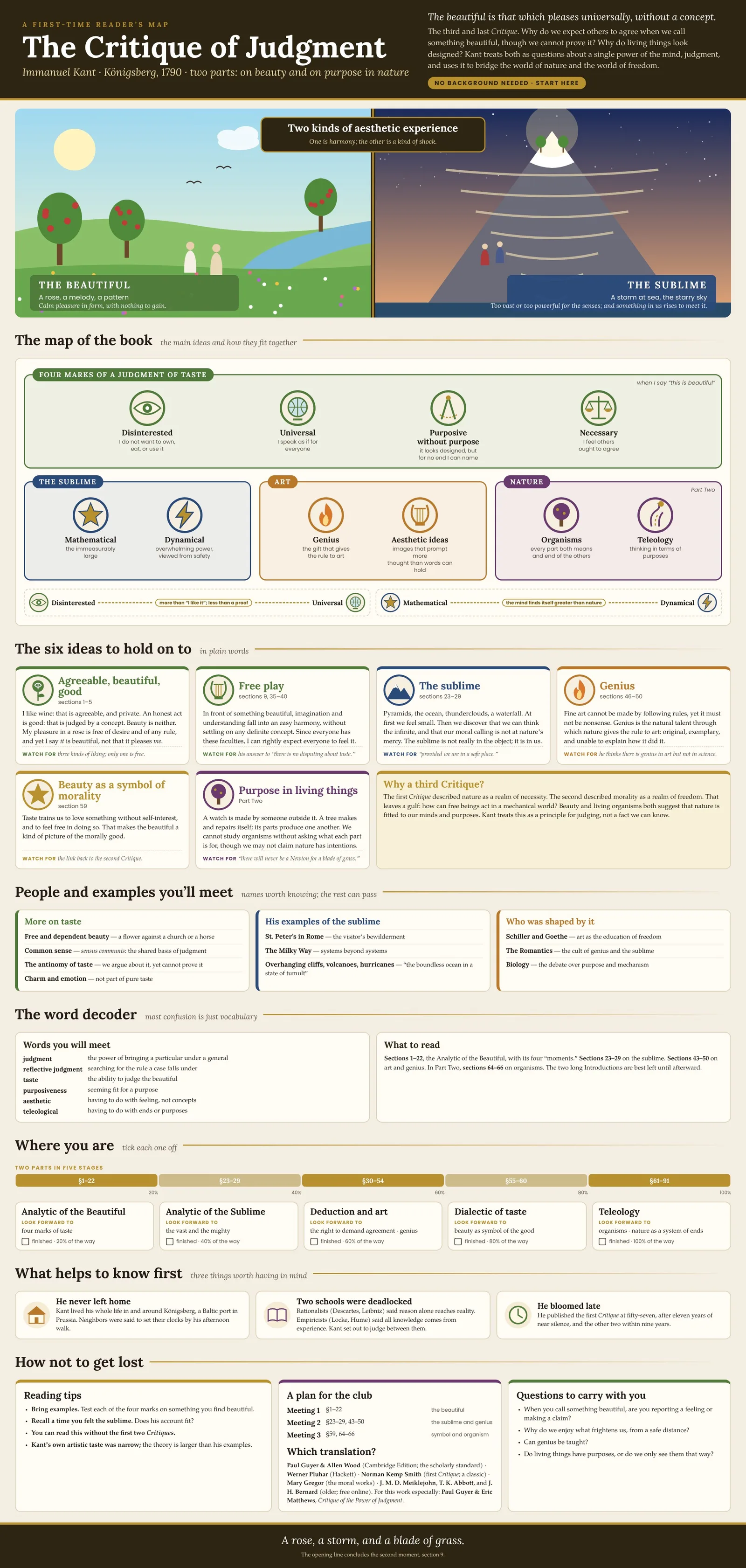
The third and last Critique. Why do we expect others to agree when we call something beautiful, though we cannot prove it? Why do living things look designed? Kant treats both as questions about a single power of the mind, judgment, and uses it to bridge the world of nature and the world of freedom.
✨ Open this rung of the Great Books Ladder → 🔗 Own page, to share or bookmark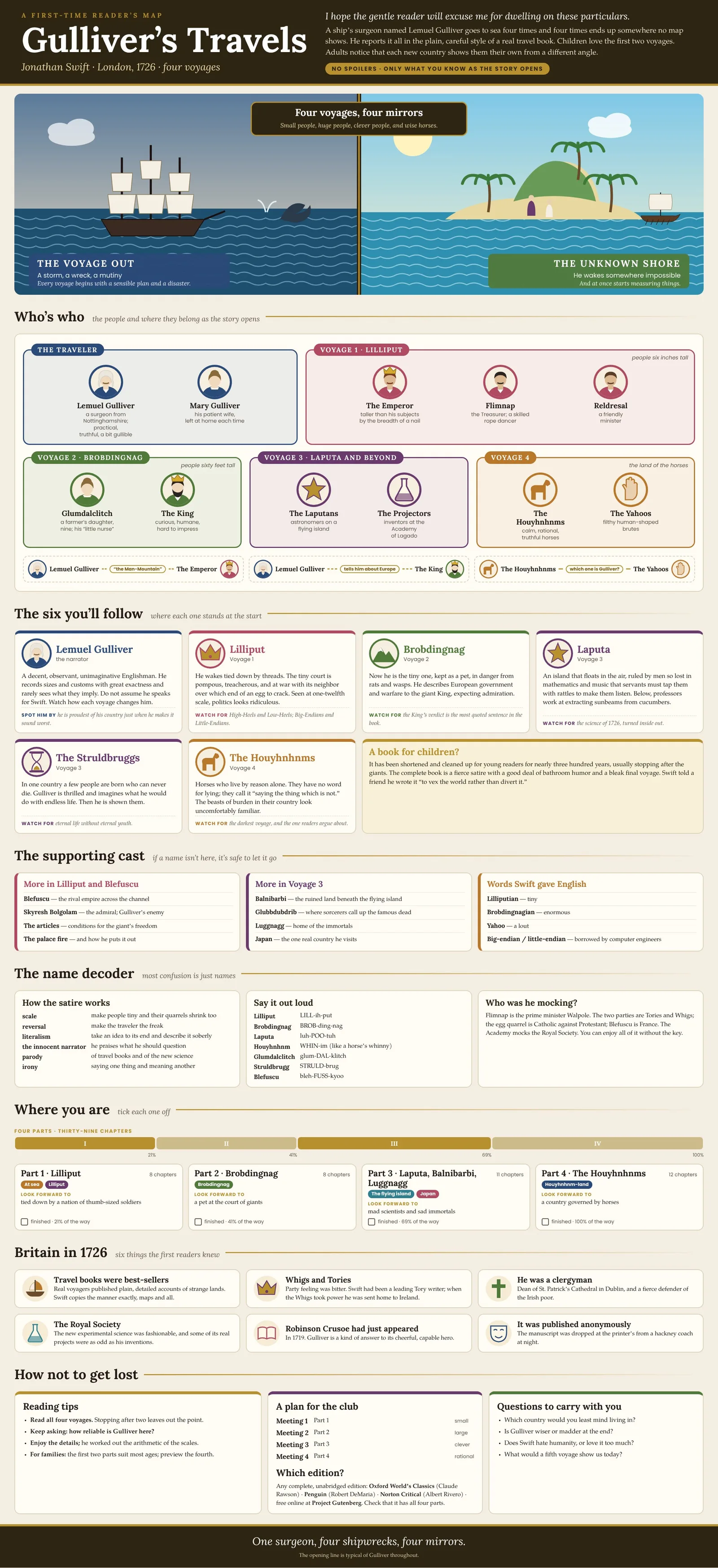
A ship’s surgeon named Lemuel Gulliver goes to sea four times and four times ends up somewhere no map shows. He reports it all in the plain, careful style of a real travel book. Children love the first two voyages. Adults notice that each new country shows them their own from a different angle.
✨ Open this rung of the Great Books Ladder → 🔗 Own page, to share or bookmark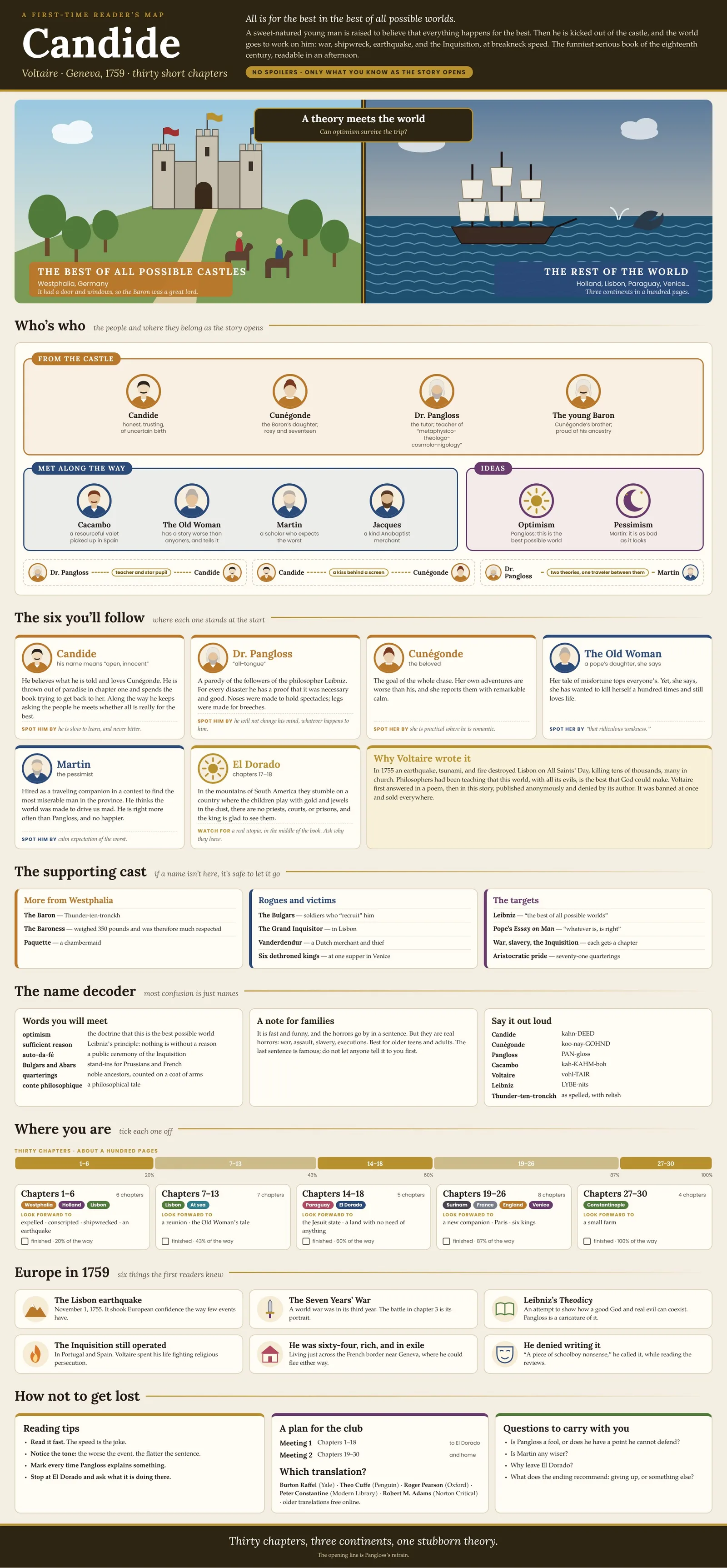
A sweet-natured young man is raised to believe that everything happens for the best. Then he is kicked out of the castle, and the world goes to work on him: war, shipwreck, earthquake, and the Inquisition, at breakneck speed. The funniest serious book of the eighteenth century, readable in an afternoon.
✨ Open this rung of the Great Books Ladder → 🔗 Own page, to share or bookmark 📚 Candide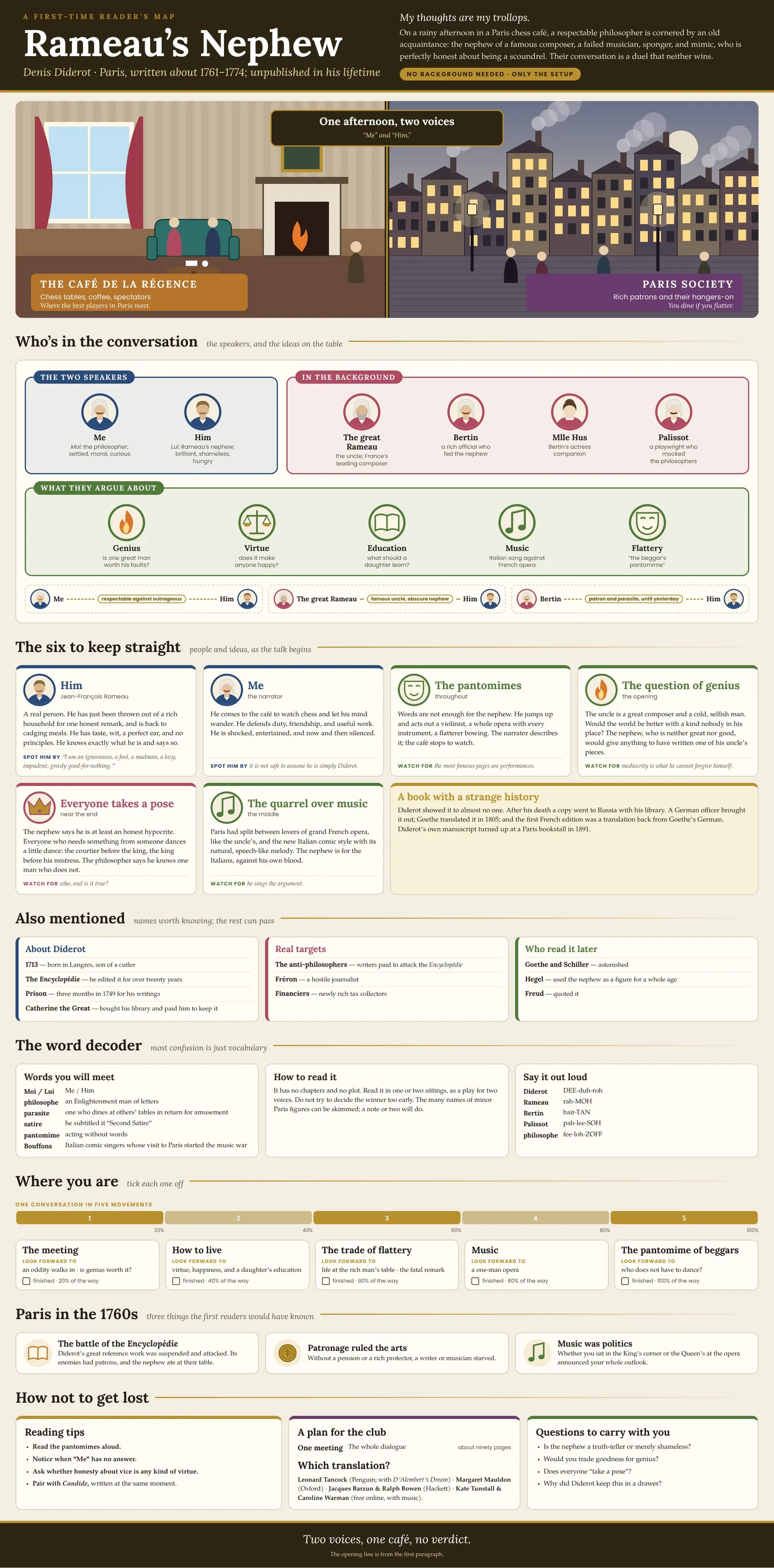
On a rainy afternoon in a Paris chess café, a respectable philosopher is cornered by an old acquaintance: the nephew of a famous composer, a failed musician, sponger, and mimic, who is perfectly honest about being a scoundrel. Their conversation is a duel that neither wins.
✨ Open this rung of the Great Books Ladder → 🔗 Own page, to share or bookmark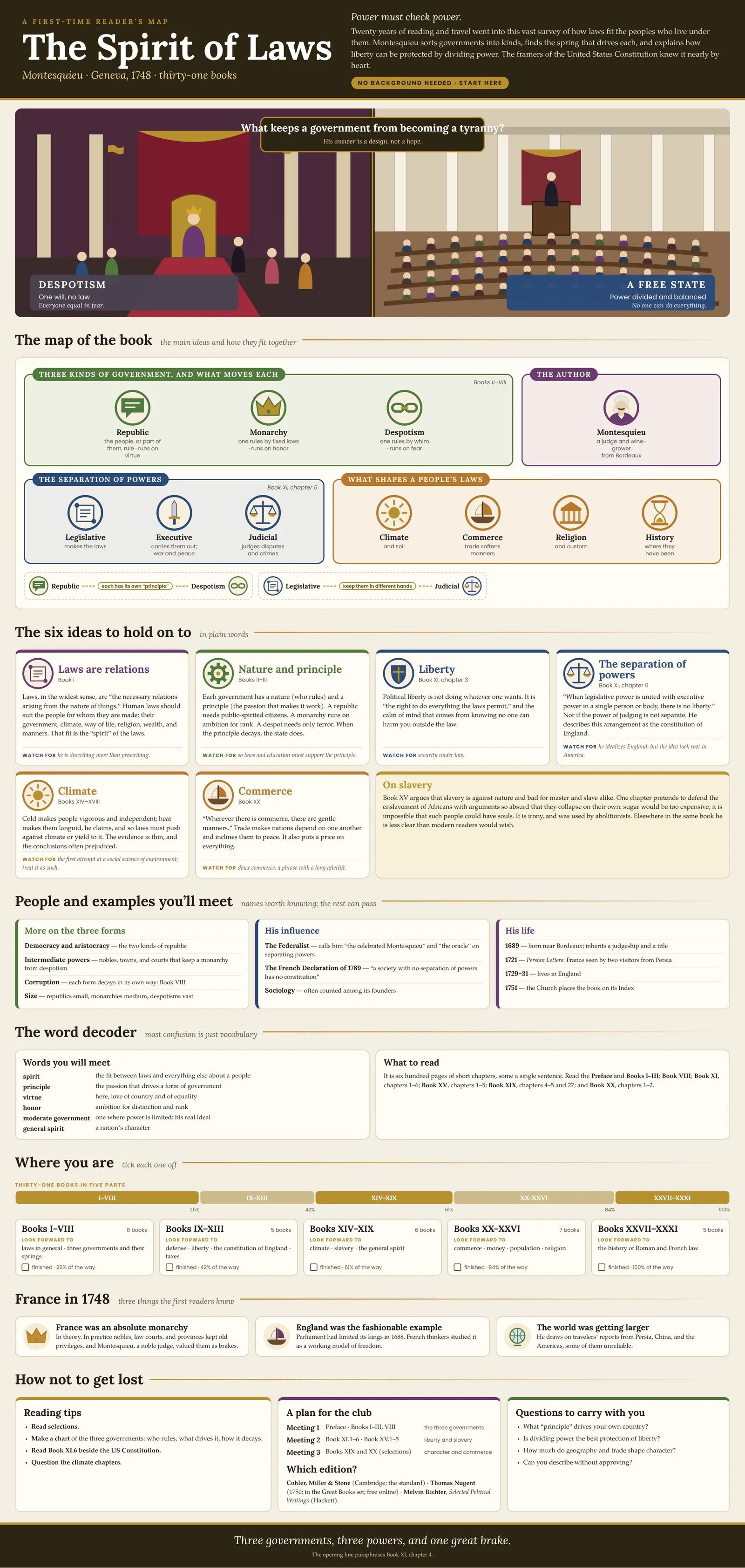
Twenty years of reading and travel went into this vast survey of how laws fit the peoples who live under them. Montesquieu sorts governments into kinds, finds the spring that drives each, and explains how liberty can be protected by dividing power. The framers of the United States Constitution knew it nearly by heart.
✨ Open this rung of the Great Books Ladder → 🔗 Own page, to share or bookmark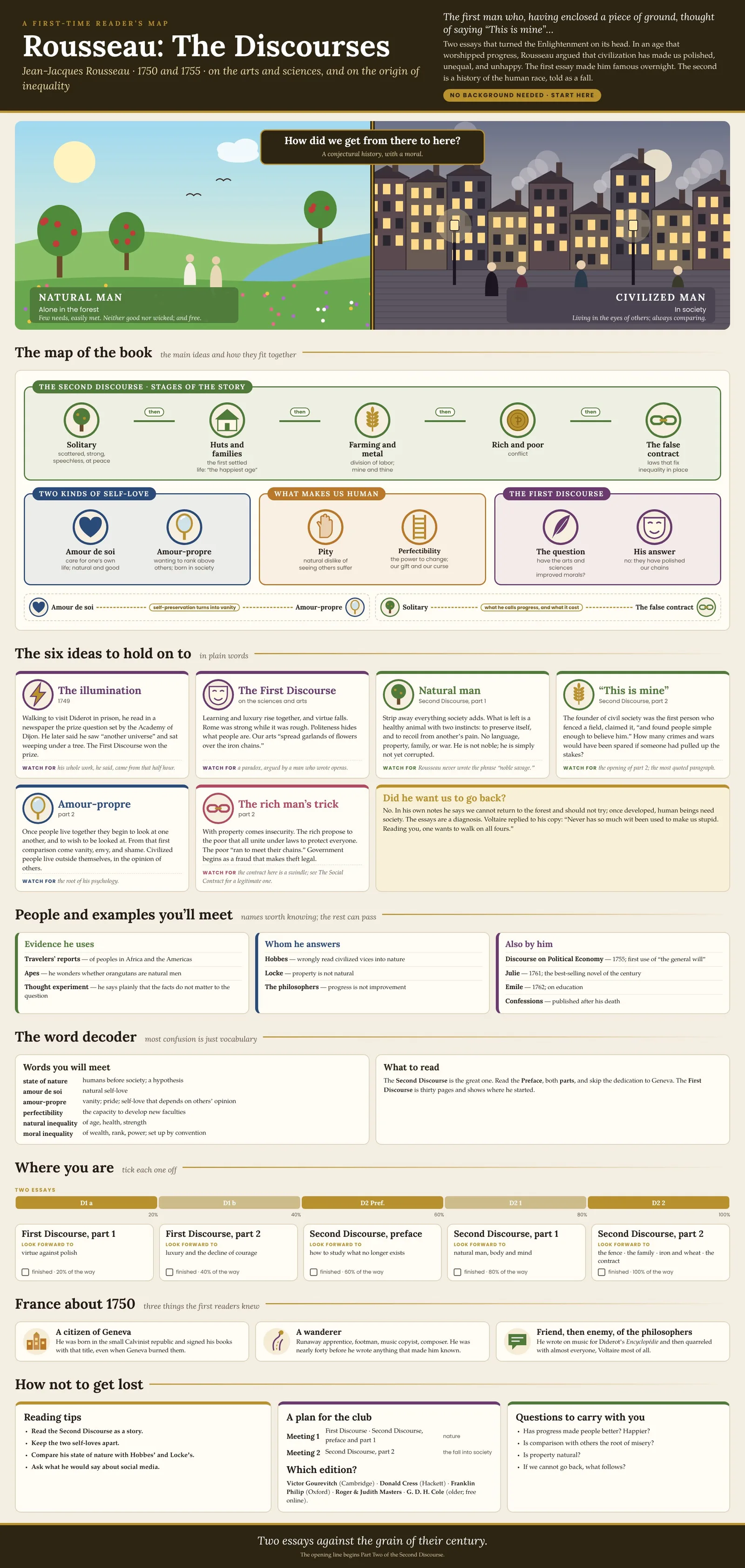
Two essays that turned the Enlightenment on its head. In an age that worshipped progress, Rousseau argued that civilization has made us polished, unequal, and unhappy. The first essay made him famous overnight. The second is a history of the human race, told as a fall.
✨ Open this rung of the Great Books Ladder → 🔗 Own page, to share or bookmark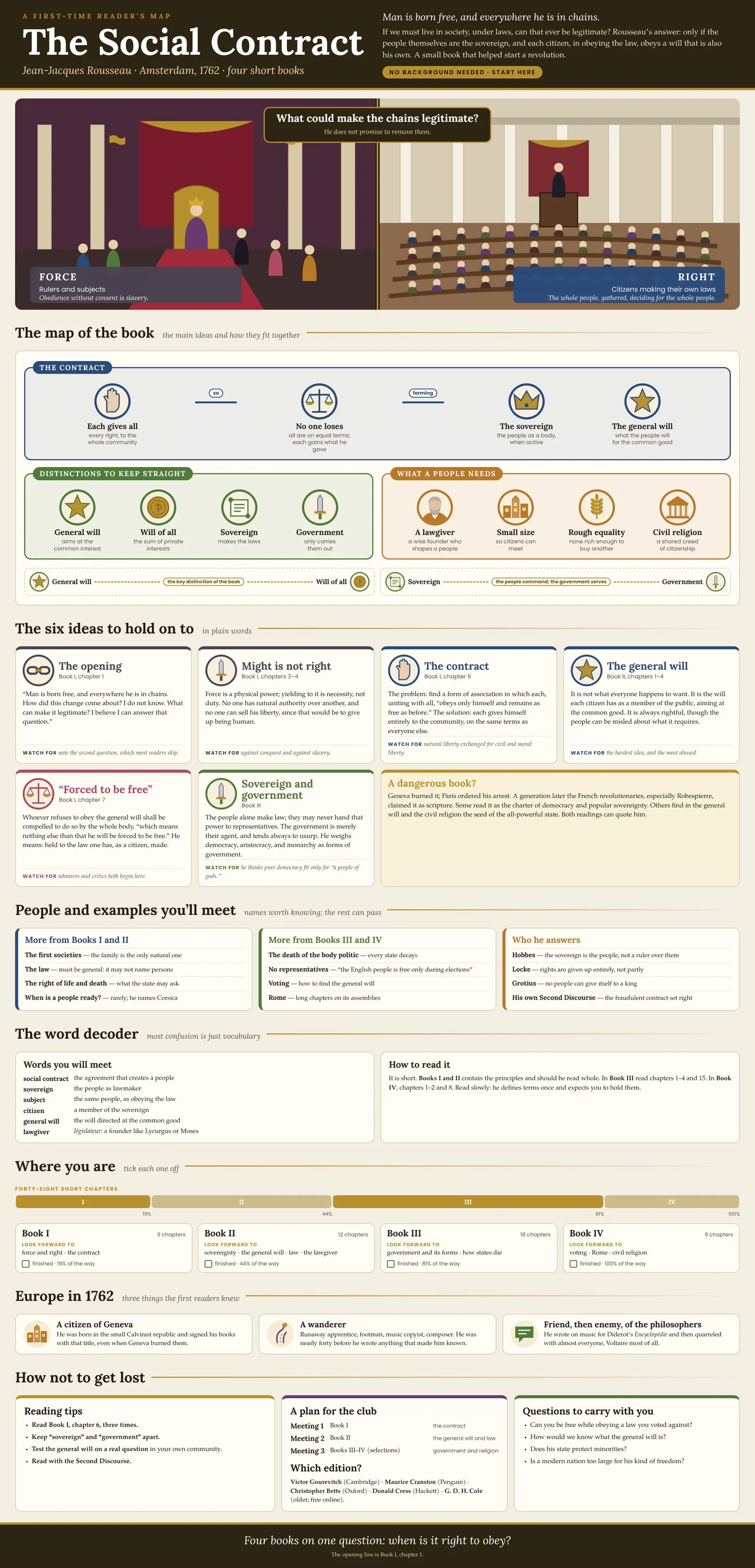
If we must live in society, under laws, can that ever be legitimate? Rousseau’s answer: only if the people themselves are the sovereign, and each citizen, in obeying the law, obeys a will that is also his own. A small book that helped start a revolution.
✨ Open this rung of the Great Books Ladder → 🔗 Own page, to share or bookmark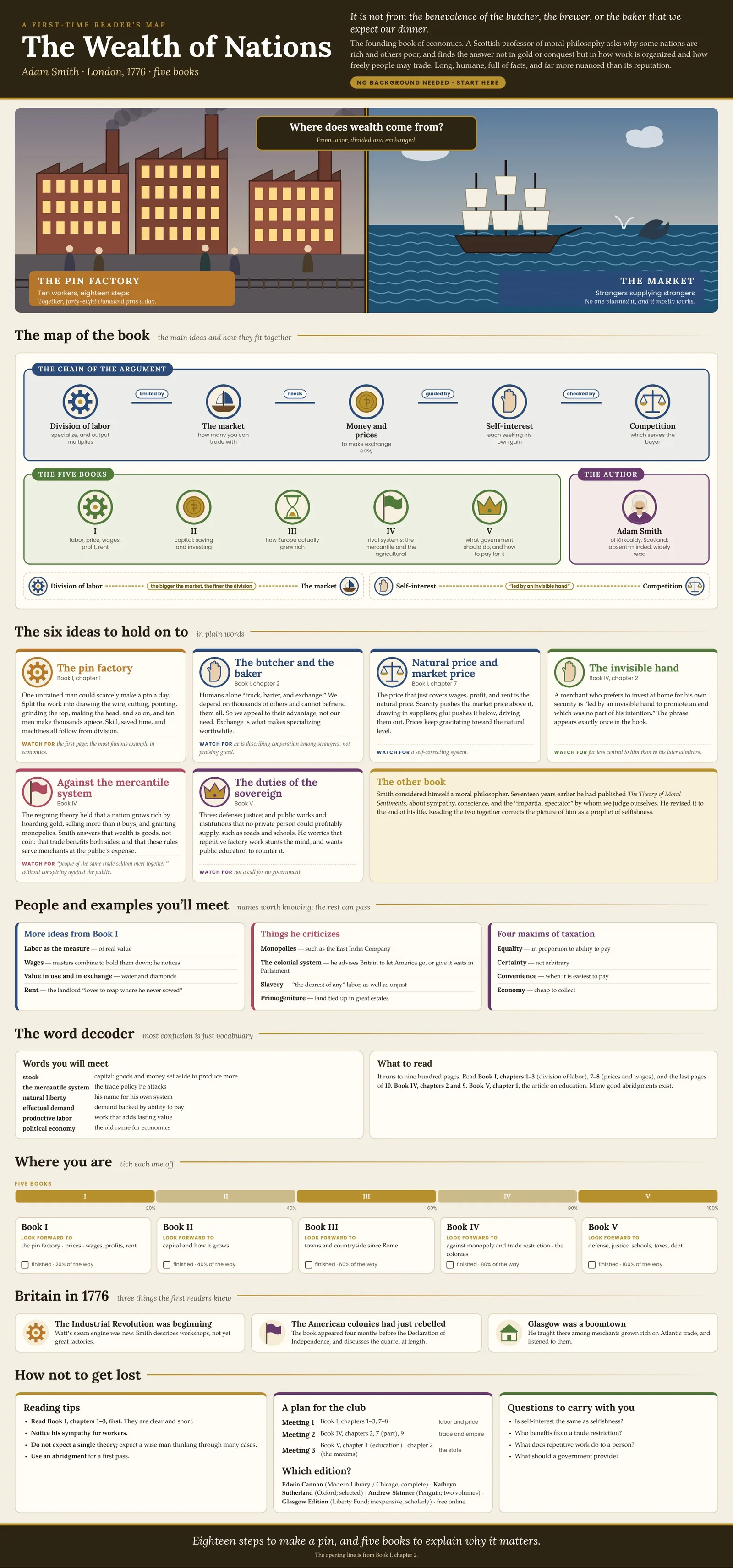
The founding book of economics. A Scottish professor of moral philosophy asks why some nations are rich and others poor, and finds the answer not in gold or conquest but in how work is organized and how freely people may trade. Long, humane, full of facts, and far more nuanced than its reputation.
✨ Open this rung of the Great Books Ladder → 🔗 Own page, to share or bookmark 📚 The Wealth of Nations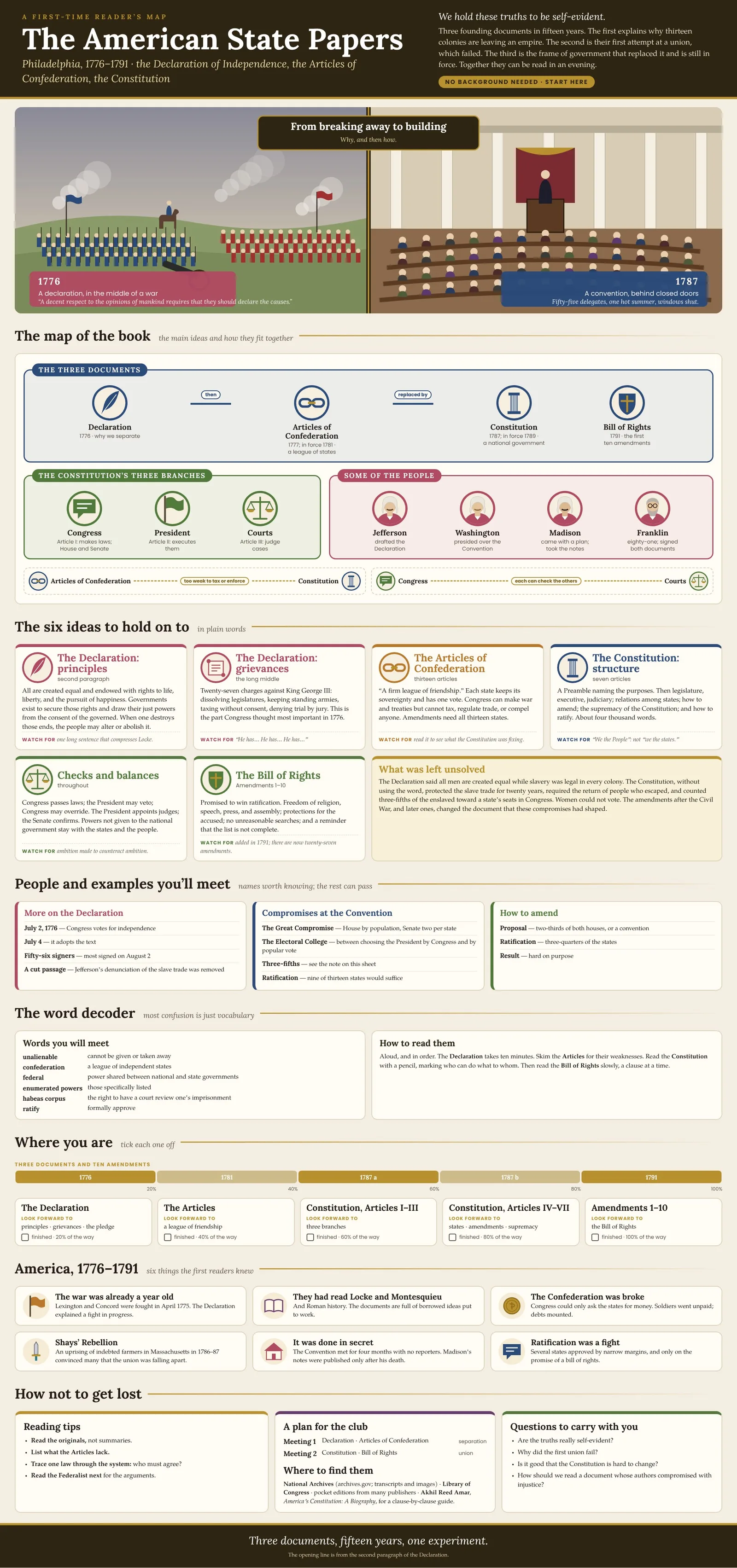
Three founding documents in fifteen years. The first explains why thirteen colonies are leaving an empire. The second is their first attempt at a union, which failed. The third is the frame of government that replaced it and is still in force. Together they can be read in an evening.
✨ Open this rung of the Great Books Ladder → 🔗 Own page, to share or bookmark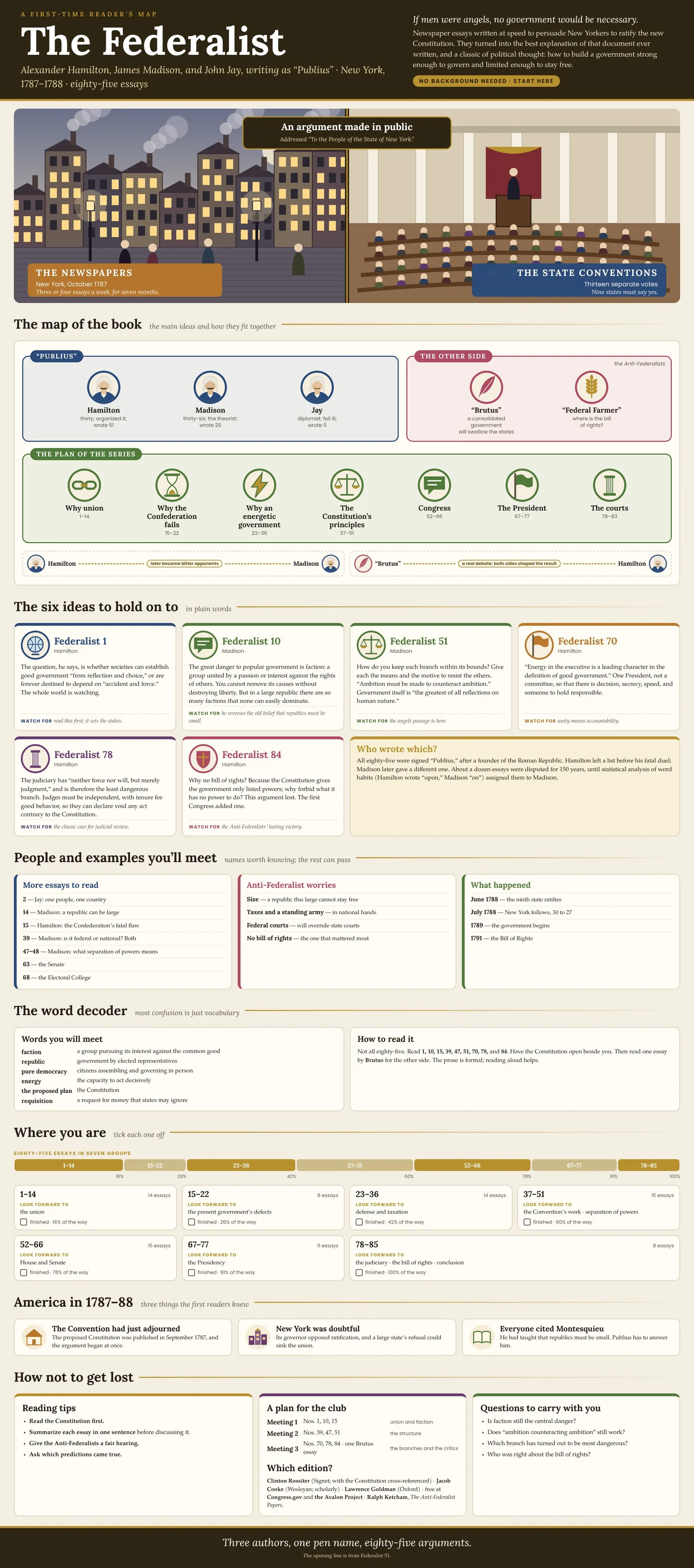
Newspaper essays written at speed to persuade New Yorkers to ratify the new Constitution. They turned into the best explanation of that document ever written, and a classic of political thought: how to build a government strong enough to govern and limited enough to stay free.
✨ Open this rung of the Great Books Ladder → 🔗 Own page, to share or bookmark 📚 The Federalist Papers (Selections)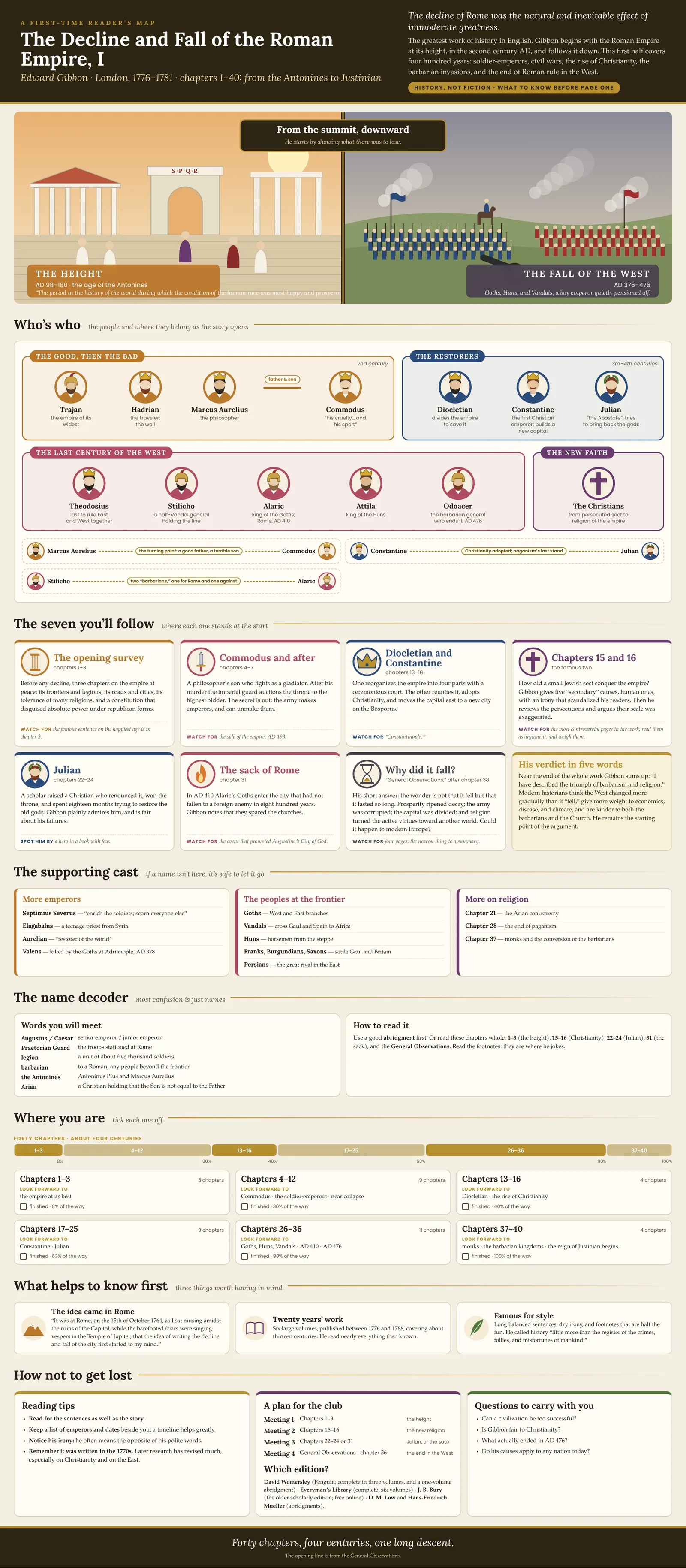
The greatest work of history in English. Gibbon begins with the Roman Empire at its height, in the second century AD, and follows it down. This first half covers four hundred years: soldier-emperors, civil wars, the rise of Christianity, the barbarian invasions, and the end of Roman rule in the West.
✨ Open this rung of the Great Books Ladder → 🔗 Own page, to share or bookmark 📚 The History of the Decline and Fall of the Roman Empire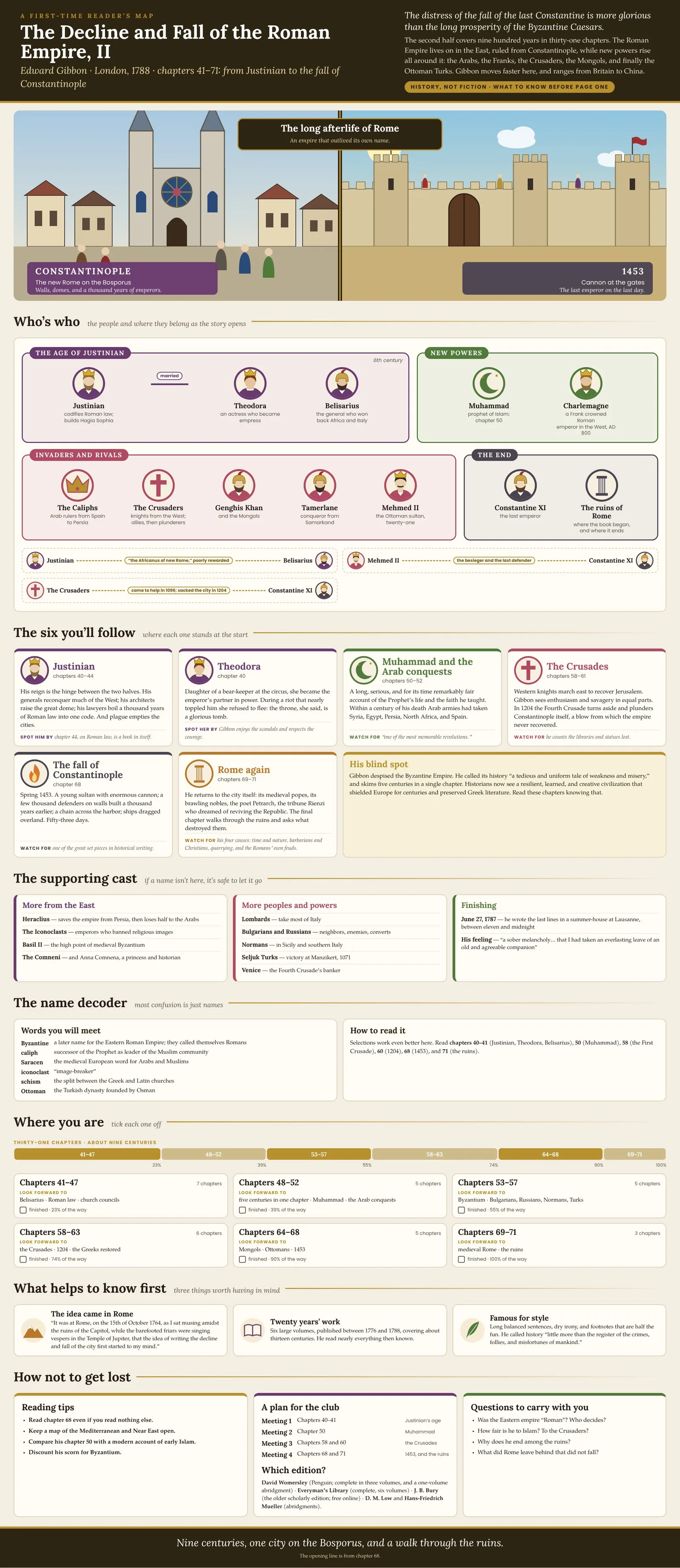
The second half covers nine hundred years in thirty-one chapters. The Roman Empire lives on in the East, ruled from Constantinople, while new powers rise all around it: the Arabs, the Franks, the Crusaders, the Mongols, and finally the Ottoman Turks. Gibbon moves faster here, and ranges from Britain to China.
✨ Open this rung of the Great Books Ladder → 🔗 Own page, to share or bookmark 📚 The History of the Decline and Fall of the Roman Empire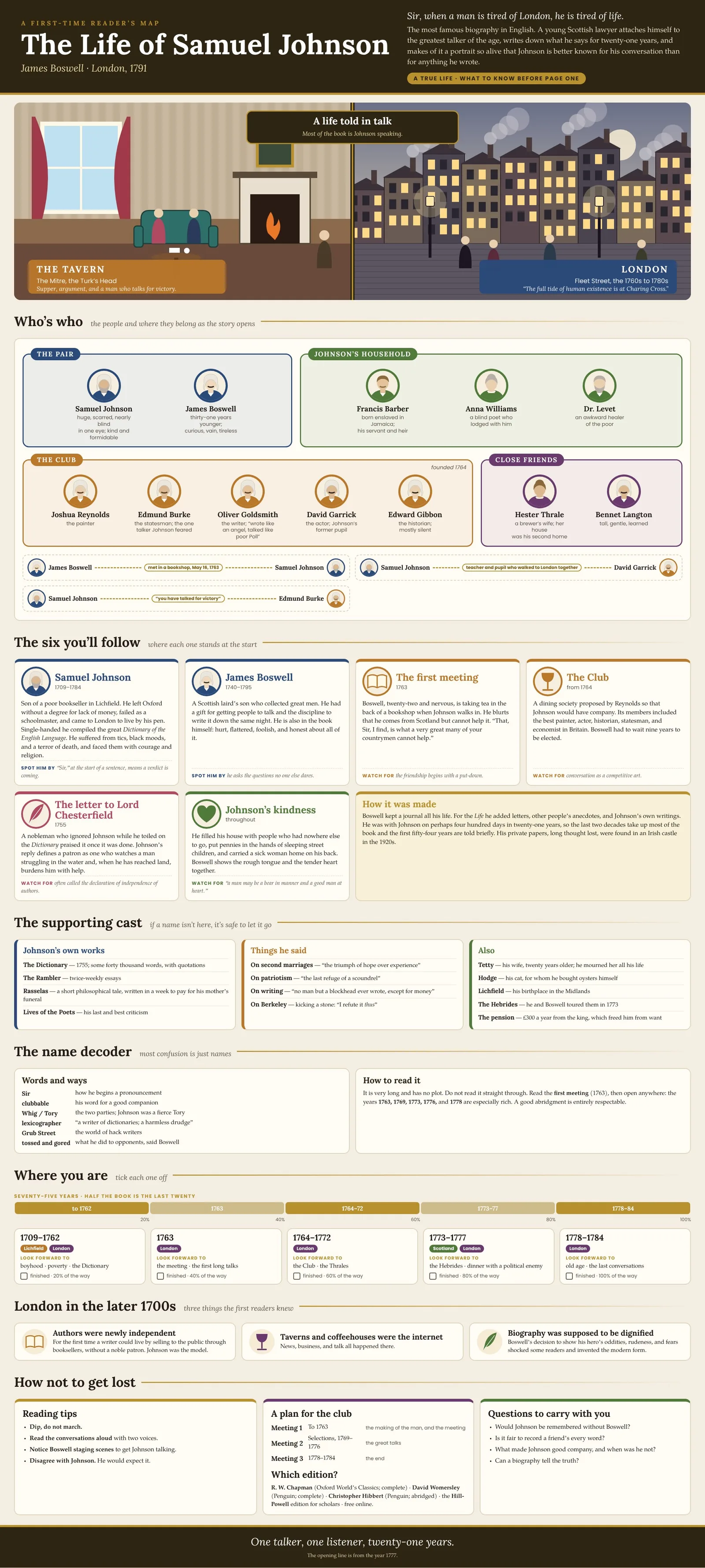
The most famous biography in English. A young Scottish lawyer attaches himself to the greatest talker of the age, writes down what he says for twenty-one years, and makes of it a portrait so alive that Johnson is better known for his conversation than for anything he wrote.
✨ Open this rung of the Great Books Ladder → 🔗 Own page, to share or bookmark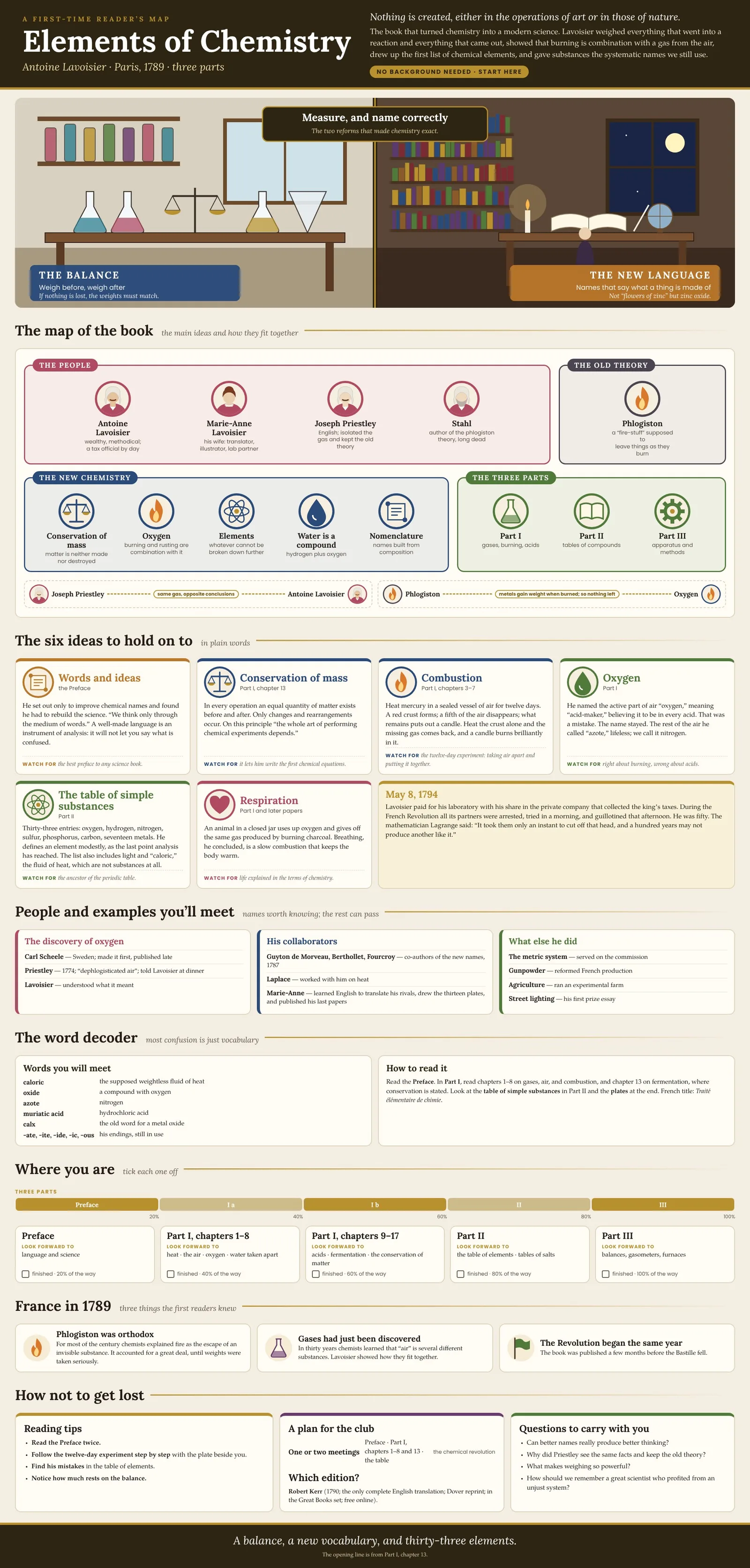
The book that turned chemistry into a modern science. Lavoisier weighed everything that went into a reaction and everything that came out, showed that burning is combination with a gas from the air, drew up the first list of chemical elements, and gave substances the systematic names we still use.
✨ Open this rung of the Great Books Ladder → 🔗 Own page, to share or bookmarkThe 19th Century 23 maps · the rungs →
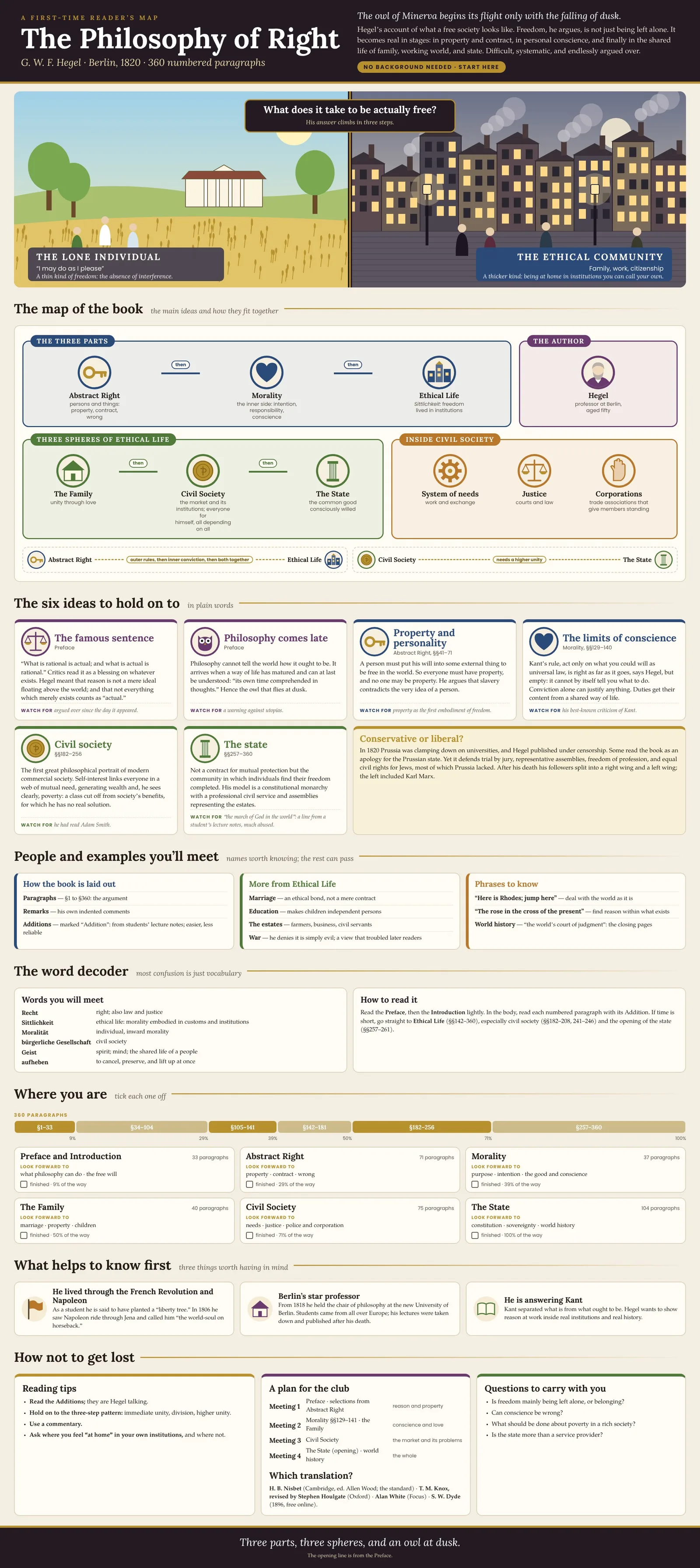
Hegel’s account of what a free society looks like. Freedom, he argues, is not just being left alone. It becomes real in stages: in property and contract, in personal conscience, and finally in the shared life of family, working world, and state. Difficult, systematic, and endlessly argued over.
✨ Open this rung of the Great Books Ladder → 🔗 Own page, to share or bookmark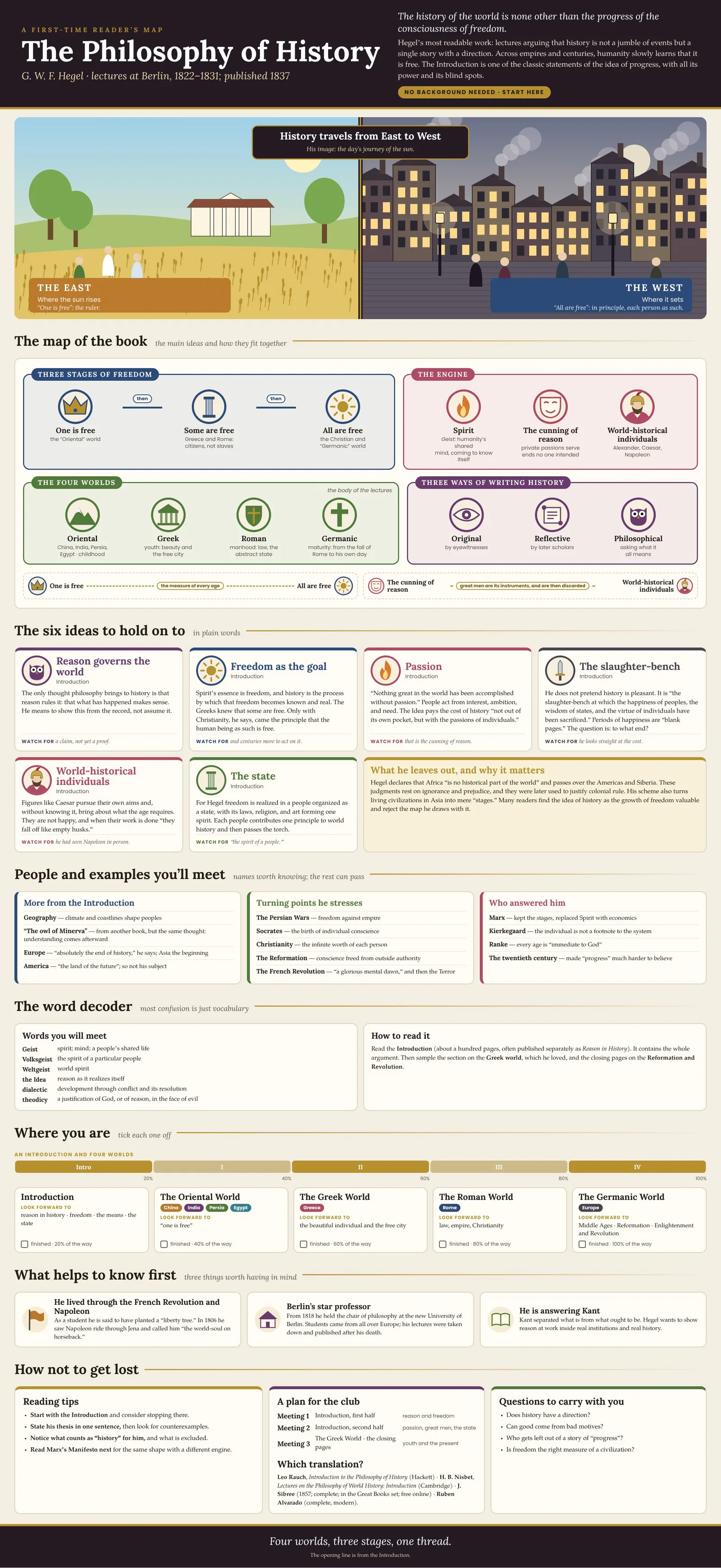
Hegel’s most readable work: lectures arguing that history is not a jumble of events but a single story with a direction. Across empires and centuries, humanity slowly learns that it is free. The Introduction is one of the classic statements of the idea of progress, with all its power and its blind spots.
✨ Open this rung of the Great Books Ladder → 🔗 Own page, to share or bookmark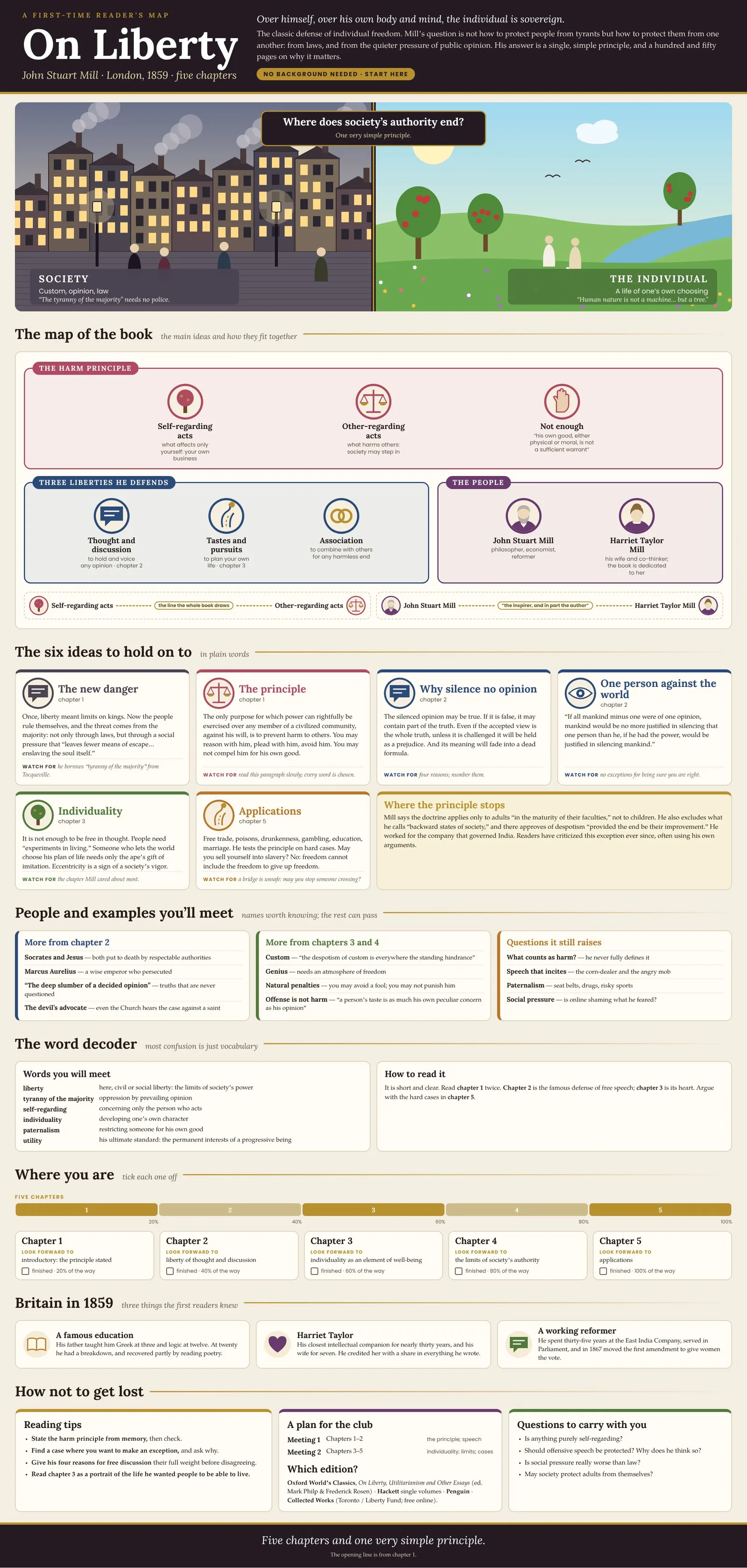
The classic defense of individual freedom. Mill’s question is not how to protect people from tyrants but how to protect them from one another: from laws, and from the quieter pressure of public opinion. His answer is a single, simple principle, and a hundred and fifty pages on why it matters.
✨ Open this rung of the Great Books Ladder → 🔗 Own page, to share or bookmark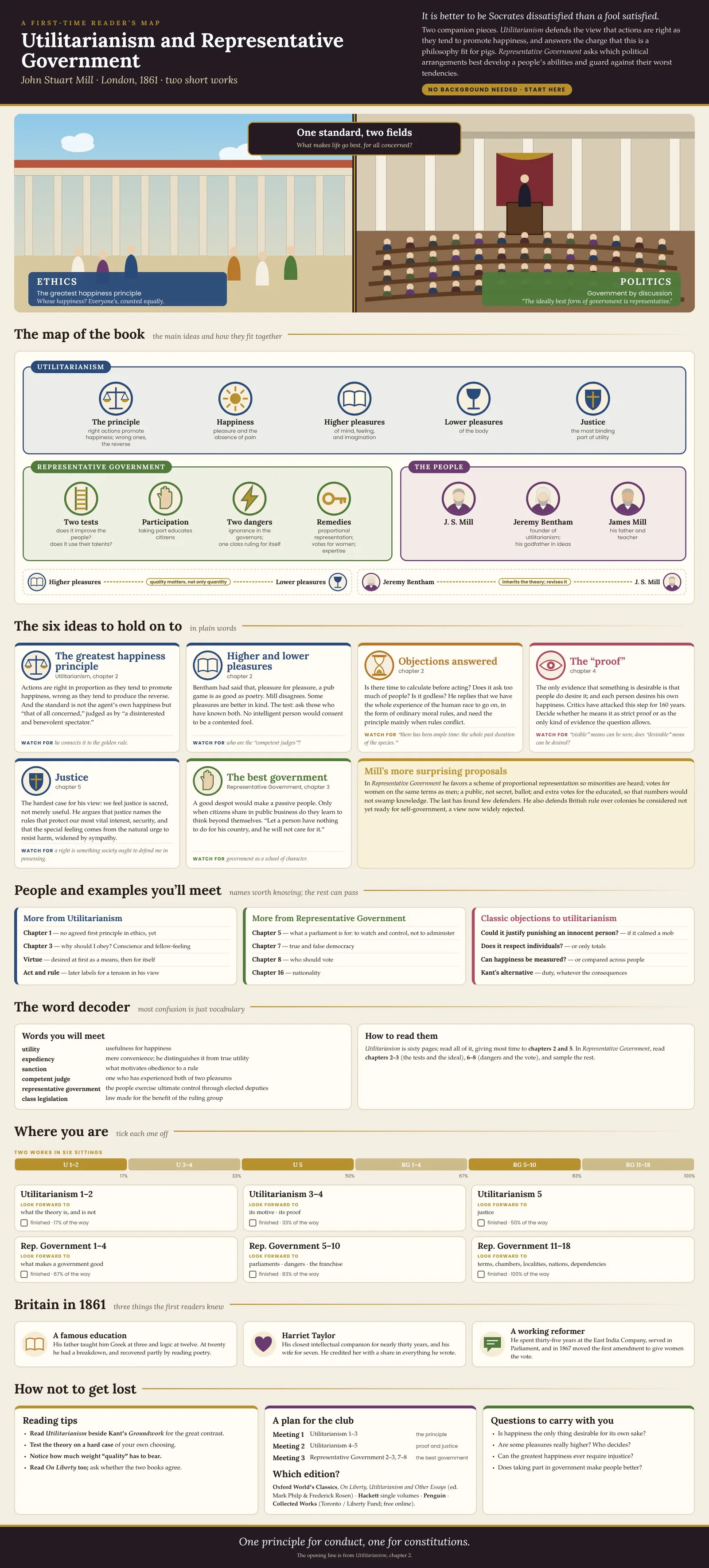
Two companion pieces. Utilitarianism defends the view that actions are right as they tend to promote happiness, and answers the charge that this is a philosophy fit for pigs. Representative Government asks which political arrangements best develop a people’s abilities and guard against their worst tendencies.
✨ Open this rung of the Great Books Ladder → 🔗 Own page, to share or bookmark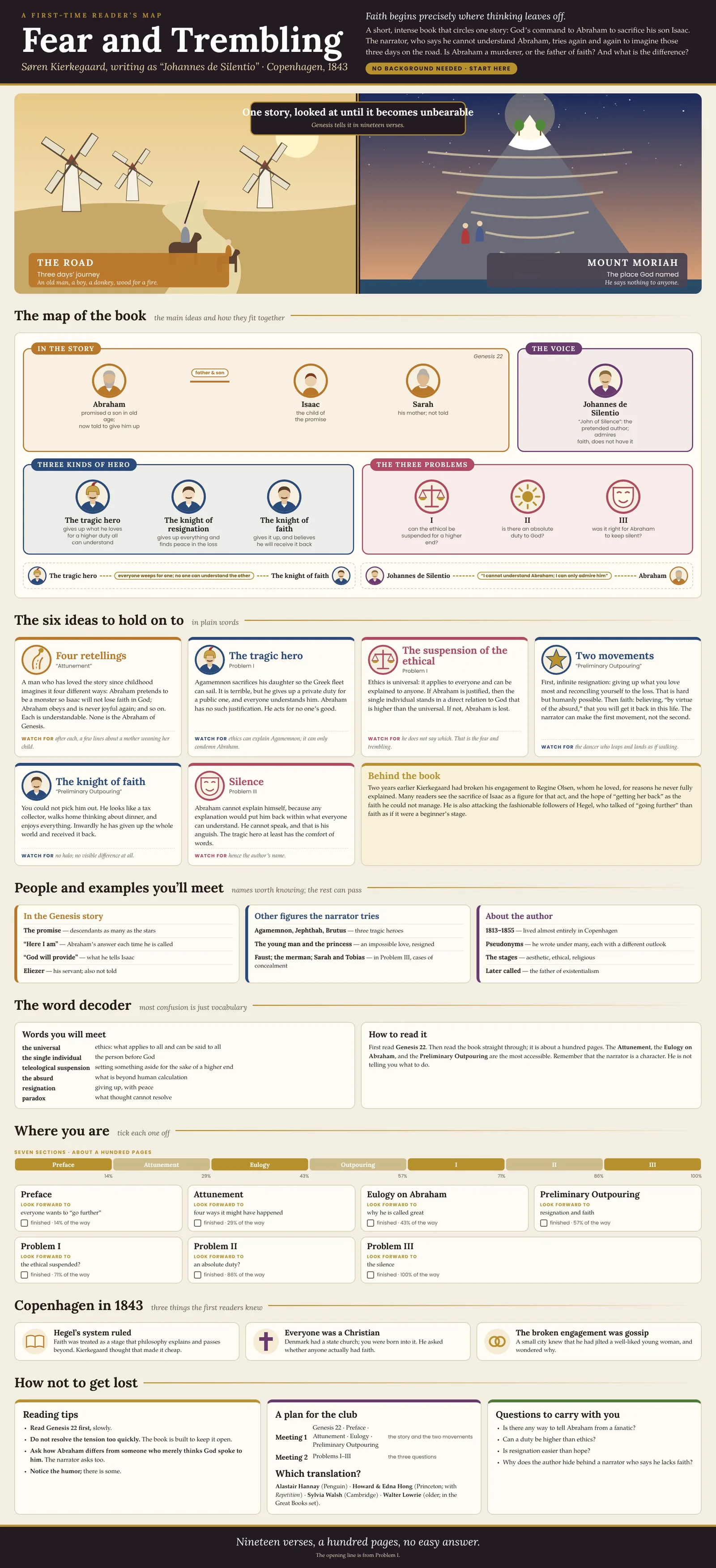
A short, intense book that circles one story: God’s command to Abraham to sacrifice his son Isaac. The narrator, who says he cannot understand Abraham, tries again and again to imagine those three days on the road. Is Abraham a murderer, or the father of faith? And what is the difference?
✨ Open this rung of the Great Books Ladder → 🔗 Own page, to share or bookmark 📚 Fear and Trembling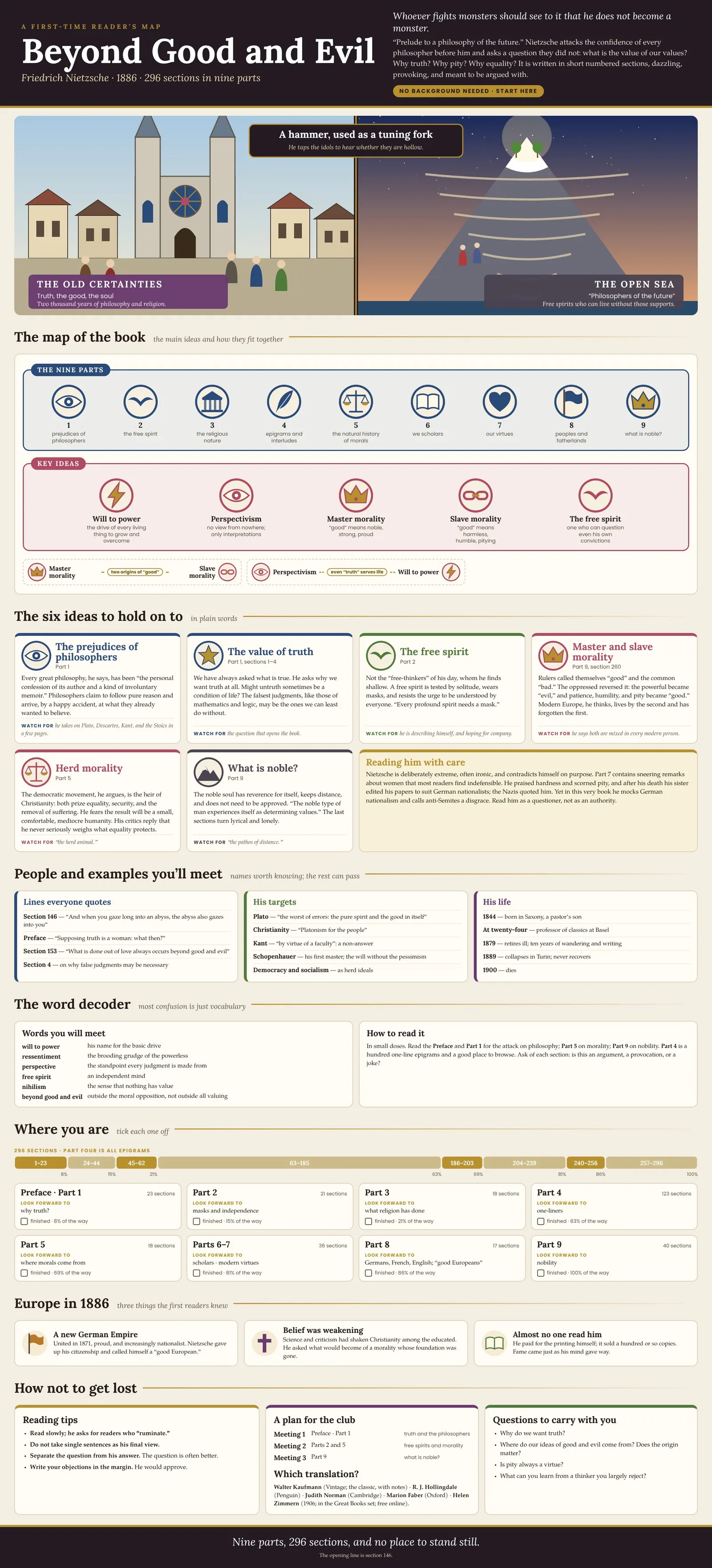
“Prelude to a philosophy of the future.” Nietzsche attacks the confidence of every philosopher before him and asks a question they did not: what is the value of our values? Why truth? Why pity? Why equality? It is written in short numbered sections, dazzling, provoking, and meant to be argued with.
✨ Open this rung of the Great Books Ladder → 🔗 Own page, to share or bookmark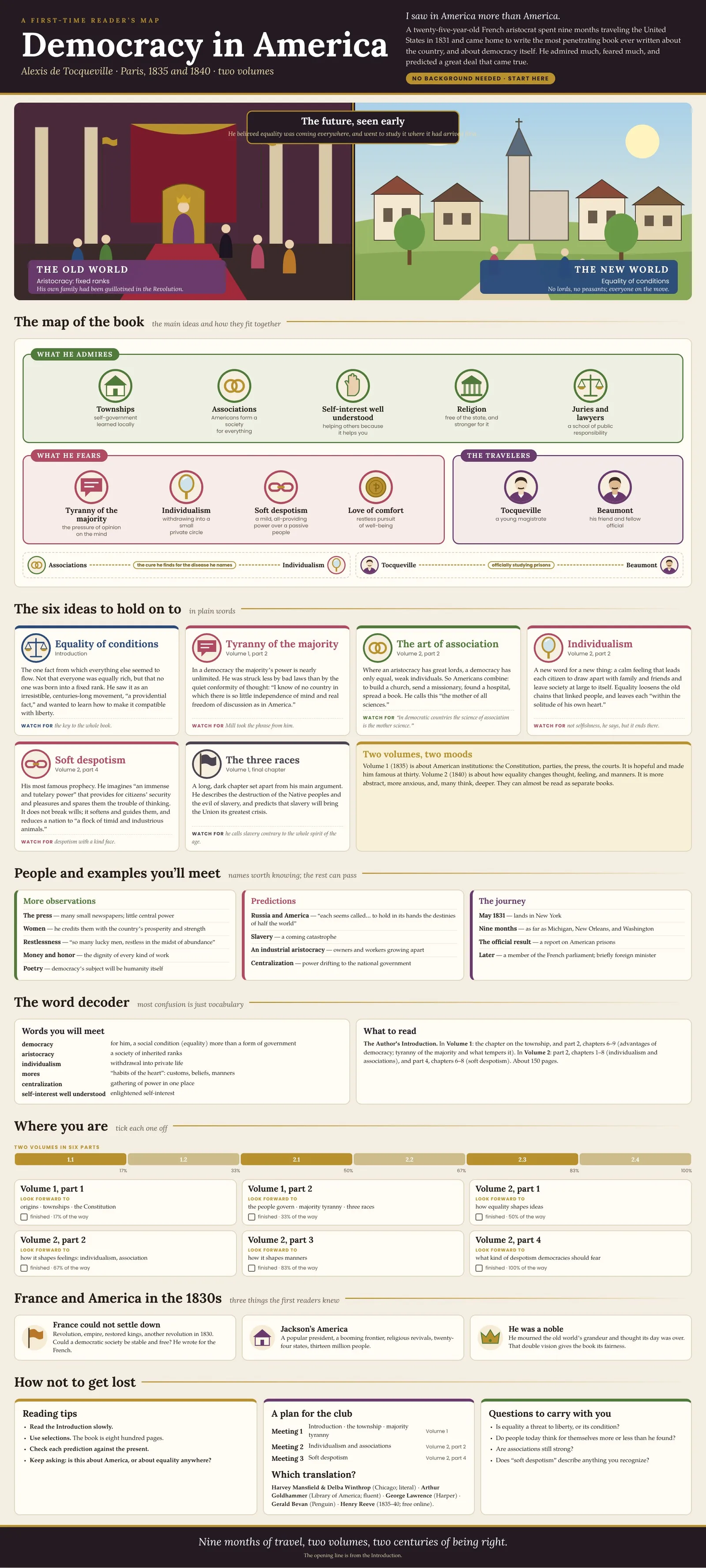
A twenty-five-year-old French aristocrat spent nine months traveling the United States in 1831 and came home to write the most penetrating book ever written about the country, and about democracy itself. He admired much, feared much, and predicted a great deal that came true.
✨ Open this rung of the Great Books Ladder → 🔗 Own page, to share or bookmark 📚 Democracy in America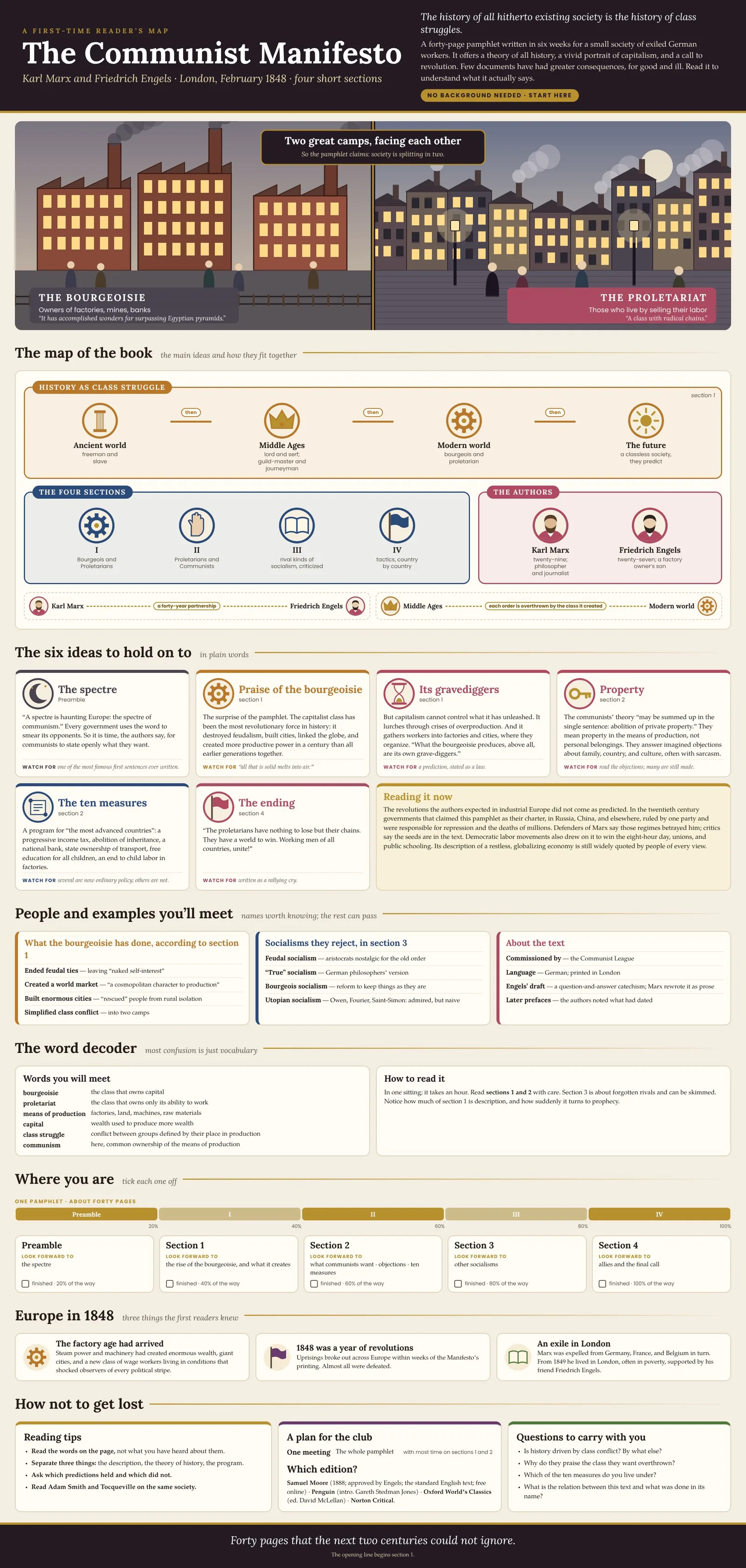
A forty-page pamphlet written in six weeks for a small society of exiled German workers. It offers a theory of all history, a vivid portrait of capitalism, and a call to revolution. Few documents have had greater consequences, for good and ill. Read it to understand what it actually says.
✨ Open this rung of the Great Books Ladder → 🔗 Own page, to share or bookmark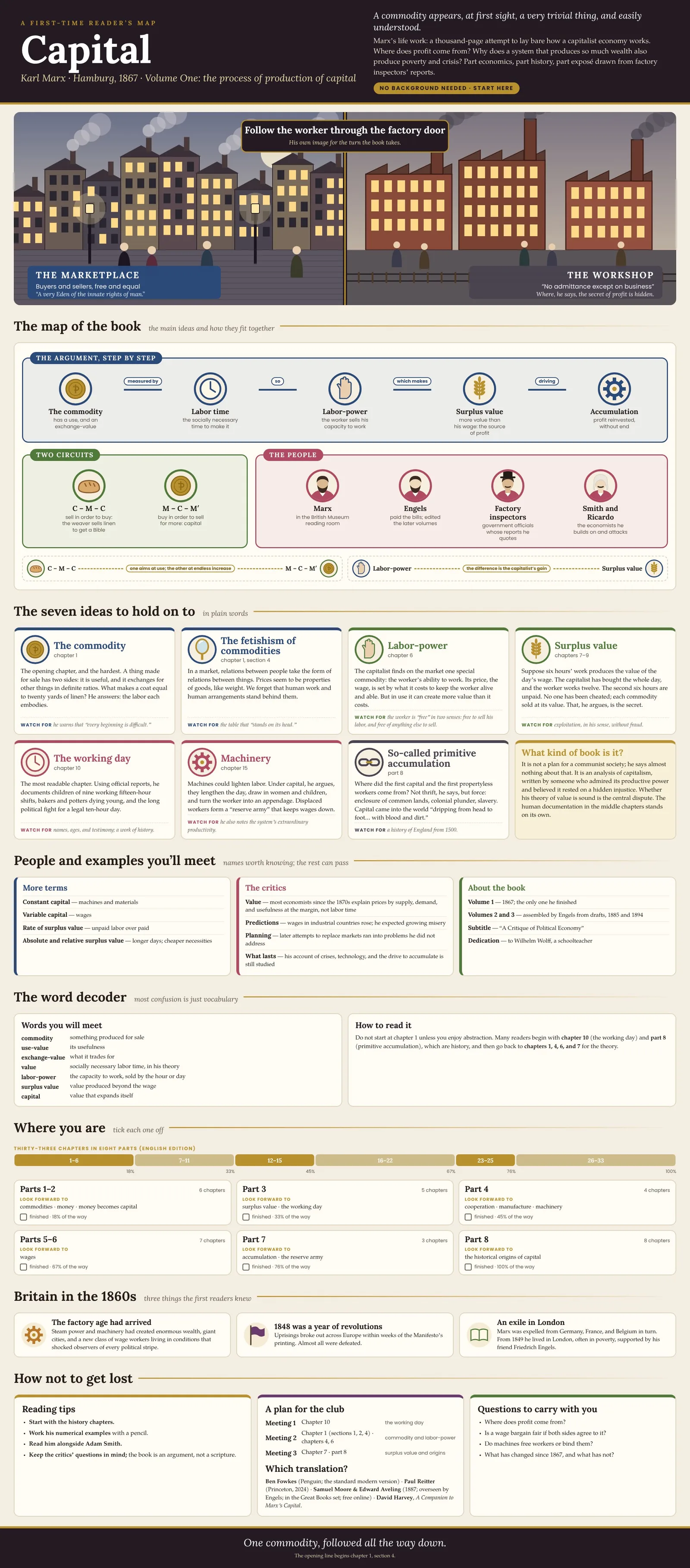
Marx’s life work: a thousand-page attempt to lay bare how a capitalist economy works. Where does profit come from? Why does a system that produces so much wealth also produce poverty and crisis? Part economics, part history, part exposé drawn from factory inspectors’ reports.
✨ Open this rung of the Great Books Ladder → 🔗 Own page, to share or bookmark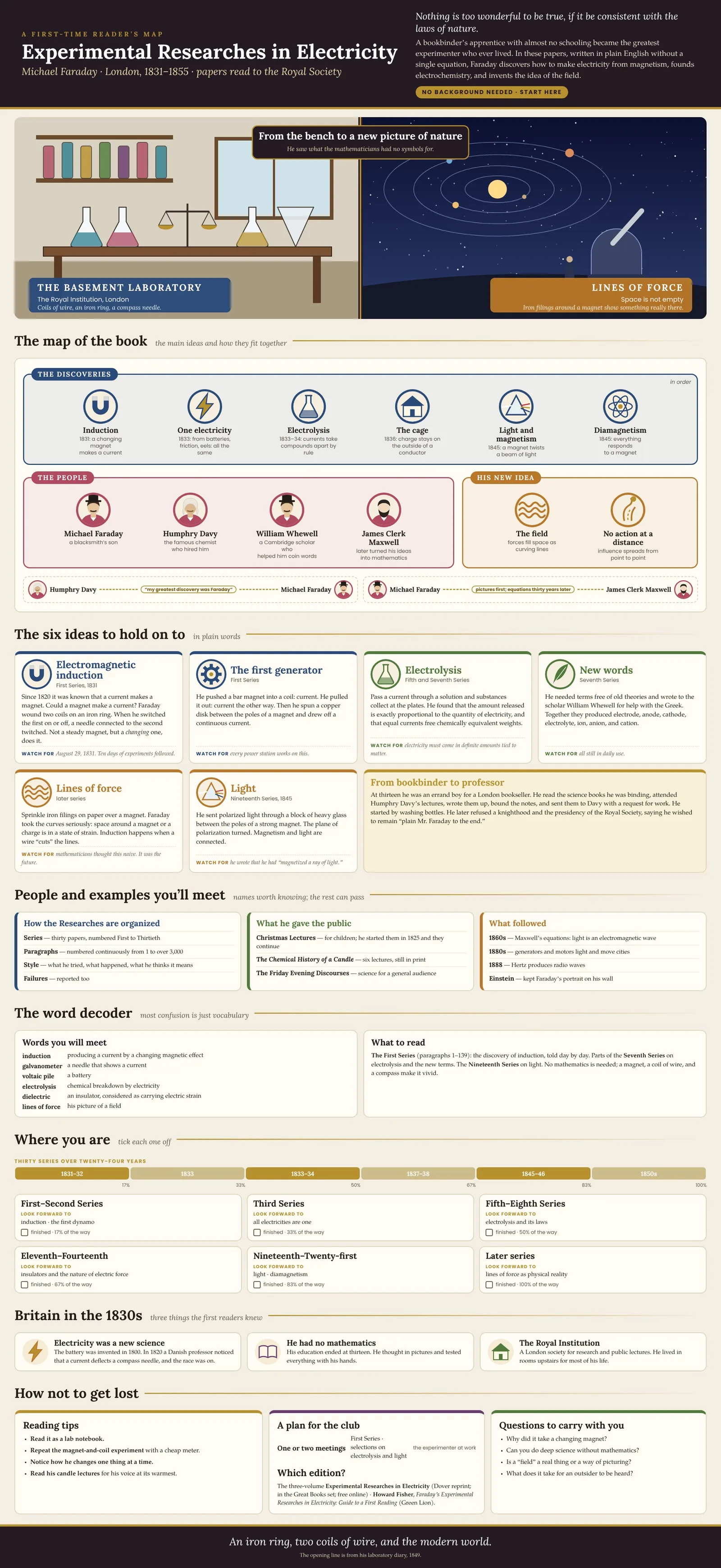
A bookbinder’s apprentice with almost no schooling became the greatest experimenter who ever lived. In these papers, written in plain English without a single equation, Faraday discovers how to make electricity from magnetism, founds electrochemistry, and invents the idea of the field.
✨ Open this rung of the Great Books Ladder → 🔗 Own page, to share or bookmark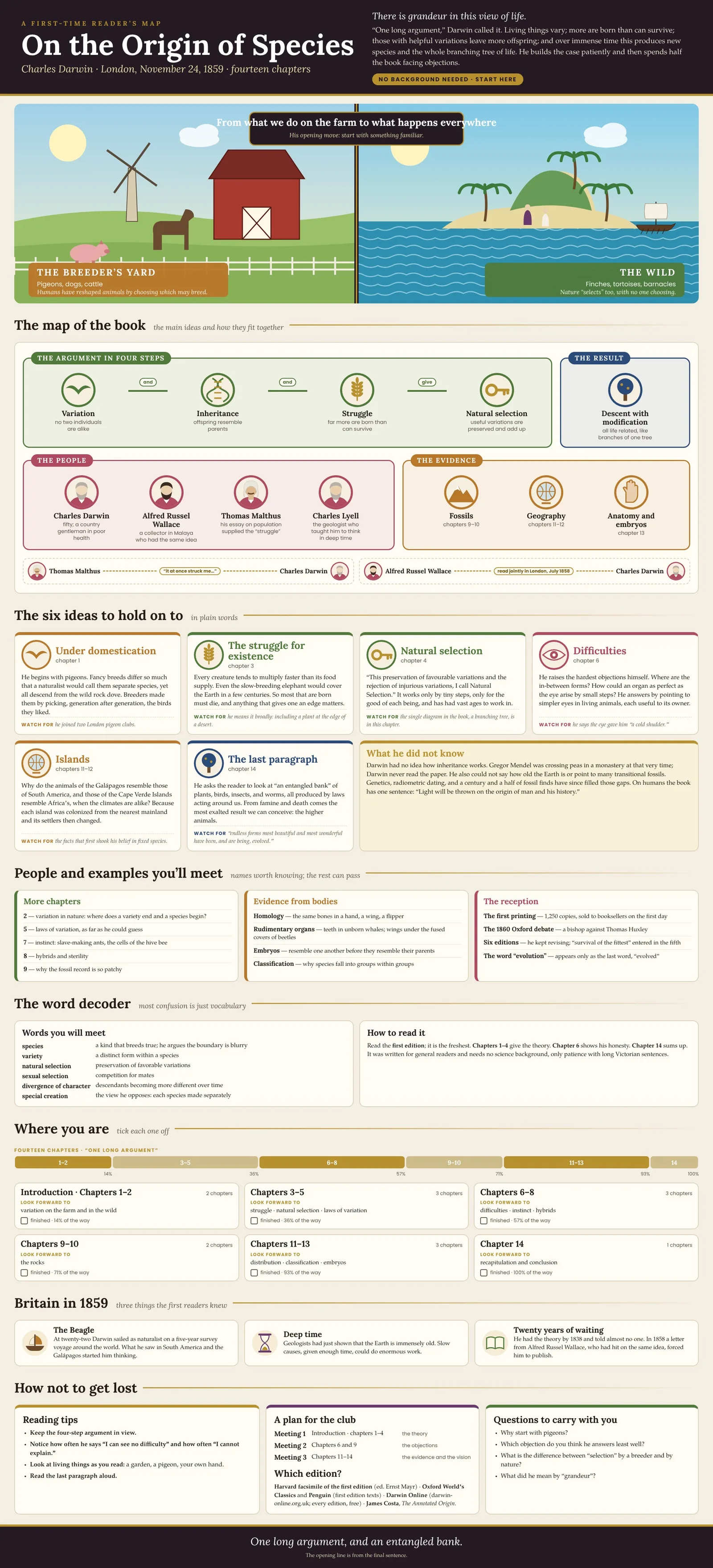
“One long argument,” Darwin called it. Living things vary; more are born than can survive; those with helpful variations leave more offspring; and over immense time this produces new species and the whole branching tree of life. He builds the case patiently and then spends half the book facing objections.
✨ Open this rung of the Great Books Ladder → 🔗 Own page, to share or bookmark 📚 On the Origin of Species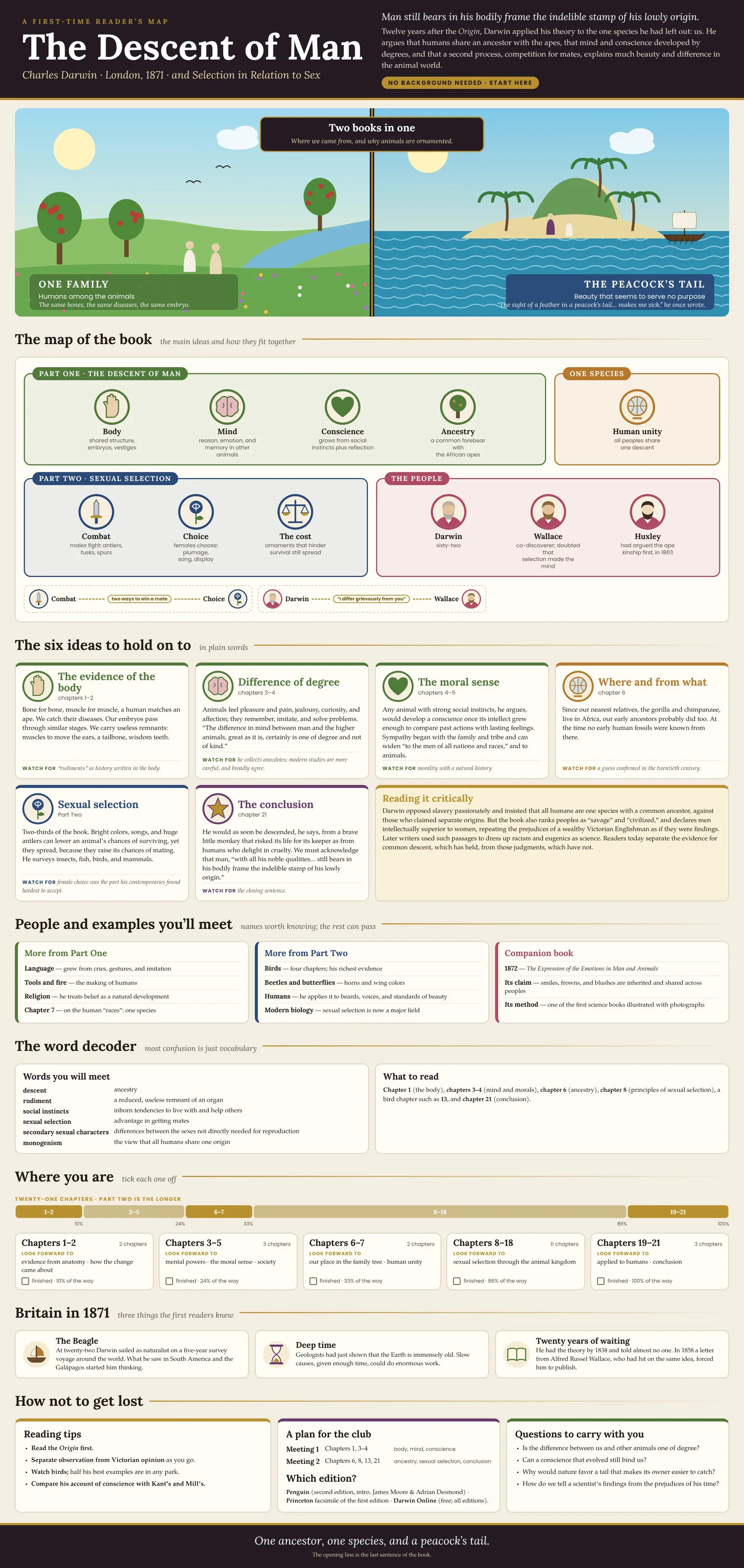
Twelve years after the Origin, Darwin applied his theory to the one species he had left out: us. He argues that humans share an ancestor with the apes, that mind and conscience developed by degrees, and that a second process, competition for mates, explains much beauty and difference in the animal world.
✨ Open this rung of the Great Books Ladder → 🔗 Own page, to share or bookmark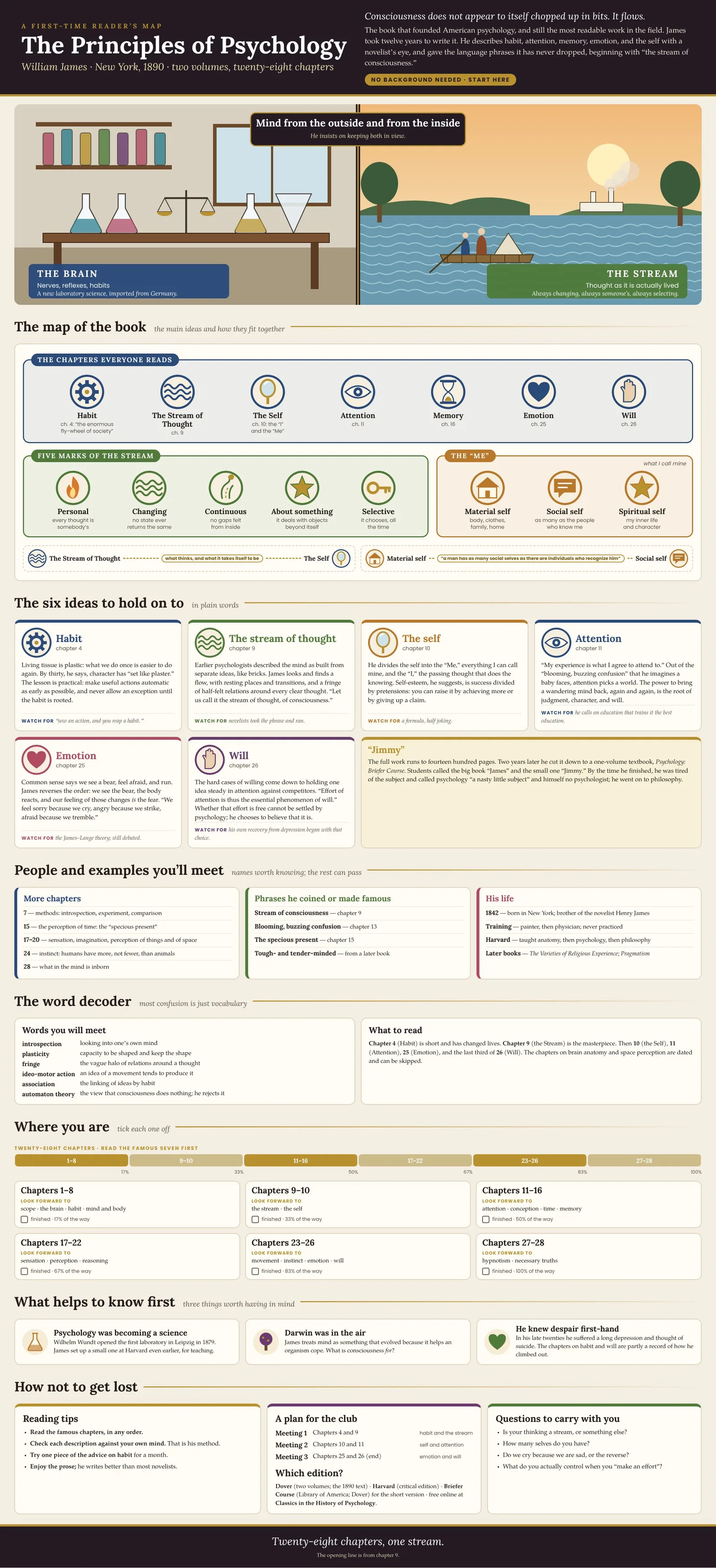
The book that founded American psychology, and still the most readable work in the field. James took twelve years to write it. He describes habit, attention, memory, emotion, and the self with a novelist’s eye, and gave the language phrases it has never dropped, beginning with “the stream of consciousness.”
✨ Open this rung of the Great Books Ladder → 🔗 Own page, to share or bookmark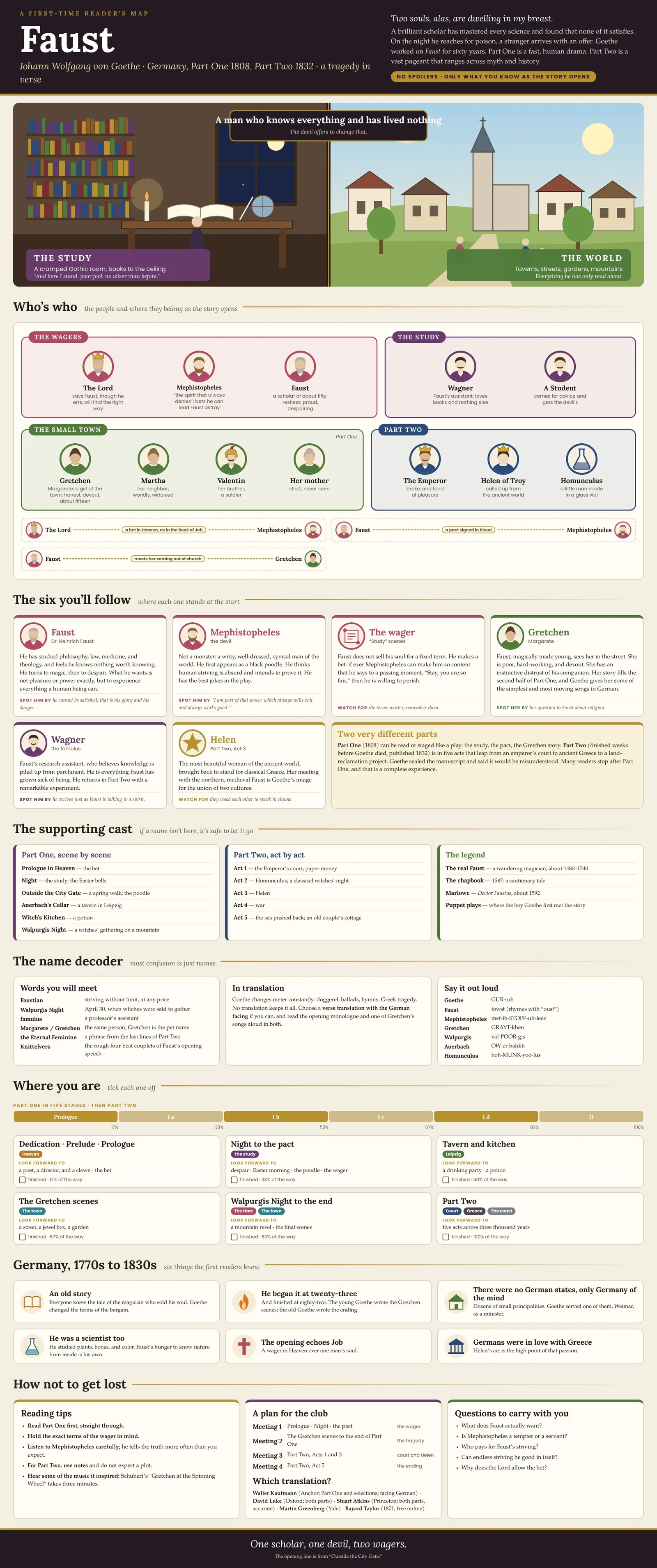
A brilliant scholar has mastered every science and found that none of it satisfies. On the night he reaches for poison, a stranger arrives with an offer. Goethe worked on Faust for sixty years. Part One is a fast, human drama. Part Two is a vast pageant that ranges across myth and history.
✨ Open this rung of the Great Books Ladder → 🔗 Own page, to share or bookmark 📚 Faust, Part I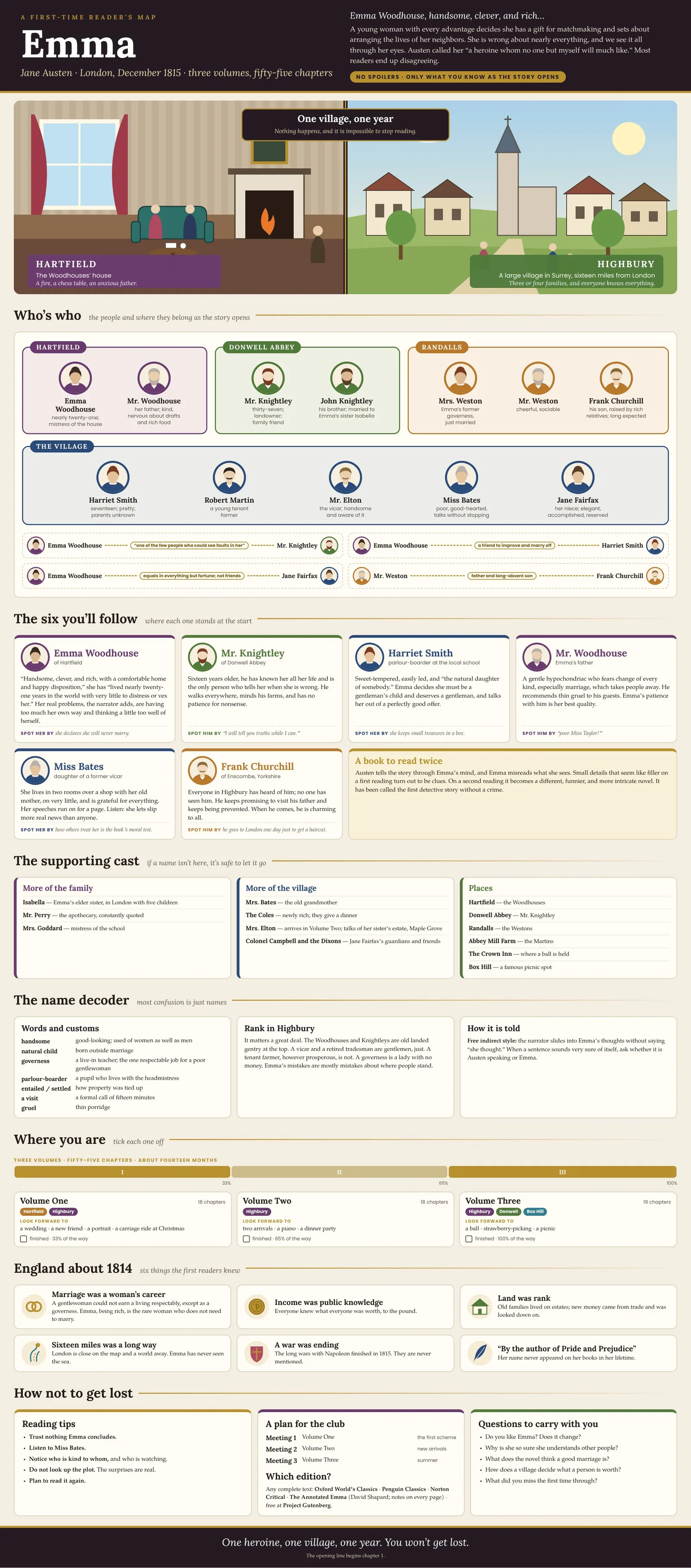
A young woman with every advantage decides she has a gift for matchmaking and sets about arranging the lives of her neighbors. She is wrong about nearly everything, and we see it all through her eyes. Austen called her “a heroine whom no one but myself will much like.” Most readers end up disagreeing.
✨ Open this rung of the Great Books Ladder → 🔗 Own page, to share or bookmark 📚 Jane Austen: Seven Novels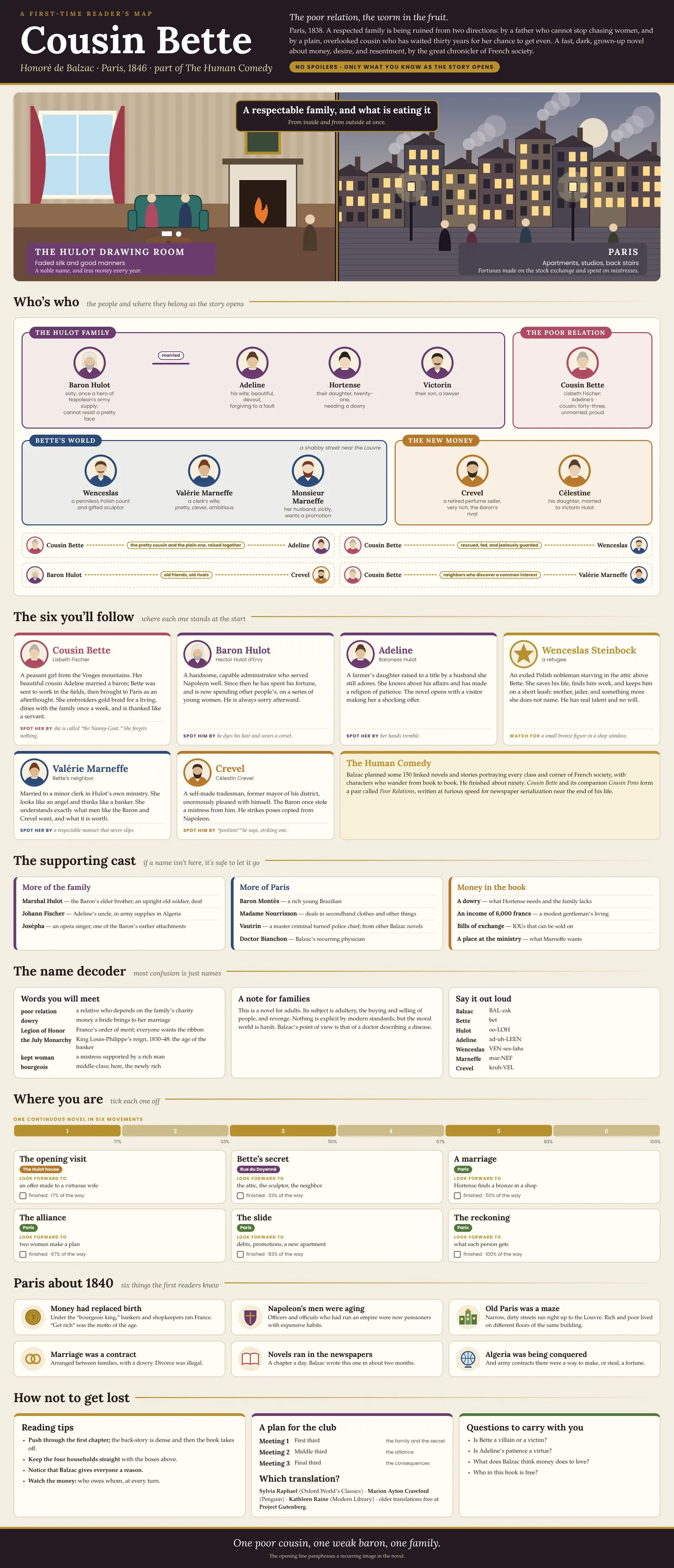
Paris, 1838. A respected family is being ruined from two directions: by a father who cannot stop chasing women, and by a plain, overlooked cousin who has waited thirty years for her chance to get even. A fast, dark, grown-up novel about money, desire, and resentment, by the great chronicler of French society.
✨ Open this rung of the Great Books Ladder → 🔗 Own page, to share or bookmark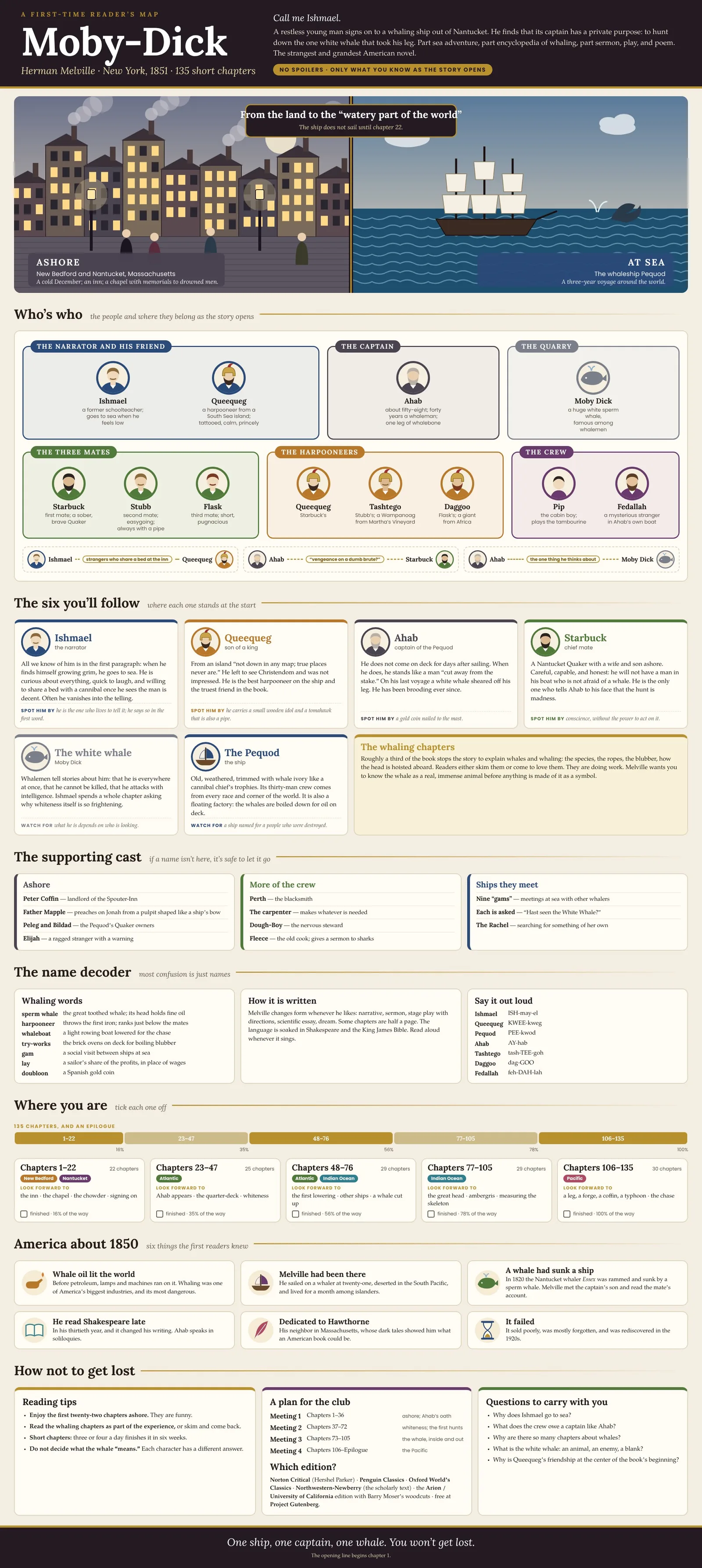
A restless young man signs on to a whaling ship out of Nantucket. He finds that its captain has a private purpose: to hunt down the one white whale that took his leg. Part sea adventure, part encyclopedia of whaling, part sermon, play, and poem. The strangest and grandest American novel.
✨ Open this rung of the Great Books Ladder → 🔗 Own page, to share or bookmark 📚 Moby-Dick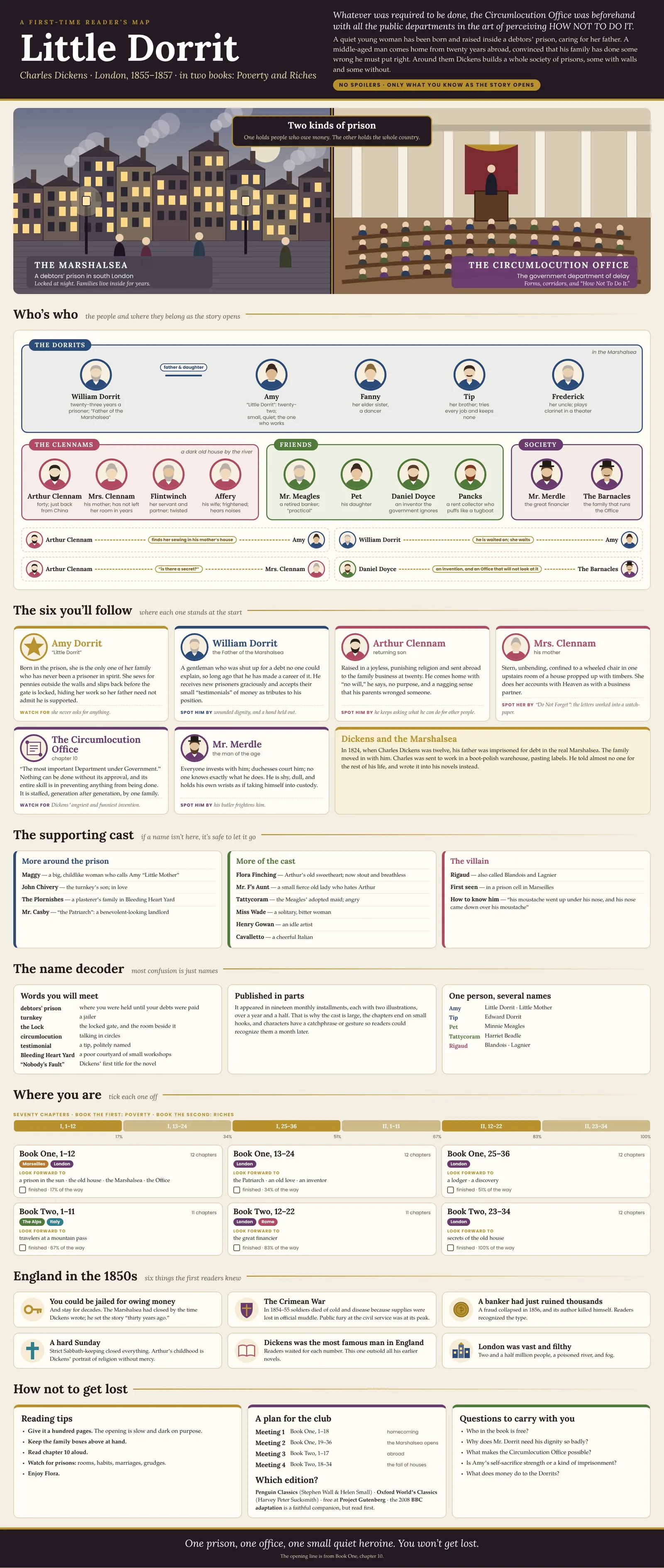
A quiet young woman has been born and raised inside a debtors’ prison, caring for her father. A middle-aged man comes home from twenty years abroad, convinced that his family has done some wrong he must put right. Around them Dickens builds a whole society of prisons, some with walls and some without.
✨ Open this rung of the Great Books Ladder → 🔗 Own page, to share or bookmark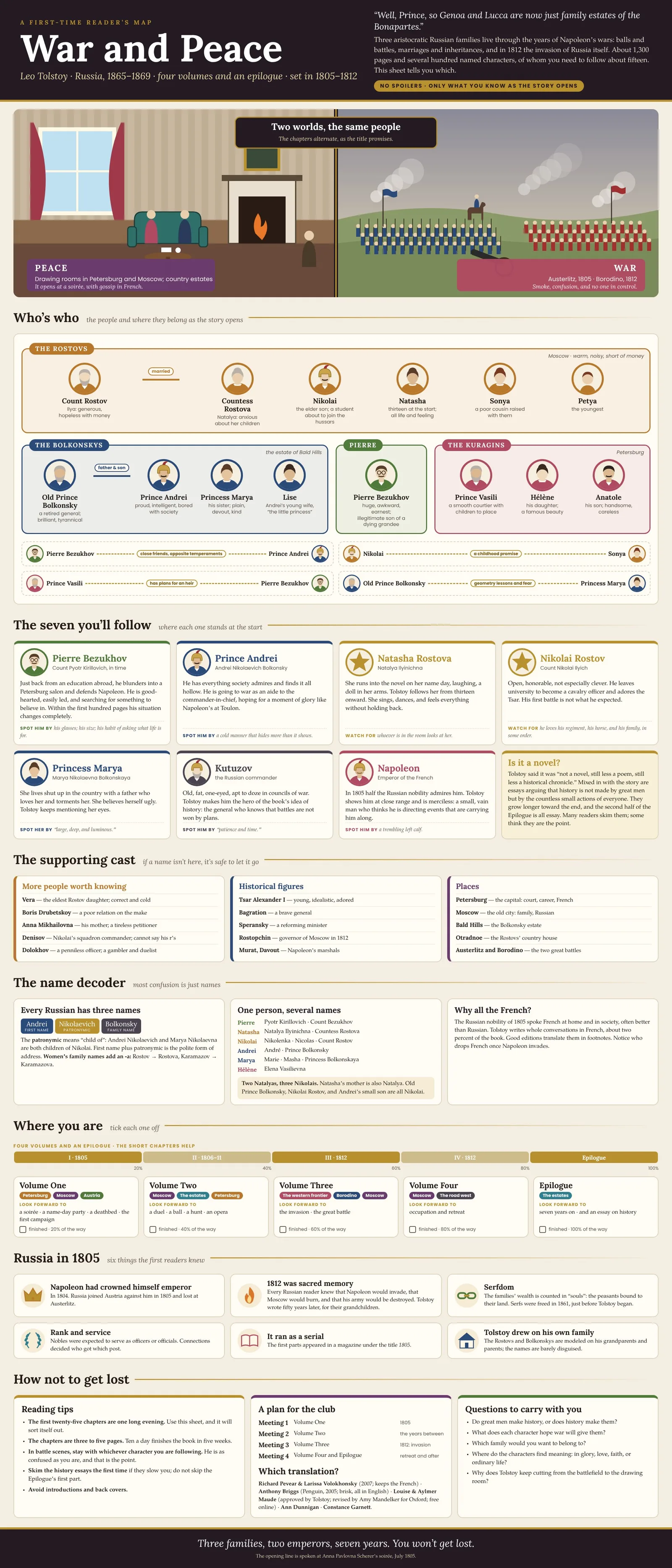
Three aristocratic Russian families live through the years of Napoleon’s wars: balls and battles, marriages and inheritances, and in 1812 the invasion of Russia itself. About 1,300 pages and several hundred named characters, of whom you need to follow about fifteen. This sheet tells you which.
✨ Open this rung of the Great Books Ladder → 🔗 Own page, to share or bookmark 📚 War and Peace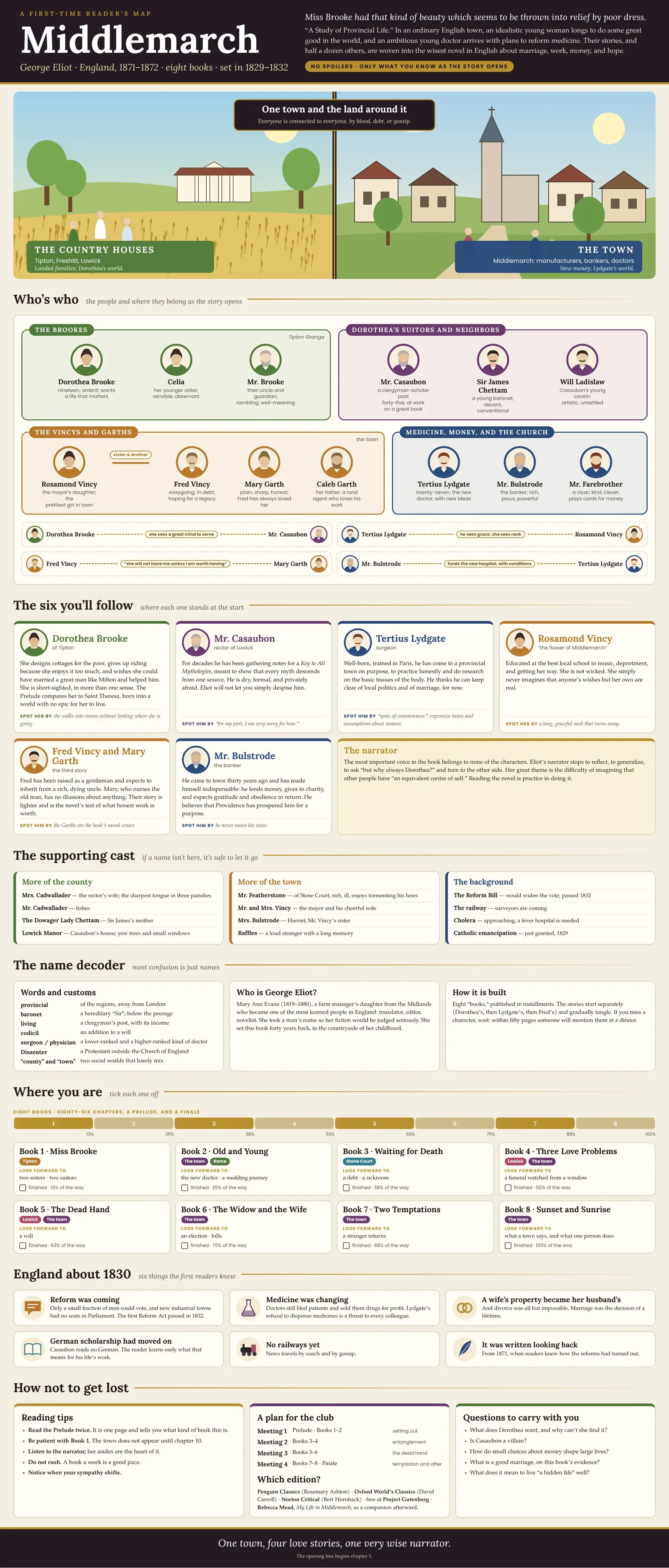
“A Study of Provincial Life.” In an ordinary English town, an idealistic young woman longs to do some great good in the world, and an ambitious young doctor arrives with plans to reform medicine. Their stories, and half a dozen others, are woven into the wisest novel in English about marriage, work, money, and hope.
✨ Open this rung of the Great Books Ladder → 🔗 Own page, to share or bookmark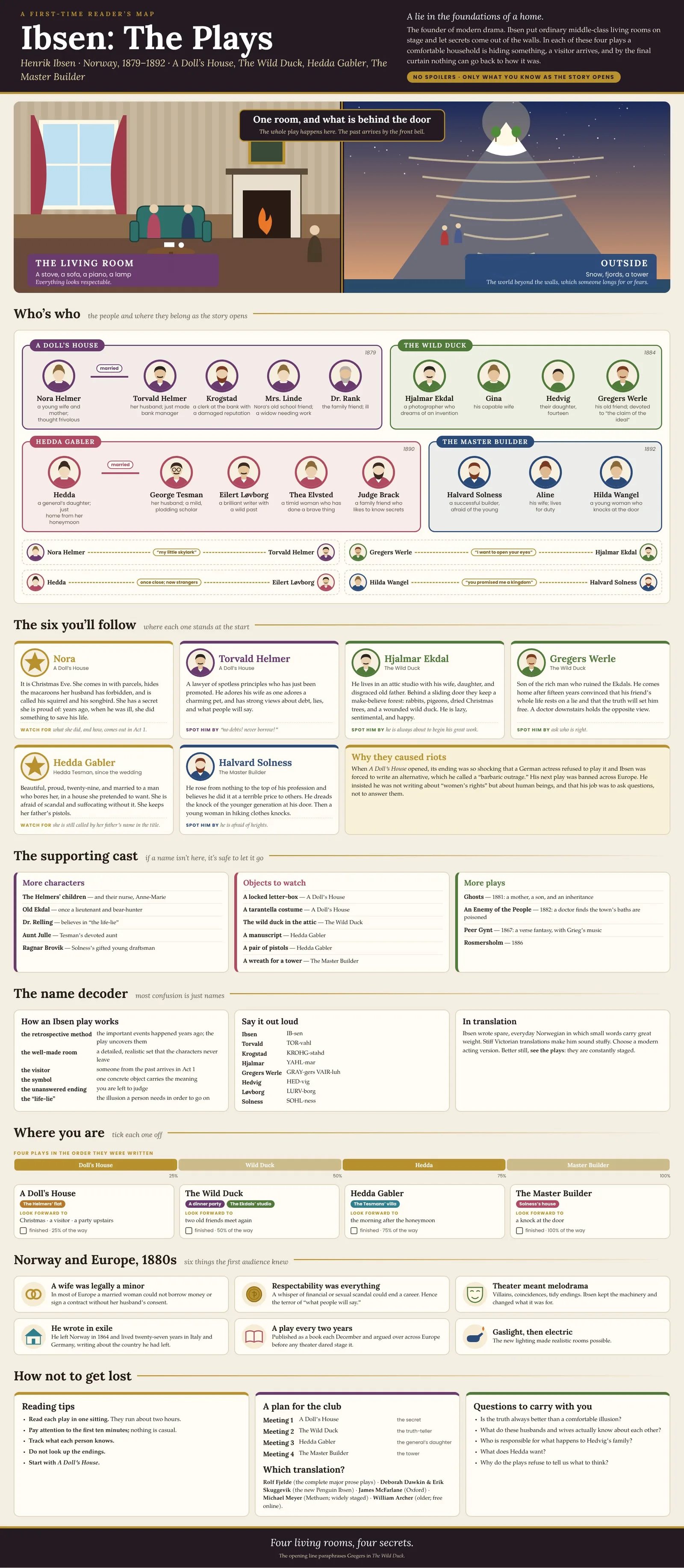
The founder of modern drama. Ibsen put ordinary middle-class living rooms on stage and let secrets come out of the walls. In each of these four plays a comfortable household is hiding something, a visitor arrives, and by the final curtain nothing can go back to how it was.
✨ Open this rung of the Great Books Ladder → 🔗 Own page, to share or bookmark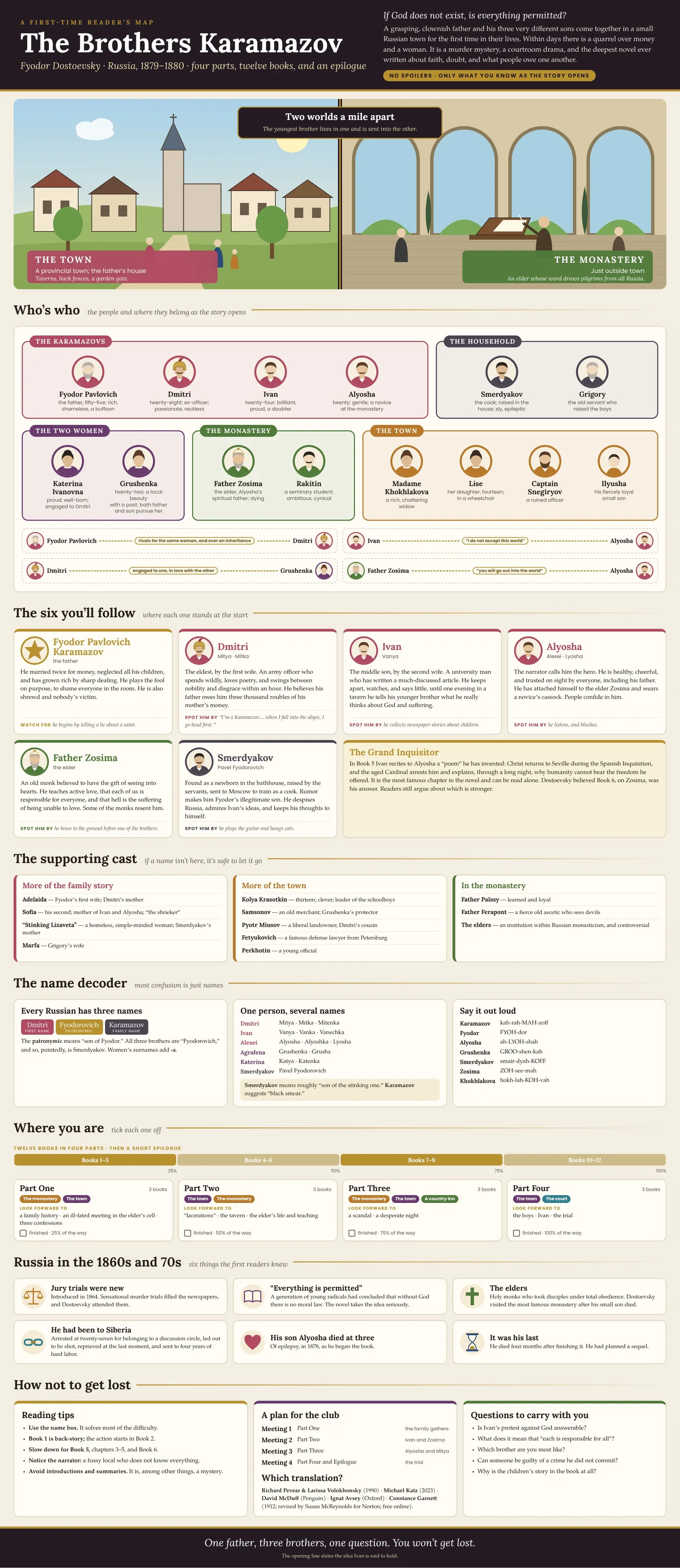
A grasping, clownish father and his three very different sons come together in a small Russian town for the first time in their lives. Within days there is a quarrel over money and a woman. It is a murder mystery, a courtroom drama, and the deepest novel ever written about faith, doubt, and what people owe one another.
✨ Open this rung of the Great Books Ladder → 🔗 Own page, to share or bookmark 📚 The Brothers Karamazov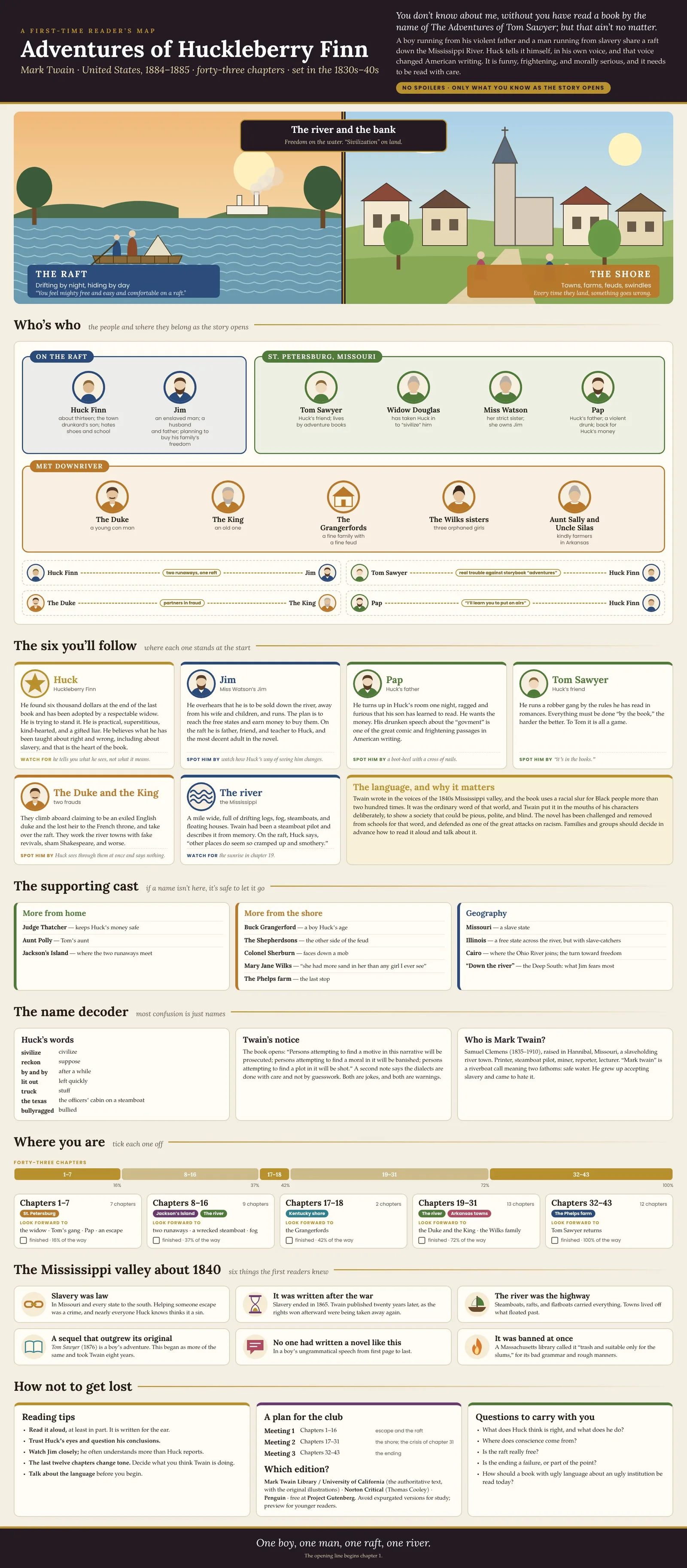
A boy running from his violent father and a man running from slavery share a raft down the Mississippi River. Huck tells it himself, in his own voice, and that voice changed American writing. It is funny, frightening, and morally serious, and it needs to be read with care.
✨ Open this rung of the Great Books Ladder → 🔗 Own page, to share or bookmarkThe 20th Century 48 maps · the rungs →
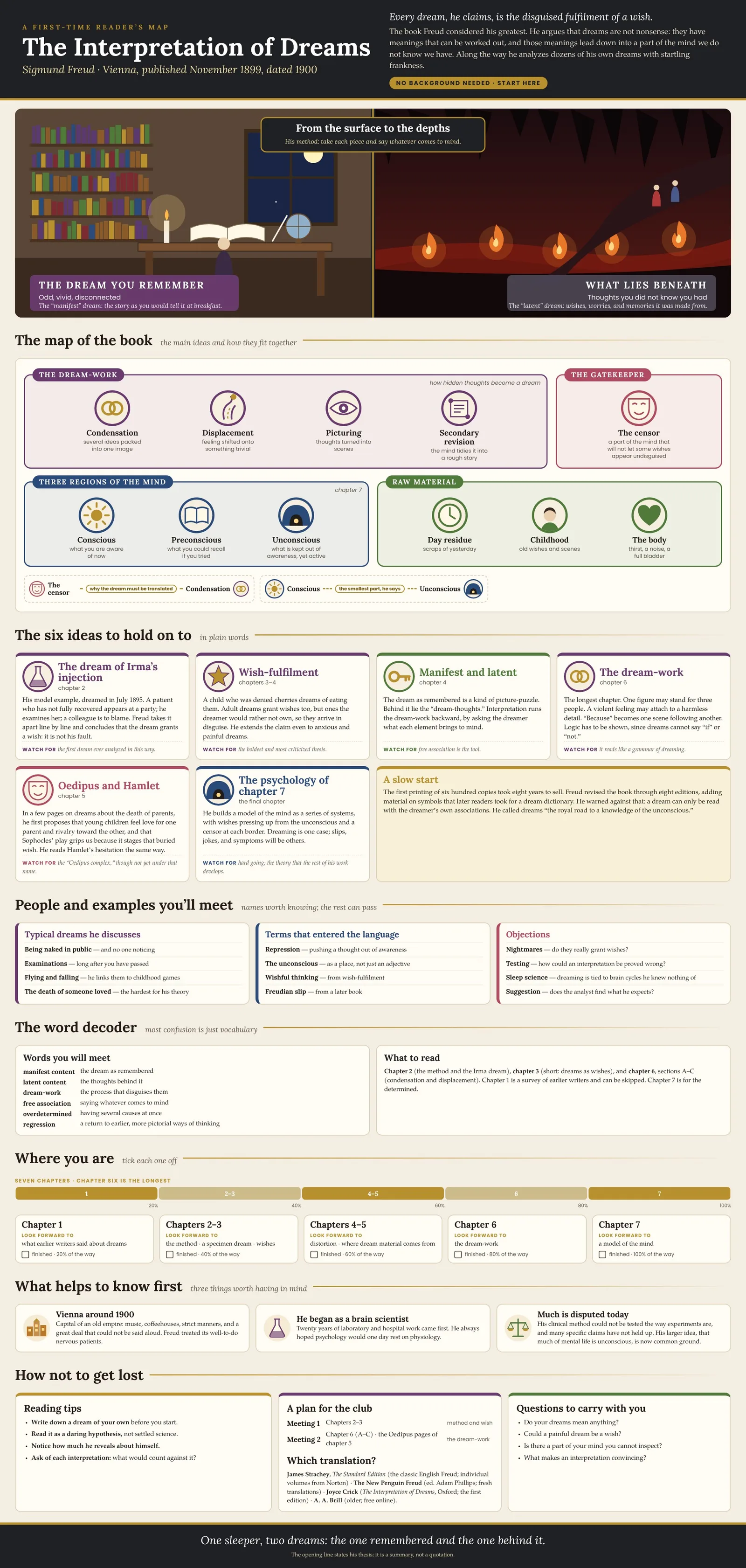
The book Freud considered his greatest. He argues that dreams are not nonsense: they have meanings that can be worked out, and those meanings lead down into a part of the mind we do not know we have. Along the way he analyzes dozens of his own dreams with startling frankness.
✨ Open this rung of the Great Books Ladder → 🔗 Own page, to share or bookmark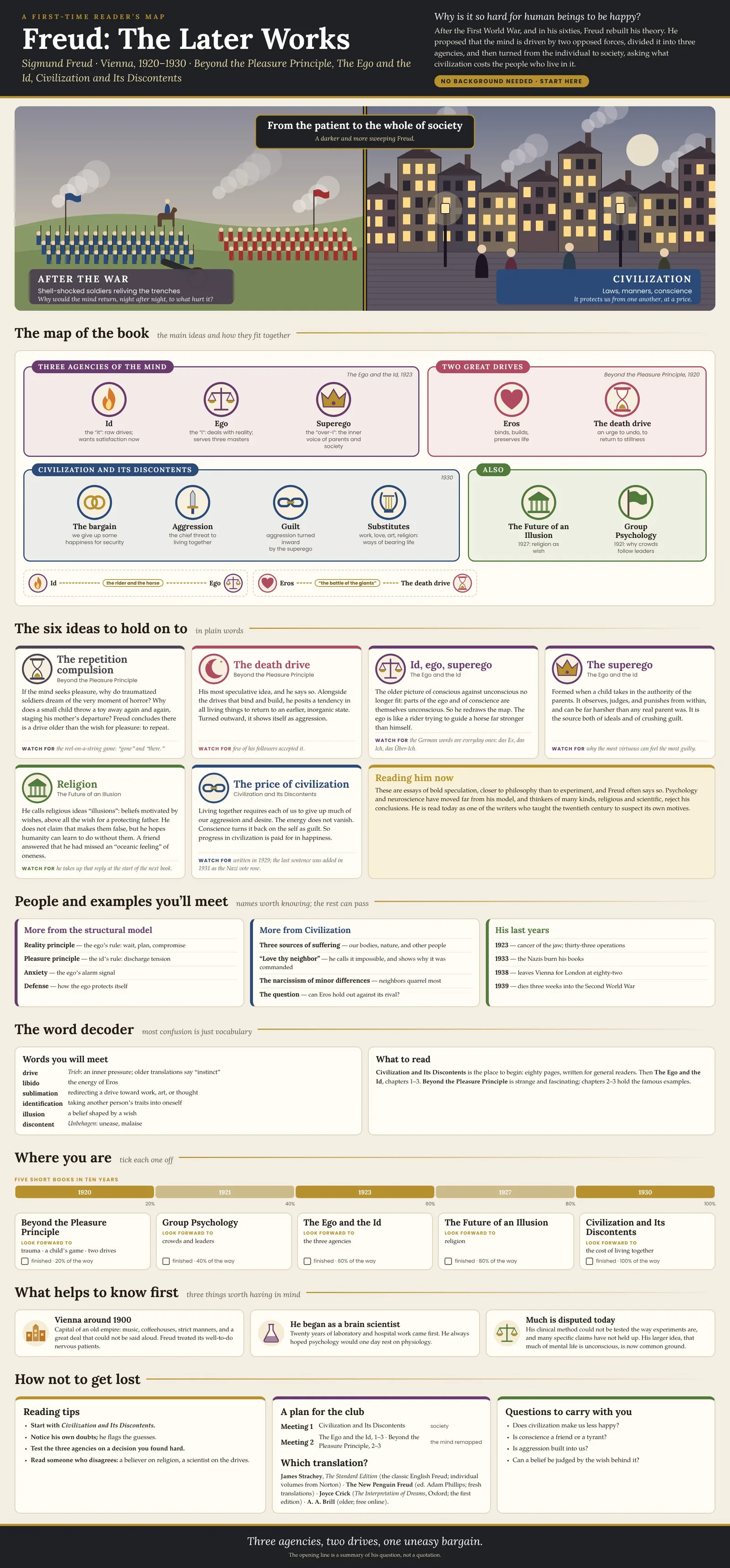
After the First World War, and in his sixties, Freud rebuilt his theory. He proposed that the mind is driven by two opposed forces, divided it into three agencies, and then turned from the individual to society, asking what civilization costs the people who live in it.
✨ Open this rung of the Great Books Ladder → 🔗 Own page, to share or bookmark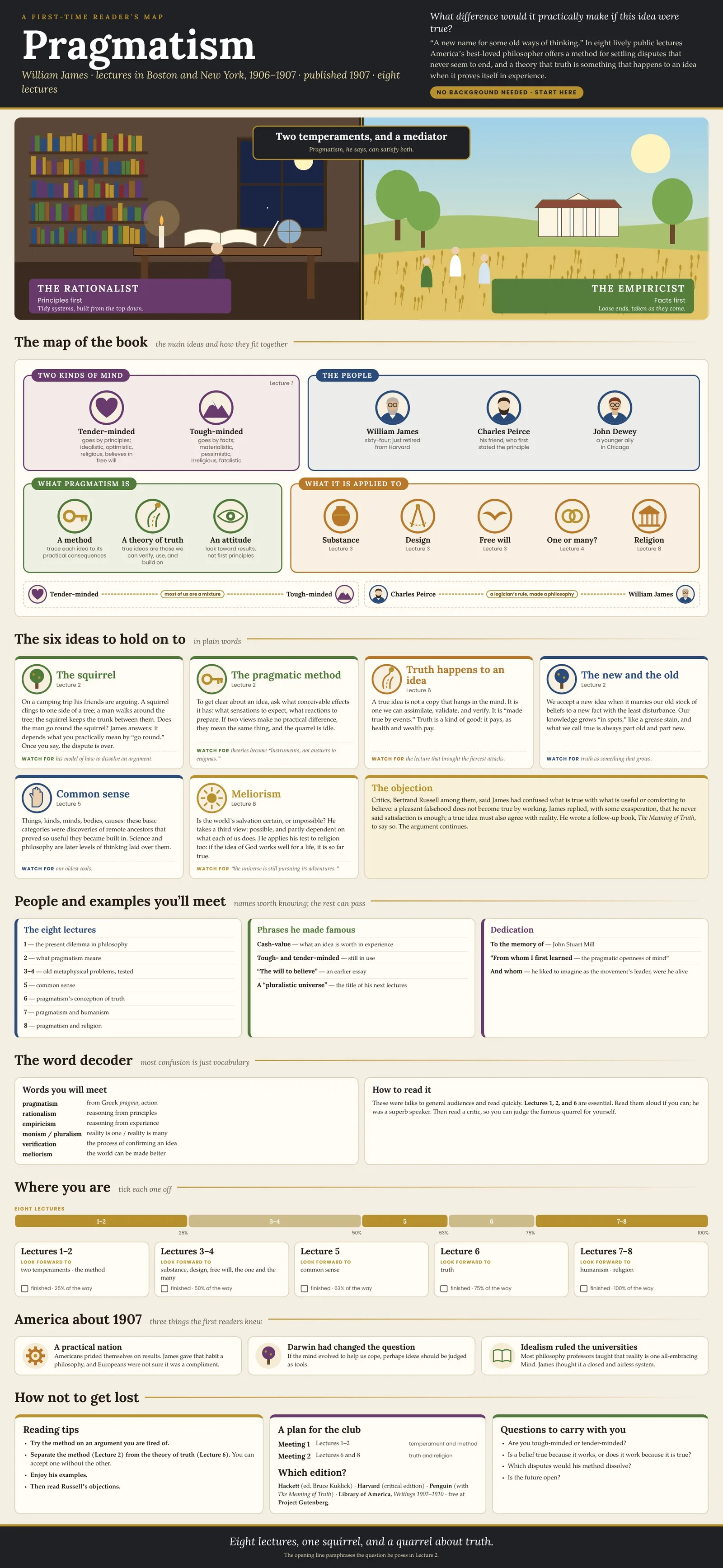
“A new name for some old ways of thinking.” In eight lively public lectures America’s best-loved philosopher offers a method for settling disputes that never seem to end, and a theory that truth is something that happens to an idea when it proves itself in experience.
✨ Open this rung of the Great Books Ladder → 🔗 Own page, to share or bookmark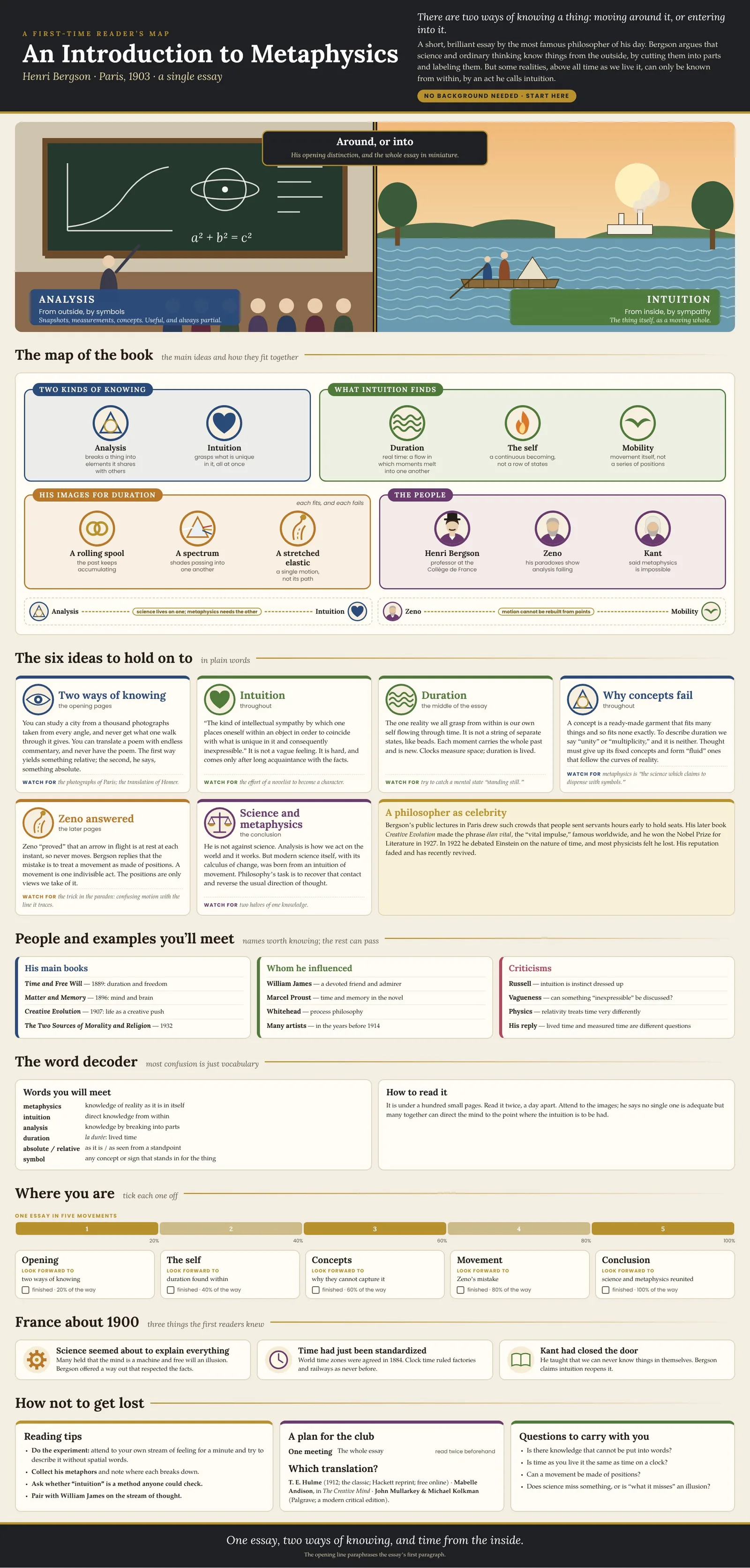
A short, brilliant essay by the most famous philosopher of his day. Bergson argues that science and ordinary thinking know things from the outside, by cutting them into parts and labeling them. But some realities, above all time as we live it, can only be known from within, by an act he calls intuition.
✨ Open this rung of the Great Books Ladder → 🔗 Own page, to share or bookmark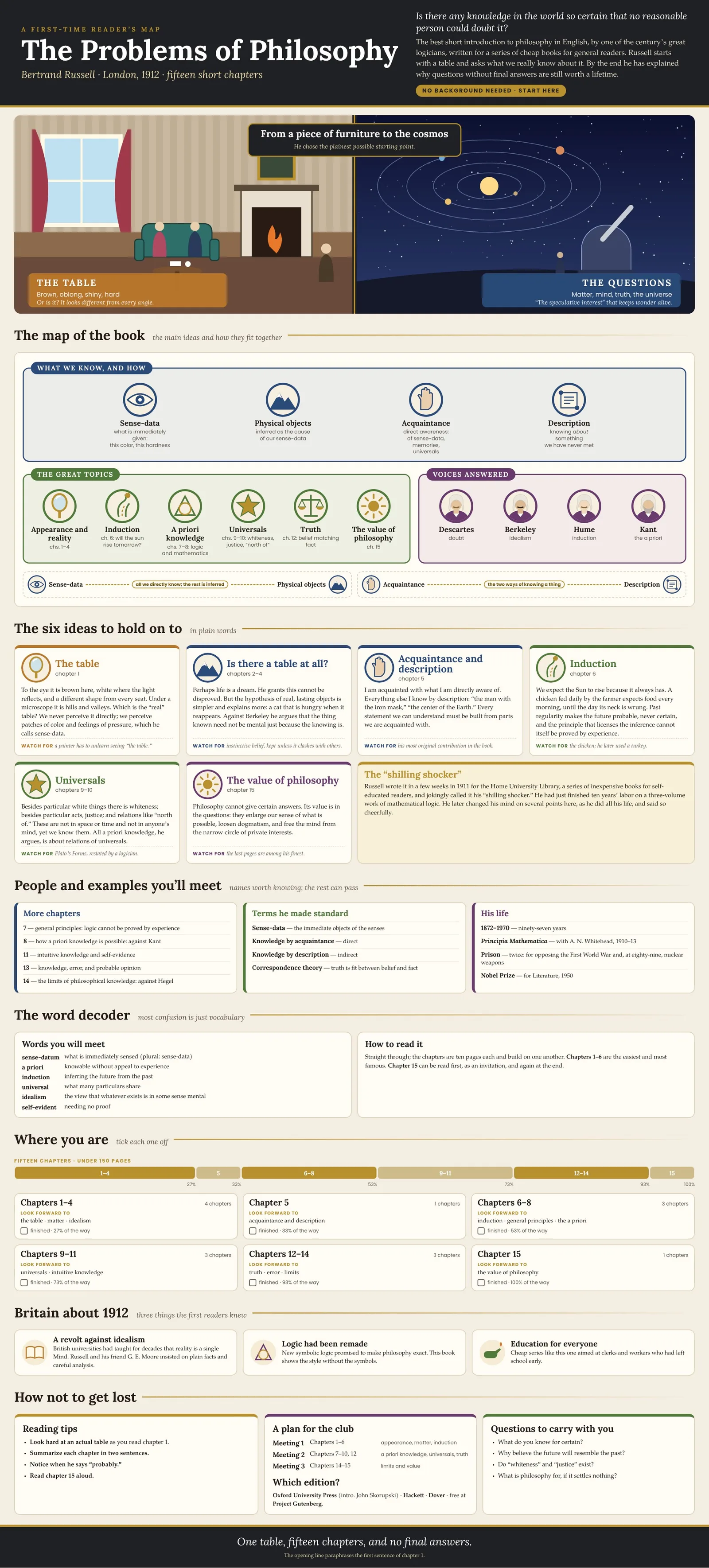
The best short introduction to philosophy in English, by one of the century’s great logicians, written for a series of cheap books for general readers. Russell starts with a table and asks what we really know about it. By the end he has explained why questions without final answers are still worth a lifetime.
✨ Open this rung of the Great Books Ladder → 🔗 Own page, to share or bookmark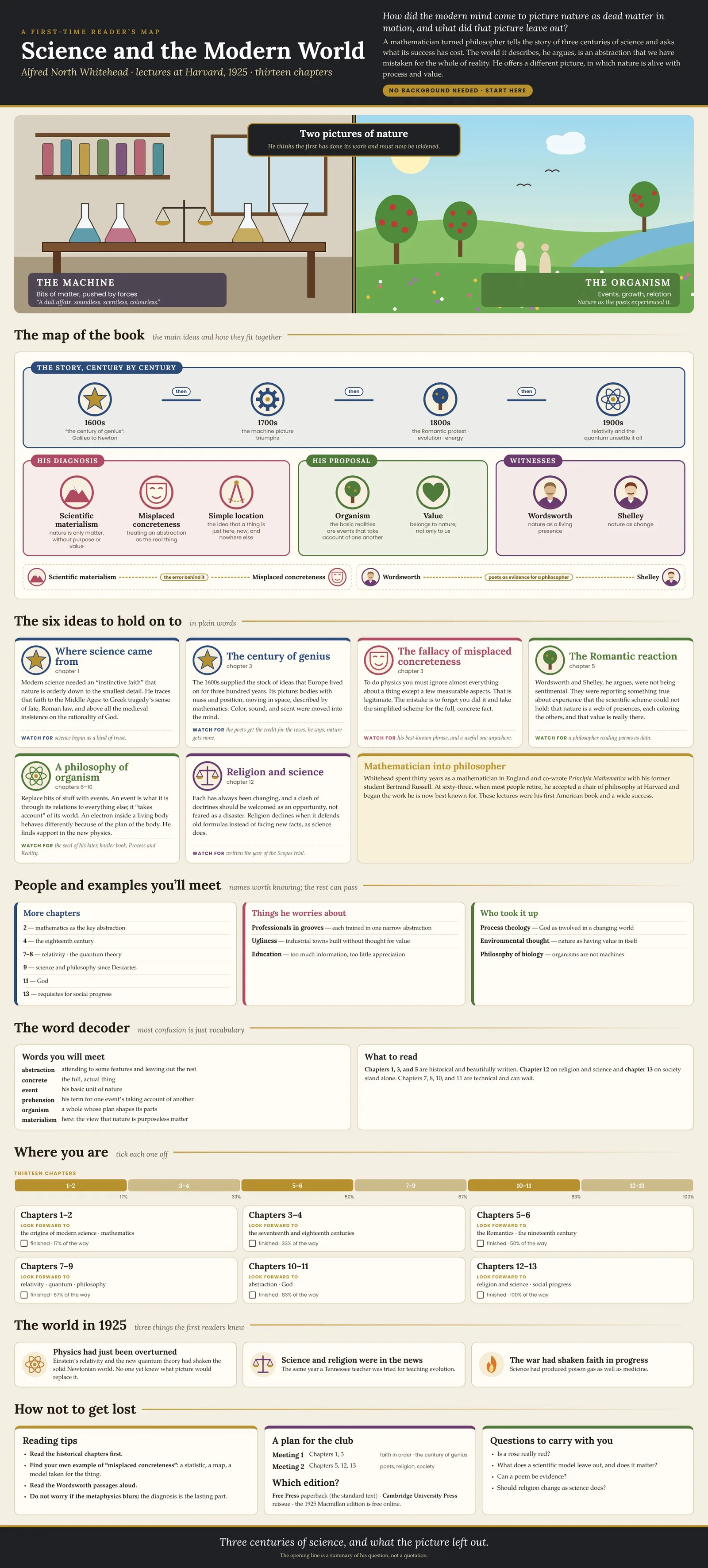
A mathematician turned philosopher tells the story of three centuries of science and asks what its success has cost. The world it describes, he argues, is an abstraction that we have mistaken for the whole of reality. He offers a different picture, in which nature is alive with process and value.
✨ Open this rung of the Great Books Ladder → 🔗 Own page, to share or bookmark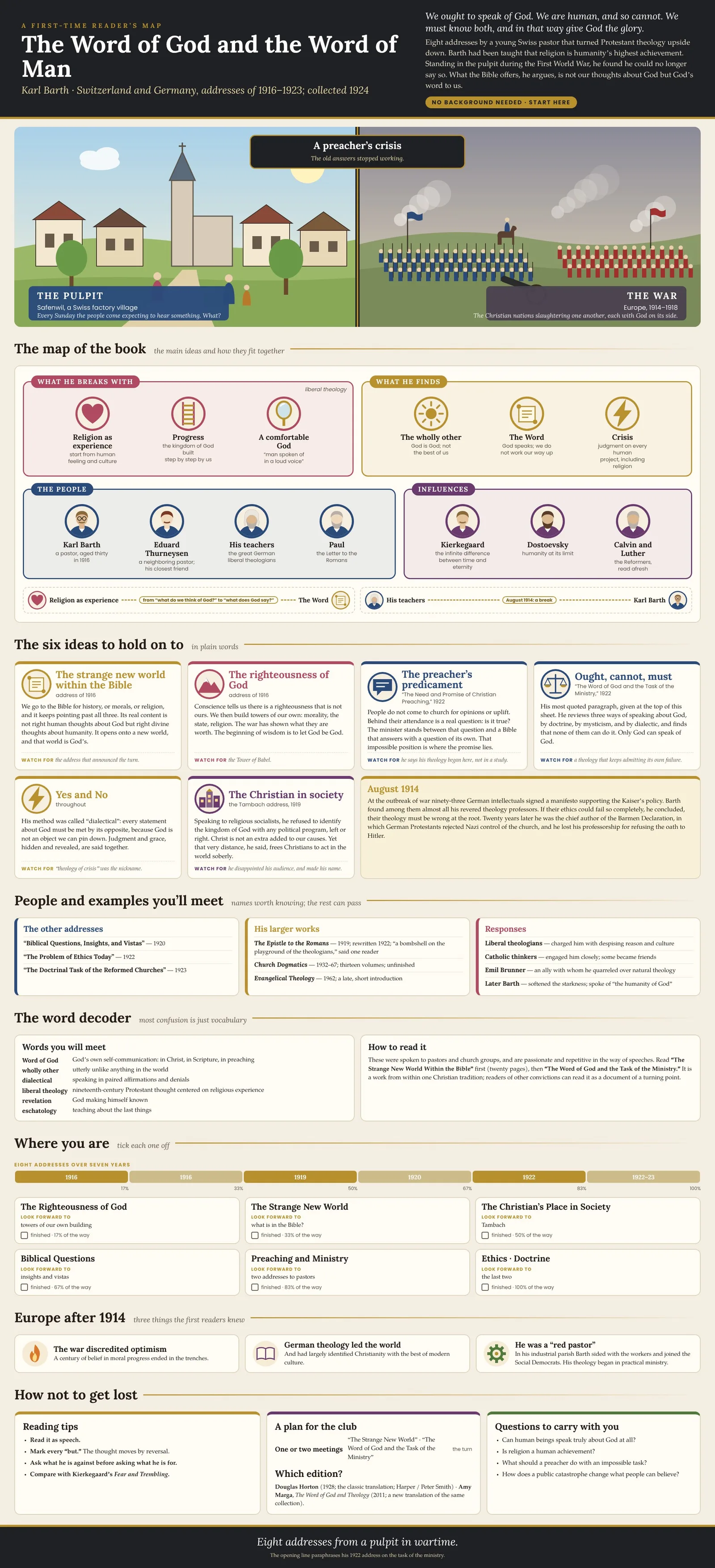
Eight addresses by a young Swiss pastor that turned Protestant theology upside down. Barth had been taught that religion is humanity’s highest achievement. Standing in the pulpit during the First World War, he found he could no longer say so. What the Bible offers, he argues, is not our thoughts about God but God’s word to us.
✨ Open this rung of the Great Books Ladder → 🔗 Own page, to share or bookmark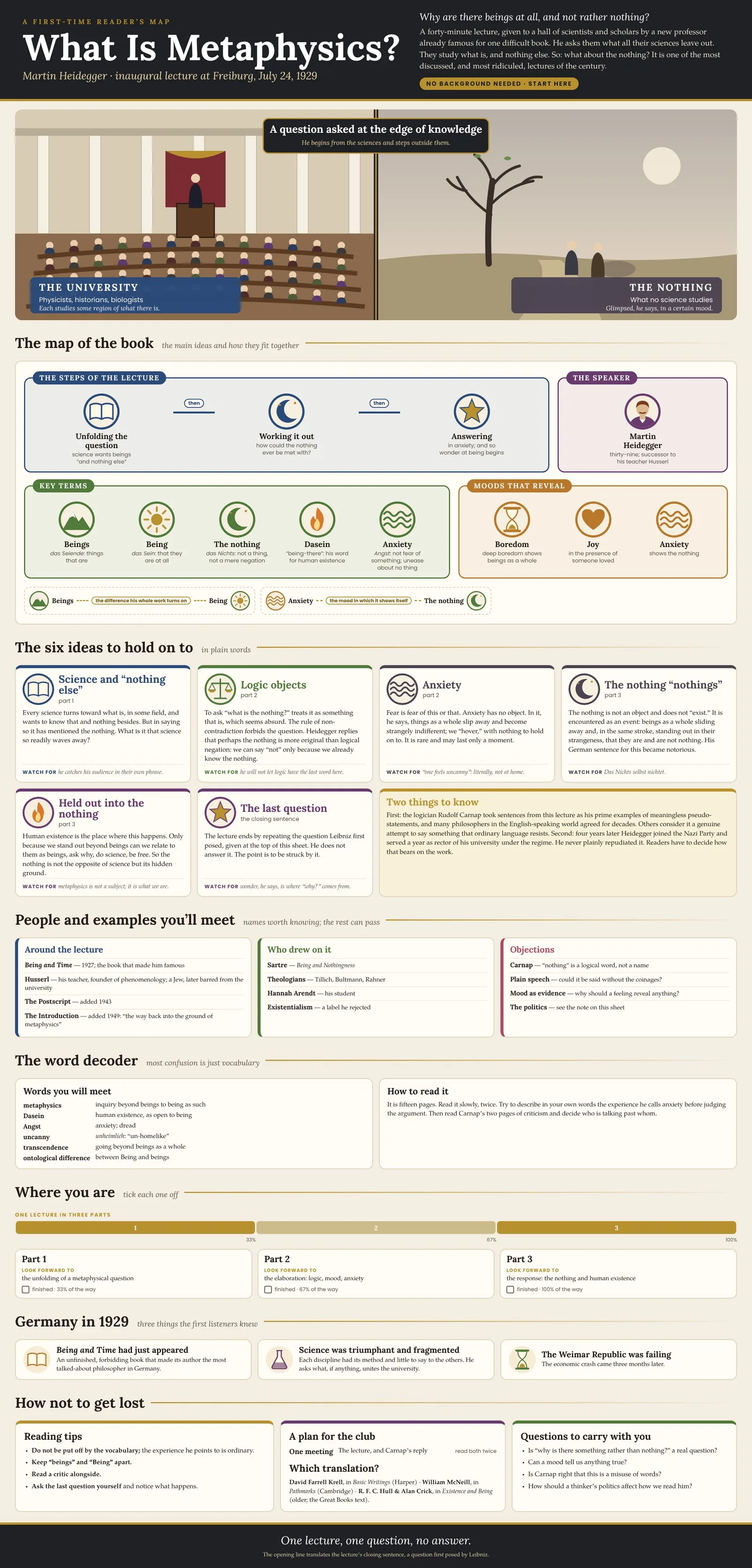
A forty-minute lecture, given to a hall of scientists and scholars by a new professor already famous for one difficult book. He asks them what all their sciences leave out. They study what is, and nothing else. So: what about the nothing? It is one of the most discussed, and most ridiculed, lectures of the century.
✨ Open this rung of the Great Books Ladder → 🔗 Own page, to share or bookmark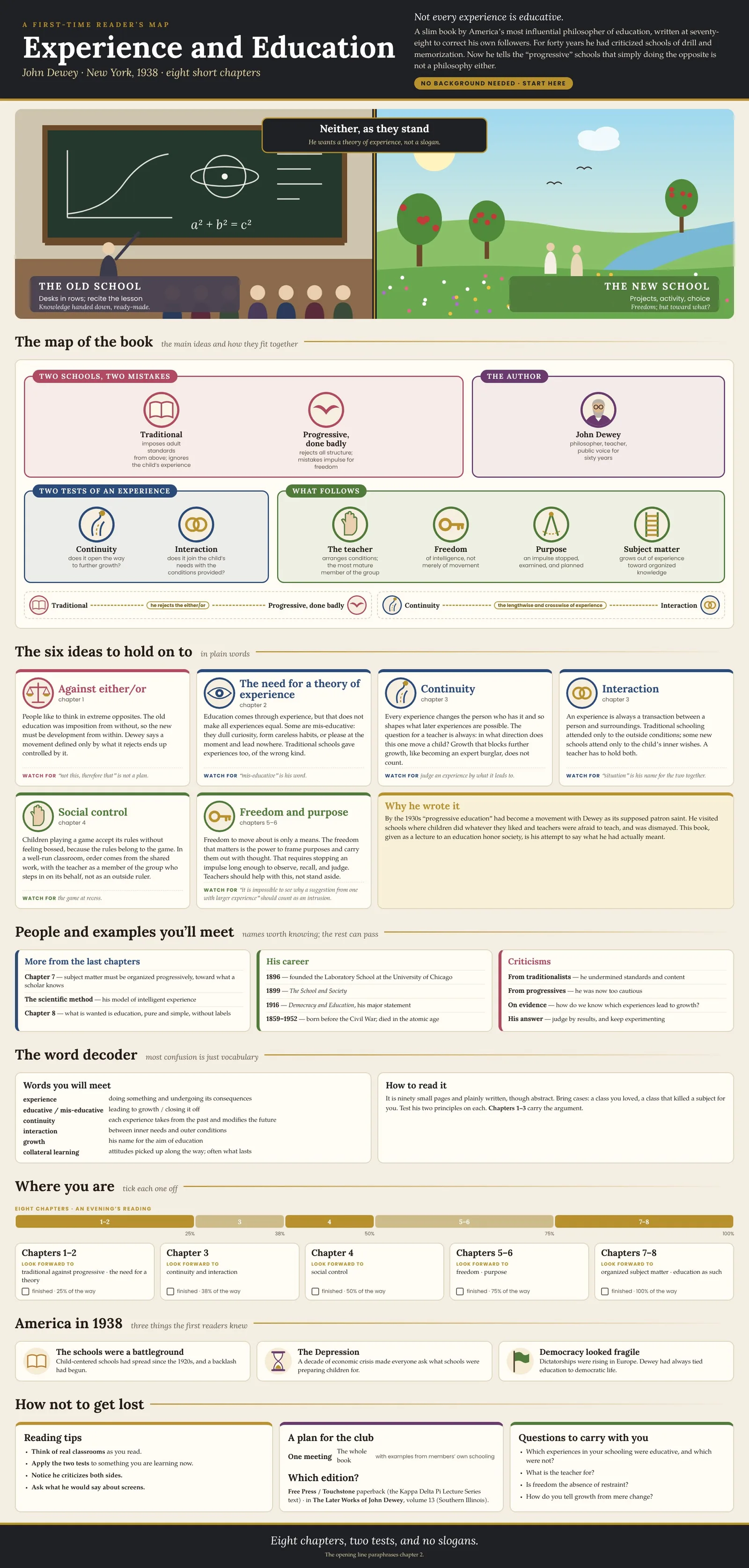
A slim book by America’s most influential philosopher of education, written at seventy-eight to correct his own followers. For forty years he had criticized schools of drill and memorization. Now he tells the “progressive” schools that simply doing the opposite is not a philosophy either.
✨ Open this rung of the Great Books Ladder → 🔗 Own page, to share or bookmark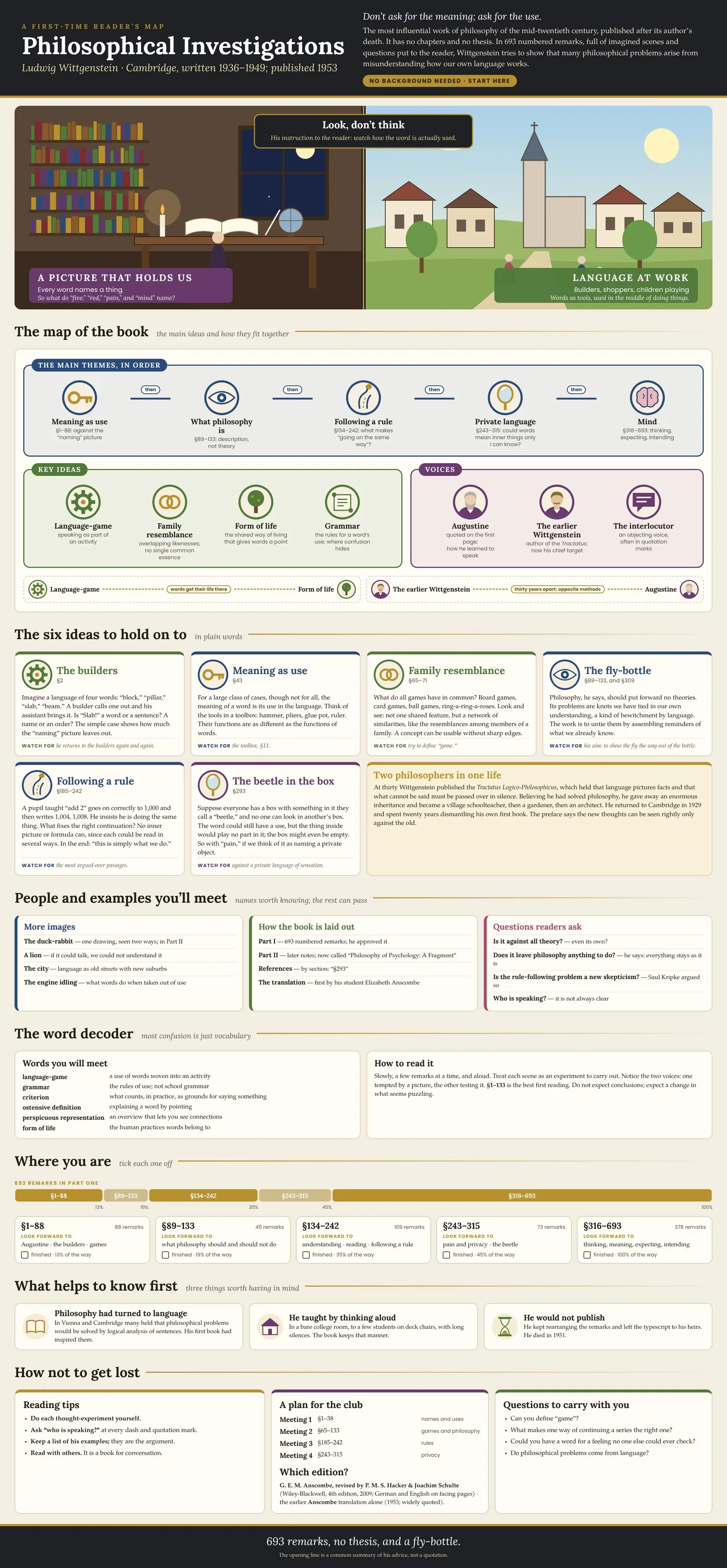
The most influential work of philosophy of the mid-twentieth century, published after its author’s death. It has no chapters and no thesis. In 693 numbered remarks, full of imagined scenes and questions put to the reader, Wittgenstein tries to show that many philosophical problems arise from misunderstanding how our own language works.
✨ Open this rung of the Great Books Ladder → 🔗 Own page, to share or bookmark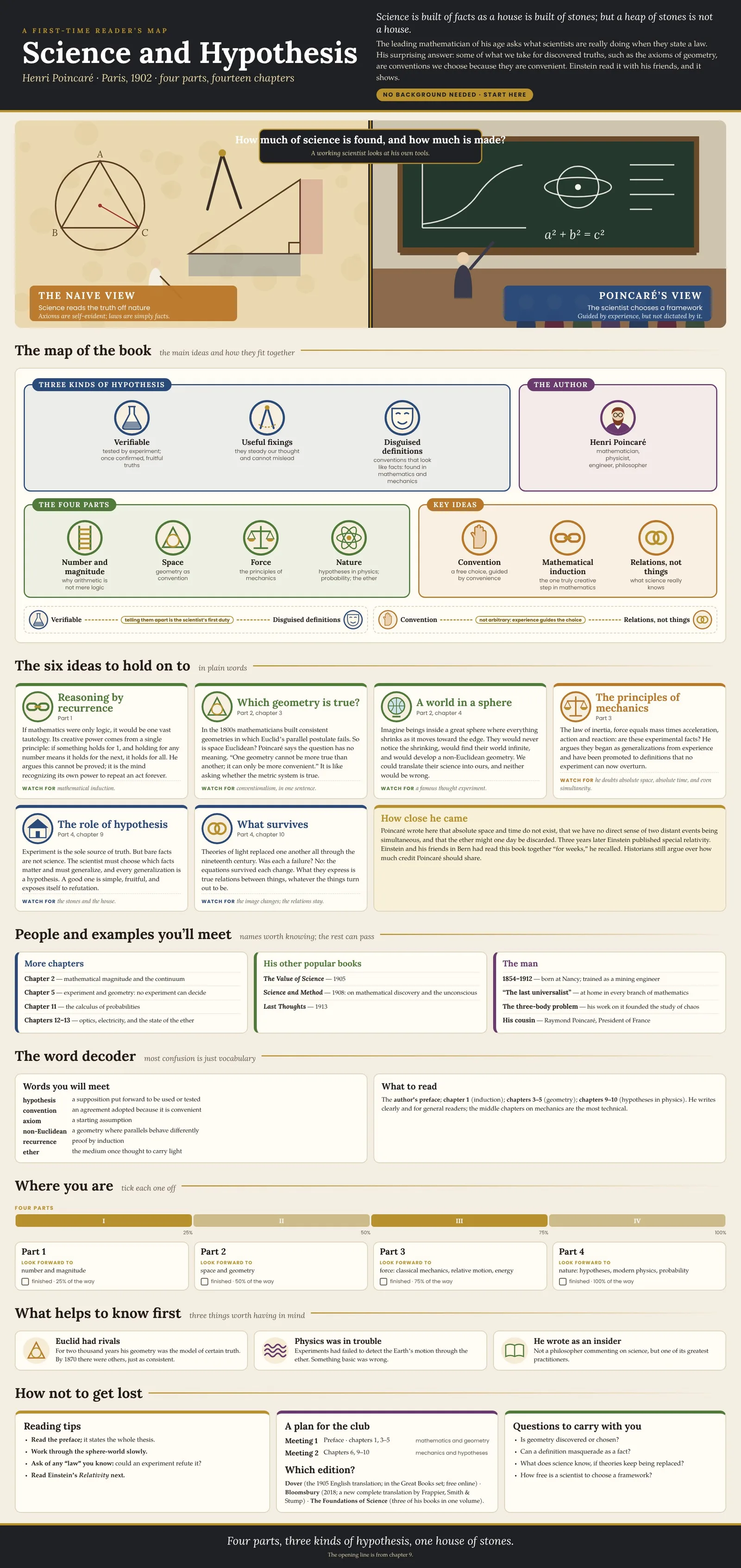
The leading mathematician of his age asks what scientists are really doing when they state a law. His surprising answer: some of what we take for discovered truths, such as the axioms of geometry, are conventions we choose because they are convenient. Einstein read it with his friends, and it shows.
✨ Open this rung of the Great Books Ladder → 🔗 Own page, to share or bookmark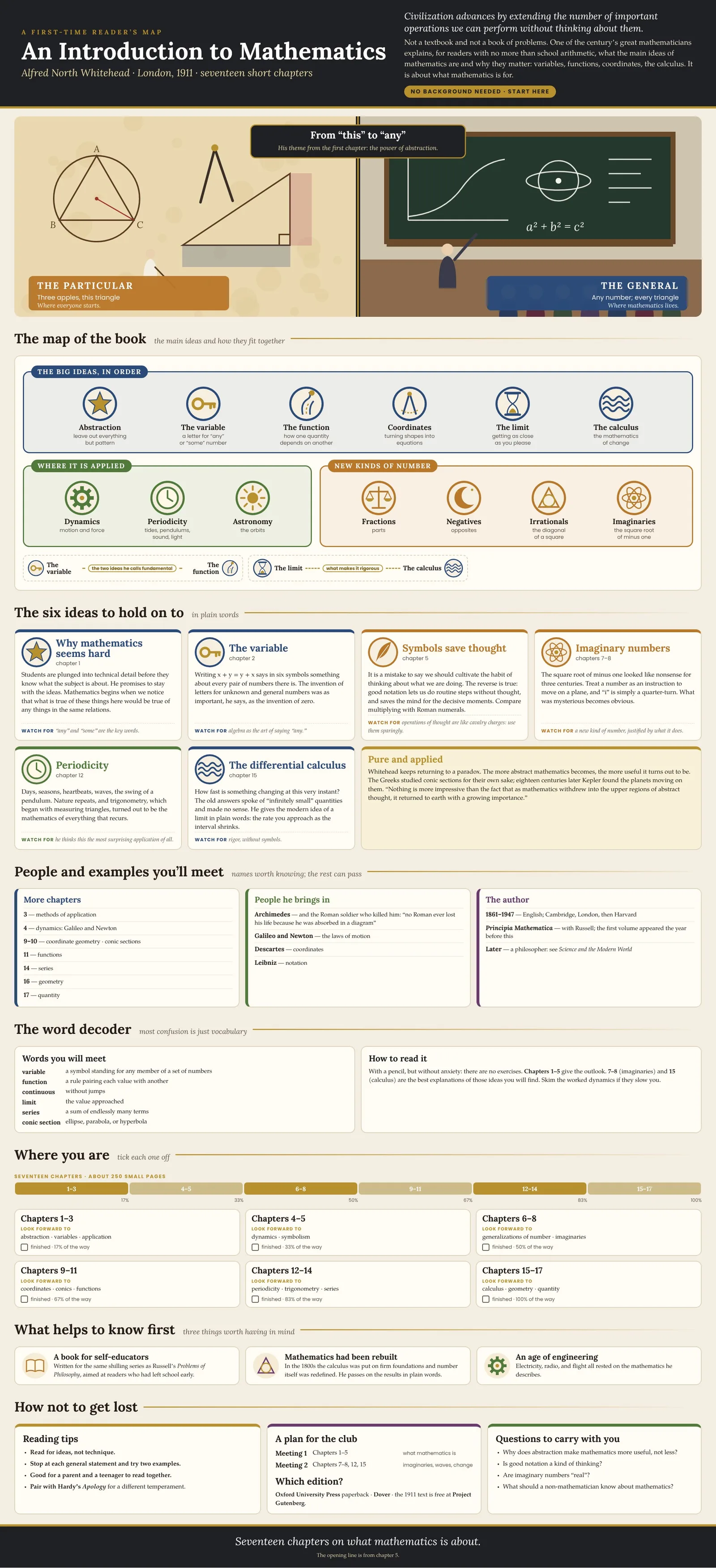
Not a textbook and not a book of problems. One of the century’s great mathematicians explains, for readers with no more than school arithmetic, what the main ideas of mathematics are and why they matter: variables, functions, coordinates, the calculus. It is about what mathematics is for.
✨ Open this rung of the Great Books Ladder → 🔗 Own page, to share or bookmark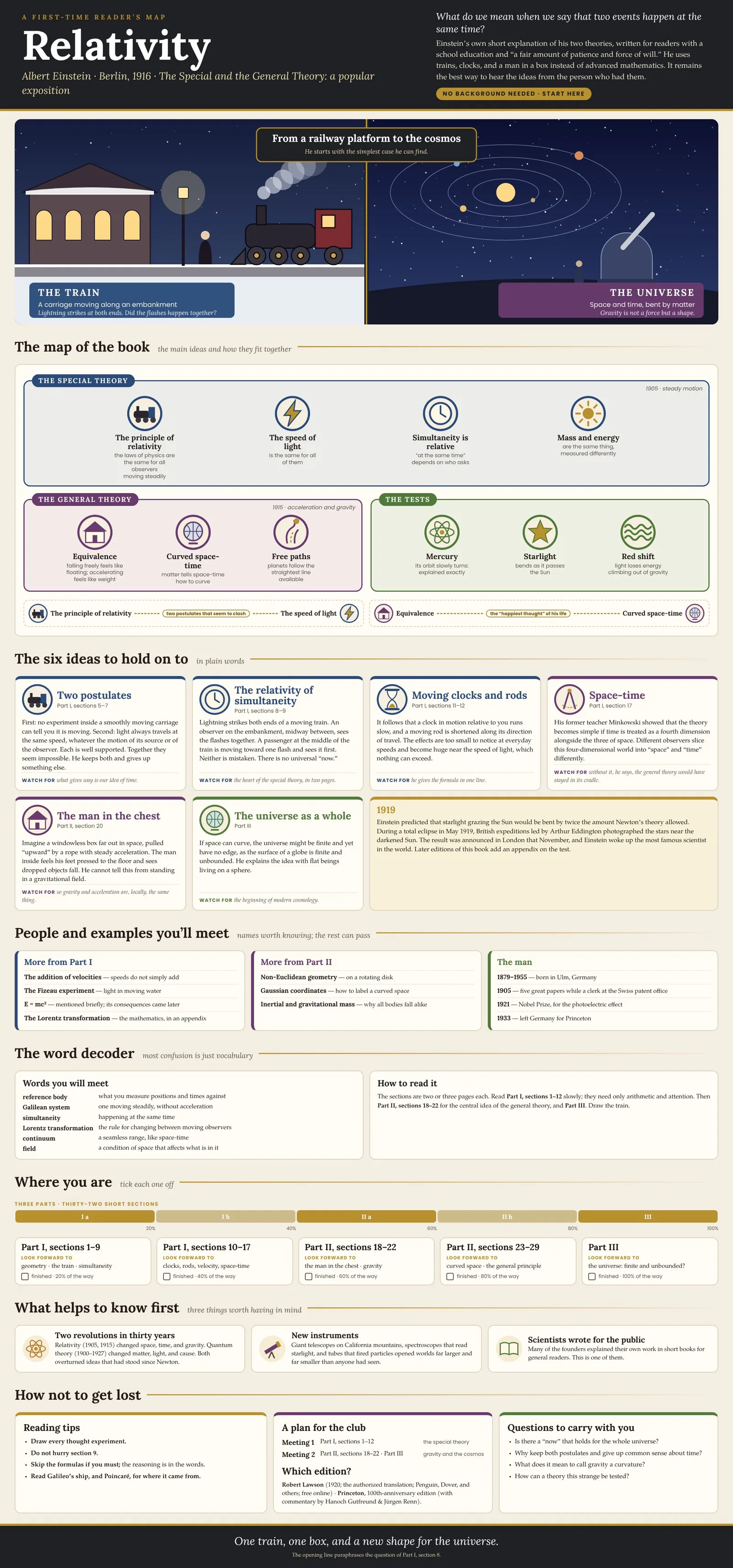
Einstein’s own short explanation of his two theories, written for readers with a school education and “a fair amount of patience and force of will.” He uses trains, clocks, and a man in a box instead of advanced mathematics. It remains the best way to hear the ideas from the person who had them.
✨ Open this rung of the Great Books Ladder → 🔗 Own page, to share or bookmark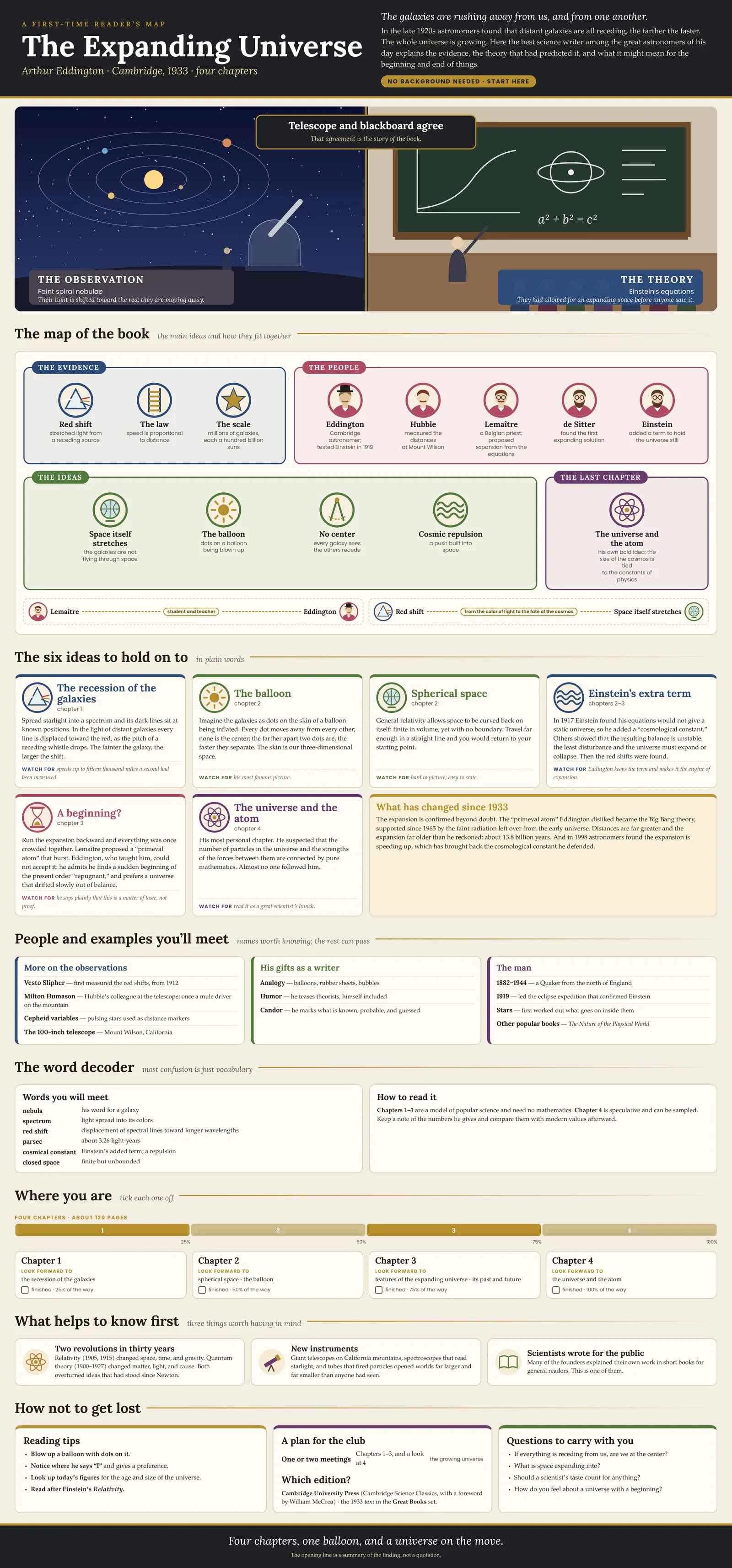
In the late 1920s astronomers found that distant galaxies are all receding, the farther the faster. The whole universe is growing. Here the best science writer among the great astronomers of his day explains the evidence, the theory that had predicted it, and what it might mean for the beginning and end of things.
✨ Open this rung of the Great Books Ladder → 🔗 Own page, to share or bookmark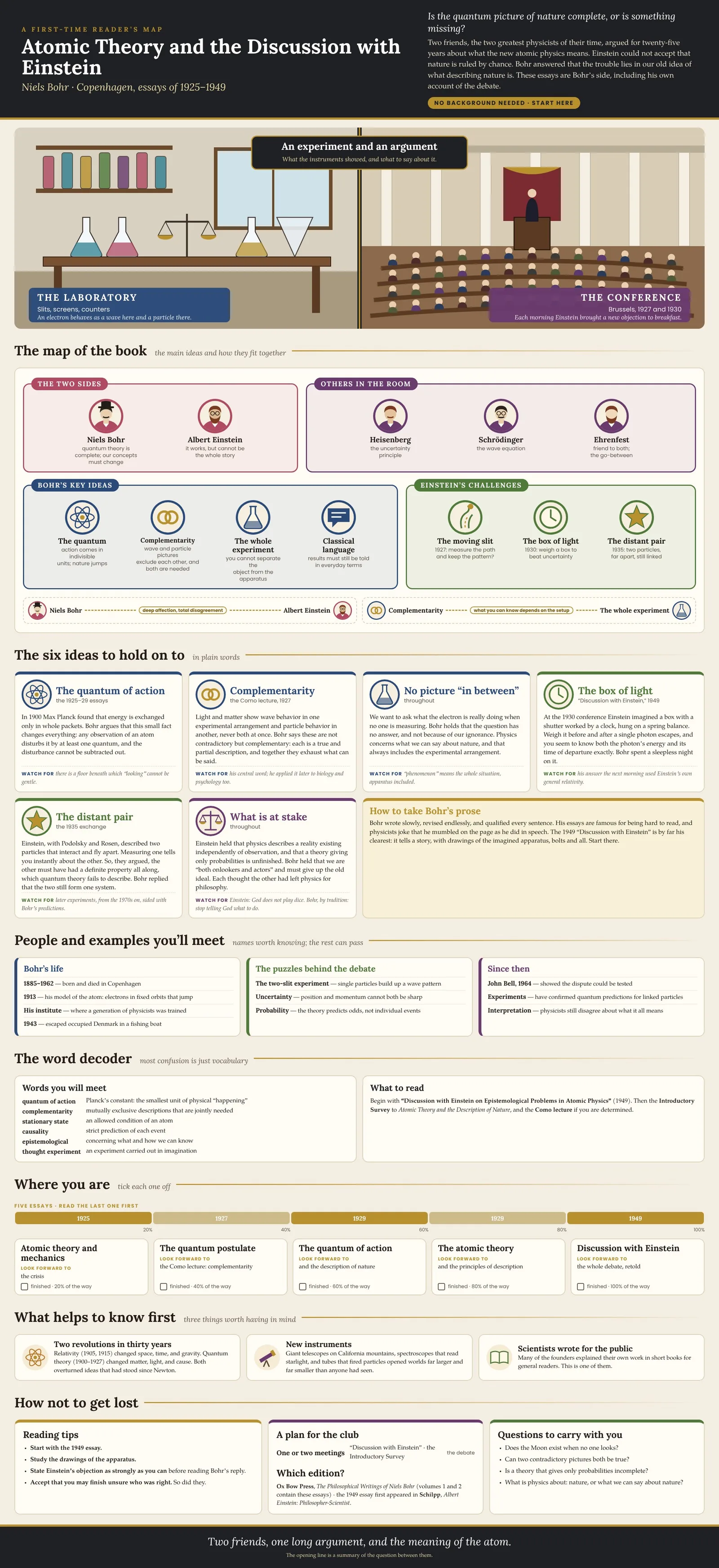
Two friends, the two greatest physicists of their time, argued for twenty-five years about what the new atomic physics means. Einstein could not accept that nature is ruled by chance. Bohr answered that the trouble lies in our old idea of what describing nature is. These essays are Bohr’s side, including his own account of the debate.
✨ Open this rung of the Great Books Ladder → 🔗 Own page, to share or bookmark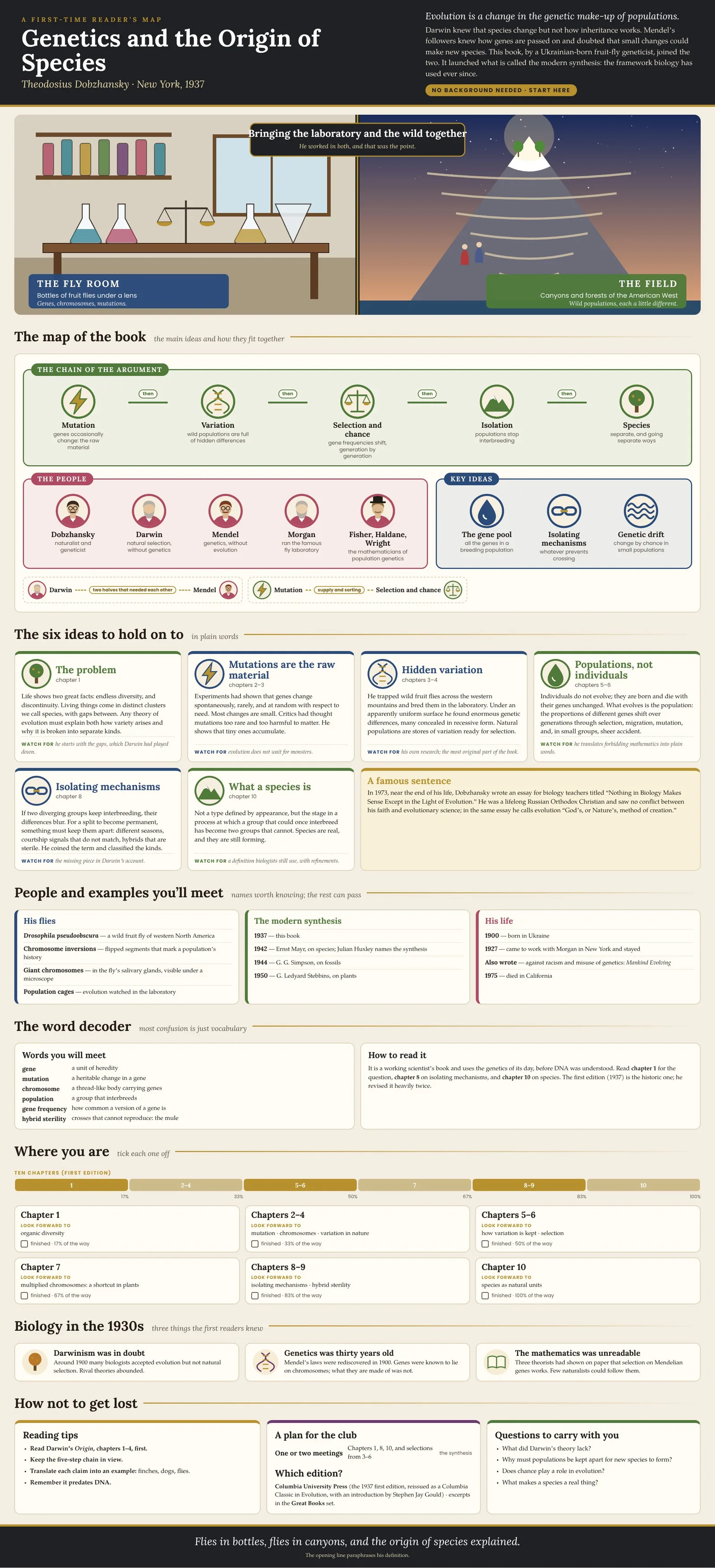
Darwin knew that species change but not how inheritance works. Mendel’s followers knew how genes are passed on and doubted that small changes could make new species. This book, by a Ukrainian-born fruit-fly geneticist, joined the two. It launched what is called the modern synthesis: the framework biology has used ever since.
✨ Open this rung of the Great Books Ladder → 🔗 Own page, to share or bookmark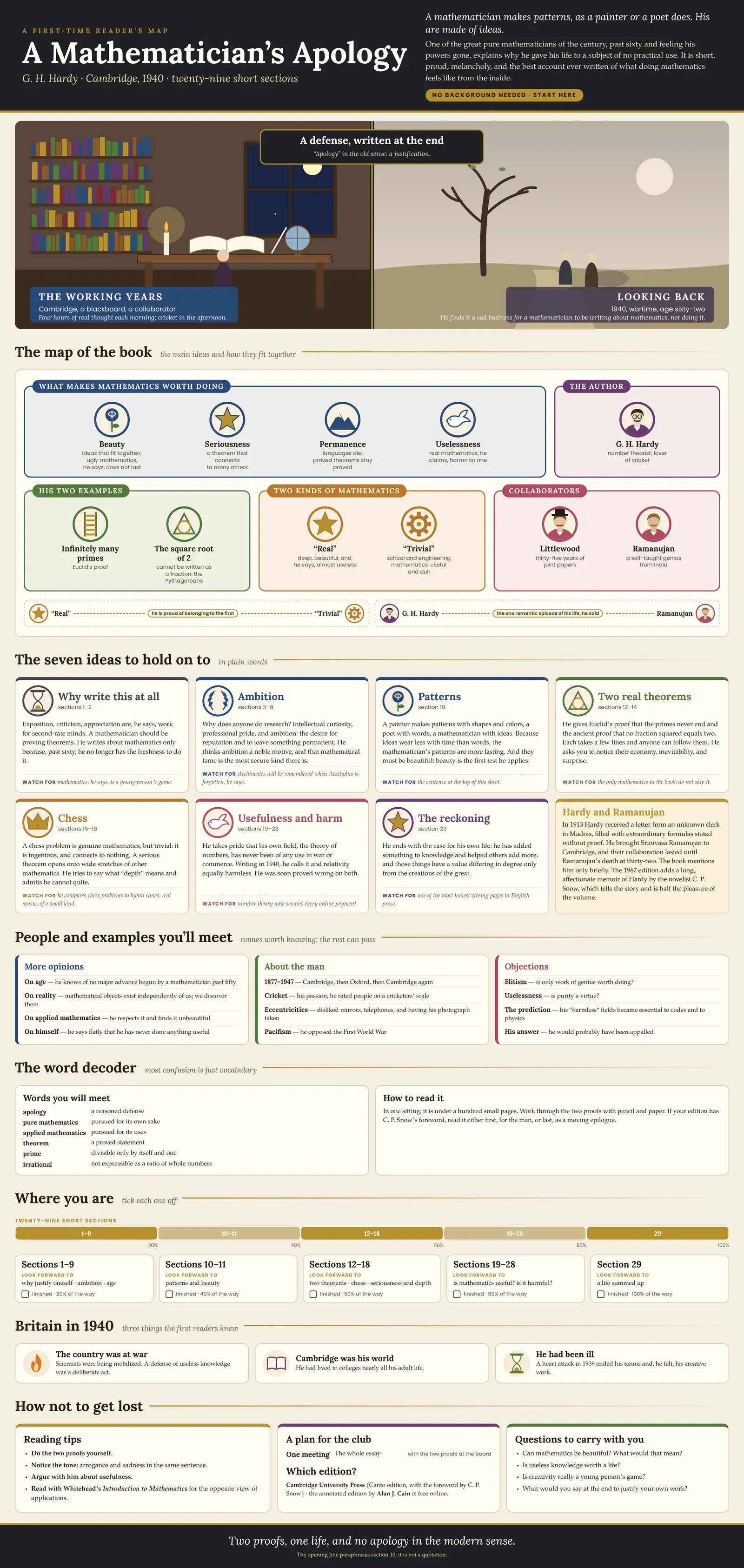
One of the great pure mathematicians of the century, past sixty and feeling his powers gone, explains why he gave his life to a subject of no practical use. It is short, proud, melancholy, and the best account ever written of what doing mathematics feels like from the inside.
✨ Open this rung of the Great Books Ladder → 🔗 Own page, to share or bookmark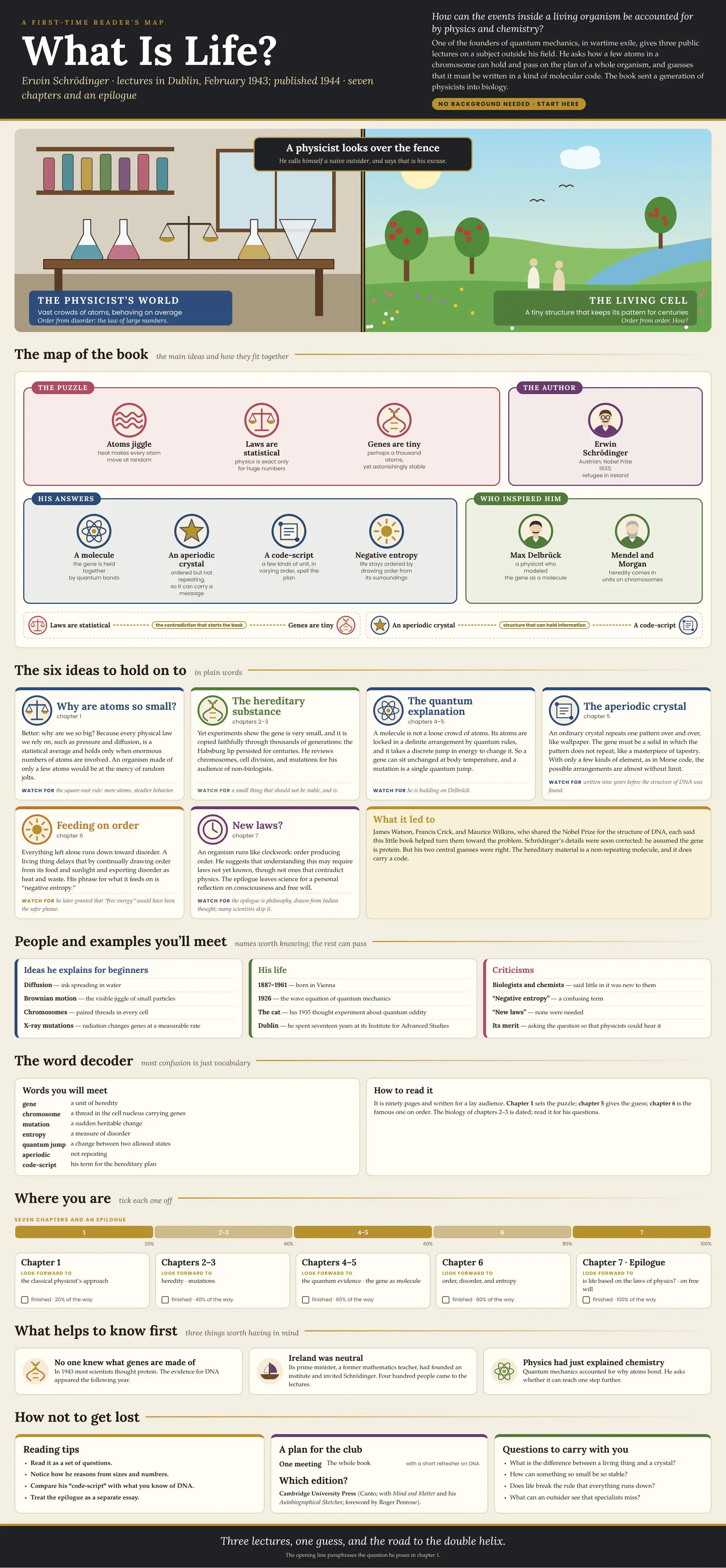
One of the founders of quantum mechanics, in wartime exile, gives three public lectures on a subject outside his field. He asks how a few atoms in a chromosome can hold and pass on the plan of a whole organism, and guesses that it must be written in a kind of molecular code. The book sent a generation of physicists into biology.
✨ Open this rung of the Great Books Ladder → 🔗 Own page, to share or bookmark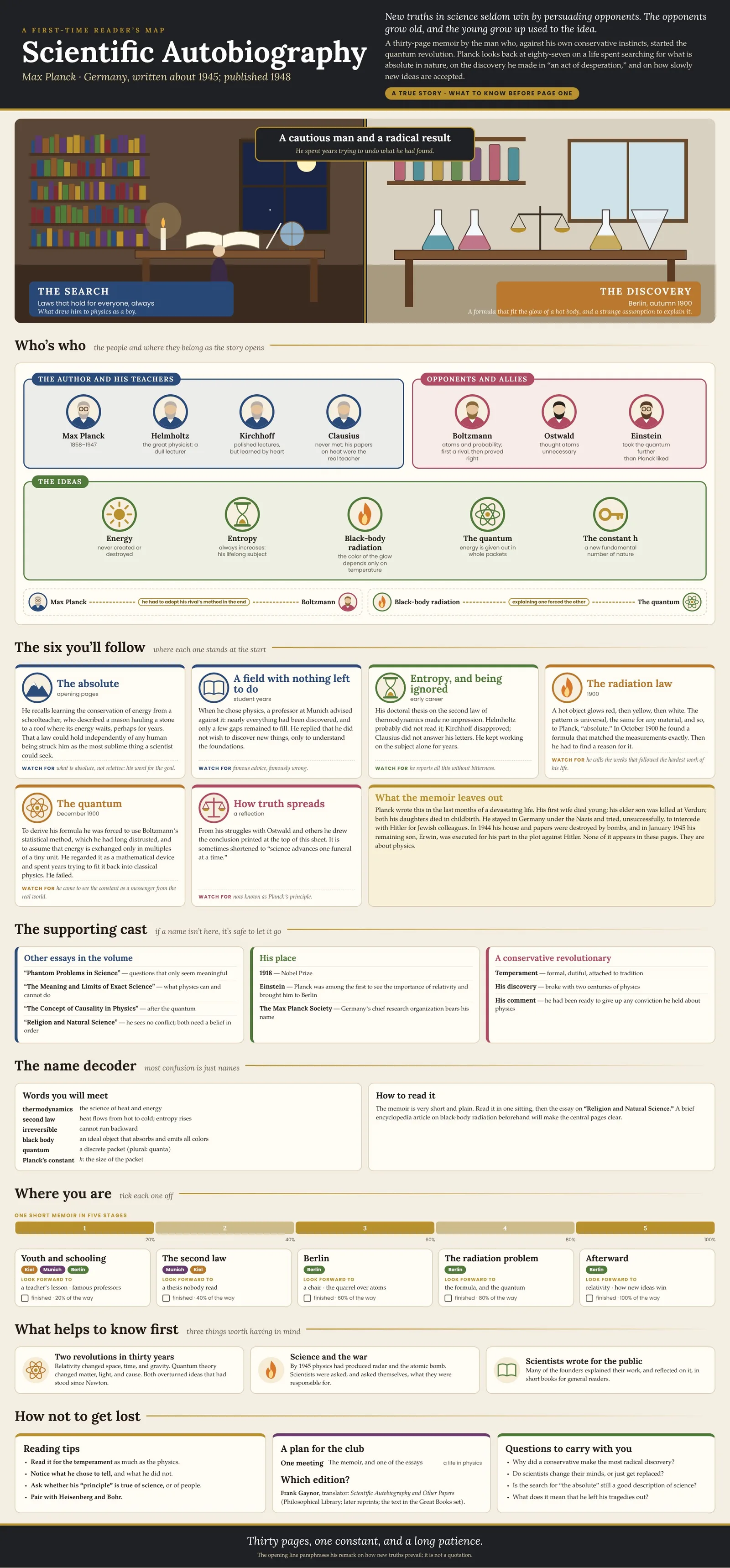
A thirty-page memoir by the man who, against his own conservative instincts, started the quantum revolution. Planck looks back at eighty-seven on a life spent searching for what is absolute in nature, on the discovery he made in “an act of desperation,” and on how slowly new ideas are accepted.
✨ Open this rung of the Great Books Ladder → 🔗 Own page, to share or bookmark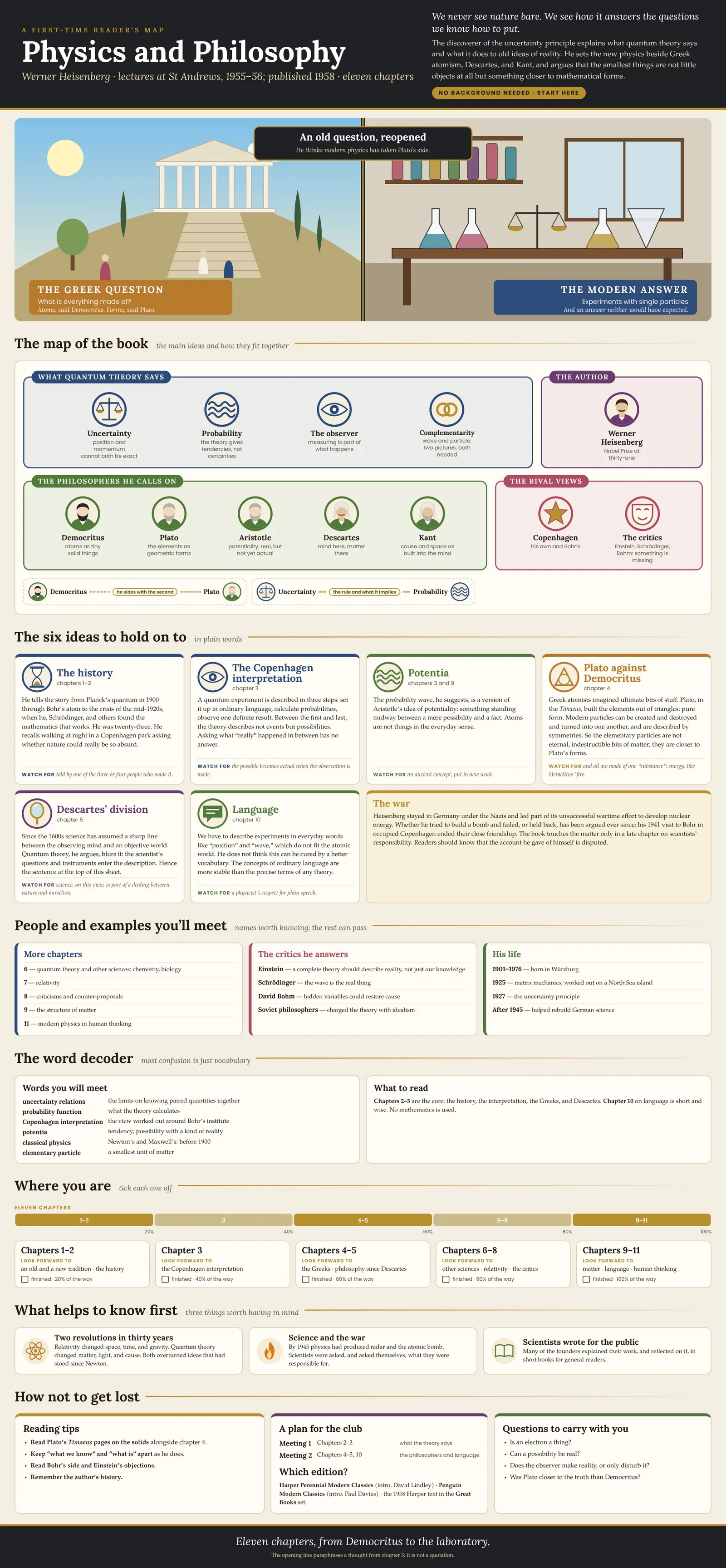
The discoverer of the uncertainty principle explains what quantum theory says and what it does to old ideas of reality. He sets the new physics beside Greek atomism, Descartes, and Kant, and argues that the smallest things are not little objects at all but something closer to mathematical forms.
✨ Open this rung of the Great Books Ladder → 🔗 Own page, to share or bookmark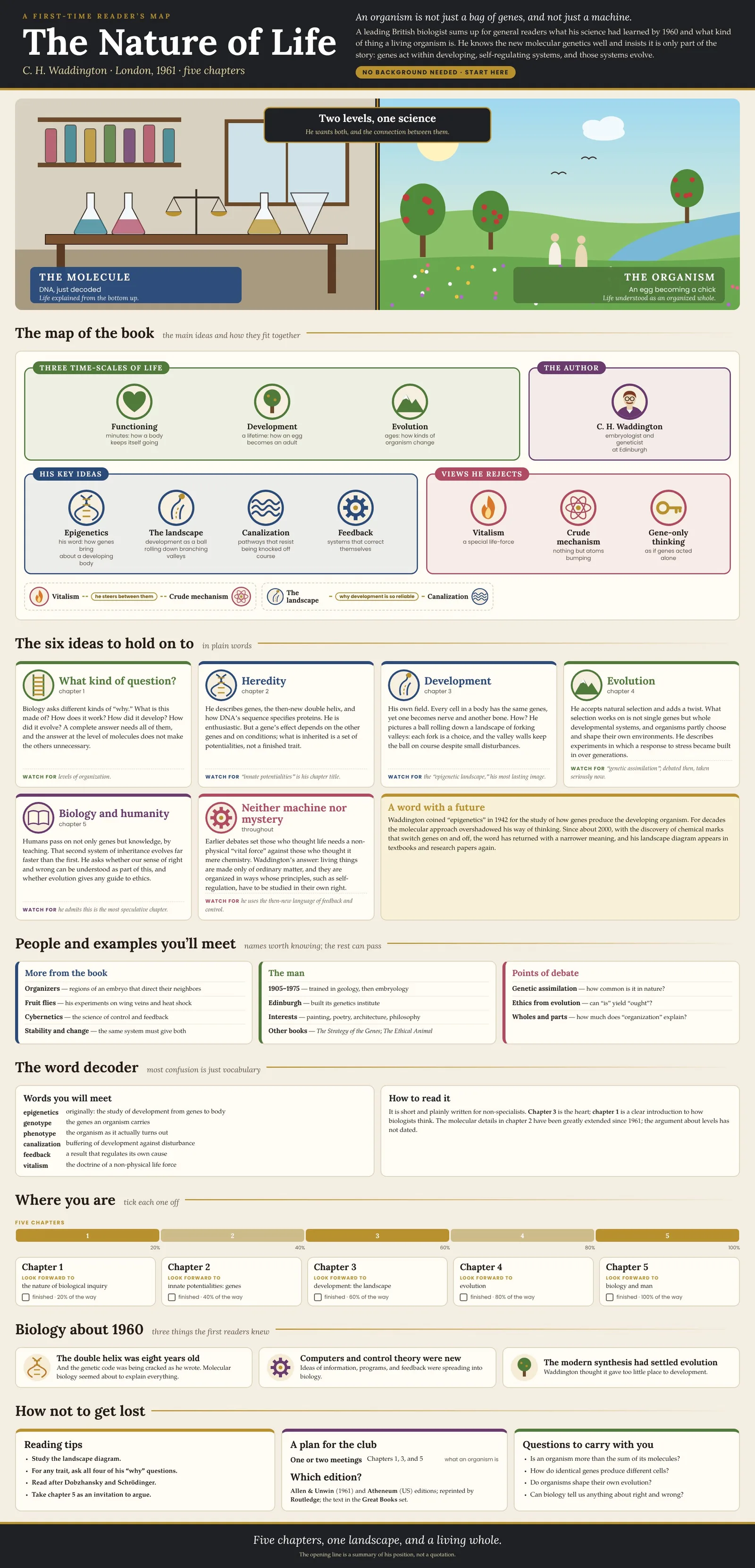
A leading British biologist sums up for general readers what his science had learned by 1960 and what kind of thing a living organism is. He knows the new molecular genetics well and insists it is only part of the story: genes act within developing, self-regulating systems, and those systems evolve.
✨ Open this rung of the Great Books Ladder → 🔗 Own page, to share or bookmark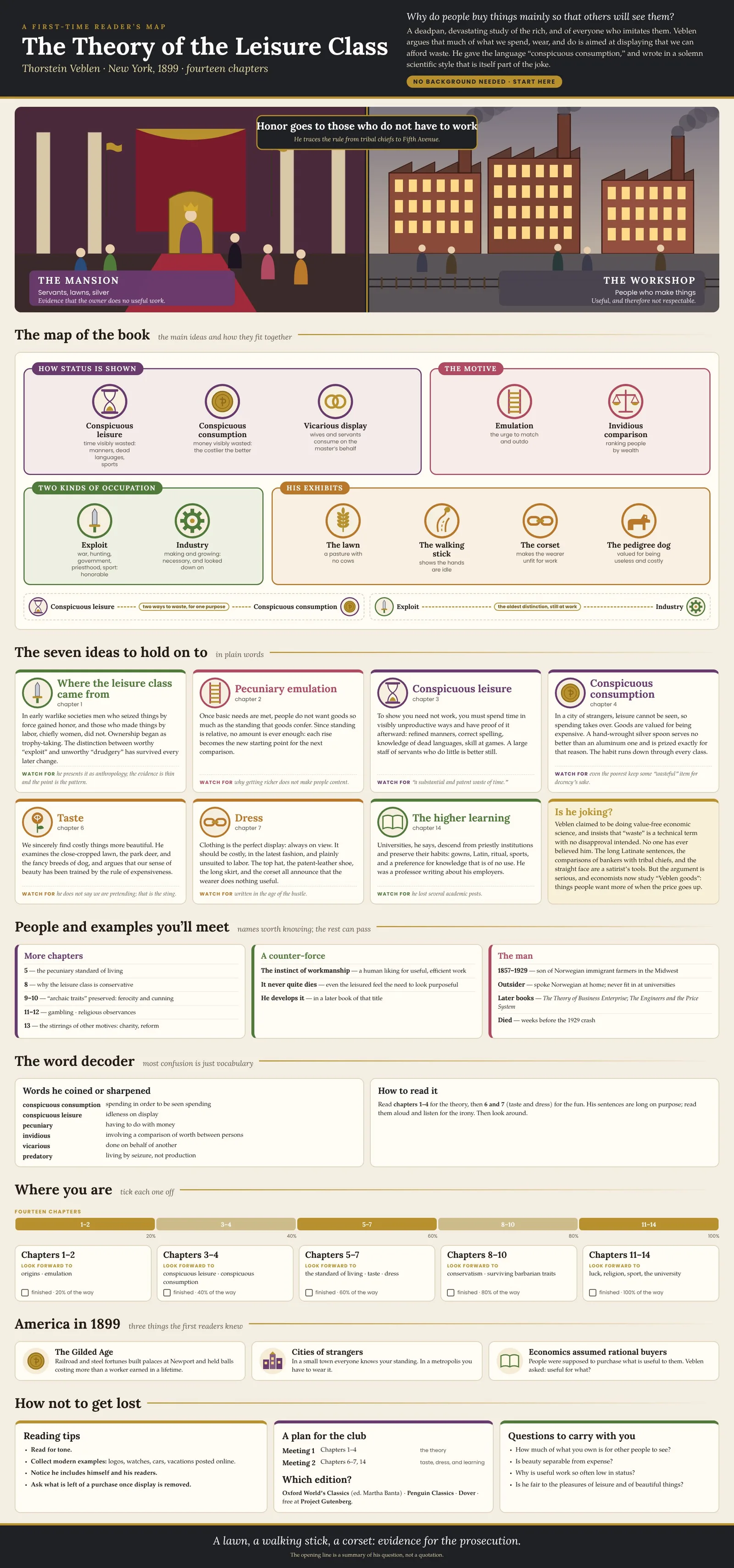
A deadpan, devastating study of the rich, and of everyone who imitates them. Veblen argues that much of what we spend, wear, and do is aimed at displaying that we can afford waste. He gave the language “conspicuous consumption,” and wrote in a solemn scientific style that is itself part of the joke.
✨ Open this rung of the Great Books Ladder → 🔗 Own page, to share or bookmark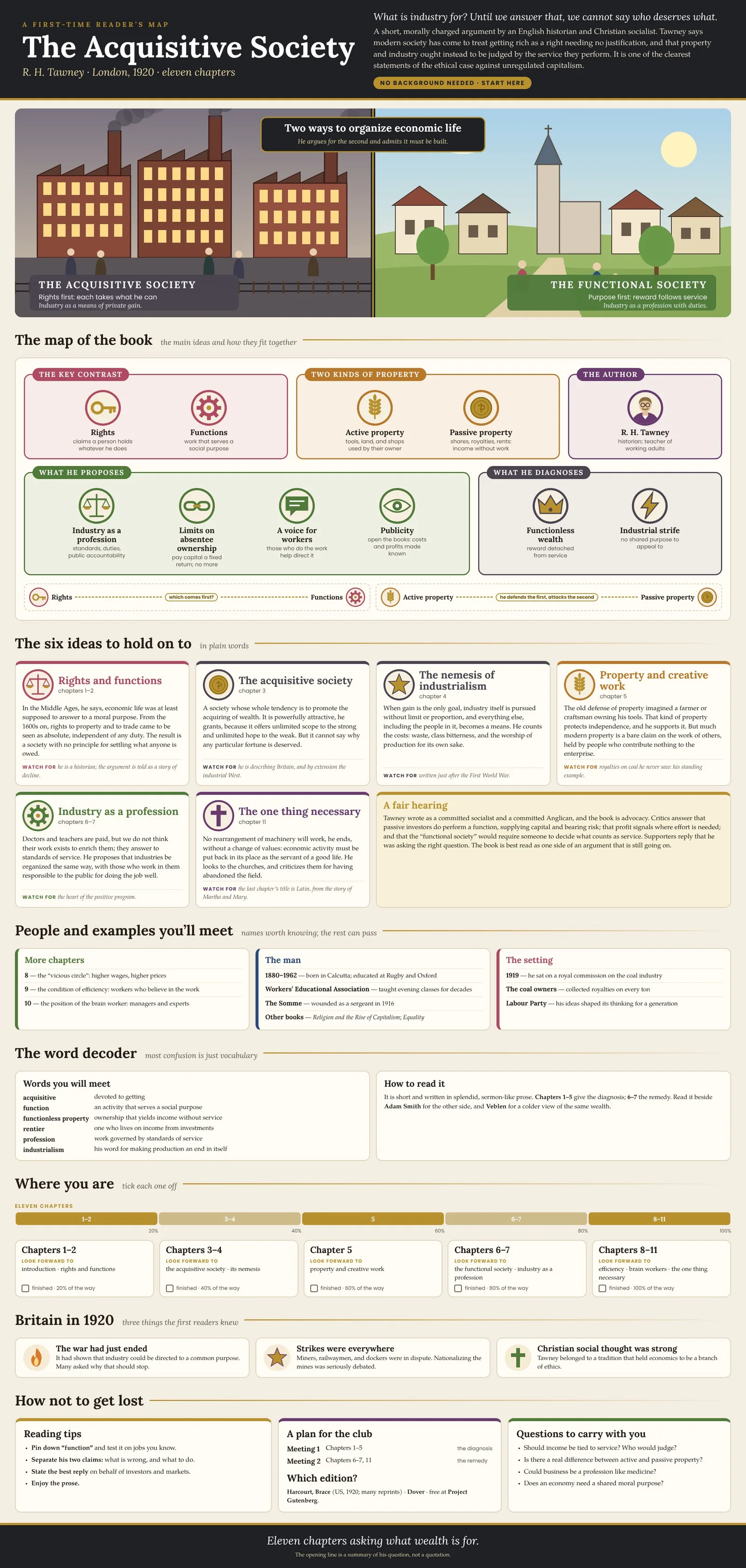
A short, morally charged argument by an English historian and Christian socialist. Tawney says modern society has come to treat getting rich as a right needing no justification, and that property and industry ought instead to be judged by the service they perform. It is one of the clearest statements of the ethical case against unregulated capitalism.
✨ Open this rung of the Great Books Ladder → 🔗 Own page, to share or bookmark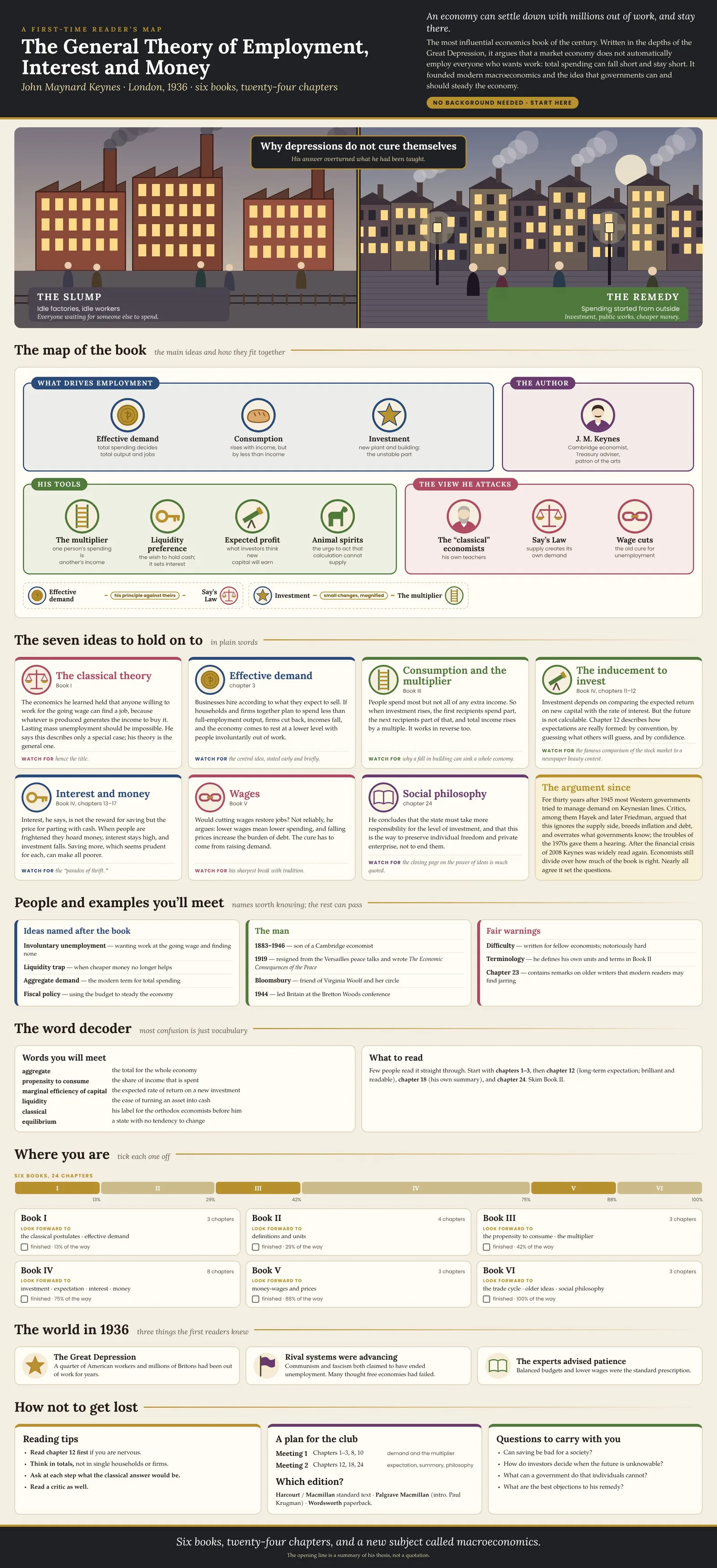
The most influential economics book of the century. Written in the depths of the Great Depression, it argues that a market economy does not automatically employ everyone who wants work: total spending can fall short and stay short. It founded modern macroeconomics and the idea that governments can and should steady the economy.
✨ Open this rung of the Great Books Ladder → 🔗 Own page, to share or bookmark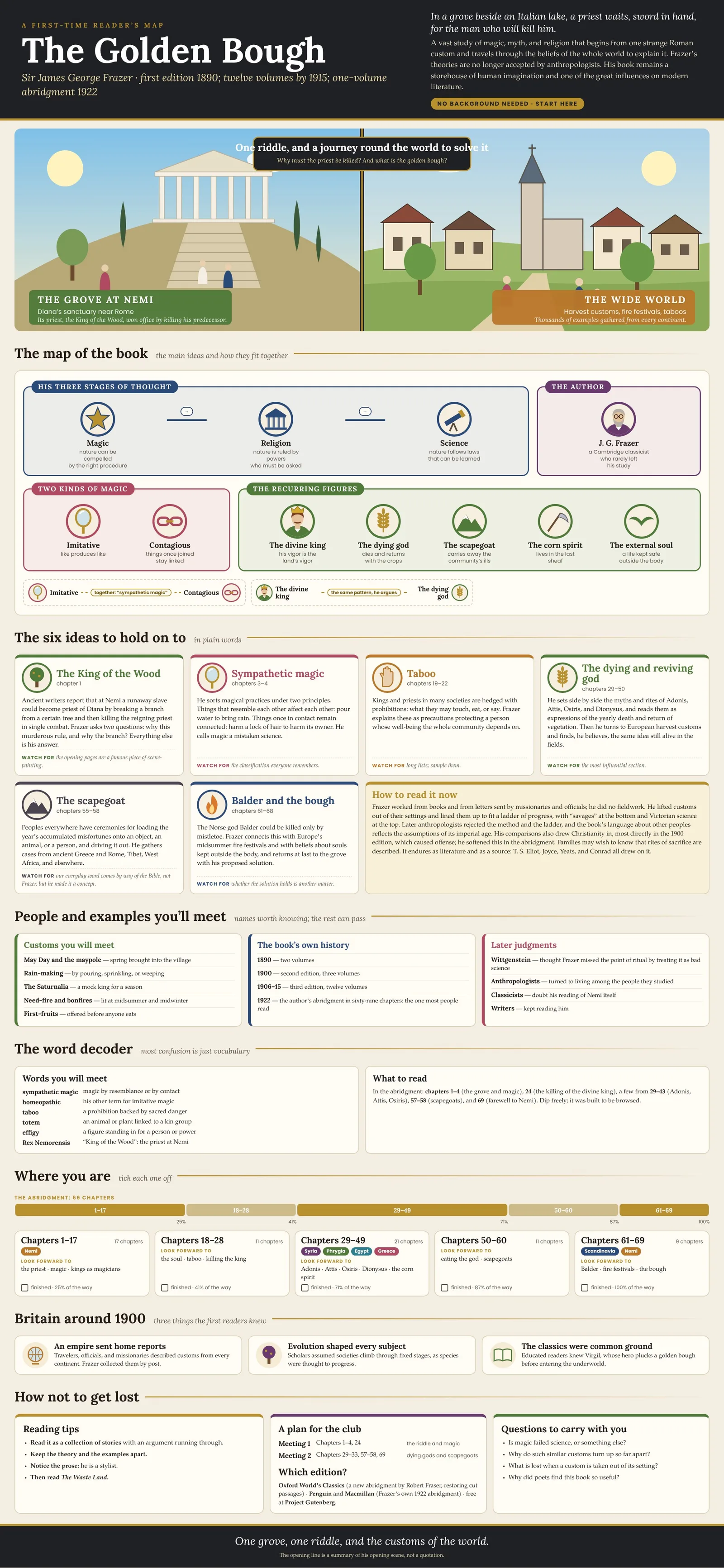
A vast study of magic, myth, and religion that begins from one strange Roman custom and travels through the beliefs of the whole world to explain it. Frazer’s theories are no longer accepted by anthropologists. His book remains a storehouse of human imagination and one of the great influences on modern literature.
✨ Open this rung of the Great Books Ladder → 🔗 Own page, to share or bookmark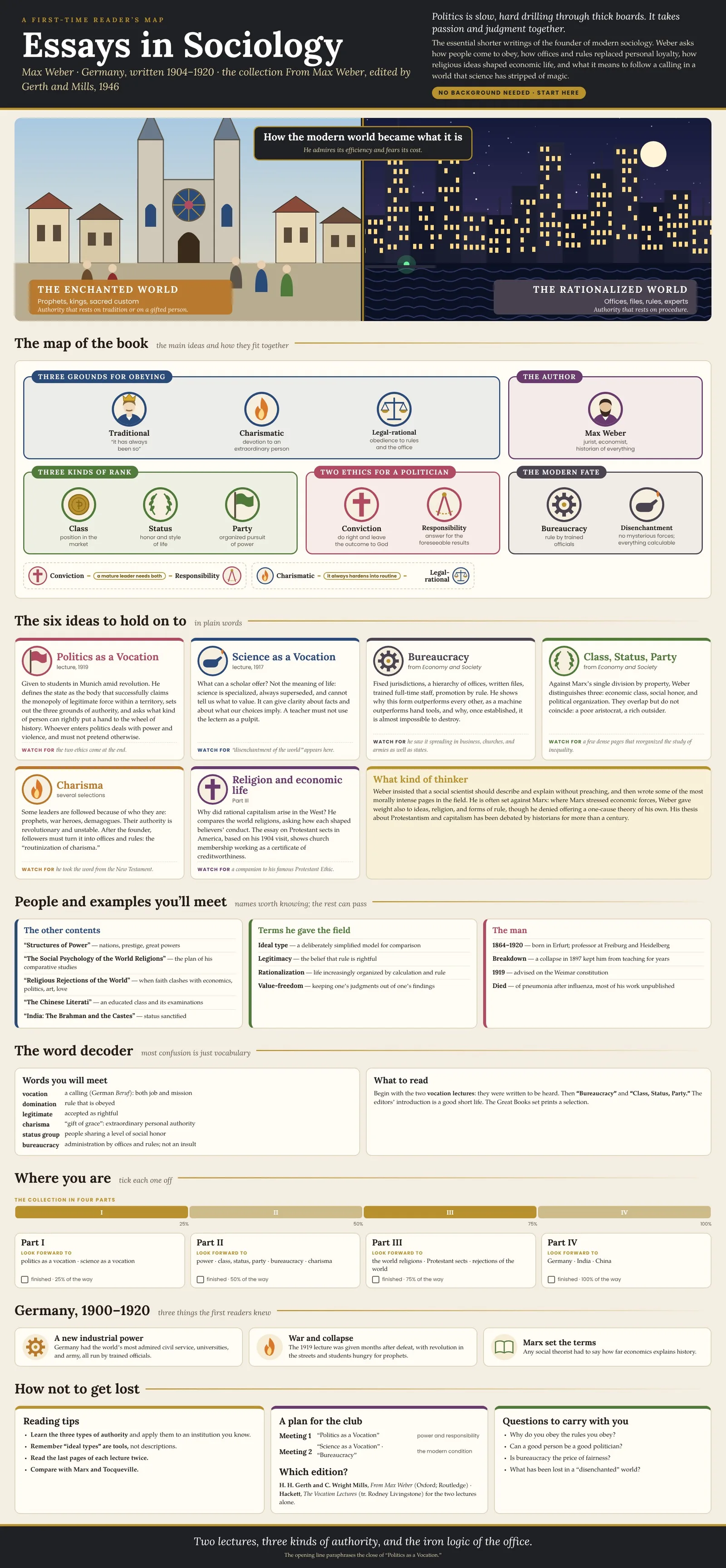
The essential shorter writings of the founder of modern sociology. Weber asks how people come to obey, how offices and rules replaced personal loyalty, how religious ideas shaped economic life, and what it means to follow a calling in a world that science has stripped of magic.
✨ Open this rung of the Great Books Ladder → 🔗 Own page, to share or bookmark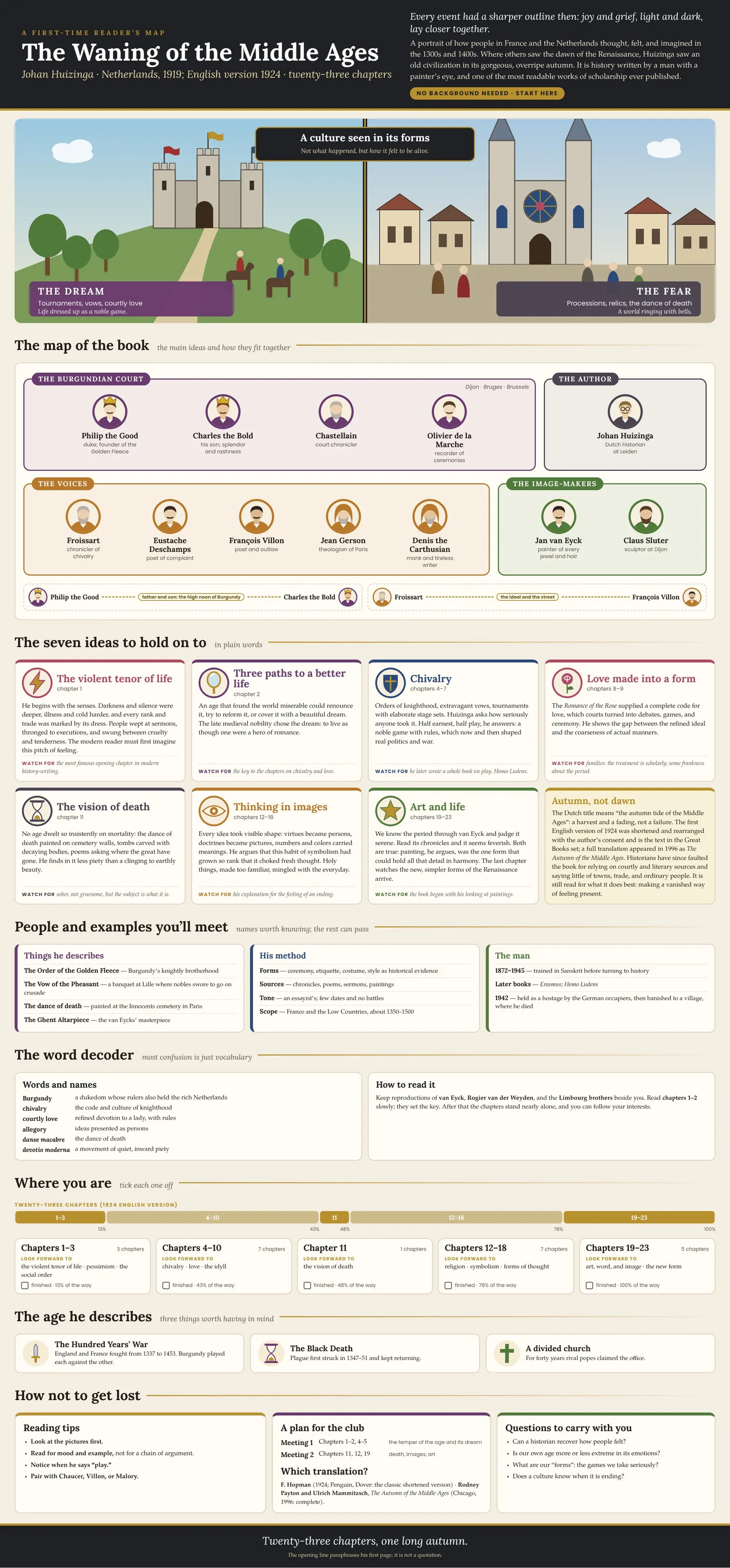
A portrait of how people in France and the Netherlands thought, felt, and imagined in the 1300s and 1400s. Where others saw the dawn of the Renaissance, Huizinga saw an old civilization in its gorgeous, overripe autumn. It is history written by a man with a painter’s eye, and one of the most readable works of scholarship ever published.
✨ Open this rung of the Great Books Ladder → 🔗 Own page, to share or bookmark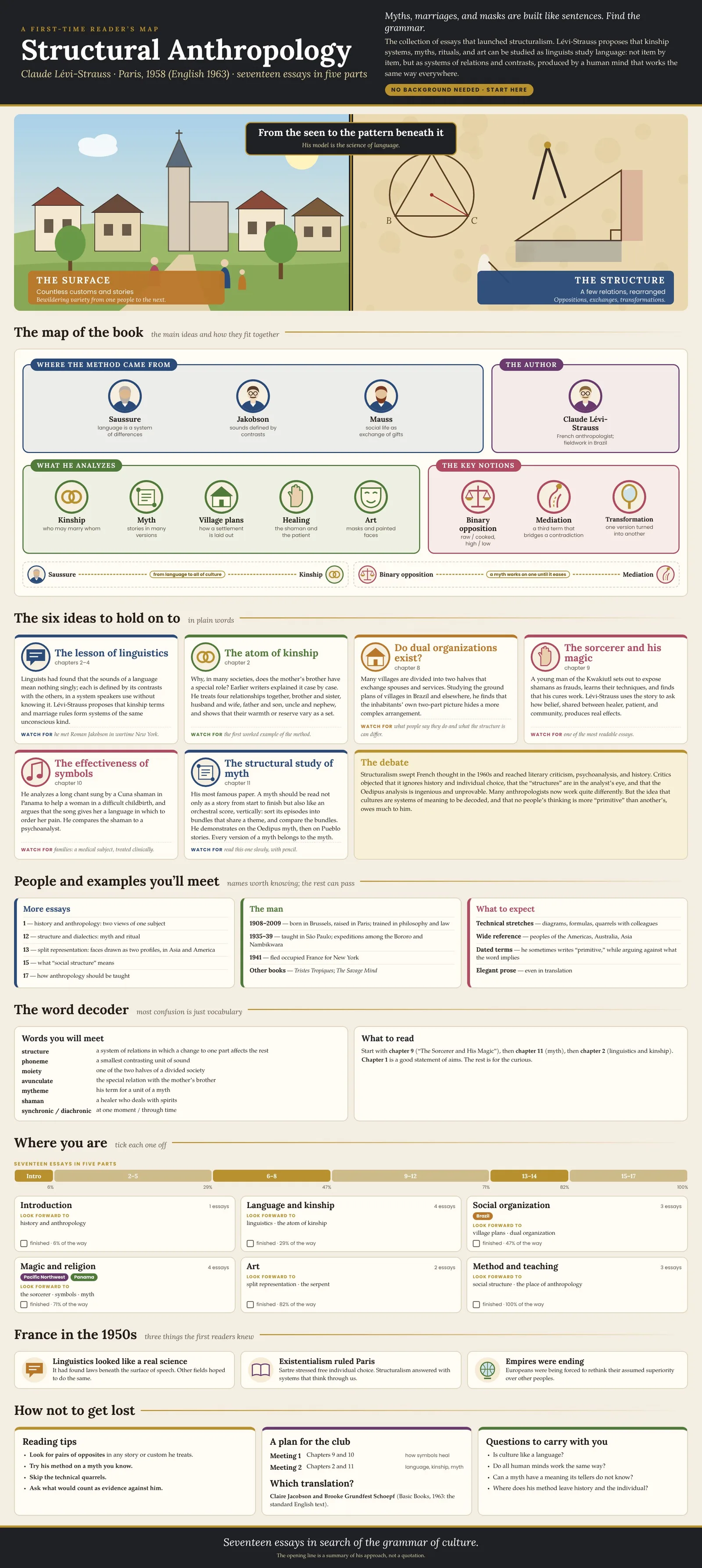
The collection of essays that launched structuralism. Lévi-Strauss proposes that kinship systems, myths, rituals, and art can be studied as linguists study language: not item by item, but as systems of relations and contrasts, produced by a human mind that works the same way everywhere.
✨ Open this rung of the Great Books Ladder → 🔗 Own page, to share or bookmark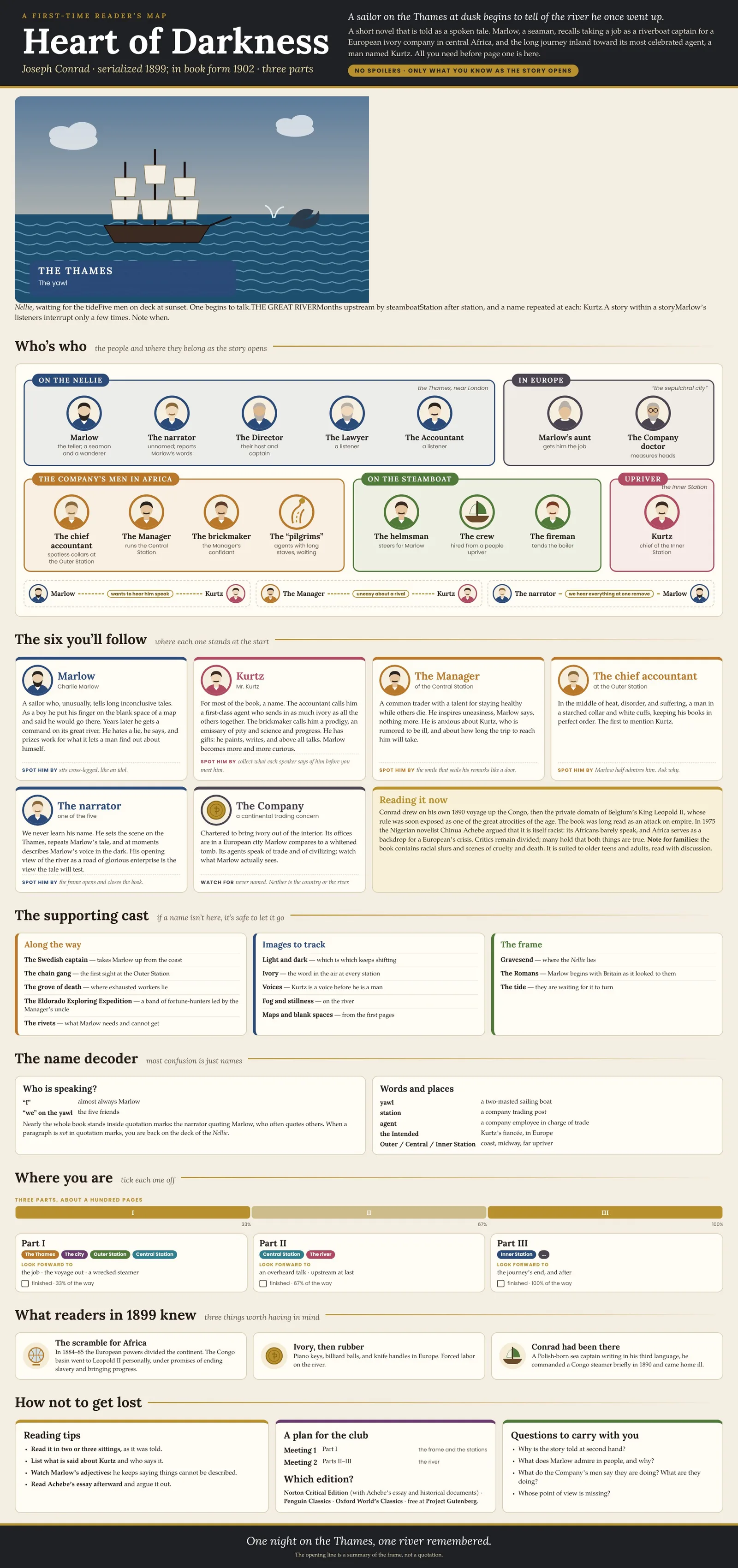
A short novel that is told as a spoken tale. Marlow, a seaman, recalls taking a job as a riverboat captain for a European ivory company in central Africa, and the long journey inland toward its most celebrated agent, a man named Kurtz. All you need before page one is here.
✨ Open this rung of the Great Books Ladder → 🔗 Own page, to share or bookmark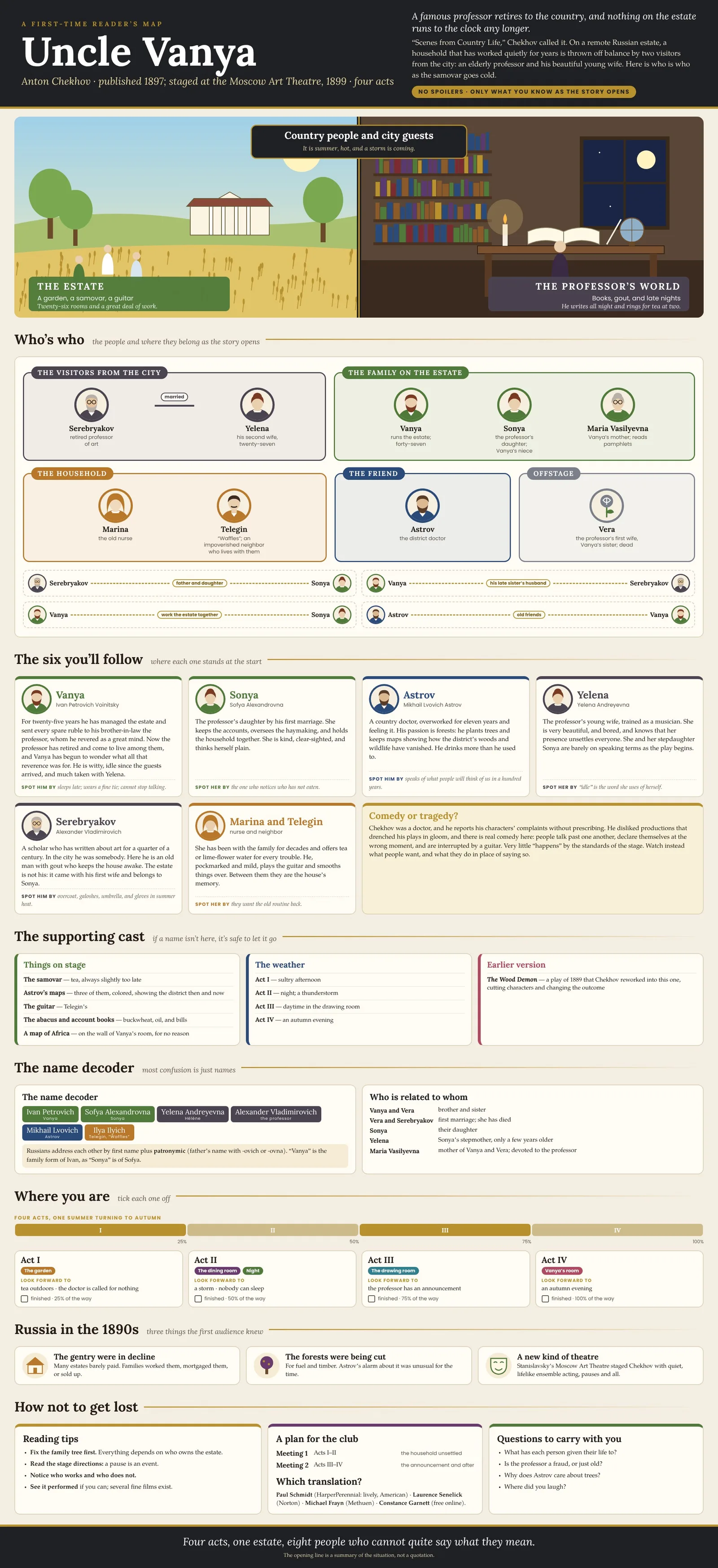
“Scenes from Country Life,” Chekhov called it. On a remote Russian estate, a household that has worked quietly for years is thrown off balance by two visitors from the city: an elderly professor and his beautiful young wife. Here is who is who as the samovar goes cold.
✨ Open this rung of the Great Books Ladder → 🔗 Own page, to share or bookmark 📚 Plays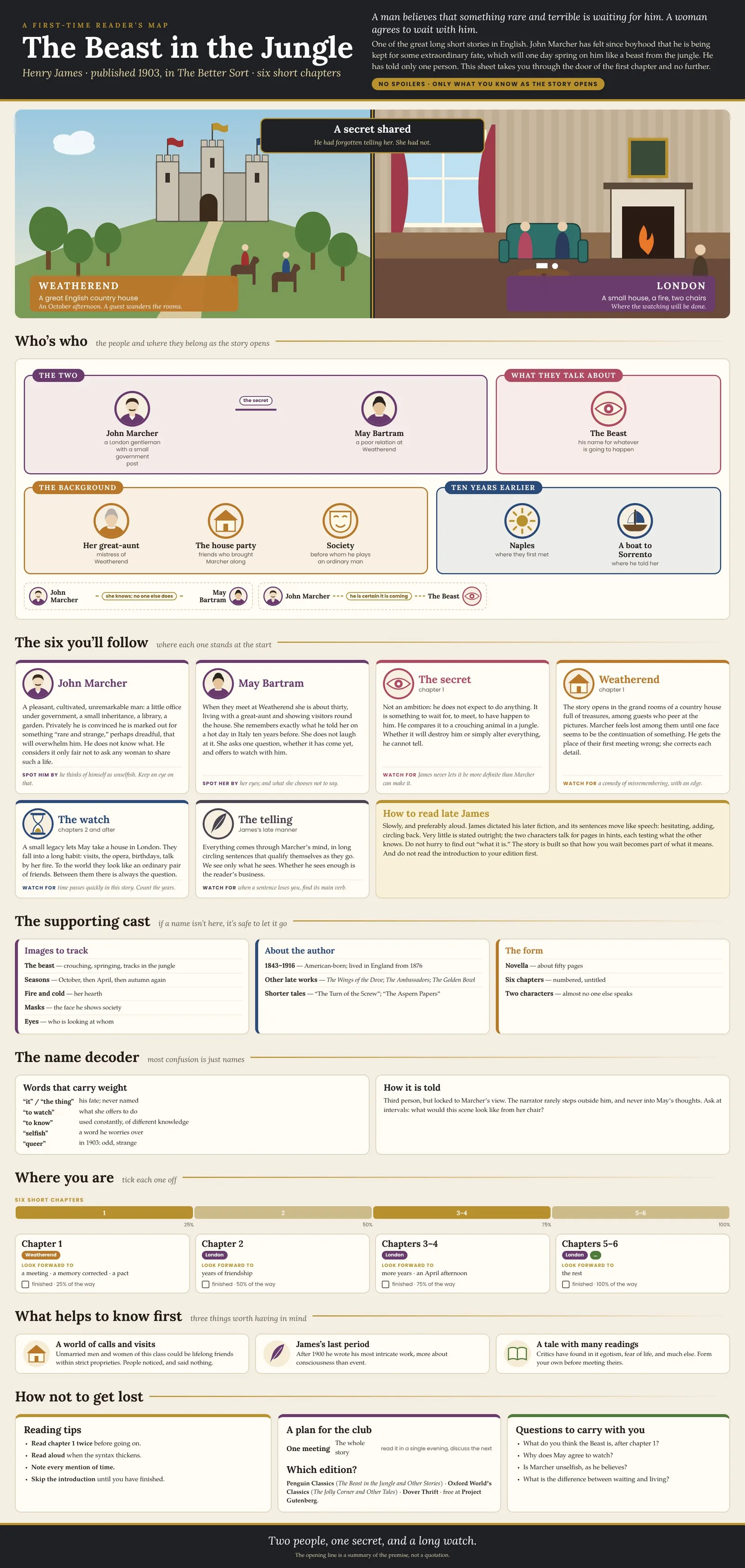
One of the great long short stories in English. John Marcher has felt since boyhood that he is being kept for some extraordinary fate, which will one day spring on him like a beast from the jungle. He has told only one person. This sheet takes you through the door of the first chapter and no further.
✨ Open this rung of the Great Books Ladder → 🔗 Own page, to share or bookmark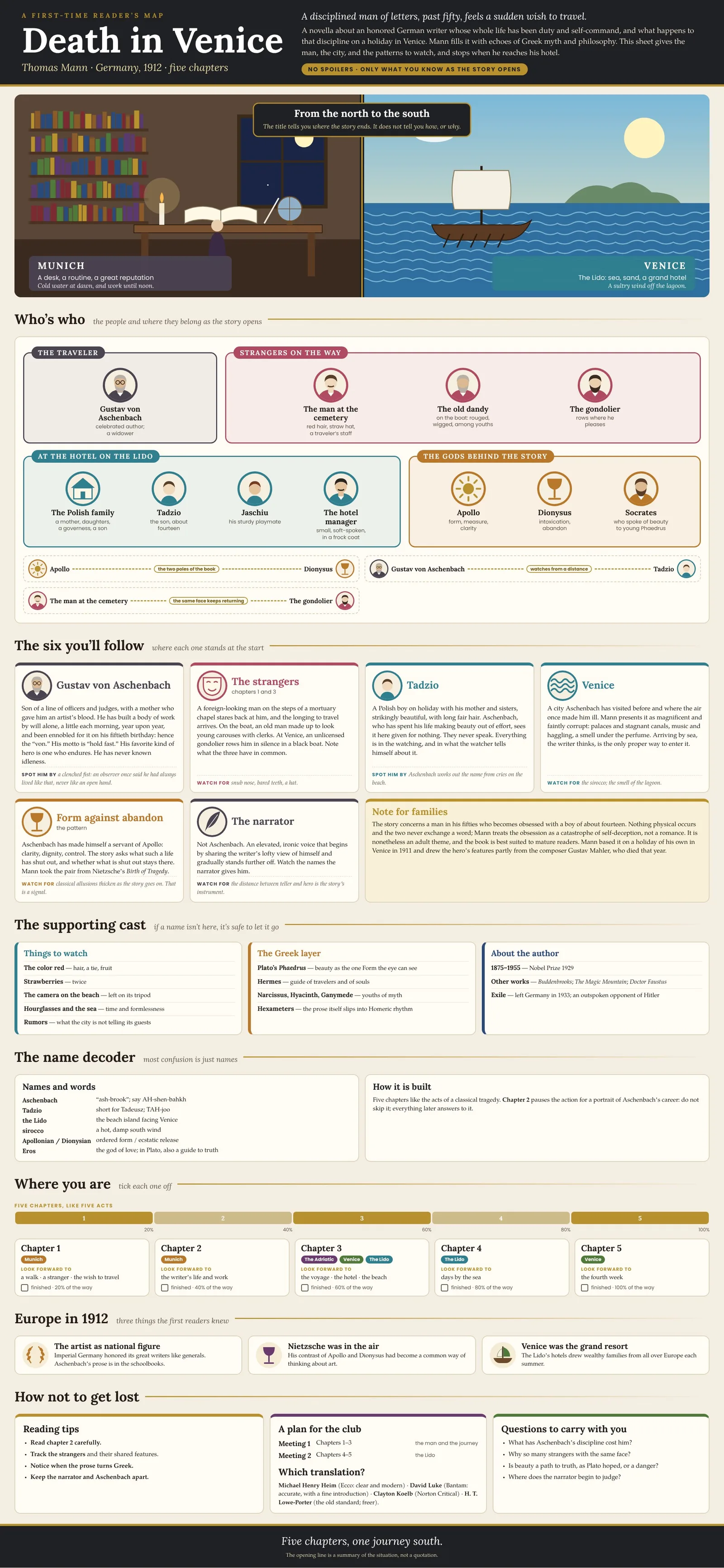
A novella about an honored German writer whose whole life has been duty and self-command, and what happens to that discipline on a holiday in Venice. Mann fills it with echoes of Greek myth and philosophy. This sheet gives the man, the city, and the patterns to watch, and stops when he reaches his hotel.
✨ Open this rung of the Great Books Ladder → 🔗 Own page, to share or bookmark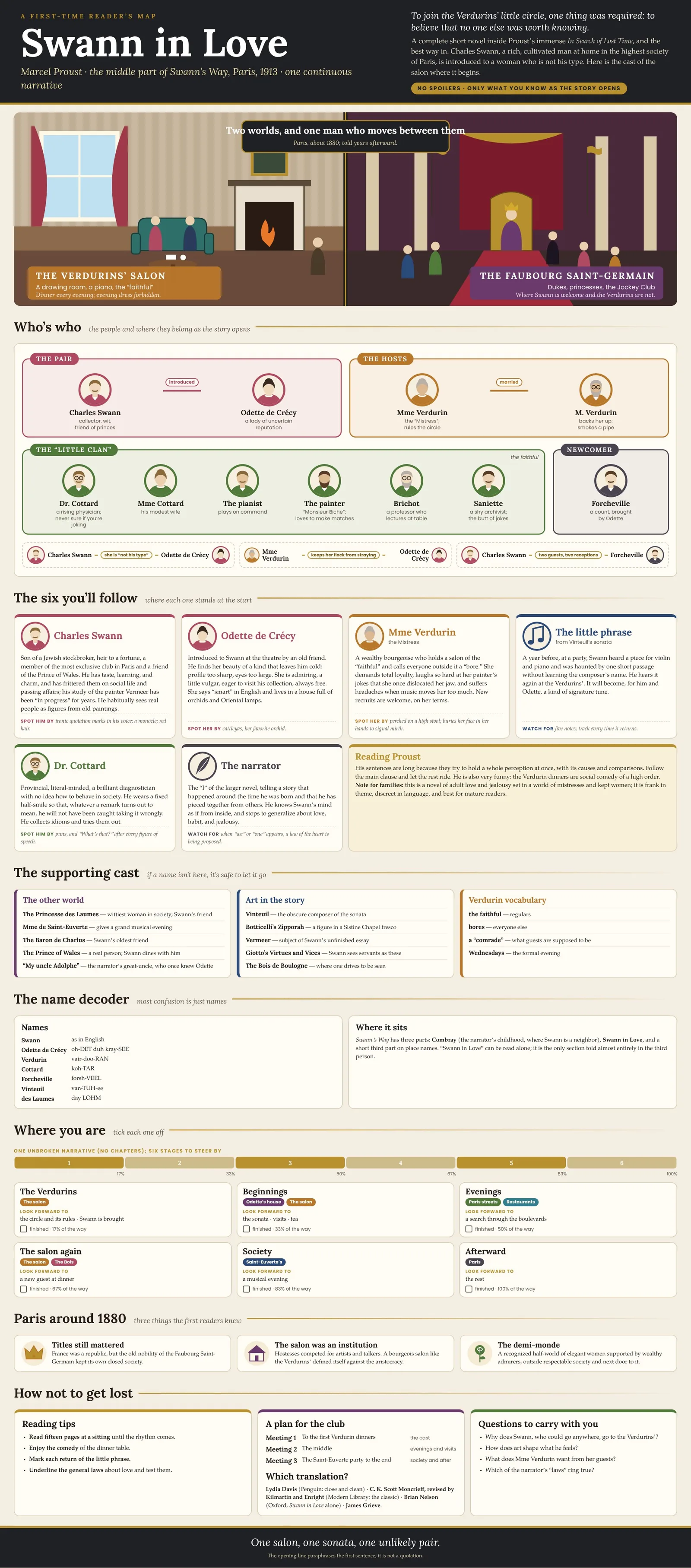
A complete short novel inside Proust’s immense In Search of Lost Time, and the best way in. Charles Swann, a rich, cultivated man at home in the highest society of Paris, is introduced to a woman who is not his type. Here is the cast of the salon where it begins.
✨ Open this rung of the Great Books Ladder → 🔗 Own page, to share or bookmark 📚 Swann's Way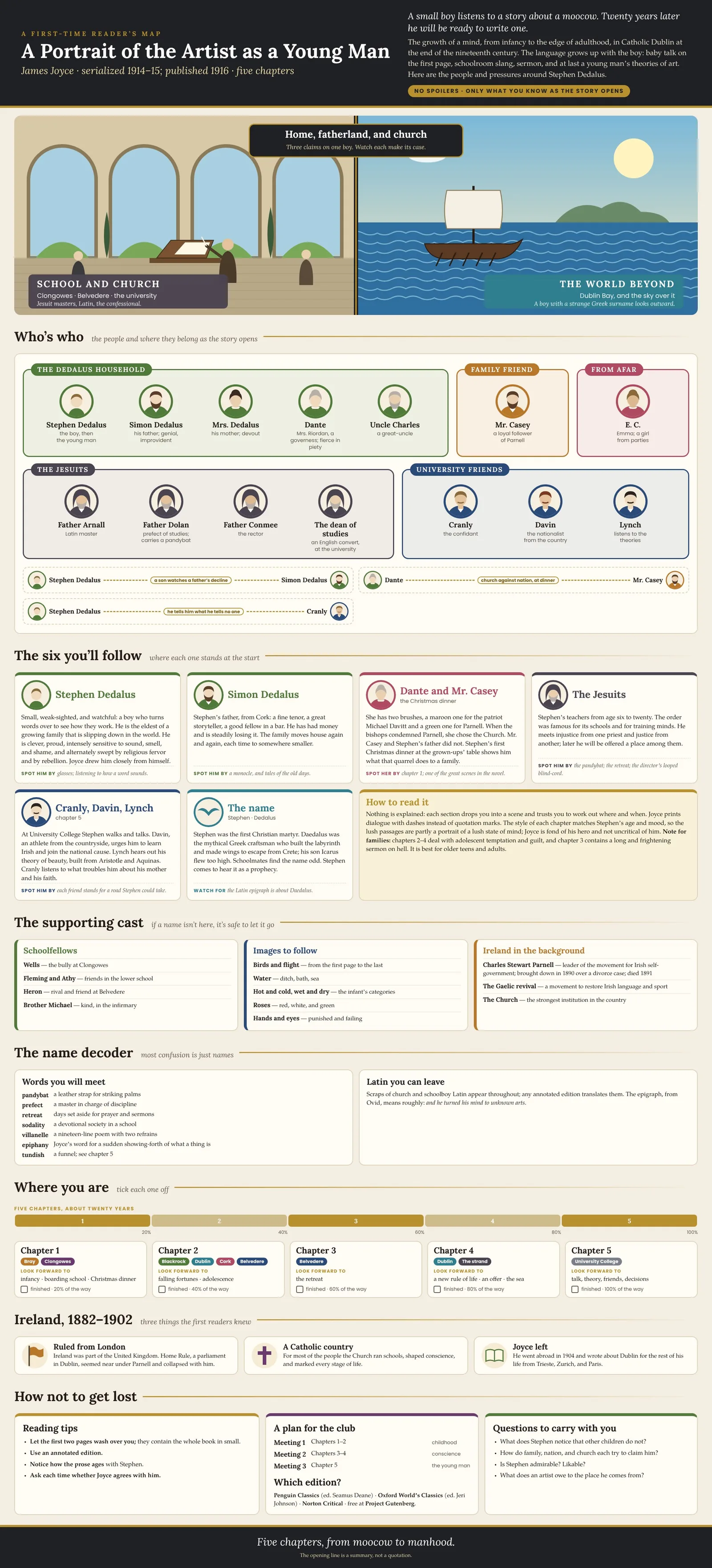
The growth of a mind, from infancy to the edge of adulthood, in Catholic Dublin at the end of the nineteenth century. The language grows up with the boy: baby talk on the first page, schoolroom slang, sermon, and at last a young man’s theories of art. Here are the people and pressures around Stephen Dedalus.
✨ Open this rung of the Great Books Ladder → 🔗 Own page, to share or bookmark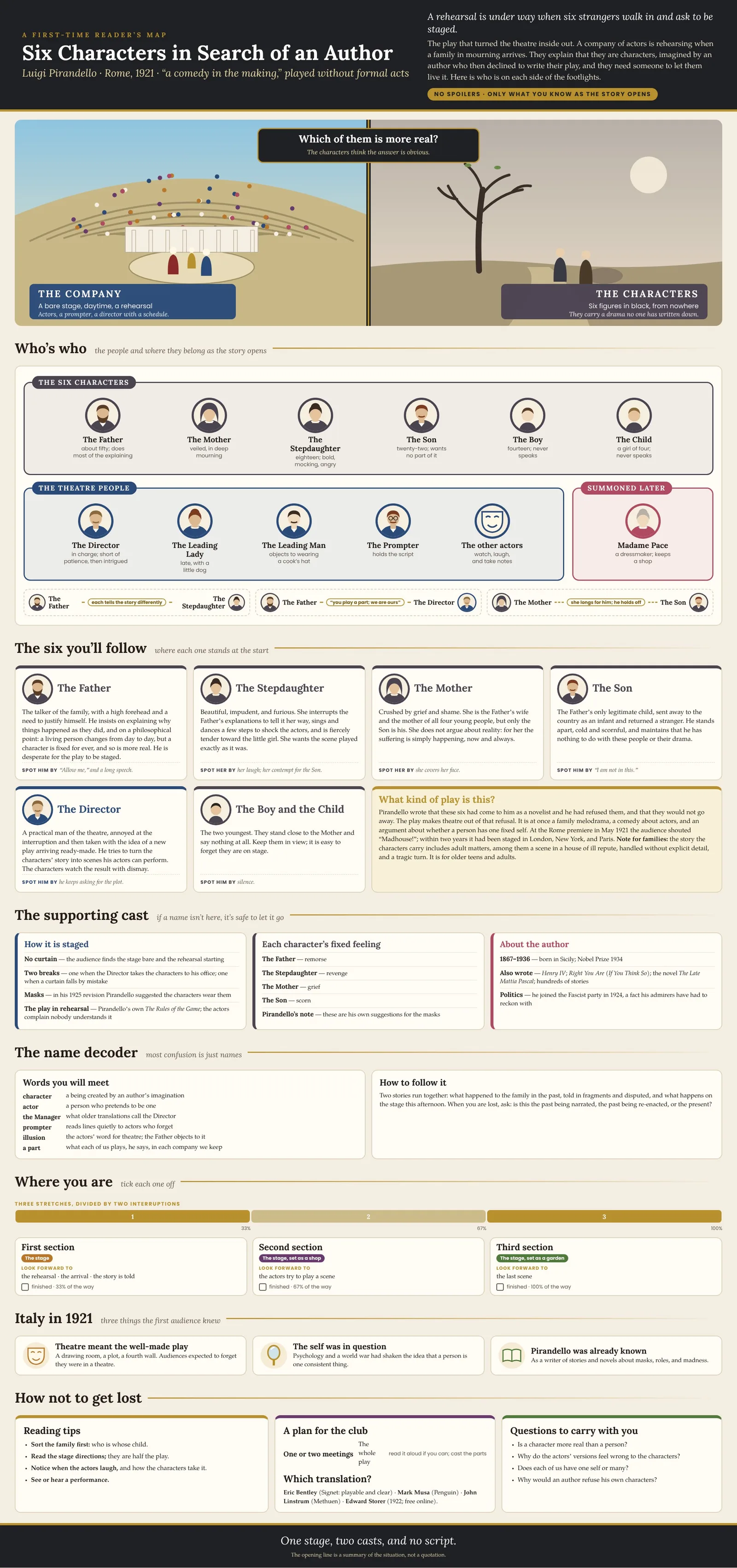
The play that turned the theatre inside out. A company of actors is rehearsing when a family in mourning arrives. They explain that they are characters, imagined by an author who then declined to write their play, and they need someone to let them live it. Here is who is on each side of the footlights.
✨ Open this rung of the Great Books Ladder → 🔗 Own page, to share or bookmark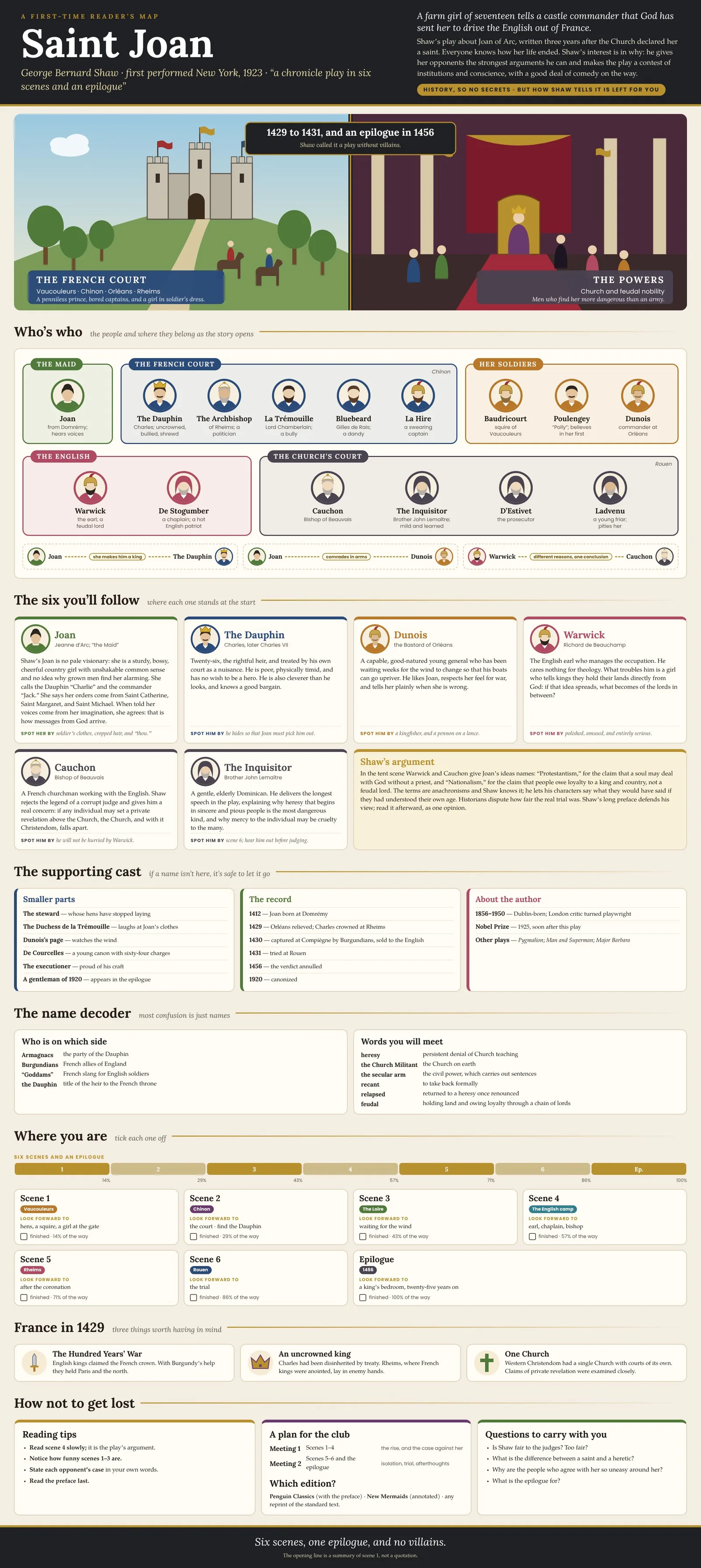
Shaw’s play about Joan of Arc, written three years after the Church declared her a saint. Everyone knows how her life ended. Shaw’s interest is in why: he gives her opponents the strongest arguments he can and makes the play a contest of institutions and conscience, with a good deal of comedy on the way.
✨ Open this rung of the Great Books Ladder → 🔗 Own page, to share or bookmark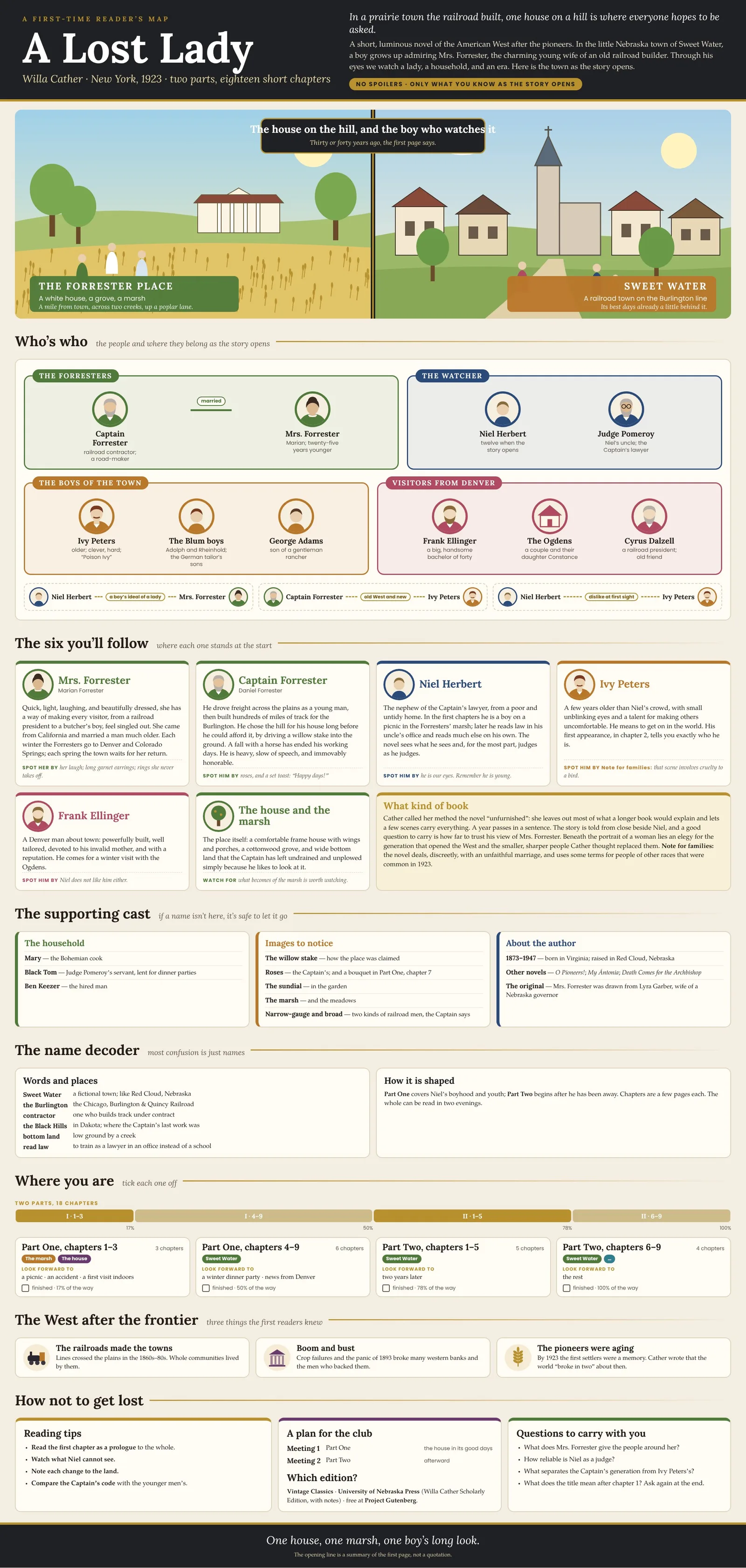
A short, luminous novel of the American West after the pioneers. In the little Nebraska town of Sweet Water, a boy grows up admiring Mrs. Forrester, the charming young wife of an old railroad builder. Through his eyes we watch a lady, a household, and an era. Here is the town as the story opens.
✨ Open this rung of the Great Books Ladder → 🔗 Own page, to share or bookmark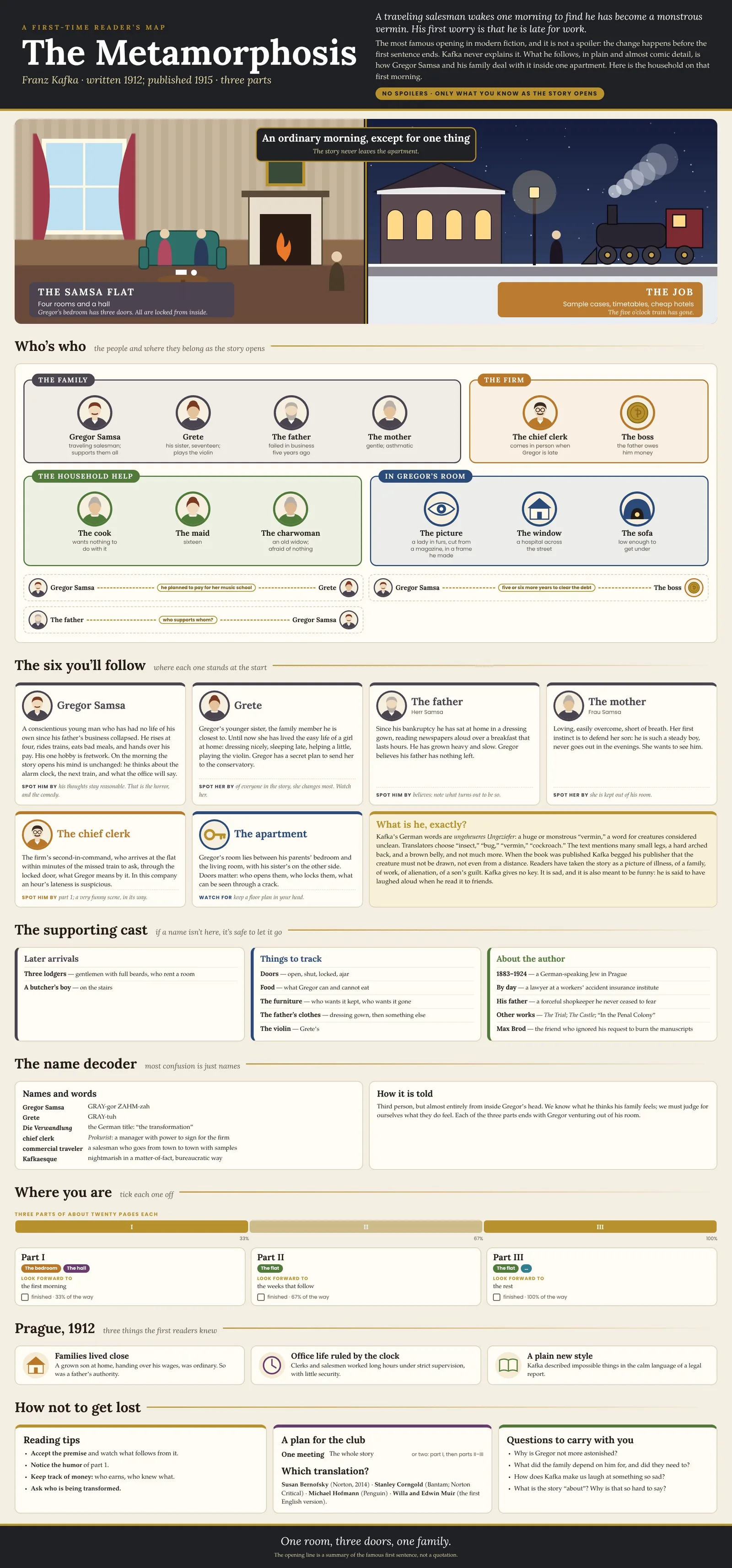
The most famous opening in modern fiction, and it is not a spoiler: the change happens before the first sentence ends. Kafka never explains it. What he follows, in plain and almost comic detail, is how Gregor Samsa and his family deal with it inside one apartment. Here is the household on that first morning.
✨ Open this rung of the Great Books Ladder → 🔗 Own page, to share or bookmark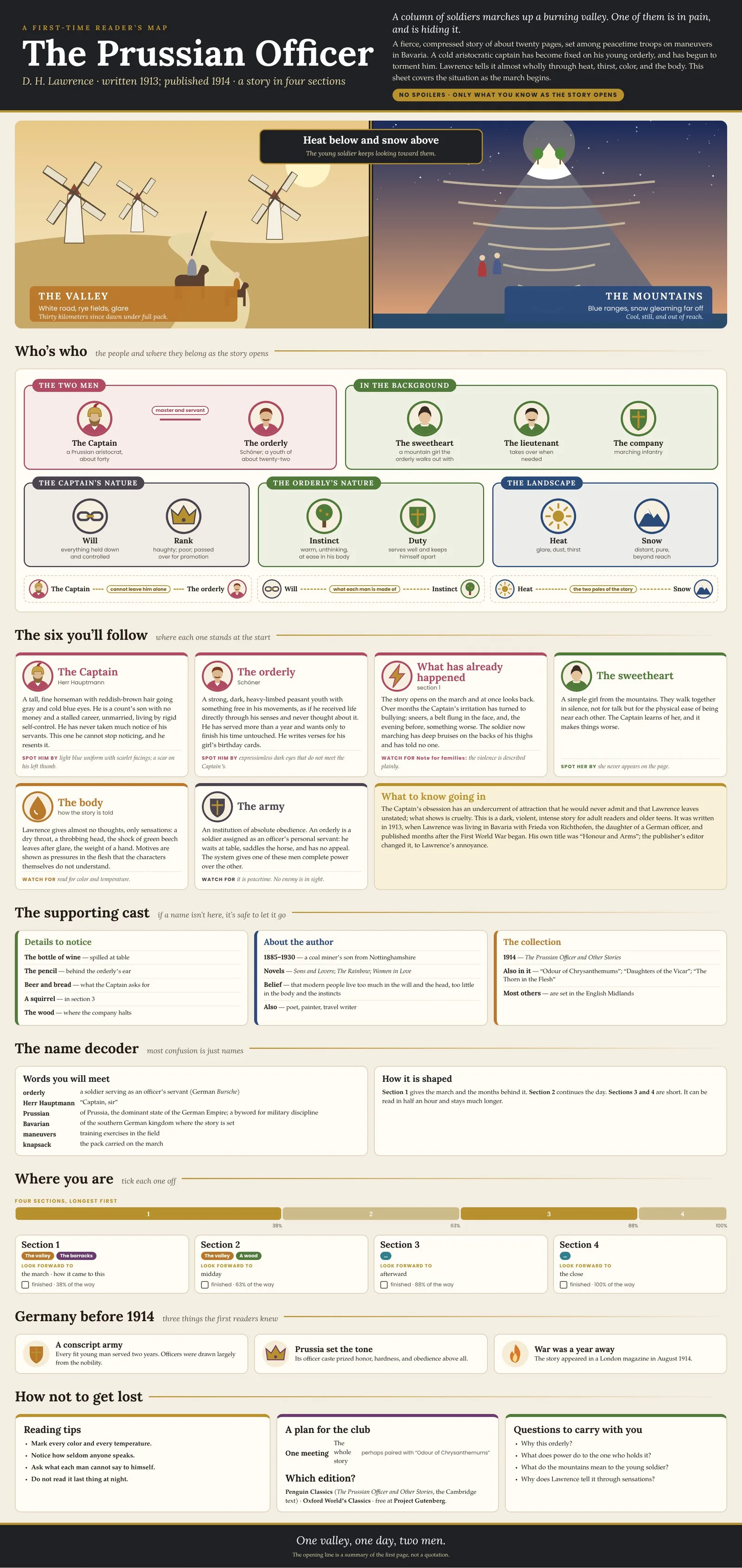
A fierce, compressed story of about twenty pages, set among peacetime troops on maneuvers in Bavaria. A cold aristocratic captain has become fixed on his young orderly, and has begun to torment him. Lawrence tells it almost wholly through heat, thirst, color, and the body. This sheet covers the situation as the march begins.
✨ Open this rung of the Great Books Ladder → 🔗 Own page, to share or bookmark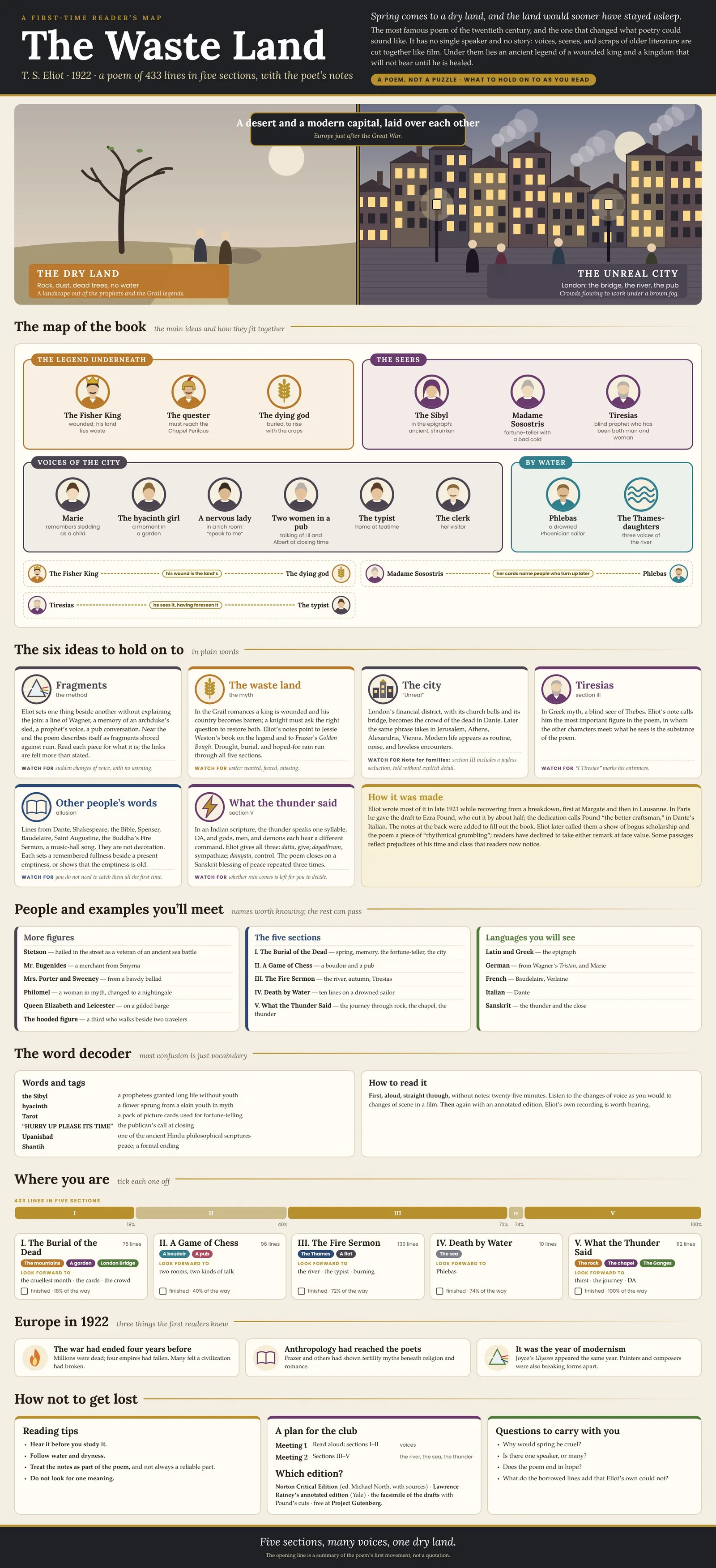
The most famous poem of the twentieth century, and the one that changed what poetry could sound like. It has no single speaker and no story: voices, scenes, and scraps of older literature are cut together like film. Under them lies an ancient legend of a wounded king and a kingdom that will not bear until he is healed.
✨ Open this rung of the Great Books Ladder → 🔗 Own page, to share or bookmark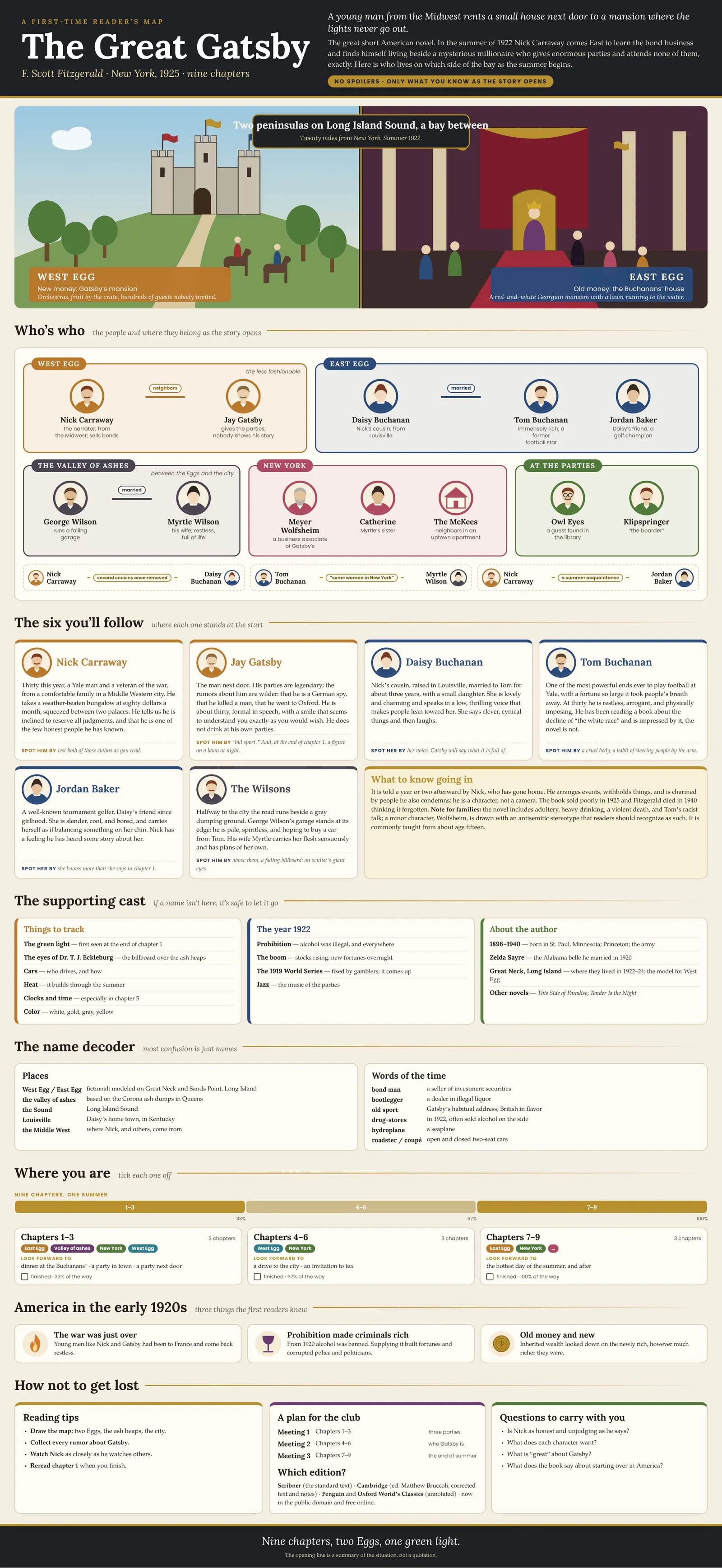
The great short American novel. In the summer of 1922 Nick Carraway comes East to learn the bond business and finds himself living beside a mysterious millionaire who gives enormous parties and attends none of them, exactly. Here is who lives on which side of the bay as the summer begins.
✨ Open this rung of the Great Books Ladder → 🔗 Own page, to share or bookmark 📚 The Great Gatsby and Other Classic Works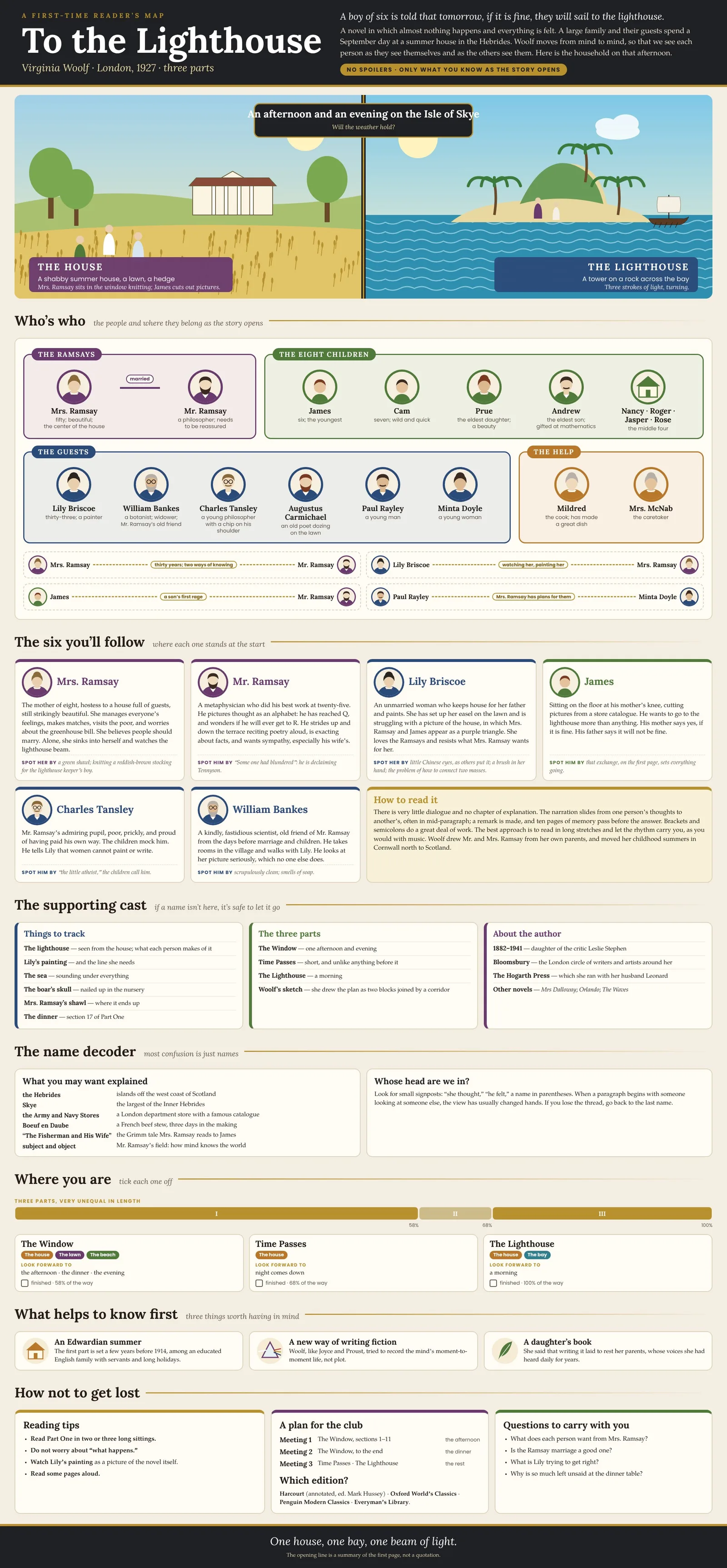
A novel in which almost nothing happens and everything is felt. A large family and their guests spend a September day at a summer house in the Hebrides. Woolf moves from mind to mind, so that we see each person as they see themselves and as the others see them. Here is the household on that afternoon.
✨ Open this rung of the Great Books Ladder → 🔗 Own page, to share or bookmark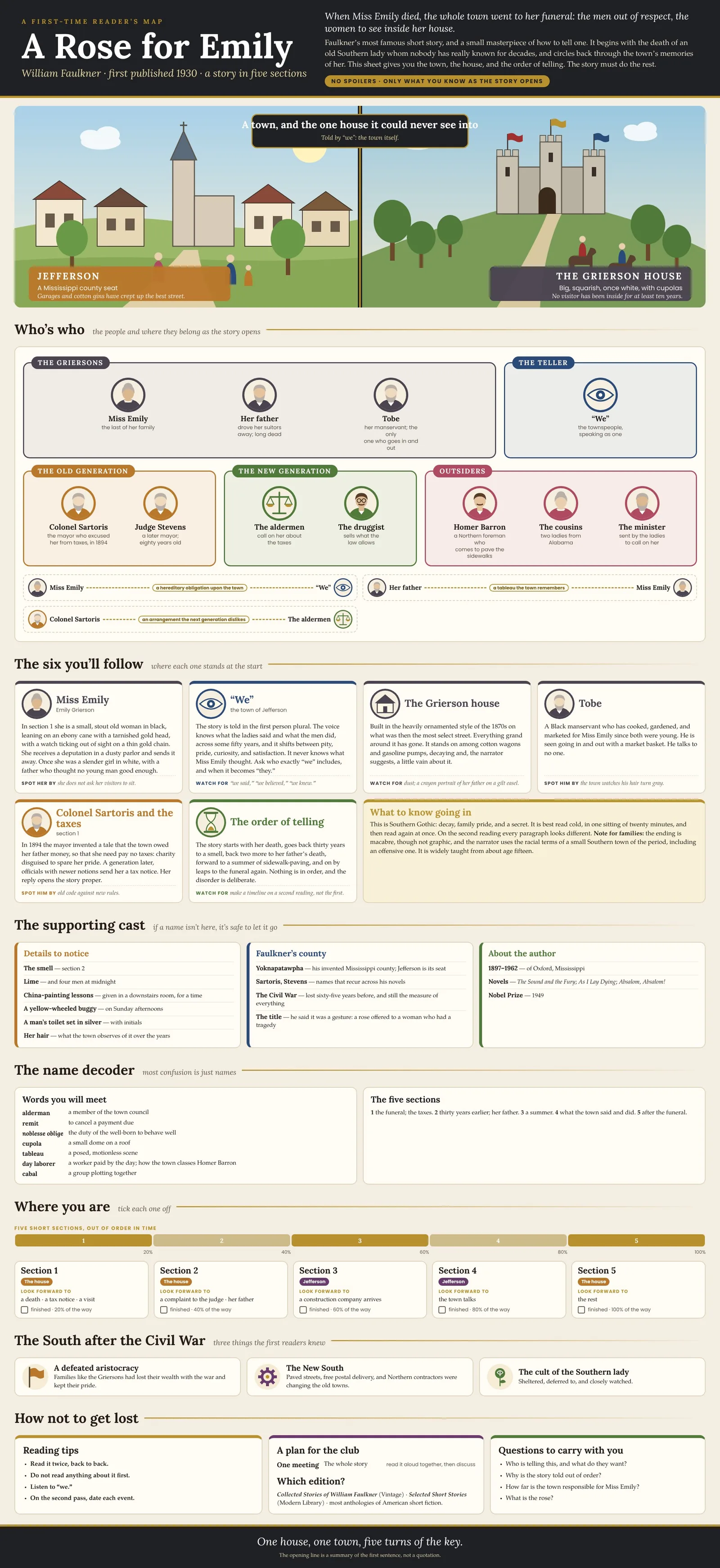
Faulkner’s most famous short story, and a small masterpiece of how to tell one. It begins with the death of an old Southern lady whom nobody has really known for decades, and circles back through the town’s memories of her. This sheet gives you the town, the house, and the order of telling. The story must do the rest.
✨ Open this rung of the Great Books Ladder → 🔗 Own page, to share or bookmark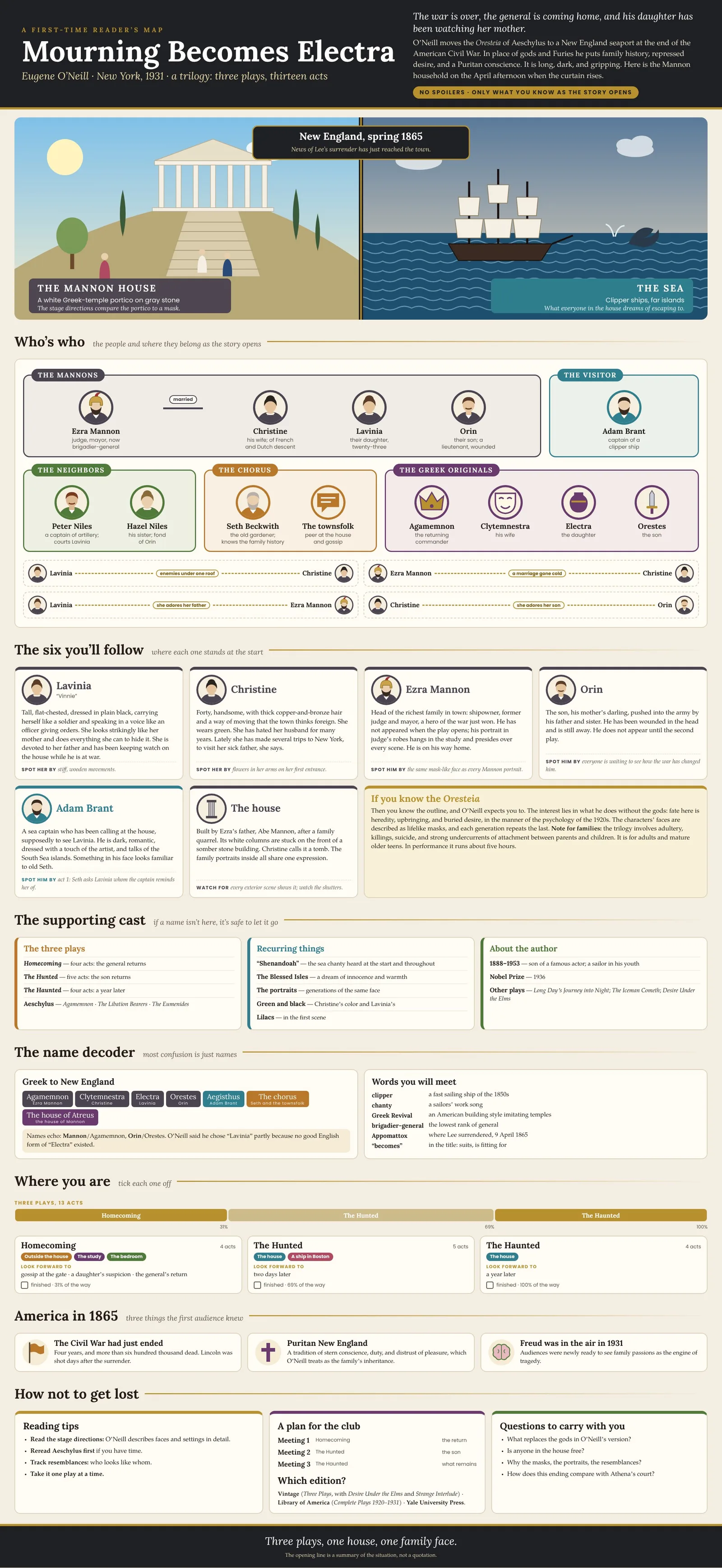
O’Neill moves the Oresteia of Aeschylus to a New England seaport at the end of the American Civil War. In place of gods and Furies he puts family history, repressed desire, and a Puritan conscience. It is long, dark, and gripping. Here is the Mannon household on the April afternoon when the curtain rises.
✨ Open this rung of the Great Books Ladder → 🔗 Own page, to share or bookmark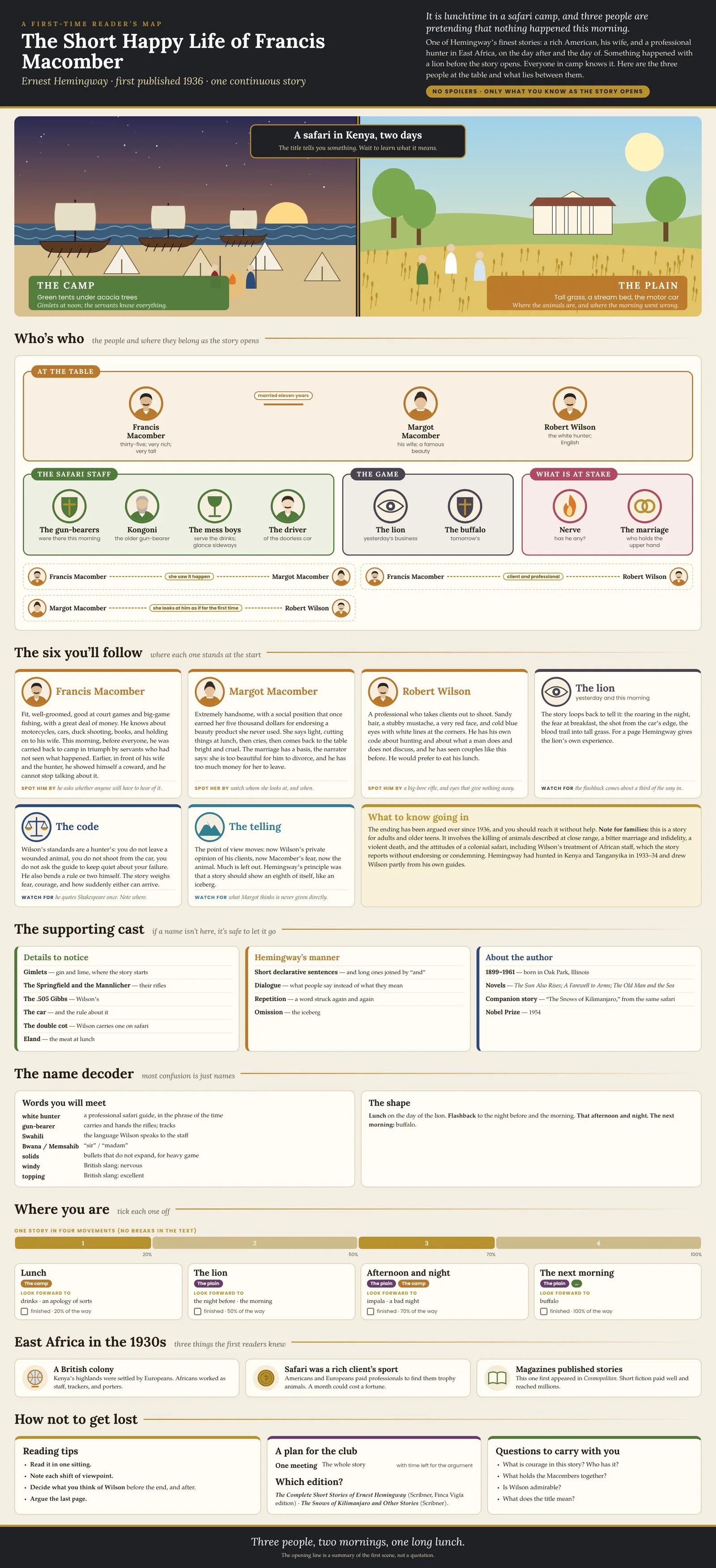
One of Hemingway’s finest stories: a rich American, his wife, and a professional hunter in East Africa, on the day after and the day of. Something happened with a lion before the story opens. Everyone in camp knows it. Here are the three people at the table and what lies between them.
✨ Open this rung of the Great Books Ladder → 🔗 Own page, to share or bookmark 📚 Ernest Hemingway: Four Novels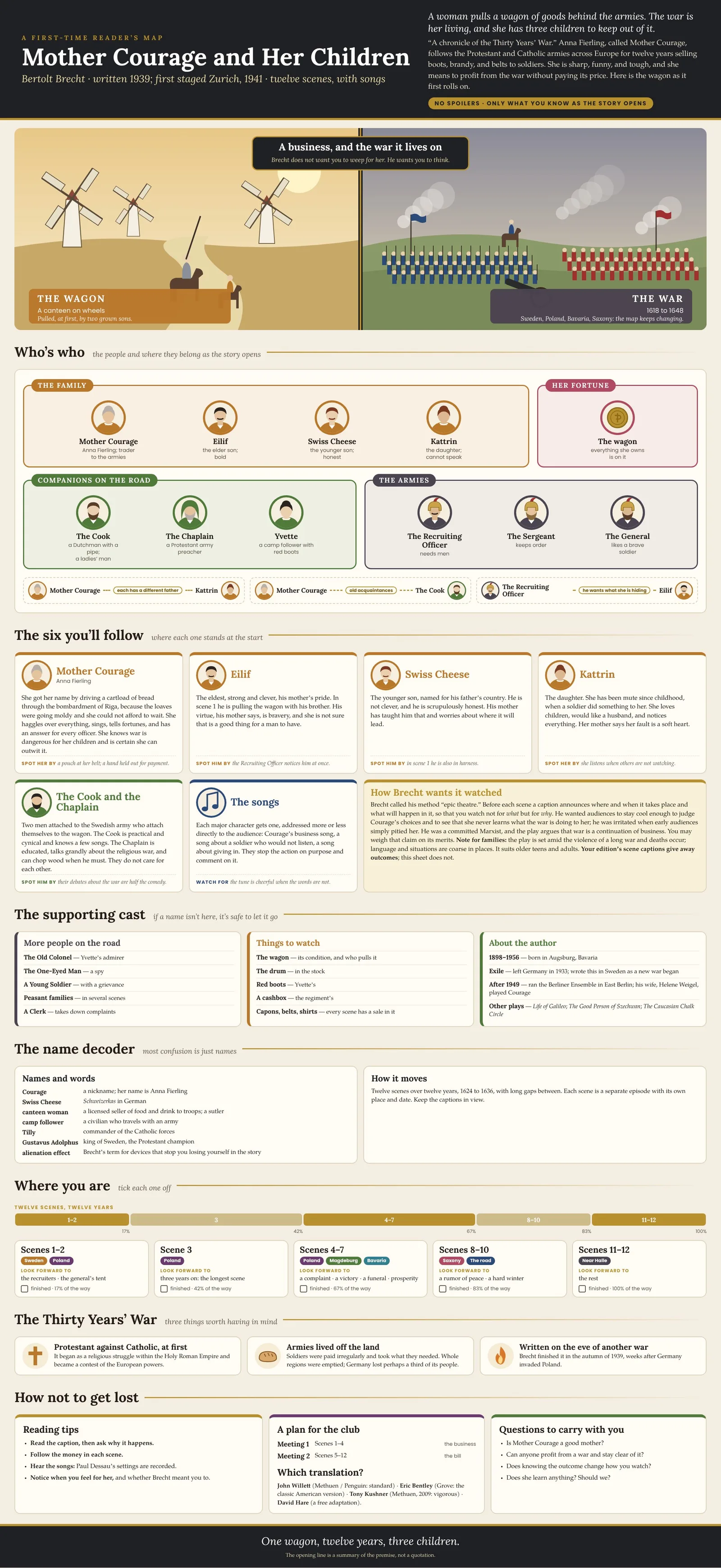
“A chronicle of the Thirty Years’ War.” Anna Fierling, called Mother Courage, follows the Protestant and Catholic armies across Europe for twelve years selling boots, brandy, and belts to soldiers. She is sharp, funny, and tough, and she means to profit from the war without paying its price. Here is the wagon as it first rolls on.
✨ Open this rung of the Great Books Ladder → 🔗 Own page, to share or bookmark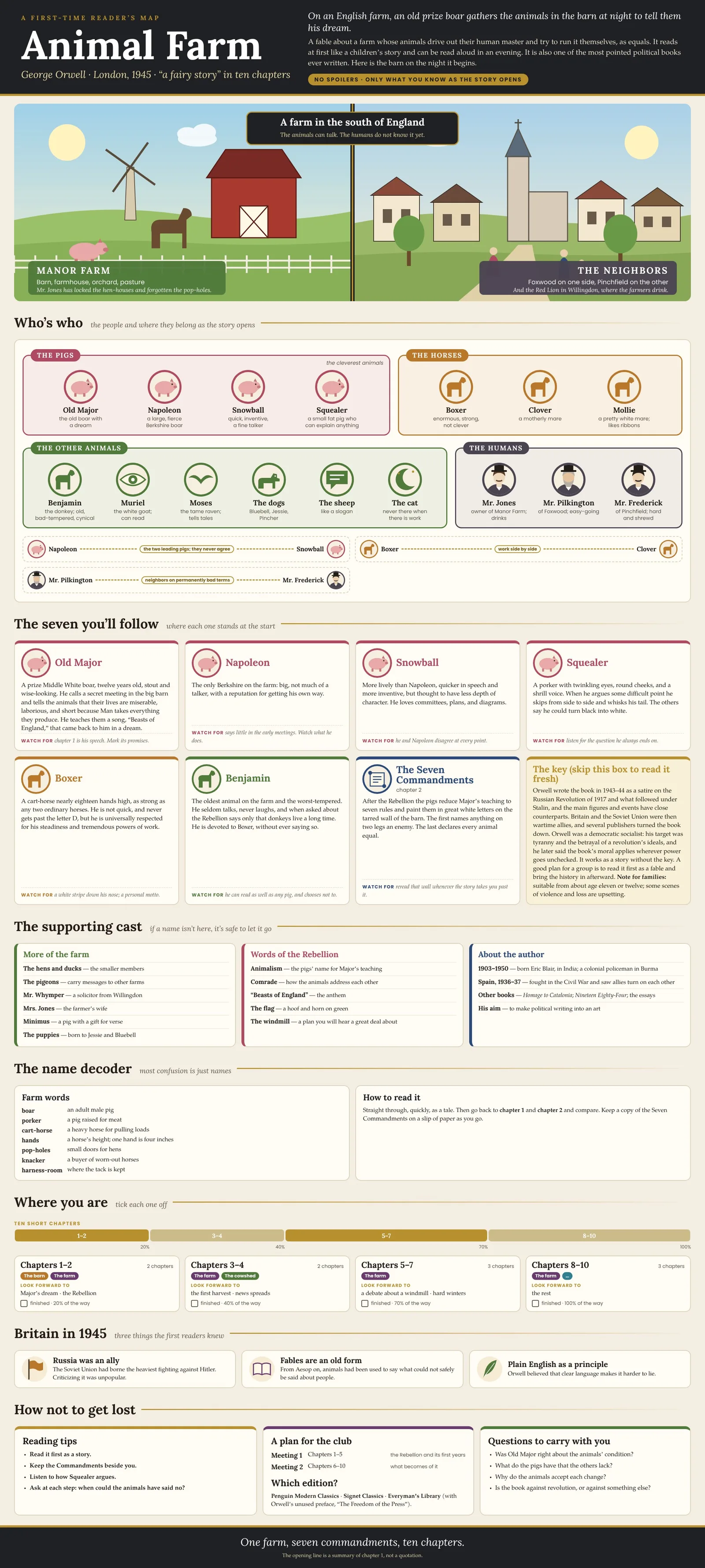
A fable about a farm whose animals drive out their human master and try to run it themselves, as equals. It reads at first like a children’s story and can be read aloud in an evening. It is also one of the most pointed political books ever written. Here is the barn on the night it begins.
✨ Open this rung of the Great Books Ladder → 🔗 Own page, to share or bookmark 📚 Animal Farm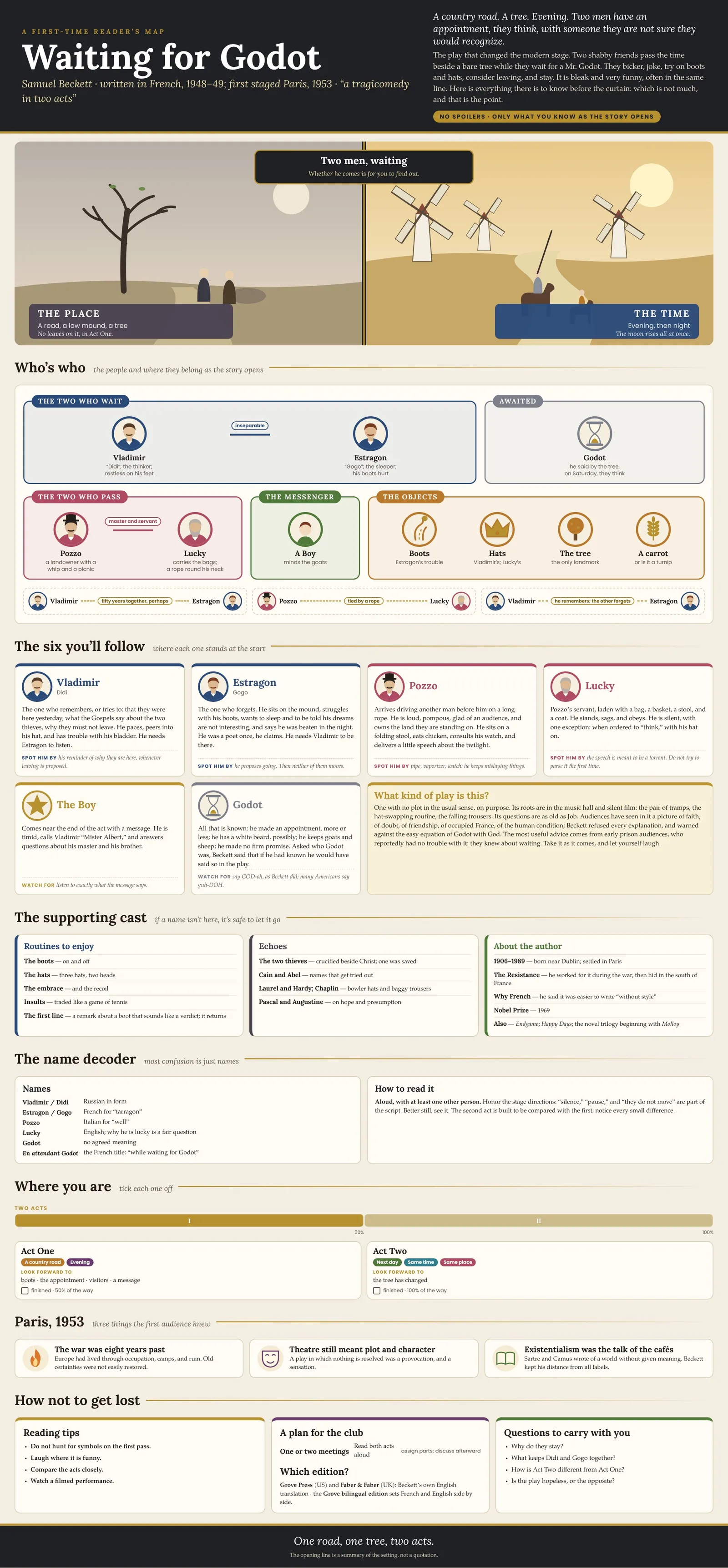
The play that changed the modern stage. Two shabby friends pass the time beside a bare tree while they wait for a Mr. Godot. They bicker, joke, try on boots and hats, consider leaving, and stay. It is bleak and very funny, often in the same line. Here is everything there is to know before the curtain: which is not much, and that is the point.
✨ Open this rung of the Great Books Ladder → 🔗 Own page, to share or bookmark